I join NewsTalk 1010 host Amanda Galbraith to to talk about “The Odyssey” and “Spider-Man: Brand New Day” and who are driving the box office to pre-COVID numbers.
I join CTV Atlantic’s Todd Battis to talk about the web slinging antics of “Spider-Man: Brand New Day,” the R-rated comedy “I Want Your Sex” and the android dreams of “Sheep in the Box.”
Fast reviews for busy people! Watch as I review three movies in less time than it takes to make the bed. Have a look as I race against the clock to tell you about the web slinging antics of “Spider-Man: Brand New Day,” the R-rated comedy “I Want Your Sex” and the android dreams of “Sheep in the Box.”
SYNOPSIS: Set four years after the memory-erasing events of “Spider-Man: No Way Home,” “Spider-Man: Brand New Day” sees Spider-Man anonymously protecting New York City as his superpowers evolve. “Spiders have three life cycles. And between cycles, it can leave the spider vulnerable to threats. Those spiders that survive… go through a kind of rebirth.”
CAST: Tom Holland, Zendaya, Sadie Sink, Jacob Batalon, Jon Bernthal, Tramell Tillman, Michael Mando, Mark Ruffalo. Directed by Destin Daniel Cretton.
REVIEW: The fourth standalone film starring Tom Holland as Peter Parker/Spider-Man is a return to the Spidey movies of old. Without a multiverse in sight “Spider-Man: Brand New Day” delivers on the promise of the title and delivers a new, almost streamlined, character driven approach. In other words, you won’t need to check Wikipedia to understand the story and characters.
Last time around in 2021s “Spider-Man: No Way Home,” supervillain Mysterio publicly revealed Peter Parker’s true Spider-Man identity, thus complicating the teen superhero’s life, and placing those closest to him in mortal danger. To protect his nearest and dearest and safeguard the multiverse, Parker convinces Dr. Strange to cast a spell to erase him from the collective consciousness. “Sometimes Spider-Man has to do the hard thing, even if it breaks Peter Parker’s heart.”
Now on his own, he keeps New York City safe, but misses his old life, particularly his former flame MJ (Zendaya). The stress of his new, anonymous existence and fighting against a powerful invisible villain, triggers a dangerous evolution in Peter’s arachnid DNA. “The spider is swallowing up the man.”
“We are faced with a danger we can’t control,” Bill Metzger (Tramell Tillman), head of the Department of Damage Control, a U.S. government agency that handles the cleanup and regulation of superhuman-related incidents, tells Parker. “One we can’t even see. You’re the only one who’s immune to it.”
Big, long and loud, “Spider-Man: Brand New Day” delivers the spectacle you expect from a Marvel Cinematic Universe movie but doesn’t forget that the ultimate appeal of the main character is his relatability. He’s blessed with superpowers—“He’s the hero every grown-up wishes they could be and every kid wants to be.”—but he’s not invincible and unlike many of his contemporaries he’s not a god, eccentric billionaire or soldier.
Instead, he’s an ordinary young man whose powers don’t solve his issues of insecurity, analysis paralysis and yearning. Then there’s the whole “with great power comes great responsibility” thing, a weight the character carries like a mantle. He’s driven to do the right thing, even if it comes at great personal cost.
“Are you Peter Parker,” asks MJ, “or are you Spider-Man?” It’s the question that lies at the heart of “Brand New Day” and the truth is he’s both, and that’s the push and pull that, as he matures, makes the character interesting and enduring.
Tom Holland, in his best “half man, half spider” performance nicely bridges the gap between the personal and physical, embodying the character’s emotional life, with a healthy dose of humor, while delivering the web-slinging action fans want.
The film’s emotional core, the relationships between MJ, Peter’s former best friend Ned Leeds (Jacob Batalon) and Peter, is intact, and it is here director Destin Daniel Cretton pulls off his best trick. MJ and Ned’s minds have been wiped of memories of Peter, and yet the connection between them still feels tangible, even though they spend little time on screen together. The sense of longing is central to Peter’s isolation from normal life, and grounds the story in its more high-flying moments.
A dynamic of a different kind is shared between Peter and Frank Castle a.k.a. the Punisher (Jon Bernthal). Screenwriters Chris McKenna and Erik Sommers shave down some of the Punisher’s rough edges, turning an R-rated character into a PG package, but Bernthal sparks with Holland and provides some of the film’s comedic highlights.
I’m carefully side-stepping a major spoiler, so I won’t make any comments on the future of the MCU, but make no mistake, there is some franchise-building happening here. Luckily it feels organic to the story, mirroring Parker’s own battles with isolation, loss and the internal struggle with the personal, profession and power aspect of having extraordinary gifts.
Recent superhero movies have had a rough time at the box office but with its blend of humanity and superhero antics “Spider-Man: Brand New Day,” even though it falls victim to an overblown final reel, is worth the trip to the theatre.
I wrote about “Spider-Man: Brand New Day” for CTVNews.ca.
“The fourth standalone film starring Tom Holland as Peter Parker/Spider-Man is a return to the Spidey movies of old. Without a multiverse in sight, ‘Spider-Man: Brand New Day’ delivers on the promise of the title, offering a new, almost streamlined character-driven approach…” Read the whole thing HERE!
SYNOPSIS: In the “The Accountant 2,” a new Ben Affleck action comedy now playing in theatres, money laundering forensic accountant Christian Wolff (Affleck), his bruiser brother Braxton (Jon Bernthal) and Treasury Agent Marybeth Medina (Cynthia Addai-Robinson) must use Christian’s special set of skills to stay alive as they track down a group of human traffickers. “Most brains seek a pattern that’s familiar,” Christian says. “My brain doesn’t work that way.”
CAST: Ben Affleck, Jon Bernthal, Cynthia Addai-Robinson, J. K. Simmons, Daniella Pineda. Directed by Gavin O’Connor.
REVIEW: Appropriately released during tax season, this buddy film of two brothers, a neurodivergent accountant and a hitman, is equal parts light and playful and dangerous and dark. With a line dancing scene and a human trafficking ring run out of a pizza company, it’s complicated and messy, but thoroughly entertaining.
The key to finding the film’s entertainment value is patience. Following a standard action thriller set up involving a retired FBI financial crimes agent (J.K. Simmons), a mysterious killer (Daniella Pineda) and determined FBI agent Marybeth Medina (Cynthia Addai-Robinson), the movie finally gets to the heart of the matter, the dynamic between brothers Christian (Ben Affleck) and Braxton Wolff (Jon Bernthal).
The movie still goes a bit heavy on exposition, but Affleck and Bernthal are an appealing combo who dance on the thin line between danger and whimsy. Both are stone cold killers, but each brings a different flavor to the story.
Affleck plays Christian as part 007, part John Nash. A deadly mix of mathematician and tactician, stereotypically, he speaks in clipped sentences and is matter of fact in the extreme, but in his relationship with Braxton there’s a sense of history and nuance in a movie that doesn’t favor nuance.
Bernthal is volatile and vulnerable, physical and funny, but his real strength is as a foil for Affleck. His action movie bona fides give some extra oomph to the climatic shoot out, but it is the brotherly bond, and their love-hate relationship, that gives the movie a beating heart.
“The Accountant 2’s” unnecessarily complicated plot and serviceable action exist essentially to put Christian and Braxton on screen together, which is fine when the result is as entertaining as this movie.
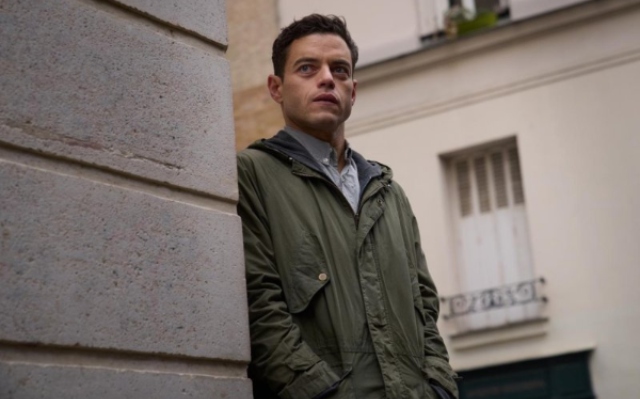
SYNOPSIS: In “The Amateur,” a new thriller now playing in theatres, Rami Malek plays a CIA cryptographer whose life is touched by tragedy when his wife is killed in a terror attack. When the agency refuses to investigate he takes matters into his own hands. Despite being “just a nerdy guy who works on computers,” he vows to use his unique set of skills to get vengeance. “I want to face my wife’s killers,” he says, “look them in the eyes, and balance the scales.”
CAST: Rami Malek, Rachel Brosnahan, Caitríona Balfe, Jon Bernthal, Michael Stuhlbarg, Holt McCallany, Julianne Nicholson, Adrian Martinez, Danny Sapani and Laurence Fishburne. Directed by James Hawes.
REVIEW: “The Amateur,” based on the 1981 novel of the same name by Robert Littell, is a workmanlike thriller, with loads of style but few actual thrills.
The story of vengeance, set into motion after CIA cryptographer Charles Heller’s (Rami Malek) wife is murdered in a terror attack, aspires to be a layered look at grief, anger, the integrity of institutional organizations and the ethics of revenge, is instead a slackly paced movie that is all surface and no depth.
It begins with promise. There’s a cast headlined by Oscar, Tony and Emmy winners, a premise that reflects government conspiracy theories and worldwide unrest, and who doesn’t love a revenge drama? But as the story unfolds it becomes a jumble of ideas that are never pulled together in a tight enough package to become truly engaging.
Malek is in virtually every scene and acquits himself well as the smartest-guy-in-the-room-with-a-grudge, but there’s never any real heat around the character. We are told over and over how brilliant he is, so while he plays a life-and-death game of “Survivor” with the baddies, it’s almost a certainty that he will Outwit, Outplay and Outlast everyone. The predictable nature of his near misses and close scrapes becomes less interesting with every minute of the film’s runtime.
And don’t get me started on the underuse of Rachel Brosnahan, who is barely given any screen time, and when she is, is relegated to playing an idealized version of Charles’ wife. Laurence Fishburne fares better but is still a stock character. He plays a no-nonsense tough guy, ripe with gravitas. It feels like the original script called for a “Laurence Fishburn type” and then they were lucky enough to get Laurence Fishburn. It’s a shame they don’t give him more to do.
As a thriller “The Amateur” rarely raises the pulse rate, but it is as a vehicle for its supporting actors that it really disappoints.
Ambitious, audacious and just a little messy, “Origin,” the new film from director Ava DuVernay, now playing in theatres, is a study of the caste system told through the lens of a writer played by Aunjanue Ellis-Taylor. Part biography, part intellectual journey, it mixes the emotional with the academic.
Ellis-Taylor is bestselling author Isabel Wilkerson, who, in real life is the first woman of African-American heritage to win the Pulitzer Prize in journalism. Happily married to Brett (Jon Bernthal), she is considering taking some time off writing and lecturing to look after her aging and ailing mother.
But tragedy and her restless intellectual curiosity push her into exploring how the unspoken caste system has shaped America, and how people are still classified to this day by a pecking order of human classifications. To that end she travels the world and history, making stops in the American South, Berlin, and India to study which groups of people have power, and which do not.
Based on Wilkerson life and the writing of the book “Caste: The Origins of Our Discontents,” “Origin” is narrative film that feels stuck between two worlds. The blend of Wilkerson’s biography, mixed with dramatic re-creations of the historical events that feed into her research, is a mix of personal and the political, but it seems as if the film is trying to decide if it is a narrative or a documentary.
Still, the choppy presentation is chock full of thought-provoking ideas. DuVernay, who also wrote the script, crafts a unique movie about connectivity, one that isn’t afraid to swing for the fences. As the film skips through world history and Wilkerson’s life, a portrait of systemic subjugation eventually comes into focus, against a backdrop of personal loss. The film’s two prongs don’t feel like a natural fit, but Ellis-Taylor’s rock-solid performance anchors the film, providing a bridge between the emotional and intellectual.
“Origin” is an interesting movie, one that bristles with the spirit of discovery, but sometimes gets allows lucidity to get lost in its execution.
Frank and provocative, “Sharp Stick,” the new film written and directed by “Girls” creator and star Lena Dunham, returns to familiar ground with a sexual coming-of-age story.
Kristine Froseth stars as 26-year-old Sarah Jo. A sexually inexperienced woman who had a hysterectomy at age 17, she still lives at home with her mom (Jennifer Jason Leigh) and wannabe Instagram influencer sister (Taylour Paige). She scraps by, babysitting for Zach, son of Josh (Jon Bernthal) and Heather (Dunham). Heather is pregnant, and Josh has a wandering eye, which happens to land on the flirty Sarah Jo.
Their ”affair” culminates with a tryst on the floor of a cramped laundry room, setting Sarah Jo off on a journey of sexual discovery involving lots of pornography, a fixation on adult film star Vance Leroy (the ornately tattooed Scott Speedman) and carefully organized, random “educational” hook-ups.
“Sharp Stick” reverberates with echoes of the frankness of “Girls” and the edgy work of filmmakers like Larry Clark and Harmony Korine, but never rises to the level of any of those namechecks.
Dunham has woven some interesting characters to surround Sarah Jo, like her mother Marilyn, played by Leigh, a much-divorced Hollywood hanger-on and twerking sister Treina, but she hasn’t given her main character any real depth. She is thirsty for carnal knowledge, and approaches it like a job, with a check list to boot, but aside from the humor inherent in that, Sarah Jo’s arc simply isn’t that interesting. Her desperation to prove to herself and others is repetitive, her actions so naïve they suggest her emotional age is far less than her stated age of 26. Given her mother’s openness regarding sex, it doesn’t ring true that Sarah Jo is completely unfamiliar with anything to do with sexuality.
“Sharp Stick” does have a few funny scenes, an interesting character or three, and an uncomfortable but refreshing candidness about sex but, by the time the end credits roll, Sarah Jo’s journey is the film’s least interesting element.