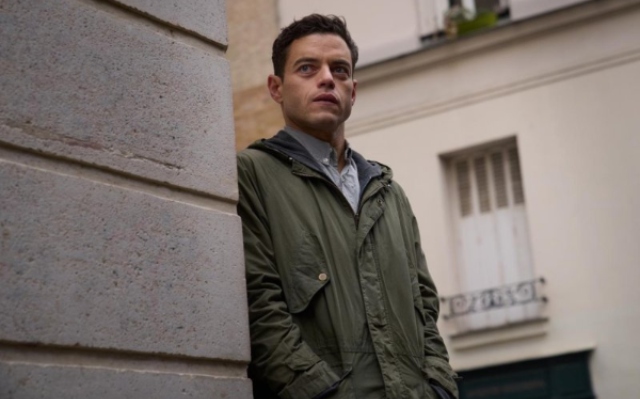
SYNOPSIS: In “Nuremberg,” a new historical drama starring Russell Crowe and Rami Malek, and now playing in theatres, a U.S. Army psychiatrist studies high-ranking Nazi officers, including Hermann Göring (Crowe), the notorious former Reichsmarschall and Hitler’s second in command, to determine their competency to stand trial for war crimes.
CAST: Russell Crowe, Rami Malek, Michael Shannon, Leo Woodall, John Slattery, Mark O’Brien, Colin Hanks, Wrenn Schmidt, Lydia Peckham, Richard E. Grant. Directed by James Vanderbilt.
REVIEW: Based on Jack El-Hai’s non-fiction book “The Nazi and the Psychiatrist,” “Nuremberg” is a handsomely mounted, old-fashioned drama that aims to comment on timely issues.
Set at the end of World War II the film sees U.S. Supreme Court Justice Robert H. Jackson (Michael Shannon) spearheading the world’s first International Military Tribunal. Among those accused of committing atrocities are Hitler’s right hand man Hermann Göring (Russell Crowe) and 21 other members of the Nazi high command.
To determine the prisoner’s fitness for trial Army psychologist Lt. Col. Douglas Kelley (Rami Malek) is brought in to assess the men and their mental states. Entering into a “battle of wits” with the charismatic and intelligent Göring, Kelley attempts to understand the true nature of evil.
“Nuremberg” clarifies its intent in the film’s final moment when a title card reading, “The only clue to what man can do is what man has done,” a quote from English philosopher R.G. Collingwood, appears on the screen. Writer, co-producer, and director by James Vanderbilt (best known as the writer of “Zodiac” and “The Amazing Spider-Man”) makes an urgent plea for today’s audience to never forget how fascism can take hold. In our modern world, where intolerance is on the rise, the lessons of the past echo loudly and demand our attention.
I just wish the film was a more powerful vehicle for the messaging.
Despite scenes of trauma, suicide and a downbeat ending, “Nuremberg” is too restrained to leave a mark on viewers. Crowe and Malek spark in their scenes, creating a cat-and-mouse game in which the power dynamic is ever shifting, and while thier performances have dramatic heft, there’s a melodramatic edge to the storytelling that blunts the impact of the film’s central premise.
“Nuremberg” is packed with big, timely lessons but its stilted presentation doesn’t deliver the emotional impact to accompany its warnings.
SYNOPSIS: In “The Amateur,” a new thriller now playing in theatres, Rami Malek plays a CIA cryptographer whose life is touched by tragedy when his wife is killed in a terror attack. When the agency refuses to investigate he takes matters into his own hands. Despite being “just a nerdy guy who works on computers,” he vows to use his unique set of skills to get vengeance. “I want to face my wife’s killers,” he says, “look them in the eyes, and balance the scales.”
CAST: Rami Malek, Rachel Brosnahan, Caitríona Balfe, Jon Bernthal, Michael Stuhlbarg, Holt McCallany, Julianne Nicholson, Adrian Martinez, Danny Sapani and Laurence Fishburne. Directed by James Hawes.
REVIEW: “The Amateur,” based on the 1981 novel of the same name by Robert Littell, is a workmanlike thriller, with loads of style but few actual thrills.
The story of vengeance, set into motion after CIA cryptographer Charles Heller’s (Rami Malek) wife is murdered in a terror attack, aspires to be a layered look at grief, anger, the integrity of institutional organizations and the ethics of revenge, is instead a slackly paced movie that is all surface and no depth.
It begins with promise. There’s a cast headlined by Oscar, Tony and Emmy winners, a premise that reflects government conspiracy theories and worldwide unrest, and who doesn’t love a revenge drama? But as the story unfolds it becomes a jumble of ideas that are never pulled together in a tight enough package to become truly engaging.
Malek is in virtually every scene and acquits himself well as the smartest-guy-in-the-room-with-a-grudge, but there’s never any real heat around the character. We are told over and over how brilliant he is, so while he plays a life-and-death game of “Survivor” with the baddies, it’s almost a certainty that he will Outwit, Outplay and Outlast everyone. The predictable nature of his near misses and close scrapes becomes less interesting with every minute of the film’s runtime.
And don’t get me started on the underuse of Rachel Brosnahan, who is barely given any screen time, and when she is, is relegated to playing an idealized version of Charles’ wife. Laurence Fishburne fares better but is still a stock character. He plays a no-nonsense tough guy, ripe with gravitas. It feels like the original script called for a “Laurence Fishburn type” and then they were lucky enough to get Laurence Fishburn. It’s a shame they don’t give him more to do.
As a thriller “The Amateur” rarely raises the pulse rate, but it is as a vehicle for its supporting actors that it really disappoints.
“Oppenheimer,” the story of the father of the atomic bomb, isn’t exactly a biopic of scientist J. Robert Oppenheimer. In his twelfth film, director Christopher Nolan includes biographical details in the telling of the tale of the man who invented the first nuclear weapons but the movie is more about consequences than creation. “Just because we’re building it doesn’t mean we get to decide how it’s used,” he says of the Atomic Bomb.
Nolan divides the story into two sections. The brightly colored “Fission” portrays the prickly Oppenheimer’s (Cillian Murphy) life as a tortured genius who overcame anti-Semitism to rise through the ranks of the European and American scientific elite to be recruited by the gruff Lieutenant General Leslie Groves (Matt Damon) as the director of the Manhattan Project. Charged with beating the Nazis and the Russians in a race to build a weapon of mass destruction, he became, by his own words, “the destroyer of worlds.”
His close ties to the Communist Party, through his ex-girlfriend, psychiatrist Jean Tatlock (Florence Pugh) and brother Frank (Dylan Arnold), is just one element of the left-leaning beliefs that eventually got his security clearance revoked. His political views, and second-thoughts about the destructive power he unleashed on the world, pitted him against his military bosses and founding commissioner of the U.S. Atomic Energy Commission Lewis Strauss (Robert Downey Jr.). Those events provide fodder for the film’s other section, the austere black-and-white “Fusion.”
An adaptation of the Pulitzer Prize-winning book “American Prometheus: The Triumph and Tragedy of J. Robert Oppenheimer” by Martin Sherwin and Kai Bird, the three-hour “Oppenheimer” is as downbeat as its weekend competition “Barbie” is upbeat.
Nolan takes his time with the telling of the tale, weaving together the scientific, psychological and political story threads to create rich tapestry that transcends the talky nature of the script. He teases great drama and tension out of a story that is essentially, a retelling of two tribunals, punctuated by the big bang that would change history.
Much of the film’s success is owed to Murphy, who, despite reciting teams of dialogue, goes internal to portray Oppenheimer’s towering intellect. Cinematographer Hoyte Van Hoytema frames Murphy’s stoic face in wide screen close-ups that showcase the actor’s ability to expose not only the character’s great intelligence, but also the realization that the power he spearheaded wouldn’t be fully understood until it was too late.
The Trinity Test sequence, the depiction of first detonation of a nuclear weapon, is a masterclass of less is more filmmaking. Nolan expertly builds tension with a countdown clock and Ludwig Göransson’s anxiety inducing soundtrack, but it is the look of scientific accomplishment tempered by an accompanying moral reckoning that spreads across Murphy’s face the moment the bomb goes off that cuts to the film’s core theme of innovation vs. consequences.
Murphy is supported by an a-list cast, including Matt Damon, who exudes movie star charisma and Downey Jr, who erases memories of Tony Stark with a blustery performance that, Marvel aside, is his most interesting since “Zodiac.”
The real star, however, is Nolan. “Oppenheimer” is the director firing on all cylinders, delivering a personal story of responsibility made epic. The brainiest blockbuster of the season is a period piece about a man who moral conundrums regarding power and the way it is wielded, that resonates just as loudly today as they did when the events took place.
“Amsterdam,” a quirky new film starring John David Washington, Margot Robbie and Christian Bale and now playing in theatres, is a convoluted story fueled by everything from fascism and birding to murder and music. If there ever was an example of a film that could have benefitted from the KISS rule, Keep It Simple Silly, this is it.
The madcap tale begins in 1933 New York City. WWI vet Dr. Burt Berendsen (Christian Bale), once a Park Avenue physician, he now runs a downtown clinic where he caters to the needs of soldiers who came back from the war broken and in pain.
When Berendsen and his best friend, fellow vet and lawyer Harold Woodsman (John David Washington), are hired by Liz Meekins (Taylor Swift), the daughter of their beloved commanding officer, to ascertain the cause of his death, they are drawn into a murder mystery involving secret organizations, ultra-rich industrialists and a crusty Marine played by Robert DeNiro.
In a flashback to the final days of WWI, we learn their backstory and meet Valerie (Margot Robbie), a nurse who treats their wounds, physically and mentally. As a trio, they swear allegiance to one another during an extended bohemian get-a-way in Amsterdam, a city that becomes a metaphor for freedom and friendship.
Reviewing “Amsterdam” stings. The production is first rate, from Academy Award nominated director David O. Russell, to the a-list cast to the ambitious script that attempts to link events of the past to today’s headlines. But, and this is what stings, the film is definitely less than the sum of its parts.
From the off-kilter tone, part screwball, part deadly serious, to the glacial pacing, which makes the already long two-hour-and-fifteen-minute running time seem much longer, and the script, which casts too wide a wide net in hope of catching something compelling, “Amsterdam” flails about, lost in its own ambition. This is the kind of story, it’s easy to imagine, the Coen Brothers could make look effortless, but Russell does not stick the landing.
He does, however, forward some lovely ideas about embracing kindness and the full experience of being alive, but even those are muddied by the inclusion of heavy-handed, and not particularly original, warnings about domestic terrorism and authoritarianism. Ideas get lost in a sea of exposition and narration, that not even these interesting actors can bring to life.
There may be an interesting story somewhere within “Amsterdam,” but it is hidden, lost in the movie’s epic ambitions.
Will James Bond (Daniel Craig) ever be happy? The dour superspy looks great in a tux, has saved the planet a dozen or more times and piloted invisible planes but despite his list of achievements, true happiness always seems to have eluded him.
In “No Time to Die,” however, it looks like Bond may have found a sweet spot in his life with his pretty love interest, Dr. Madeleine Swann (Léa Seydoux). But Craig’s fifth and final time as 007 isn’t all sunshine and roses as much as it is a requiem for a character who was shaped by trauma.
“No Time to Die,” now only playing in theatres, kicks off with a cold open unlike any other Bond beginning. Two decades ago, against a remote, icy Norwegian backdrop, the young daughter of a Spectre agent is orphaned when a masked murderer invades her home. “Your father killed my entire family,” he says between bullets. She survives, and twenty or so years later grows up to be Dr. Swann, psychotherapist and the only woman who can make James Bond smile.
On holiday in Materna, Italy, she encourages him to visit the grave of heartbreaker Vesper Lynd, and put her memory to rest. He does, and soon the idyll with his new girlfriend ends, literally blowing up in his face.
Convinced Swann has betrayed him, the superspy cuts her loose, vowing to never lay eyes on her again.
Cut to five years later. Bond is retired from MI6, but lured back into the game of international espionage when his friend and CIA field officer Felix Leiter (Jeffrey Wright) and associate Logan Ash (Billy Magnussen) ask him to help locate Valdo Obruche (David Dencik), a missing scientist working on a deadly DNA Nanobots weapon.
The job sees Bond square off with one of his greatest foes, Ernst Stavro Blofeld (Christoph Waltz) and revenge-thirsty terrorist Lyutsifer Safin (Rami Malek), a master in the art of asymmetric warfare.
“No Time to Die” shakes up the Bond formula while still offering most of what fans pay to see. There are exotic locations, some high-flying action and the odd 007 one-liner. They are embedded into the DNA of the franchise; character traits that have not been genetically edited out of the movie.
The womanizing, which was so much a part of the Bond folklore, is still there, but trimmed, and played for comic effect. In one instance Ana de Armas, whose appearance as CIA agent Paloma amounts to an extended cameo, charmingly closes the door on that aspect of the Bond legend. In a short but eventful scene, she almost steals the show, and leaves the audience wanting more.
What director Cary Joji Fukunaga, who co-wrote the script alongside Neal Purvis, Robert Wade, Phoebe Waller-Bridge and Scott Z. Burns, has done is add in a ponderous reevaluation of Craig’s years as Bond. Call backs abound to “Casino Royale,” “Quantum of Solace,” “Skyfall,” and “Spectre” and loose ends are tied into bows in in the film’s many Easter eggs. Much of that material is fan service as the fifteen-year Craig reign comes to a close. A shot of M’s (Judi Dench) portrait nods to Bond’s connection to her and Fukunaga reaches back to “Casino Royale” for a tribute to Felix “Brother from Langley” Leiter (Jeffrey Wright). It feels like a nice, respectful way to usher out one era and bring in the next, in whatever form that may take.
But “No Time to Die” is not simply a tip of the hat to the past. With an eye to the future, Fukunaga and Craig have fundamentally changed what a Bond movie is. As the only Bond actor to have an arc for his character, Craig didn’t simply put on Pierce Brosnan’s tux and carry on as so many of the previous actors have done. He took Bond to places he’s never been before, amping up the emotionality of the character as a person born out of trauma. He talks about having everything taken from him as a child, “before I was even in the fight.” For the first time in Bond history, 007 is feeling the ticking of the clock, and not the timer on a bomb he’s trying to diffuse, but the metaphorical hands of time tightening around him.
This approach effectively changes “No Time to Die’s” dynamic, from action film to soul-searching character drama. The 163-minute running time allows the characters to explore why and how they landed where they did in life, but it also sucks much of the urgency from the storytelling. Add to that Malek’s Safin, a clichéd villain who really should make a larger impact, and the drama necessary to shake that martini is lessened.
There is #NoTimeForSpoilers in this review but suffice to say, “No Time to Die” is a Bond film unlike any other. Craig leaves the franchise having made the biggest impact on the character since Sean Connery set the rules more than half a century ago. His finale is drawn out and may rely too heavily on pop psychologically but it’s an important film in the Bond canon. It may even be the most important and exciting since “Dr. No.” Why? Because, as an on-screen card promises, “James Bond will return,” but the movie gives us no hint as to what that re-invented future will entail and that, after almost sixty years of a steady diet of 007isms, is “No Time to Die’s” most exciting achievement.
“The Little Things,” a Los Angeles-set crime drama now available in select theatres and on PVOD, features a trio of Oscar winners in a dark story that shows the soft underbelly of the glamour capitol.
Set in 1990, pre-DNA testing, this is a story of old-fashioned police work. Wits, stakeouts, payphones and bleary eyes are their tools. Obsession and black coffee fuel them.
Oscar winner number one Denzel Washington is Joe Deacon, a deputy sheriff in small town California, whose job as a big city detective is long in the rearview mirror. When he joins strait-laced LAPD detective Sgt. Jim Baxter (Oscar winner number two, Rami Malek) on the hunt for a serial murderer, they focus on Albert Sparma (Oscar winner number three, Jared Leto) an off-kilter character they suspect is the killer. Turns out, their case reverberates with echoes from Deacon’s troubled past.
“The Little Things” sets up an interesting mystery. The SoCal setting resonates with an eerie Golden State Killer sun-dappled vibe and there are enough cryptic clues to keep you—and Deacon and Baxter—guessing. Washington and Malek play an odd couple, brought together by their shared obsessions, and Leto is suitably sideways to lend an aura of menace to his character. But, taken as a whole, the elements feel let down by the climax of the story. No spoilers here, but Baxter’s behavior in the minutes leading up to the film’s resolution don’t feel authentic, as though they are not driven by the character and what he would do in the situation. Instead, the ending feels informed simply by the need to wrap up the story in a dramatic way.
It’s too bad because most of what comes before is quite good. Deep characterizations, worthy of the trio’s Oscar wins, help set the scene. Writer and director John Lee Hancock avoids the visual clichés of most Los Angeles sets dramas; there’s palm trees, but no Hollywood highlights, just rundown motel rooms and skid row streets. It all adds up, until Baxter’s inexplicable decisions (AGAIN, NO SPOILERS HERE) take the viewer out of the story.
As Deacon says several times in “The Little Things,” life and, in this case, storytelling are all about the little things, the details that come together to tell the tale. Hancock gets most of the little things right, but not all.
Another franchise, another eccentric genius. Robert Downey Jr. laves Tony Stark behind to return to the big screen in a reboot of a remake of a classic story of a man who could talk to animals.
When we first meet Dr. John Dolittle (Downey) he’s at the Howard Hughes recluse stage of his life. The passing of his wife has left him despondent, unable to enjoy the company of humans so he lives in seclusion with only a menagerie of animals for company.
To pass the time he plays chess with a timid gorilla named Chee-Chee (voice of Rami Malek) and in conversation with the various animals who crowd his home, including his trusted macaw advisor Polynesia (voice of Emma Thompson) and Jip (voice of Tom Holland), a bespectacled dog.
“I don’t care about anyone, anywhere, anymore,” the doctor says.
Of course, that’s not true. When animal lover Tommy Stubbins (Harry Collett) shows up at Dolittle’s gate with an injured squirrel (voice of Craig Robinson)—“I’m too beautiful to die,” the squirrel says.—on the same day the doctor is summoned to Buckingham Palace to see the ailing Queen Victoria (Jessie Buckley), he is brought back into the human world. Her Majesty is gravely ill and if she dies the treasury will take the animal sanctuary Dr. Dolittle calls home. Worse, all his animals will be thrown out into the world during hunting season.
To save the Queen‘s life he must embark on a journey to find the Eden Tree and its magical, healing fruit. It’s trip fraught with danger and is the same journey that cost his beloved wife her life. Add to that some palace intrigue, an island of misfits and thieves, turbo boosting whales, a vengeful squirrel and even a dragon and you have a new chapter in the life of the man who can talk to animals.
Kids will likely find “Dolittle’s” chatty animals amusing but this isn’t simply a movie about wise cracking beasts. At its beating heart it is a movie about pain, but, as one character says, not the kind of hurt inflicted by a bullet or a knife. It’s about the agony of losing someone. Dolittle’s heart is broken by the death of his wife, and that ache is the engine that propels the entire movie. So, while the young’uns may giggle at the animals but the movie’s underlying downer vibe and generic approach suggests that Dolittle’s wife isn’t the only lifeless part of this movie.
Downey plays the character with a sense of bemused confusion, topped with a mealy-mouthed Billy Connolly impression that changes from scene to scene. It’s a pantomime performance that makes the best of his finely tuned comic timing but feels sloppy and needlessly mannered.
“Dolittle” contains some good pop psychology for children about working together—”Teamwork makes the dream work!”—and facing their fears but overall a movie featuring talking animals shouldn’t be this banal.
I have very fond memories of Queen. They were one of the biggest bands in the world when I was in my early teens and their brand of pomp rock appealed to my young ears. “Bohemian Rhapsody,” the band’s best-known song and masterpiece, isn’t a dance song by any stretch of the imagination but that didn’t stop my classmates and me from giving it a go in the school gym.
The slower introduction and the rockin’ last part are fairly easy to move around the room to, it’s the operatic middle section that would have caused less determined kids to abandon the dance floor. But, in a moment I have never forgotten, my school chums spontaneously came together like a roomful of Maria Callases and Luciano Pavarottis to sing lines like, “Scaramouch, Scaramouch will you do the fandango?” at the top of their lungs.
That song brought us all together, the romantics, the head bangers, the nerds; everyone stood up and was heard. It was fantastic. Magnifico even. I wish I could say the same about the new film “Bohemian Rhapsody” starring Rami Malek as the late, great Freddie Mercury.
Mercury was not a subtle performer and that spirit has rubbed off on the film, for better but mostly for worse. The performance scenes are fun, over-the-top and enjoyable. It’s when Mercury doesn’t have a microphone in his hand that the movie suffers. “We need to get experimental,” he says to EMI executive Ray Foster (Mike Myers). Too bad screenwriter Anthony McCarten (“Darkest Hour,” “The Theory of Everything”) only wrote the line and didn’t take it to heart.
With a script researched by Wikipedia the film zips through the band’s career and singer’s personal life, focussing on the high points—the writing of “Bohemian Rhapsody” and Live Aid—while giving the truly dramatic details a boilerplate treatment.
Mercury’s homosexuality is addressed but not deeply explored. He has relationships with two men, Paul Prenter (Allen Leech) and Jim Hutton (Aaron McCusker), and we see him visit a fetish club but not until the movie is half over. Before then it spends a great deal of time establishing the bond with Mary Austin (Lucy Boynton), a woman he called the love of his life.
In the film’s best dramatic scene he comes out of the closet, admitting to her that while he loves her he also thinks he may be bisexual. She disabuses him of the notion, admitting she knows he is gay. It’s a tender scene that sheds light on their connection more than anything that comes before or after.
As for the band, if not for their brightly coloured wardrobe, Brian May (Gwilym Lee), Roger Taylor (Ben Hardy) and John Deacon (Joe Mazzello) would barely make an impression. They are there to stand behind Mercury and start the occasional argument so he can whip out a bon mot, smirk and flit away.
Mercury, of course, is the most compelling character. Overcome with father issues and a desire to perform both on stage and off he’s also a man who allows himself to be manipulated by a lover who clearly does not have his best interest in mind. Malek, fake teeth and all, does a good imitation of Mercury. He can strut and swagger but it feels like an impression, a very good one, but one that never goes beyond skin deep. To paraphrase one of Mercury’s most famous lyrics, “it never feels like real life, it feels like fantasy.”
Brian May and Roger Taylor were directly involved with the making of the movie so it shouldn’t come as a surprise that the story has an “authorized” feel to it, but it is puzzling how the timeline has been twisted to fit the narrative. The montage of their first tour of America is set to “Fat Bottom Girls,” a tune they wouldn’t write for another four years and the writing of “We Will Rock You” is off by three years.
Those are fan details and easily forgiven narratively. What’s more troubling is the film’s handling of Mercury’s AIDS diagnosis. The movie portrays Mercury telling his band mates, three men he calls “his family,” about his illness a week before Live Aid in July 1985. Jim Hutton, Mercury’s boyfriend at the time of his death, says the singer was diagnosed in late April 1987, years after the events in the film. Moving a song or two through time is one thing. Playing around with the life-and-death details of Mercury’s illness for dramatic effect is quite another.
“Bohemian Rhapsody” ends with a rousing recreation of the band’s legendary twenty-minute Live Aid set. Cut back to four songs (“Bohemian Rhapsody,” “Radio Ga Ga,” “Hammer to Fall” and “We Are the Champions”) it captures their fist-pumping triumph on the Wembley stage. It also sends audiences out of the theatre with some of Queen’s biggest hits ringing in their ears. It’s the Principle of Recency, wherein the thing you experience last is the thing you remember most, like a delicious, sugary dessert at the end of a bland meal. The “Live Aid” impersonation is an effective and memorable way to end a by-the-book movie.
The remounted “Papillon,” starring Charlie Hunnam and Rami Malek in the roles made famous by Steve McQueen and Dustin Hoffmann in the original, maintains the brutality of the 1973 film but plays more like a buddy flick than the resilience-of-the-human-spirit epic it should have been.
Based on the “75 percent true” tale of Henri Charrière, a safecracker nicknamed Papillon, the 1930’s era story sees him sent to a hellhole jungle penal colony in French Guyana for a crime he didn’t commit. Sentenced to life in prison with hard labour on Devil’s Island, he begins to plot his escape as soon as he arrives, despite the fact that no one has ever successfully fled the island. To assist and finance his plan he offers protection to Louis Dega (Malek), a spindly, wealthy, white-collar criminal with a relative fortune hidden in a place where the sun don’t shine. Faced with abominable conditions and dictatorial prison guards the pair, along with a couple of others, stages a daring run at freedom.
Leaner and meaner than the original the reboot nonetheless hews fairly closely to the 1973 screenplay by Lorenzo Semple Jr. and Dalton Trumbo. Some grisly scenes featuring crocodiles and lepers have been blue-pencilled but the basic idea of the bond between the two men in the face of unimaginable adversity remains. Hunnam and Malek make a good team—with Malek even giving the Degas character more inner life than Hoffmann managed—but the movie itself doesn’t contain the same sense of struggle. Certainly there is violence, Hunnam is frequently covered in blood, mud or worse, but the previous film was grittier, less refined. Dialogue was sparse—in the new one Hunnam and Malek chatter like school kids throughout—and there was a sense of hopelessness that fuelled the need for escape. Here their mission feels pat, like a typical prison drama. It’s less meaningful, simply a run from the violence and horrors of their incarceration, and not a spiritual journey.
“Papillon” gets much right and features nice performances from the leads but feels like an unnecessary revamping of the story.