Fast reviews for busy people! Watch as I review three movies in less time than it takes to make your bed. Have a look as I race against the clock to tell you about the hellish hallmark “Obsession,” the rowdy revenge of “Is God Is” and the secrets of “The Wizard of the Kremlin.”
SYNOPSIS: In “The Wizard of the Kremlin,” a new political drama now playing in theatres, Paul Dano plays a television producer who rises through the ranks to become the spin doctor and master of manipulation for KGB agent Vladimir Putin.
CAST: Paul Dano, Alicia Vikander, Tom Sturridge, Will Keen, Jeffrey Wright, Jude Law. Directed by Olivier Assayas.
REVIEW: Adapted from Giuliano da Empoli’s novel, “The Wizard of the Kremlin,” this is not a reliable history lesson. Instead, we’re told by the film’s opening title card that it is “an original work of fiction with artistic intent.” Names and situations have been changed but this fictionalized story is no stranger than the real story of television producer and strategist Vladislav Surkov, architect of the post-USSR Kremlin.
Beginning in 2019, years after Vladimir Putin’s enigmatic advisor Vadim Baranov (Paul Dano) retired from public life, the film is framed as a conversation between “the Wizard of the Kremlin” and American writer Lawrence Rowland (Jeffrey Wright), whose article “Vadim Baranov and the Invention of Fake Democracy” caught Baranov’s eye.
Baranov’s episodic story begins with a “When I was growing up…” and winds along his journey through the new world of the early 1990s Russia. From life under Communism and a particularly hedonistic theatre school, where he learned how to stage eye catching spectacles, to reality television (“First rule,” he says, “don’t be boring.”) to the world of banking oligarchs and the upper echelons of a new world order, it’s a tale of nationalism, chaos, autocracy and the power behind the power. “I don’t know much about politics,” he says, “but I do know about communications.”
The conversational framing device is an efficient way to drop big chunks of exposition and keep the story moving forward, but it also means an over reliance on voice over. In a show me don’t tell me medium, it feels more like a lecture and a low energy one at that.
Dano’s monotone, I suppose, is befitting a man of mystery, someone who spent a career as the unknowable person behind the throne, but it is too one-note to be compelling. It’s a shame because the machinations of creating a new political brand could be a fascinating and timely topic.
Bringing more energy is Law whose Putin is charismatic and chilling as he calmly speaks (in an English accent) of the advantages of Stalin’s rule and eliminating rivals. “We need to inspire fear and fury,” he says. It’s all surface, no real introspection here, but it’s a pretty good surface.
“The Wizard of the Kremlin” is ambitious but despite revealing Baranov’s secrets, ultimately doesn’t have that much to say.
SYNOPSIS: In “Highest 2 Lowest,” the new film from director Spike Lee, Denzel Washington plays a music mogul faces a moral dilemma as he attempts to protect his friends and family from a kidnapping plot and stave off the takeover of his legendary record label, Stackin’ Hits Records.
CAST: Denzel Washington, Ilfenesh Hadera, Jeffrey Wright, ASAP Rocky, and Ice Spice. Directed by Spike Lee.
REVIEW: When Spike Lee’s “Highest 2 Lowest,” a modern-day reimagining of Akira Kurosawa’s 1963 film “High and Low,” is firing on all cylinders it is a thing of propulsive beauty. A subway chase sequence, based on the car chase in “The French Connection,” is edge of your seat stuff, and a showdown between music mogul David King (Denzel Washington) and rapper Yung Felony (A$AP Rocky), is an acting masterclass with the intensity of a rap battle.
Those scenes represent the movie in full flight, and they are vital and exciting, the kind of filmmaking and performances that jump off the screen. Both scenes up the stakes for everyone involved, which is lucky, because the rest of the film, while fraught with complications, is never imbued with a sense of danger. Sure, there are guns, a kidnapping and a ransom bag filled with 17.5 million dollars, but this isn’t a crime drama.
Not really.
Spike Lee and screenwriter Alan Fox use the kidnapping as a backdrop to explore fatherhood, relevancy in a changing world, ethical dilemmas, legacy and, of course, Lee’s favorite basketball team, the Knicks.
It makes for a dizzying, but uneven film.
The first hour, wallpapered with Howard Drossin’s melodramatic score, paints the gregarious David King as a man who lives up to his last name. He lives, with his wife Pam (Ilfanesh Hadera) and son Trey (Aubrey Joseph) in a NYC penthouse palace, decorated with museum quality art and mementos from King’s illustrious career. His record label, his life’s work, is about to be sold and he’s willing to risk it all to buy it back. “It’s not a risk,” he tells Pam, “it’s a rebirth.”
The business deal is thrown into jeopardy when a kidnapping plot (NO SPOILERS HERE) throws King’s life and finances into limbo. Forced to reckon with his past, present and future, King must make some very difficult choices.
The second hour, as the kidnapping plot kicks in and the financial talk fades, revs up the film’s momentum as King takes action to resolve the kidnapping and kickstart his personal and professional rebirth.
Howard Hawks once said that a great film has three great scenes and no bad ones, and while “Highest 2 Lowest” has great scenes, and the sheer force of Washington’s work ensures there are no bad ones, it feels as if the puzzle pieces don’t quite fit together. As the character work of the first half gives way to the more exciting second half, the film takes on a disjointed, idiosyncratic feel.
It never settles into a groove, it’s restless, idiosyncratic, mixing tones, themes and even film stocks. Even so, it’s compelling to watch Lee and Washington, two lions in winter, strut their stuff.
Washington hands in a bravura performance, almost Shakespearean in its theatricality. Like Washington said at the Cannes Film Festival before a screening of the film, “King Kong ain’t got s— on me.”
Lee captures that work in a movie that feels like a Spike Lee joint. It’s vibrant, in love with its characters and, even though it feels disordered, it’s a film that feels both contemporary and classic. It’s an utterly unique work that only Spike Lee could have made.
Ultimately, “Highest 2 Lowest” is a story about staying relevant for a new generation, about getting your groove back headlined to two artists who have never lost their groove.
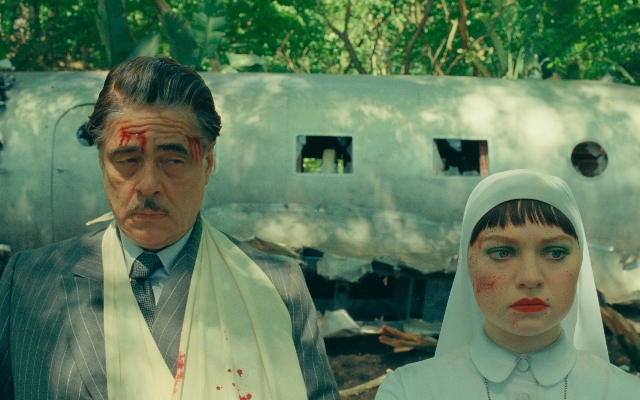
SYNOPSIS: In “The Phoenician Scheme,” a new Wes Anderson film now playing in theatres, Benicio del Toro is Zsa-zsa Korda, a shady businessman who made his fortune through “unholy mischief.” On the verge of a new venture, he finds himself in the crosshairs, literally, of tycoons, foreign terrorists and determined assassins. “Why do you need to keep assassinating me all the time?” he asks.
CAST: Benicio del Toro, Mia Threapleton, Michael Cera, Riz Ahmed, Tom Hanks, Bryan Cranston, Mathieu Amalric, Richard Ayoade, Jeffrey Wright, Scarlett Johansson, Benedict Cumberbatch, Rupert Friend, Imad Mardnli and Hope Davis. Directed by Wes Anderson.
REVIEW: There was a time when I loved Wes Anderson’s movies. His holy trinity, “Bottle Rocket,” “Rushmore,” and “The Royal Tenenbaums,” were all unconventional gems; movies with a singular point-of-view that examined the lives of misfits and oddballs.
Then I stopped loving and stared merely liking Anderson’s movies as his signature whimsical style began to squeeze the life out of his stories of self-discovery and community. Still, his stop-motion “Fantastic Mr. Fox,” for example, was mannered but also hilarious and poignant.
These days, I long for the days of the relative restraint of “The Darjeeling Limited” and “Moonrise Kingdom.” Perhaps it’s a case of familiarity breeding contempt (although think that is too harsh a word), but to me Anderson’s films have lost the humanity of his earlier work. They still cover much of the same thematic ground, commenting on family dysfunction, failure and redemption, but they now feel as though they arrive covered in bubble wrap like precious museum pieces.
Such is the case with his latest, “The Phoenician Scheme,” a stylish story of big money, attempted assassinations and family, it features a topflight cast, who all seem to be having a swell time slotting themselves into Anderson’s carefully crafted, artisanal film. But there is an air of artificiality that settles over the movie like a shroud which sucks way much of the emotional depth.
“The Phoenician Scheme” is pretty, occasionally amusing and the commitment to deadpan performances is unparalleled, but even though I’ll watch anything with Benicio del Toro, it is more concerned with style than substance. As a result, its well-worn take on the evils of capitalism, as personified by del Toro, feels academic rather than authentic.
The smart, funny and insightful, “American Fiction,” winner of this year’s Toronto Film Festival People’s Choice Award, is a satire that sees Jeffrey Wright as an exasperated novelist who confronts racial stereotypes by writing a book that forces him to balance hypocrisy with selling out.
An adaptation of Percival Everett’s 2001 novel “Erasure,” the film stars Wright as Thelonious “Monk” Ellison, an author and English Lit professor frustrated that his publisher rejects his latest work as not being “Black enough,” while another book, “We Lives in da Ghetto” by Sintara Golden (Issa Rae), is heralded by critics as a modern masterpiece.
As Monk struggles personally—his brother Cliff (an excellent Sterling K. Brown) is experiencing a massive life shift while his mother Agnes (Leslie Uggams) is in decline, and will soon need a care home, which the family cannot afford—his professional life turns upside down.
“Monk,” says his agent Arthur (John Ortiz), “your books are good, but they’re not popular. Editors want a Black book.”
“They have a Black book,” says Monk. “I’m Black and it’s my book.”
Angry, on a whim he bangs out “My Pafology,” a satire of Golden’s book under the pseudonym Stagg R. Leigh. Filled with tired and reductive stereotypes of gang violence and broken homes, his gag novel becomes a publishing sensation, receiving an offer of a $750,000 advance and huge marketing campaign.
Monk is the only person, it seems, who gets the joke. “It’s the most lucrative joke you’ve ever told,” says Arthur.
It may have started as a joke, but Monk needs the money. If he accepts the offer, however, does that mean he’s perpetuating tropes that play into what he regards as “Black trauma porn”?
“American Fiction” finds sharp humor in identity politics, perception and culture wars. Serious in its message but playful in tone, it can cut to the quick. In one scene, Monk and Golden, the only two Black jurors on a literary panel, are castigated to by the white judges to “hear Black voices.” It is one of the film’s funniest scenes, but the performative nature of the sentiment is all too realistic.
As Monk, we see Wright in a different sort of role. Given the chance to flex his rarely-used comedy muscles, he excels, playing up his curmudgeonly character’s conundrum to maximum effect. It’s bittersweet. As he watches the fictious Stagg R. Leigh’s book become successful. It confirms his feelings about the biases of the publishing industry. He reacts with a mix of outrage and humor. It’s a bravura work that hopefully means it won’t take thirty years to give Wright another leading role in a theatrical release.
Giving Wright a run for his money is Brown who steals every scene he’s in. His character Cliff is a mess, pushing personal boundaries as a man coming out of the closet and building a new life. Like Wright, Sterling creates a character that gets laughs, but the laughs aren’t shallow, they come from a deep well of pain and Cliff’s lived experience.
Director Cord Jefferson’s “American Fiction” asks why stereotypes of Black trauma are so prevalent in entertainment by not so subtly satirizing the process and the people who create the limited view of Black life in books and on screens. It is insightful but never forgets to entertain.
In “Rustin,” a new reverential historical drama now streaming on Netflix, Emmy Award winner Colman Domingo plays Bayard Rustin, a gay Black man whose vision and tenacity had an outsized effect on the Civil Rights Movement. He’s been largely forgotten by history but “Rustin,” produced by Barack and Michelle Obama’s production company Higher Ground, serves as a potent reminder of his activist legacy.
The story of the run-up to 1963’s March on Washington for Jobs and Freedom and the famous “I Have a Dream” speech, “Rustin” sets the stage with harrowing images of 1950s segregation.
Cut to 1960 and a plan between Rustin and Reverend Martin Luther King Jr’s. (Aml Ameen) to launch a protest march on the Democratic National Convention. The plan is thwarted by U.S. Congressman Adam Clayton Powell Jr’s. (Jeffrey Wright) threat of a misinformation campaign, linking the two men romantically. Powell’s allegation, while untrue, causes a rift between the two men that sees Rustin kicked to the curb.
Three years later Rustin hatches another plan, a massive, non-violent march on Washington to pressure the Kennedy administration to initiate a strong federal civil rights bill in Congress.
With little to no support from DC’s power base, due to racism, his former communist membership and his sexuality—“When it comes to the old guard,” he says, “I’m considered a pariah.”—Rustin seeks support from his estranged friend King. “Do this Dr. King,” he says. “Own your power.”
The next eight tumultuous weeks find Rustin balancing his personal life—an affair with married preacher Elias (Johnny Ramey)—and his work with King and their band of “angelic troublemakers” as they arrange one of the largest political rallies for human rights in United States history. “On August 28,” he says, “Black, white, young, old, rich, working-class, poor will descend on Washington, DC.”
“Rustin” tells the story of a landmark moment in the battle for Civil Rights, but this isn’t just a history lesson. It’s really is a character study of the charming, driven man who made it happen.
The movie itself is stagey and straightforward, prone to grandstanding with an over-reliance on exposition, but it comes alive whenever the charismatic Domingo is on screen.
As portrayed in the film, Rustin is a powerhouse, a man predisposed to challenging authority, to giving voice to hard truths, to never backing down. Domingo inhabits him, embracing the strength to never apologize for who he is or his quest for justice and equality. “On the day I was born Black, I was also born homosexual. They either believe in justice and freedom for all, or they do not,” he rails against his detractors. It’s a muscular, timely performance that makes up for the film’s other shortcomings.
By times, “Rustin” feels rushed. Several scenes end prematurely and without explanation, giving the film an odd rhythm. But, the final moments as the march comes to life, are moving, empowering and pack an emotional punch, as does the portrait of a behind the scenes trailblazer and hero.
For better and for worse, there is nothing quite like a Wes Anderson film. The director’s unique production design is all over his new sci fi comedy “Asteroid City,” but with this film it is clear that whimsy has finally replaced storytelling on his to do list.
This is a twisty-turny one. Like a set of nesting dolls, it’s a film, within a play, within a show hosted by a Rod Sterling-esque talking head (Bryan Cranston), within a teleplay written by playwright Conrad Earp (Edward Norton).
The bulk of the “action” takes place in Asteroid City, a remote New Mexico desert town—population 87—where Steve Carell’s motel manager hosts a Junior Stargazer convention. Gifted kids and their parents from all over the state convene to showcase their incredible, and often outlandish, inventions.
It’s an interesting group that includes recently widowed war photographer Augie Steenbeck (Jason Schwartzman), father to “brainiac” Woodrow (Jake Ryan) and son-in-law to Stanley (Tom Hanks), movie star Midge Campbell (Scarlett Johansson) and the rough-n-tumble J.J. Kellogg (Liev Schreiber). Along for the ride are singing cowboy Montana (Rupert Friend), teacher June (Maya Hawke), Dr. Hickenlooper (Tilda Swinton) a scientist from the local observatory and the fast-talking Junior Stargazer awards judge, General Grif Gibson (Jeffrey Wright).
When the convention is interrupted by a visiting alien, the whole thing is locked down for a mandatory government quarantine.
Despite the quirky tone and Anderson’s trademarked stylistic choices, “Asteroid City” is a serious film, albeit one laced with a healthy dose of absurdism. A study in how people deal with grief, and the true nature of love, Anderson’s characters experience existential dilemmas, angst born of loss and dissatisfaction. Threats are posed by nuclear bombs and life from other planets unexpectedly dropping by to say hello and children wonder aloud what happens when we die. A shroud of melancholic anxiety hangs over the film, like a shroud, but Anderson’s staging of the film, the meta story within a story structure, obscures the movie’s deeper meanings under layers of style.
The cast, particularly Johansson and Hanks, bring focus to Anderson’s unfocussed story, and Carell, Cranston and briefly Goldblum are having fun, but it sometimes feels the surfeit of characters are there more to decorate the screen than to forward the story.
“Asteroid City” may delight long-time fans, but casual moviegoers or newcomers to the director’s oeuvre may find the film’s mannered obtuseness off kilter and off putting.
On some level Batman has always been escapist entertainment. The comics, TV shows and movies have always tackled big topics like morality, vengeance and the razor’s edge between anarchy and order but between Adam West’s grin, Michael Keaton’s gadgets and Christian Bale’s colorful foes, escapism is always part of the mix.
“The Batman,” starring Robert Pattison as the Caped Crusader, and now playing in theatres, is three hours of entertaining Bataction but the real-world themes of distrust in elected officials, our constitutions and each other, provide anything but escapism.
The story begins on Halloween night, as costumed criminals swarm Gotham City. As chaos reigns on the streets, the Bat-Signal illuminates the sky. “When the light hits the sky it’s not just a beacon,” says Batman (Pattison), “it’s a warning… to them. Fear is a tool.”
It’s a tool Batman uses effectively. His masked presence, his fists of fury and habit of snarling, “I’m vengeance,” have made him a fearsome presence in Gotham City. The rank-and-file police don’t know what to make of the Caped Crusader, but Detective James Gordon (Jeffrey Wright) sees him as an asset, particularly when high ranking city officials begin dying at the hands of The Riddler (Paul Dano), a psychopath whose costume suggests he is a fan of the Gimp from “Pulp Fiction.”
At each grisly murder the Riddler leaves behind a cutesy card for Batman, inscribed with a riddle, like “What does a liar do when he dies?” that could serve as a clue to solve the crime.
As the evidence, and the bodies, pile up, Batman’s investigation leads him to a wide-ranging conspiracy involving a local crime boss (John Turturro), his minion Oswald Cobblepot a.k.a. The Penguin (Colin Farrell doing a pretty good impression of James Gandolfini), a long-held Wayne family secret and nightclub worker and cat burglar Selina Kyle a.k.a. Catwoman (Zoë Kravitz).
“The Batman’s” almost three-hour running time may seem daunting, particularly in the wake of several overly long superhero movies that haven’t delivered the goods. I’m happy to report that director Matt Reeves has crafted a movie that flies by in the bat of an eye.
This is not an origin story, that tale has been told over and over. It is more of a coming-of-age tale. As played by Pattison, Bruce Wayne is a dour and sour hero who, when asked, “Are you hideously scarred?” replies “Yeah.” His scars, however, are all on the inside.
He is driven by a sense of vengeance to clean up the streets of the kind of people who killed his parents. That, he says, is his legacy, not the fabulously wealth of Wayne Enterprises. As the story progresses his mood doesn’t change—it’s as if Pattison’s perfect cheekbones would shatter if he ever cracks a smile—but his outlook does. Batman may be the face of vengeance, but by the time the end credits roll, he realizes hope trumps vengeance. “People need hope,” he says. “To know someone is out there for them. The city is angry. The city won’t change, but I have to try.”
After five “Twilight” movies Pattison understands how to brood on screen. He is comfortable with the stillness the character requires, which works well to emphasize the Batman’s loner status. The stillness of the character, when he isn’t running, jumping or jackhammering a bad guy, suggests a calm but that sense is betrayed by the simmering rage behind Pattison’s eyes. It is that anger that gives him an unspoken reason to exist.
This is a Batman who is still figuring things out, who is fueled by his single-minded need for revenge, but working to funnel his energies in a way that will benefit him, the people he loves and Gotham City. He doesn’t have superpowers, just a powerful drive and a handful of gadgets. He’s a one-man army, and Pattison does a good job of showing us, not telling us, the complexity of the character.
Director Reeves has stripped away much of the slickness of the Christopher Nolan and Zack Snyder films in favor of a grittier vision. Think 1970s movies like “Chinatown,” “The French Connection” or “Taxi Driver.” Reeves has made a boiled down detective noir that scales back the theatrics of previous versions to concentrate on the personal stuff.
But that doesn’t mean there isn’t action to spare. The new Batmobile, now a muscle car, makes its debut in a wild car chase and Pattison’s Batman doesn’t kill people, unlike Affleck’s take on the character, but that doesn’t mean he isn’t willing to pummel the heck out of his adversaries.
“The Batman” is an interesting new direction for the Caped Crusader movies. There have been better villains in other films and the sins of the father angle has been explored before, but this movie captures the zeitgeist in a very interesting way. It confronts hot button topics like the alt right, agents of chaos and lying politicians, issues ripped from the headlines, but is tempered with a message of hope, of rebuilding belief in the world around us.
I suppose every generation gets the Batman they deserve. Our hard knock world has delivered us a Batman with an edge; a troubled hero who almost succumbs to his worst tendencies, but, in the end, looks toward a horizon of hope. It’s a powerful message for our world gone mad, particularly when it comes from a guy in a mask.
“The French Dispatch,” now in theatres, is the most Wes Anderson-y film in the Wes Anderson playbook. If you forced a bot to watch 1000 hours of Anderson’s films and then asked it to write a movie on its own, “The French Dispatch” would be the result.
Broken into three stories, this is the story of three writers and their work for The French Dispatch, an American owned newspaper supplement edited by Arthur Howitzer Jr. (Bill Murray) from their offices in Ennui-sur-Blasé, France.
On the occasion of Howitzer’s passing the staff assemble to put together a special edition of the paper to honor him. After a quick intro to the paper and the town by Herbsaint Sazerac (Owen Wilson), the movie introduces its first tale, an outlandish take on the birth of abstract expressionism.
Benicio Del Toro stars as Moses Rosenthaler, a temperamental artist incarcerated for double murder. His muse is Simone (Léa Seydoux), the guard of his cell block. When his work is discovered by art dealer Cadazio (Adrien Brody), who happens to be doing time for financial improprieties, Moses reluctantly becomes a worldwide sensation.
Next is “Revisions to a Manifesto,” Anderson’s take on the French May 1968 student uprising. French Dispatch reporter Lucinda Krementz (Frances McDormand) covers the story of wild-haired Zeffirelli (Timothée Chalamet), the revolutionary Juliette (Lyna Khoudri) and the manifesto they want to present to the world.
The final story involves food critic Roebuck Wright (Jeffrey Wright). He recounts how a food prepared by brilliant police chef Nescaffier (Stephen Park) foiled the kidnapping of a police commissioner’s son.
Fans of Anderson’s work know what to expect. Perfectly composed shots, Bill Murray and fussy, idiosyncratic situations and dialogue. Aficionados will not be disappointed by “The French Dispatch.” It offers up Anderson’s trademarks in droves. But for me, a longtime Anderson fan, the preciousness of the storytelling verges on parody. There are some beautiful, even poetic moments in what amounts to an examination of the creative life, but the arch style that typifies Anderson’s work is in overdrive here and overwhelms the message.