I’ve done this a long time, but on Friday as I sat next to Boo Radley, Lt. Col. William “Bill” Kilgore and Tom Hagan, all rolled up in the form of Robert Duvall, I don’t mind admitting I was star struck.
Even though he was one of the most quotable actors I had spoken to during the opening days of TIFF — for instance he said, “I call Billy Bob Thornton the hillbilly Orson Welles.” — while he was talking all I could hear were his lines from his famous movies rolling around in my head.
Getting an up close and personal look at the 83-year-old Oscar winner, brought back memories of him as Apocalypse Now’s warmongering Kilgore, shirtless kneeling down to tell his soldiers, “I love the smell of napalm in the morning,“ and Don Corleone’s loyal adopted son Tom in The Godfather. “He never asks a second favor when he’s been refused a first.”
The actor was at TIFF to discuss the opening night film The Judge. He stars opposite Robert Downey Jr. as an erasable old judge, who, when accused of vehicular manslaughter must reluctantly rely on his estranged lawyer son for a defense in court. Luckily I pulled myself together long enough to take some notes.
When he’s asked what it’s like to play a mean character, he says, “Who’s mean? What’s mean about him? He’s a human being.”
He adds, “I almost didn’t take this but once I took it I had to jump in. There are so many negative things about the guy.”
But when asked if he’s afraid to immerse himself in negative characters, his answer turns into a master class on acting. “Why would I be afraid? Once I commit to do it, I’ll do it. I just wonder about it sometimes. Is it worth it to show those negative aspects of somebody?
“But Shakespeare said you hold a mirror up to nature. You try and approximate life as much as possible. Brando used to watch Candid Camera. You try and watch things as closely as you can. You learn from life and you try and represent life as accurately as possible. There’s no right or wrong, there’s just truthful and untruthful.”
He’s a living legend, a star whose career spans six decades, but he’s not nostalgic for the past.
“I think movies are better than ever now. The actors are better. There’s room for everybody now. If you go world wide, I think the actors are better than ever.”
As for his own career, he has more movies on tap, including one he’s directing, starring his wife Luciana Pedraza as a “lady Texas Ranger.” “I got a few more left in me before they wipe the drool,” he says.
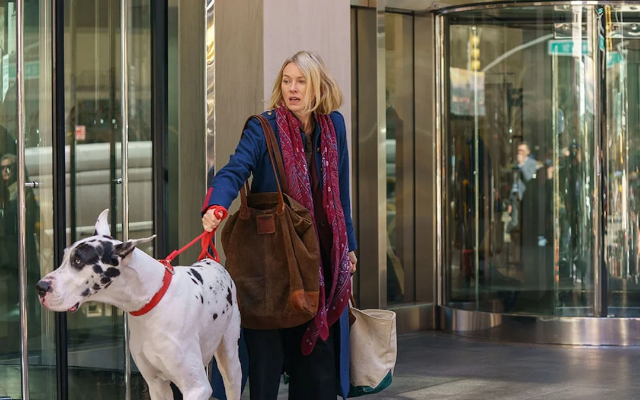
SYNOPSIS: In “The Friend,” a new drama now playing in theatres, Naomi Watts plays a woman who must clean up the loose ends of her late friend Walter’s estate, including finding a home for his massive Great Dane named Apollo.
CAST: Naomi Watts, Bill Murray, Sarah Pidgeon, Carla Gugino, Constance Wu, Ann Dowd, Bing. Directed by Scott McGehee and David Siegel.
REVIEW: Dog lovers planning on seeing “The Friend” may want to add in a bit of extra cash for Kleenex into the weekly budget. An understated story about the transformational power of companionship, it will pull at your heartstrings like a Great Dane pulling on its leash.
Bill Murray plays Walter, an author, raconteur and university professor. He’s also the proud dad to a dog so large it puts the Great into Great Dane. Named Apollo, the dog was found abandoned and became Walter’s cohort in the months leading up to his death by suicide.
After the funeral Walter’s widow Barbara (Noma Dumezweni) approaches her late husband’s best friend Iris (Naomi Watts). “I wanted to ask you if you could take the dog,” she says. “This is what Walter wanted.”
Trouble is, Iris lives in a rent-controlled New York City apartment with a no dogs policy. Also, she doesn’t really like dogs, but something about Apollo’s grief at the loss of his master clicks with her, and soon the two are cooped up in Iris’s small apartment, despite the objections of her superintendent Hektor (Felix Solis).
“The Friend” is a gentle movie that is about much more than if Iris can finagle a way to get Apollo on her lease. This is a movie that, in very subtle ways, essays the difficult process of moving after a friend takes their own life, especially as the echoes of the life that once was still reverberate loudly.
It meanders and is occasionally repetitive, but the emotional stakes are very high. Watts plays Iris on simmer, gradually allowing her grief to come to a boil. Two remarkable scenes, one in a psychiatrist’s office, the other an imaginary confrontation, reveal the character’s depth without excessive sentimentality.
Murray, who appears only briefly, is a welcome presence, but it is Bing the Great Dane and his expressive eyes, who deserves top billing.
“The Friend” is a low-key but heartfelt film that is more than just a movie about a depressed, cute dog. It’s a movie about a depressed, cute dog that treats the dog’s feelings with grace and care.
After a quick detour to Summerville, Oklahoma, the fifth movie in the Ghostbusters Universe sees the Spengler family back where the story began. “Ghostbusters: Frozen Empire,” now playing in theatres, grafts a proton blast of nostalgia to a new supernatural story of tiny Stay Puft Marshmallow Men, Spenglers and an iconic New York City firehouse.
In 2021’s “Ghostbusters: Afterlife” OG (Original Ghostbuster) Egon Spengler’s daughter Callie (Carrie Coon), her two teenage kids, Trevor (Finn Wolfhard) and Phoebe (Mckenna Grace), move to Egon’s abandoned Oklahoma farmhouse. When apocalyptic entity Gozer the Gozerian enters the scene, the family, along with mentor Mr. Grooberson (Paul Rudd) and some familiar faces—Ray Stantz (Dan Aykroyd), Peter Venkman (Bill Murray) and Winston Zeddemore (Ernie Hudson)—team to keep the world safe.
The new film sees Callie, the kids and Grooberson, now Callie’s boyfriend, bustin’ ghosts in New York City. Using Egon’s tools, they zoom through the streets in the classic Ectomobile, and operate out of the firehouse made famous in the first film. Zeddemore now owns the building, which has become dangerously overstuffed with trapped ghosts.
On top of that, when the fast-talking Nadeem (Kumail Nanjiani) sells Stantz an ancient orb, it releases Garraka, an ice demon with the power to harness an army of escaped ghosts and trigger a new Ice Age. “The Death Chill,” says Stanz. “Your veins turn onto rivers of ice. Your bones crack. And the last thing you see is your own tear ducts freezing up.”
To stop this “unimaginable evil” the Ghostbusters, old and new, must once again band together.
Another face from the past also resurfaces. Forty years after their first run in, former EPA inspector Walter Peck (William Atherton), is now NYC’s mayor, and still holds a grudge. “The Ghostbusters are finished,” he says.
“Ghostbusters: Frozen Empire” is busting at the seams, and not just with ghosts. A jumble of old and new characters, mythology and fan service, it’s overstuffed and yet feels lacking.
Aside from Mckenna, Aykroyd and Emily Alyn Lind as Melody, a lonely ghost who befriends Phoebe, none of the other characters make much of an impression, other than looking cool while posing with proton packs. It’s fun to see Hudson in an expanded role, but Murray doesn’t really appear, it’s more like he arrives, leaving a trail of Venkmanesque one-liners in his wake.
Rudd, Potts and most of the new proton pack slingers, however, all take a backseat to the busy story.
Fans will get a kick out of Slimer’s return, a haunted pizza is funny and the new Ice Demon, for the brief time they occupy the screen, is a creepy and cool addition to the Ghostbusters menagerie of meanies, but the script, penned by director Gil Kenan and Jason Reitman, doesn’t deliver the laughs. There are amusing moments, but the broadly comedic tone established by the classic “Ghostbusters” movies has been replaced by an earnest, nostalgic flavor.
“Ghostbusters: Frozen Empire” isn’t exactly a bust, but there isn’t as much life left in the franchise as die-hard fans may have hoped.
“Ant-Man and the Wasp: Quantumania,” now playing on theatres, kicks off Marvel’s phase five with a talky sci fi story, heavy on the scientific blather. Instead of “Quantumania,” a more appropriate subtitle could have been: More Fun Than Physics Class!
“It’s a pretty good world,” says Scott Lang (Paul Rudd), a.k.a. Ant-Man. He’s a member of the Avengers, gifted with the power of size manipulation and some funny dialogue. “I’m glad I saved it.” Basking in the glow of his heroic contributions to mankind, he’s written a book titled “Look Out for the Little Guy,” and shamelessly drinks in the praise of his friends and fans.
His family, however, thinks he is resting on his laurels, and, in secret, are still working on ways to help the planet. His romantic partner Hope van Dyne, a.k.a. Wasp (Evangeline Lilly), daughter Cassie (Kathryn Newton) and the original Ant-Man Hank Pym (Michael Douglas), have created a sort of satellite for deep space, except it connects them to the Quantum Realm, a subatomic level where the realities of space and time don’t exist.
Having spent 30 years trapped in the subatomic world, Hope’s mother Janet (Michelle Pfeiffer) is horrified by their experiments. “Do you know how dangerous the Quantum Realm is? Turn it off now.”
Of course, Cassie and Co learn too late that the connection to the Quantum Realm goes both ways, and they are all sucked into the satellite and transported to the strange world, a place that looks like a Yes album cover from 1973 come to life.
Separated into two groups, Scott and Cassie are captured by freedom fighters led by Jentorra (Katy O’Brian), while Hope, Hank and Janet are cut loose, on the run from Janet’s old nemesis, a destroyer of worlds called Kang the Conqueror (Jonathan Majors).
Kang needs the Pym Particles, the subatomic particles developed by Hank which can increase or reduce mass as well as density and strength, to exit the Quantum Realm and travel through time and bring havoc to the real world.
Only Ant-Man and his ragtag gang can stop him and his interdimensional threat, but only if they can navigate the Quantum Realm and come together as a group.
There is a lightness of touch to “Quantumania.” Rudd’s charisma sees to that, and he provides some genuinely funny moments in the film. Majors brings the secret sauce as a great cartoon villain, but the talky script and messy action scenes suck away much of the fun.
You may be thinking, “But Michael Douglas talks to a giant ant. How can that be bad?” True enough, it is something I never would have expected to see, and I got a kick out of it, but for every nifty moment like that, there is sea of exposition, as if the filmmakers don’t trust the audience to understand what is happening unless it is spelled out for them.
The loud, CGI-overload climax fills the screen but doesn’t grab the imagination. There are cool creatures and action enough for any two movies, but it all feels thrown at the screen, willy-nilly. There is a lot of it, but none of it is memorable or particularly original.
“Ant-Man and the Wasp: Quantumania” is a let-down, a movie that feels more like an introduction to the next batch of MCU movies than a standalone.
Heartwarming is not a word often used to describe movies based on the Vietnam War, but “The Greatest Beer Run Ever” is no “The Deer Hunter,” “Platoon” or “Apocalypse Now.” It’s an occasionally glib, often naïve movie that studies the timely issue of the gap between the press and the public, and the horrors of war.
“Green Book” director Peter Farrelly presents another hard-to-believe-it’s-true story set during the height of the Vietnam War in 1967.
Zac Efron plays an aimless, but well-meaning Merchant Marine named John “Chickie” Donohue, a playful patriot who accepts a dare from the guys at his local NYC bar to track down his army buddies in Vietnam and deliver good old American beer to them as a thanks for their service.
“It’s not going to be easy,” he says, “but I’m going to show them that this country is still behind them.”
With a duffle bag full of Pabst Blue Ribbon, he makes his way into the heart of the conflict, hanging out with hardnosed war correspondents like Arthur Coates (Russell Crowe) and getting in over his head, but nonetheless, handing out “sudsy thank you cards” to soldiers on the front lines.
At the heart of the film is Efron in his meatiest role in years. His eager performances matches the tone of the film. He’s a charismatic actor who plays up Chickie’s good-natured, guileless side. Even as the weight of the war bears down on him, he’s still tossing chilly PBRs to his buds with a grin. He’s fine, but his trip to Vietnam feels more like a goofy—but dangerous— adventure and not a serious journey of self-discovery. He does find his way to a new understanding of the world, but the movie meanders along the way to revealing his enlightenment.
“The Greatest Beer Run Ever” is a Vietnam War movie with a twist. A story of loyalty and friendship, it comes with good intentions, even if it leans into its crowd-pleasing aspects a little too heavily.
With the release of “Ghostbusters: Afterlife,” the supernatural comedy now playing in theatres, the Reitman family proves they ain’t afraid of no sequels. The fourth film in the franchise sees Jason Reitman, son of the original director Ivan, reinvent the series, this time for a younger audience.
The reboot begins with single mother Callie (Carrie Coon) inheriting a rundown old house from her estranged OG (Original Ghostbuster) father Egon Spengler. Located just outside the tiny town of Summerville, Oklahoma, it’s “worthless aside from the sentimental value,” but Callie is desperate. She’s been evicted from her city apartment and sees the move as a way to start a new life for her two teenage kids, Trevor (Finn Wolfhard) and Phoebe (Mckenna Grace).
“We’re completely broke,” Trevor tells a friend. “And the only thing that’s left in our name is this creepy old farmhouse my grandfather left us in the middle of nowhere.”
Summerville is far from New York City, the original epicenter of Ghostbuster’s supernatural activity, “human sacrifice, dogs and cats living together and mass hysteria,” but it turns out the sleepy little town is also haunted. Phoebe, who takes after the grandfather she never met, is sensitive to the ghostly goings-on and with the help of her grandad’s old ghost traps, new mentor Mr. Grooberson (Paul Rudd) and some familiar faces, she will attempt to get to the bottom of the paranormal problem.
Despite the Reitman name front and center, “Ghostbusters: Afterlife” doesn’t really feel like a “Ghostbusters” film. There is plenty of fan service and call backs to the original movie but the humor is muted and the anarchy of the first film is replaced by family drama. Modelled after the kid led adventure movies of the 1980s, it feels more like a coming-of-age indie grafted onto a big studio premise.
Reitman populates the film with likable characters. Grace nails the nebbish Phoebe, creating a deadpan wise-beyond-her-years character that blends seamlessly into the “Ghostbusters” world and as her sidekick Podcast, Logan Kim is a scene stealer. The adults, Coon and Rudd, acquit themselves well, and Dan Ackroyd’s first scene is the best role he’s had in years.
But despite the characters the story takes too long to get to the ghostly stuff. Once there, it delivers a proton blast of nostalgia and an epic CGI supernatural showdown, but at twenty minutes longer than the original it feels stretched.
“Ghostbusters: Afterlife” attempts to pay tribute to the franchise while moving it forward in a different direction but despite a couple stand out performances, it is a ghost of the original.
“The French Dispatch,” now in theatres, is the most Wes Anderson-y film in the Wes Anderson playbook. If you forced a bot to watch 1000 hours of Anderson’s films and then asked it to write a movie on its own, “The French Dispatch” would be the result.
Broken into three stories, this is the story of three writers and their work for The French Dispatch, an American owned newspaper supplement edited by Arthur Howitzer Jr. (Bill Murray) from their offices in Ennui-sur-Blasé, France.
On the occasion of Howitzer’s passing the staff assemble to put together a special edition of the paper to honor him. After a quick intro to the paper and the town by Herbsaint Sazerac (Owen Wilson), the movie introduces its first tale, an outlandish take on the birth of abstract expressionism.
Benicio Del Toro stars as Moses Rosenthaler, a temperamental artist incarcerated for double murder. His muse is Simone (Léa Seydoux), the guard of his cell block. When his work is discovered by art dealer Cadazio (Adrien Brody), who happens to be doing time for financial improprieties, Moses reluctantly becomes a worldwide sensation.
Next is “Revisions to a Manifesto,” Anderson’s take on the French May 1968 student uprising. French Dispatch reporter Lucinda Krementz (Frances McDormand) covers the story of wild-haired Zeffirelli (Timothée Chalamet), the revolutionary Juliette (Lyna Khoudri) and the manifesto they want to present to the world.
The final story involves food critic Roebuck Wright (Jeffrey Wright). He recounts how a food prepared by brilliant police chef Nescaffier (Stephen Park) foiled the kidnapping of a police commissioner’s son.
Fans of Anderson’s work know what to expect. Perfectly composed shots, Bill Murray and fussy, idiosyncratic situations and dialogue. Aficionados will not be disappointed by “The French Dispatch.” It offers up Anderson’s trademarks in droves. But for me, a longtime Anderson fan, the preciousness of the storytelling verges on parody. There are some beautiful, even poetic moments in what amounts to an examination of the creative life, but the arch style that typifies Anderson’s work is in overdrive here and overwhelms the message.
Sofia Coppola and Bill Murray have only worked together twice, but “On the Rocks,” in select Theatres now and on Apple TV+ on October 23, makes you wish they would become exclusive. She gets him in all his scampish glory, allowing the septuagenarian to revel in playing a smooth talking, lovable old scamp who drinks Cutty over ice and teaches his young grandkids to bluff at poker. Murray is the Michelangelo of mischief, a clown prince with heart and soul and Coppola knows how to mine it.
Set in pre-pandemic New York City, the story centers on Laura (Rashida Jones), an author and mom who discovers that she’s not as happily married as she thought. Her high tech businessman husband Dean (Marlon Wayans) is aloof, never home and when she finds a strange make-up case in his luggage, he makes a lame excuse straight out of “Cheaters 101.”
Her father Felix (Bill Murray), a loquacious, jet setting art dealer knows about infidelity. He’s a scoundrel who knows, for instance, that The Plaza is the best place to have an affair because it has exits on three different streets for a fast extra-marital escape. He’s not shocked Dean might be having an affair, he’s just surprised he’s doing it at the Soho House, a building he considers déclassé.
Over a birthday dinner at the ritzy 21 Club, at the table where Bogart proposed to Bacall, Felix suggests they investigate on their own, using his knowledge if the cheating mind to catch Dean in the act. In a cherry red sports car they set out on their mission—“This is wartime,” he says.—but the relationship they expose isn’t the one they expected.
“On the Rocks” isn’t a rom com or a screwball comedy or an adventure film. It’s a Sofia Coppola film, a movie that teleports the viewer into a heightened world of privilege while still mining a deep emotional core. And it’s laugh out loud funny, for a time anyway.
It is light, plot wise, but exists to showcase the chemistry between Murray and Jones. Their relationship is the real love story in the film, as fractured and dysfunctional as it may be. They look at the world through very different eyes but are bound by blood.
During the caper portion they have an almost Nick and Nora vibe, exchanging sharp, smart and funny repartee. Later when the action turns introspective, they get real, exposing their feelings in a raw, real and regretful way.
Murray is loose, droll and deadpan. He’s a walking, talking anachronism who says things like, “Women. You can’t live with them. You can’t live without them. That doesn’t mean you have to live with them,” and yet there is a bittersweet quality to the work that adds unspoken layers. It is a very particular performance and one unique to his style.
Jones plays off Murray with a different kind of performance. She’s warm, vulnerable and naturalistic, even when they are mid-escapade. The trick here is to not let Murray steal the show, and she ably manages to share the spotlight.
“On the Rocks” also features nice supporting work from Wayans who dials down his comedy instincts to play it straight and Jenny Slate as an over-sharer Laura bumps into now and again. Both bring much to the proceedings but the main attraction here are the leads. Coppola knows that and while the ending may be a bit pat, the endearing characters are the draw, not the story.
Imagine the painstaking process that goes into making stop-motion animated films like Isle of Dogs. Instead of using computer-generated imagery, animators meticulously manipulate little puppets a centimetre or two at a time, shoot a frame or two and repeat the process until the film is done. On average, working at a good clip, a stop-motion animator can complete one or two minutes of film per week.
According to whom you speak, the process is either a labour of love or pure torture.
“People think it’s monotonous and tedious, but I think stop motion creates a dream quality,” said legendary animator Ray Harryhausen. “I never found it tedious or monotonous.”
Others, like The Boxtrolls producer Travis Knight, say “It’s the worst way to make a movie. It makes no sense.”
However you feel about the method, the results are beautiful. At its best, stop motion has a timeless quality and otherworldly charm born from the old-fashioned process that brings it to the screen. It’s handmade with a level of craftsmanship and soul that not even the most skilled programmer working on an advanced computer can imitate.
“There’s a strange quality in stop-motion photography, like in King Kong,” says Harryhausen, “that adds to the fantasy. If you make things too real, sometimes you bring it down to the mundane. In Kong, you knew he wasn’t real, but he looked like a nightmare, you know? He acted real, and the dinosaurs looked real. But there was something about them that had a magic that you don’t quite get yet in CGI.”
Director Wes Anderson says Harryhausen’s work and the stop-motion animated holiday specials of Rankin/Bass Productions inspired Isle of Dogs.
“I really liked these TV Christmas specials in America,” he said. “I always liked the creatures in the Harryhausen-type films, but really these American Christmas specials were probably the thing that really made me want to do it.”
A film still from Isle of Dogs Behind the Scenes (in virtual reality) by Paul Raphael, Felix Lajeunesse and the Isle of Dogs Production Team.
Isle of Dogs, which became the first animated film to ever open the Berlin Film Festival in February, tells the story of the exile of the dogs of Megasaki City to a vast garbage dump, and a 12-year-old boy who sets off to find his lost pet.
The film’s handmade technique is already earning rave reviews. Slate said that Anderson’s stop-motion animations, including 2009’s Fantastic Mr. Fox, “are the warmest, the most emotionally accessible, the most real” of all of Anderson’s films.
That’s the magic of stop motion. From its earliest usage in 1897’s The Humpty Dumpty Circus, to the pioneering work of Harryhausen and Willis O’Brien, to the advanced visions of Aardman’s Wallace and Gromit movies, the exquisite Coraline from Henry Selick, and Czech filmmaker Jan Švankmajer, who mixes stop motion with live actors, all stop-motion films have one thing in common — a humanity that shines through the technology. It isn’t perfect, it’s primal.
Animation, as Pixar’s Brad Bird says, is about creating the illusion of life. Stop motion, with its reliance on the animator’s hands-on skills, presents an imperfect but organic image that can ignite imaginations.
Harryhausen told me it was the stop motion of the original 1933 King Kong that changed his life. “I saw it when I was 13,” he said, “and I haven’t been the same since.”