I join the Bell Media Radio Network national night time show “Shane Hewitt and the Night Shift” to talk about Quentin Tarantino and “Borat” star Sacha Baron Cohen’s upcoming swashbuckling stage comedy coming soon to the West End. Then I review the new whale of a tale “Whalefall” and suggest some whale themed cocktauils for your enjoyment!
Big monsters are back. Movies like “The Host” and “Cloverfield” have reintroduced audiences to that rarest, but biggest of beasts, the giant out-of-control monster. Who needs vampires and zombies when you could have a ninety foot tall squid with a bad attitude and a Christmas bulb for a head?
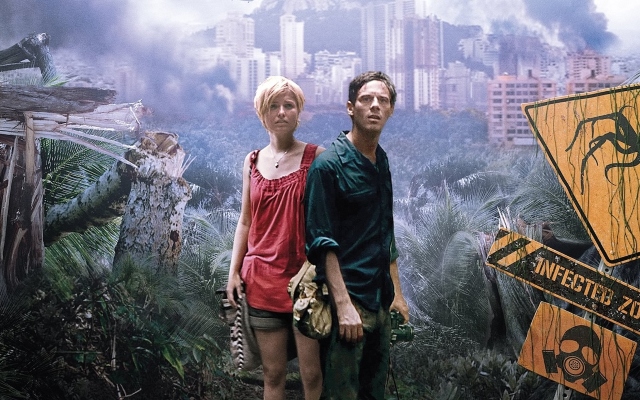
Another addition to the big monster genre is “Monsters,” an indie movie that reportedly only cost $15,000. Part road trip, part romance and all atmosphere, the story of Andrew (Scoot McNairy), an opportunistic photojournalist, who must escort his boss’s daughter, Sam (Whitney Able), back to the U.S. border through the treacherous quarantine area inhabited by… you guessed it, giant creatures left there when a NASA space craft carrying samples of extraterrestrial life crashed.
It’s a pure b-movie premise and for the first fifteen minutes or so promises to be little more than a Roger Corman film with better CGI. Then something happens. The movie becomes about the relationship between total opposites Andrew and Sam as they bond over their trip’s hardships and the strangeness of their surroundings. It’s a giant monster movie that focuses on the characters and despite some wild plot contrivances, it works.
The character study is a slow burn that leads up to the big reveal, the unveiling of the creatures. For most of the film they are seen and not heard but director Gareth Edwards paces the film carefully building up suspense through use of sound effects to climax with a wild mating dance between two of the Lovecraftian beasts. It’s a strangely beautiful and eerie sequence that brings the movie to a close.
“Monsters” isn’t as effective as “District 9” or “Cloverfield,” two other recent movies that introduced us to new creatures, but it is a complex film with timely messages about immigration (the US is protected by a giant fence to keep the monsters out) and our reactions in times of danger.
They grow up so quickly, don’t they? One day they are slimy bipedal creatures who look like a cross between Yul Brenner and a slug, the next they are flesh eating, underwater breathing alien looking supermodel types. At least that’s the way it is in “Splice,” a new sci fi thriller starring Oscvar winners Sarah Polley and Adrien Brody, about a creature who goes from newborn to troubled teen in a matter of weeks.
Clive (Brody) and Elsa (Polley) are bio chemists (and boyfriend and girlfriend) who develop a splicing technology which binds the DNA from multiple animals to create new life and, possibly, cures for everything from Parkinson’s to cancer. It’s the medical breakthrough of the century. The next logical step is to fuse human and animal DNA but despite their success in the lab, their employers, the evil conglomerate Newstead Pharma, is wary of the publicity such a radical step would incur. Secretly the pair go rogue, continue their experiments, and give “birth” to a new life form they dub Dren (that’s “nerd” backwards), a tailed creature resembling a bald dinosaur. Clive, conflicted by the ethical and moral issues of cloning, wants to kill the creature but Elsa won’t have it. “Human cloning is illegal,” she says, “but this won’t be entirely human.” Dren develops at a rapid pace, changing from unrecognizable organism to something akin to a humanoid kangaroo. Soon though problems arise. The creature becomes Daddy’s little… whatever, leaving Elsa to deal with Dren’s difficult puberty.
Like the hybrid creature at the center of the action “Splice” is a cross of genres—part b-movie sci fi and part body horror à la David Cronenberg. Liberally mixing “The Island of Dr. Moreau,” “Frankenstein” and “The Brood,” “Splice” examines ideas of life and death, of playing God, of what is human (and what is not) and even touches on Woody Allen style relationships. There are plenty of moral concepts to chew on, many ruminations to be had on what it is to be human, but only if you look past the b-movie thrills director Vincenzo Natali slathers on with a trowel.
Splice goes places that bigger budget science fiction wouldn’t dare to tread. This isn’t the enviro-friendly sci fi of James Cameron or the space opera of George Lucas. No, this has more in common with the exploitation films of Roger Corman. There’s an icky creature, some scientist sexy time and loads of crazy science. Corman might not have been as successful at layering in the love, jealousy and real human emotions Natali heaps on his characters but I think the b-movie king would approve of “Splice’s” overall tone. It’s doesn’t skimp on the blood and guts but it’s funnier than you think it is going to be, wilder than expected—Sarah Polley’s maternal instincts towards Dren are right out of “Mommie Dearest”—and takes several unexpected twists and turns.
“Splice” is giddy good fun, the rare sci fi flick that revels in its b-movie roots while also offering up something to think about over a beaker of coffee afterward.
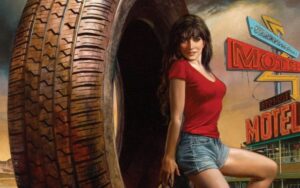
“Rubber” is an odd movie. It’s become fanboy-fashionable to rave about the story of a killer tire—yes, you read that right—with psychokinetic powers—think “Carrie” with treads—who terrorizes the American southwest and I’ll throw my hat in the ring, but only to a certain point. Writer/director Quentin Dupieux begins the film with an existential manifesto, an ode to the “no reason” element he says is crucial to the success of any movie.
“In the Steven Spielberg movie E.T, why is the alien brown? No reason,” says Lieutenant Chad (Stephen Spinella) in the film’s opening minutes. “I could go on for hours with more examples. The list is endless. You probably never gave it a thought… but all great films, without exception, contain an important element of no reason.”
The speech, while entertaining, is a dodge that allows the director to present all the story’s bizarre twists with a straight face but it is kind of disingenuous. Of course there is a reason why the tire comes to life and kills people. Just like there is a reason why there is a group of people in the desert watching the tire’s killing spree through binoculars as though they are watching a movie. I could go on for hours with more examples, to quote Lieutenant Chad, but you get the point.
It’s an absurdist tract on how and why we watch movies, what entertainment is and the movie business, among other things. But frankly, mostly it’s about a tire rolling around the desert and while there is something kind of hypnotic about watching the tire on its murderous journey—think “Natural Born Killer” but round and rubbery—that doesn’t mean “Rubber” is a good movie. For all its subtext, style and audacious storytelling it is still essentially a cool short film idea stretched beyond comfort to 82 minutes (with credits).
“You may come and go, but you will not take people from the city. If I hear of it, a single time, I will destroy you without salvation.” — Tada Cuda (Lincoln Maazel)
Imagine George A. Romero going to a psychic early on in his career.
“There’s good news and bad news,” she might say, gazing into her crystal ball. “Which would you like first?”
“The good news,” the Dawn of the Dead director would reply.
“You will make many movies . . .”
“That’s great! What’s the bad news?”
“The only ones people will go see all have the words ‘of the Dead’ in the title.”
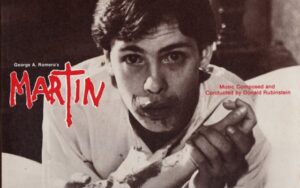
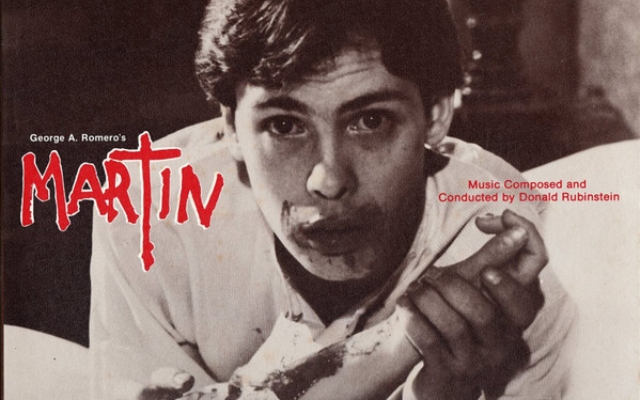
That didn’t happen of course, but the fact remains that zombie king Romero has had a rough time attracting audiences for his non-Living Dead efforts. Dig deep into the Romero bargain bin, though, and there are a number of films that deserve a second look. The Crazies is a spooky thriller about a manmade combat virus that causes death and permanent insanity in those infected while Knightriders is a wild romp that can best be described as The Legend of King Arthur meets Mad Max. Best of all is Martin, an arty 1977 movie about a young man who believes he is a vampire.
The eponymous creature of the night, Martin Matthias (played by Dawn of the Dead casting director John Amplas), is a shy suburban teenager with a blood lust, but none of the usual trappings of the Nosferatu. Instead of fangs he uses razorblades and needles to do the dirty work and he isn’t averse to garlic, sunlight or crucifixes. Despite no actual proof of his undead status, he is steadfast in his conviction.
Surprisingly he’s not alone in his belief. Cuda (Lincoln Maazel), an elderly old-world cousin believes that vampirism is a family “shame” and makes it his calling to save Martin’s soul by trying to arrange an exorcism with the local priest. He also takes the boy in and gives him a job at his neighborhood grocery store, but Martin can only control his cravings for so long.
Martin actually has more in common with Taxi Driver than it does with Dracula. Romero’s films have always brimmed with social commentary, but his 70s work is especially ripe with societal resonance. In Martin he filters the post-Vietnam ills of drug addiction and urban decay through the lens of a vampire film, focusing on the reasons why Martin behaves the way he does and not the behavior itself. Compared to other horror films this one barely qualifies as a shocker. There are just three violent scenes and while they are bloody, the gore is used more as a measure of Martin’s ineptness — his sloppy killing skills — than to scare.
Often labeled as horror, it’s more accurate to call Martin a psychological drama as Romero spends the entire film flirting with the question of whether Martin is really a vampire, or just a drug addict with a vivid imagination. Eerie black and white flashbacks portray him as an undead creature, but the reality is a much different story. With these black and white sequences Romero muddies the water, never settling on a definitive answer, preferring to let the viewers decide for themselves whether there are supernatural forces at work, or if this is all the product of a diseased mind.
In Romero’s world the notion that Martin might not be a vampire is scarier than if he was a certified bloodsucker. Romero uses the troubled mid-’70s and its products — drug-addicted youths, decaying cities and stultifying suburban life — as a catalyst for the kind of fantasy world Martin creates just to cope with his life. This reality, Romero seems to imply, is far more terrifying than a fanged man in a cape could ever be.
“I didn’t try to come down on one side or the other,” Romero said. “I like the lady or the tiger kind of thing. I tried to keep it ambiguous, but in my mind, he was a disturbed kid.”
Martin is dense with the kind of social subtext that Romero favors in his films. His zombie movies have been thinly veiled comments on consumerism and the media, and Martin is no less layered. On the surface it seems to be a simple story, but dig a little deeper past the garish lighting and Romero reveals a mixed bag of metaphors regarding drug addiction, mental illness and the evil that humans do to one another. It’s purposefully ambiguous. The director is asking the viewer to look inside themselves to decide what answer to Martin’s status they are comfortable with. Is he a vampire or disturbed young man? Drug addicted or mentally ill? The answer you come up with — what you chose to believe — Romero implies, says as much about you are as it does about Martin.
On the Saturday October 3, 2026 edition of The Richard Crouse Show we’ll meet First let’s meet Robert Mark Kamen, screenwriter of 23 movies, including The Karate Kid, Taken and many others. Yup, he’s the mind behind lines like Wax On Wax Off and Liam Neeson’s famous, “a very particular set of skills” speech.
His latest project is The Karate Kid: The Musical, which will be playing on Toronto at the Princess of Wales Theatre until November 1. See Mirvish.com for more details.
Then, Canadian blues-rock legend Colin James, eight-time Juno winner, multi-platinum artist, and one of the most electrifying guitarists this country has ever produced, joins the show. From the prairies of Saskatchewan to stages around the world, he’s earned a devoted following and collaborations with some of music’s greatest names. Now he shares a whole new side of the story with Playing the Changes: A Musician’s Memoir—a funny, open-hearted, and deeply moving account of his early years, the road that led him to open for Stevie Ray Vaughan at eighteen, and the making of a lifelong musician, all the way up to the release of his debut album.
Finally, Duncan Fremlin, musician, banjo player, singer, and frontman of the country-folk group Whiskey Jack stops by. Today we talk about his new book “Stories Not Fit for the Stage – An Anthology,” a collection of tall tales, confrontations, anecdotes and encounters—some accidental, some not—with music and entertainment figures.
Each week on the nationally syndicated Richard Crouse Show, Canada’s most recognized movie critic brings together some of the most interesting and opinionated people from the movies, television and music to put a fresh spin on news from the world of lifestyle and pop-culture. Tune into this show to hear in-depth interviews with actors and directors, to find out what’s going on behind the scenes of your favourite shows and movies and get a new take on current trends. Recent guests include Chris Pratt, Elvis Costello, Baz Luhrmann, Martin Freeman, David Cronenberg, Mayim Bialik, The Kids in the Hall and many more!
All iHeartRadio Canada stations are available across Canada via live stream on iHeartRadio.caand the iHeartRadio Canada app. iHeartRadio Canada stations are also connected through Alexa, Siri, and Google Home smart speakers.
I wrote about the Toronto Star’s Theatre Club outing at the Coal Mine Theatre for a production of “Pre-Existing Condition.”
“Toronto Star Theatre Club participants gathered recently in an intimate performance space on Danforth Avenue to watch an equally intimate play about a woman struggling to rebuild her life, find justice and process lingering trauma in the wake of domestic violence.
“On Sept. 19, the Coal Mine Theatre — “Off, off Broadview” as founder and artistic director Ted Dykstra called it — saw the audience sit on opposite sides of a traverse stage for the performance of “Pre-Existing Condition” by playwright Marin Ireland. The last Toronto Star Theatre Club event of its inaugural season, it was sponsored by Havelock Metal…” Read the whole thing HERE!