Two far flung events inspired director Tobe Hooper to write The Texas Chain Saw Massacre, the down-and-dirty 1974 indie film that spawned sequels, prequels and last year’s splashy 3D remake–the imaginatively titled Texas Chainsaw 3D.
In November 1957 police raided the home of Plainfield, Wisconsin farmer Ed Gein, uncovering some gruesome evidence that would lead to charges of murder and body snatching. After two trials he spent the rest of his life in a mental facility, but his story would go on to inspire three memorable movie characters–Norman Bates from Psycho, Buffalo Bill from The Silence of the Lambs and one other that would serve as the basis for six films.
Gunnar Hansen, who played Leatherface in Texas Chain Saw Massacre, says Hooper and co-writer Kim Henkel based the character of the hooded chainsaw killer on Gein.
“When they set out to write this movie,” he said, “they decided to have a family of killers who had some of the characteristics of Gein: the skin masks, the furniture made from bones, the possibility of cannibalism.”
Hooper adds the story was also partially inspired by “the massacres and atrocities in the Vietnam War” and a display of chainsaws in the hardware section of a crowded Montgomery Ward’s department store.
“The idea popped,” he remembered. “I said, ‘Ooh, I know how I could get out of this place fast — if I just start one of these things up and make that sound.’”
That nerve jangling noise–the revving of a chainsaw–has been the soundtrack of terror ever since. The original is an atmospheric gem, a white-knuckle movie that made Leatherface the first icon of modern horror.
The apron-wearing cannibal has appeared in five more films–most of which don’t veer too far from the original plot line of unsuspecting kids falling prey to a family of demented, cannibalistic inbreds. There’s The Texas Chain Saw Massacre 2, directed by Tobe Hooper and starring Dennis Hopper, Leatherface: TCM III, TCM: The Next Generation (starring the then unknown Matthew McConaughey and Renée Zellweger), The Texas Chain Saw Massacre, TCM: The Beginning and the new 3D version.
Leatherface’s scares don’t always happen on screen, however. At the Kingsway Theatre in Toronto the flick inspired audience participation when someone dressed in a butcher’s outfit ran down the aisle brandishing a real, revving chainsaw.
I sit with NewsTalk 1010 host Deb Hutton to talk about a new Beatles museum coming to Liverpool, England, Spotify VS. AI, Selena Gomez’s vocal changes, and I review the stop motion animated “Wildwood” and the historical documentary “Once Upon a Time in Harlem.”
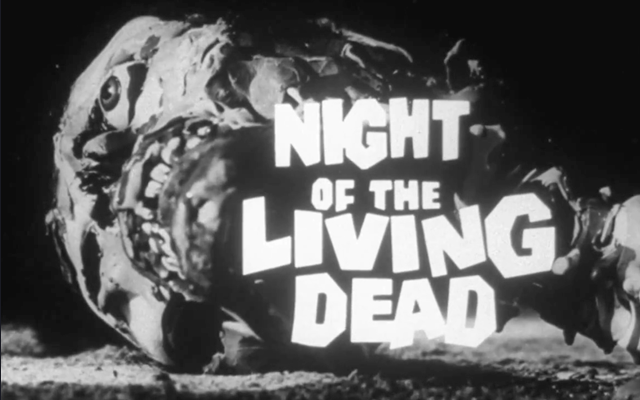
Without Night of the Living Dead movies like 28 Days Later, Shawn of the Dead or even Zombie Strippers wouldn’t exist. In 1968 the story of story of people trapped in a rural Pennsylvania farmhouse trying to survive an attack by reanimated ghouls dragged a bloody new horror genre into the marketplace. For better (see Re-Animator) and for worse (see Zombie Nightmare) the movie Rex Reed called “a classic” has spawned four decades of brain eating and head explosions, but according to the film’s co-author John Russo the origin of the idea was anything but sinister.
“Sometime in the winter of 1966 George Romero and I were having lunch with Richard Ricci,” says Russo, then a co-partner with Romero and Russell Streiner (who has the film’s most famous line, “They’re coming to get you, Barbara!”) in The Latent Image, a commercial television production house. “George and I were complaining about the fickleness of our commercial clients who, when they had not too much money to spend, would come to us for a good, creative job on their spots and sales films, and would promise to come back to us next time, when they would have more money to spend. But when they got more money they’d run away to the supposed glitz and glamour of New York or Hollywood. Richard said, ‘So why don’t you do something about it?’ I thought about it and said, ‘We oughtta be able to make something better than the crap we see on Chiller Theater.’
“George right away got excited, slammed the table with his big hand, sending bottles and glasses flying, and yelled, ‘We’re gonna make a movie!’”
The two batted around several ideas. One, titled Monster Flick, was a horror comedy about teenage aliens, while another focused on flesh eating aliens. “But we quickly discovered that we could not afford all the necessary special effects,” he says, so the writing continued.
“We’d go to work late at night in separate offices, at separate typewriters,” says Russo. “I said right away that our story should start in a cemetery because folks found cemeteries spooky. I was working on a script that started in a cemetery and involved aliens coming to earth in search of human flesh. But George took a break at Christmas time and came back with half of a story that started in a cemetery, and was in essence what became the first half of Night of the Living Dead. There were all the proper twists and turns and a lot of excitement, but George never said who the attackers were or why they were attacking.
“I said, ‘I like this, George, but who are these attackers? You never say.’ And he said he didn’t know. So I said, ‘It seems to me they could be dead people. But why are they attacking? What are they after?’ Again, he said he didn’t know. So I said, ‘Why don’t we use my flesheating idea?’ And he agreed.
“So that’s how the modern flesheating zombies were born!”
The film, titled Night of the Flesheaters, was shot on a shoe string budget—Bosco Chocolate Syrup and pig’s intestines subbed for real blood and guts—in rural Pennsylvania between June and December 1967. Once finished, Russo and Romero had a hard time selling the movie because of its unflinching violence and gory special effects. The pair stuck to their guns, however, denying distributor after distributor who demanded cuts or a happy ending. Finally they found a company who would show the film uncensored but there was still a problem.
“There was already a movie called Flesheaters, and their attorney threatened us, so we had to come up with a different title,” says Russo. “George Romero decided on Night of Anubis, after the Egyptian god of the dead. This was a weak title, and when Continental Pictures got ready to distribute we changed it to Night of the Living Dead.”
The movie premiered on October 1, 1968 earning a rave from Roger Ebert and that other mark of success for a horror film, condemnation from fundamentalist Christian groups.
These days it doesn’t take a lot of braaaaaaaaaaaaaaaains to see the legacy of Night of the Living Dead. The ghoulish story is considered a classic, has spawned comedies like the box office hit Zombieland and serious television shows like The Walking Dead and was even selected by the Library of Congress for preservation in the National Film Registry as a film deemed “culturally, historically or aesthetically significant.”
“We were absolutely dedicated toward making a movie that was true to its premise and the motivations of its characters, from start to finish,” says Russo, adding, “[the movie] struck a primal chord in everybody, perhaps because of the atavistic memory of our species as easy prey for wild beasts, which we were for most of human history. We all carry the deep-seated fear of being devoured.”
I join the Bell Media Radio Network national night time show “Shane Hewitt and the Night Shift” to talk about more Jon Stewart, a new voice for Apu, a priceless brassiere and I review the docmenary “Once Upon a Time in Harlem” and offer some suggestions for cocktails to enjoy with the film.
Check out Richard’s entry in Biff Bam Pop’s! 31 Days of Horror!
In front of the camera Erich von Stroheim was known to the public as “The Man You Love to Hate.” Behind it he might have been known as “The Man the Studios Love to Hate” because of his haughty attitude and disregard for the Tinsel Town power structure.
In a Hollywood career that spanned forty years the Austrian born director and actor saw his stock rise and fall many times. He first made a name for himself during WWI playing cruel aristocratic German villains—in one film he actually throws a crying baby out a window!— the stereotype which earned him the title “The Man You Love to Hate.”
In the silent era he was also a much sought after director until his arrogance—he made a nine-hour movie called Greed—budgetary follies—he was the first director to spend over one million dollars on a film—and attention to detail—his scripts were often as long as the novels he was adapting—made him unemployable by the big studios. Unable to find important work behind the camera he was forced to concentrate on performing.
Despite his hatred for acting—he couldn’t remember his lines and didn’t like taking orders—he was a striking screen presence. His well-crafted pompous screen persona was put to good use in Jean Renoir’s La Grande Illusion and Billy Wilder’s Sunset Boulevard, for which he was nominated for the Academy Award for Best Supporting Actor, but it is a little seen 1935 film that captures von Stroheim at his ominous best… TO READ THE WHOLE THING CLICK HERE!
I join the Bell Media Radio Network national night time show “Shane Hewitt and the Night Shift” to talk about Quentin Tarantino and “Borat” star Sacha Baron Cohen’s upcoming swashbuckling stage comedy coming soon to the West End. Then I review the new whale of a tale “Whalefall” and suggest some whale themed cocktauils for your enjoyment!
Big monsters are back. Movies like “The Host” and “Cloverfield” have reintroduced audiences to that rarest, but biggest of beasts, the giant out-of-control monster. Who needs vampires and zombies when you could have a ninety foot tall squid with a bad attitude and a Christmas bulb for a head?
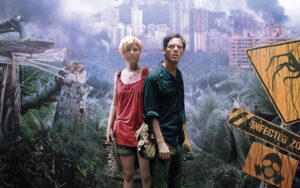
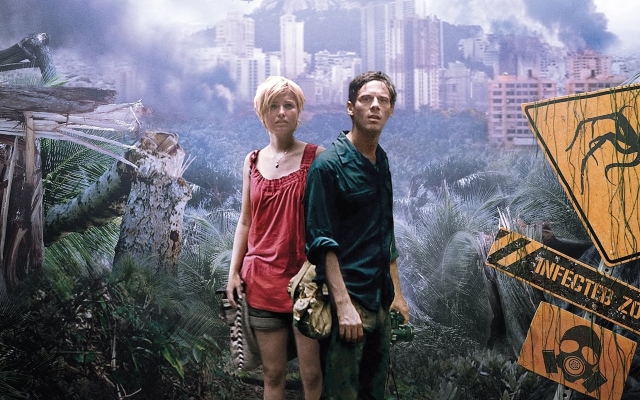
Another addition to the big monster genre is “Monsters,” an indie movie that reportedly only cost $15,000. Part road trip, part romance and all atmosphere, the story of Andrew (Scoot McNairy), an opportunistic photojournalist, who must escort his boss’s daughter, Sam (Whitney Able), back to the U.S. border through the treacherous quarantine area inhabited by… you guessed it, giant creatures left there when a NASA space craft carrying samples of extraterrestrial life crashed.
It’s a pure b-movie premise and for the first fifteen minutes or so promises to be little more than a Roger Corman film with better CGI. Then something happens. The movie becomes about the relationship between total opposites Andrew and Sam as they bond over their trip’s hardships and the strangeness of their surroundings. It’s a giant monster movie that focuses on the characters and despite some wild plot contrivances, it works.
The character study is a slow burn that leads up to the big reveal, the unveiling of the creatures. For most of the film they are seen and not heard but director Gareth Edwards paces the film carefully building up suspense through use of sound effects to climax with a wild mating dance between two of the Lovecraftian beasts. It’s a strangely beautiful and eerie sequence that brings the movie to a close.
“Monsters” isn’t as effective as “District 9” or “Cloverfield,” two other recent movies that introduced us to new creatures, but it is a complex film with timely messages about immigration (the US is protected by a giant fence to keep the monsters out) and our reactions in times of danger.
They grow up so quickly, don’t they? One day they are slimy bipedal creatures who look like a cross between Yul Brenner and a slug, the next they are flesh eating, underwater breathing alien looking supermodel types. At least that’s the way it is in “Splice,” a new sci fi thriller starring Oscvar winners Sarah Polley and Adrien Brody, about a creature who goes from newborn to troubled teen in a matter of weeks.
Clive (Brody) and Elsa (Polley) are bio chemists (and boyfriend and girlfriend) who develop a splicing technology which binds the DNA from multiple animals to create new life and, possibly, cures for everything from Parkinson’s to cancer. It’s the medical breakthrough of the century. The next logical step is to fuse human and animal DNA but despite their success in the lab, their employers, the evil conglomerate Newstead Pharma, is wary of the publicity such a radical step would incur. Secretly the pair go rogue, continue their experiments, and give “birth” to a new life form they dub Dren (that’s “nerd” backwards), a tailed creature resembling a bald dinosaur. Clive, conflicted by the ethical and moral issues of cloning, wants to kill the creature but Elsa won’t have it. “Human cloning is illegal,” she says, “but this won’t be entirely human.” Dren develops at a rapid pace, changing from unrecognizable organism to something akin to a humanoid kangaroo. Soon though problems arise. The creature becomes Daddy’s little… whatever, leaving Elsa to deal with Dren’s difficult puberty.
Like the hybrid creature at the center of the action “Splice” is a cross of genres—part b-movie sci fi and part body horror à la David Cronenberg. Liberally mixing “The Island of Dr. Moreau,” “Frankenstein” and “The Brood,” “Splice” examines ideas of life and death, of playing God, of what is human (and what is not) and even touches on Woody Allen style relationships. There are plenty of moral concepts to chew on, many ruminations to be had on what it is to be human, but only if you look past the b-movie thrills director Vincenzo Natali slathers on with a trowel.
Splice goes places that bigger budget science fiction wouldn’t dare to tread. This isn’t the enviro-friendly sci fi of James Cameron or the space opera of George Lucas. No, this has more in common with the exploitation films of Roger Corman. There’s an icky creature, some scientist sexy time and loads of crazy science. Corman might not have been as successful at layering in the love, jealousy and real human emotions Natali heaps on his characters but I think the b-movie king would approve of “Splice’s” overall tone. It’s doesn’t skimp on the blood and guts but it’s funnier than you think it is going to be, wilder than expected—Sarah Polley’s maternal instincts towards Dren are right out of “Mommie Dearest”—and takes several unexpected twists and turns.
“Splice” is giddy good fun, the rare sci fi flick that revels in its b-movie roots while also offering up something to think about over a beaker of coffee afterward.
 Two far flung events inspired director Tobe Hooper to write The Texas Chain Saw Massacre, the down-and-dirty 1974 indie film that spawned sequels, prequels and last year’s splashy 3D remake–the imaginatively titled Texas Chainsaw 3D.