SYNOPSIS: In “Digger,” a new dark comedy now playing in theatres, Tom Cruise plays the title character, an oil tycoon who launches a campaign to become humanity’s savior before a disaster of his own making destroys the world. “If we can’t control the course of nature,” her says, “at least we can control the narrative.”
CAST: Tom Cruise, Riz Ahmed, John Goodman, Sandra Hüller, Michael Stuhlbarg, Jesse Plemons. Directed by Alejandro G. Iñárritu.
REVIEW: A study in justification of one’s actions, “Digger” is a dark satire, touched by farce, of narrative control in the face of crisis.
Tom Cruise, disguised by an inch of aging make-up, fake teeth and an elaborate comb-over, plays Digger Rockwell, the world’s most powerful oil tycoon. Eccentric, greedy and immoral—“Mr. Rockwell is a man who would roast our children alive if he thought he could sell them for a dime,” says scientist Ganesh (Riz Ahmed)—he does not like bad news.
When he gets bad news about the stability of one of his oil platforms, he ignores it and the resulting explosion causes havoc, creating aa ice shelf then size of Washington, D.C. on a collision course with Western Europe. “Digger here got us into this mess,” says the President of the United States (John Goodman), “and Digger’s gonna dig us out again.”
Rather than accept blame for the worldwide chaos Digger treats the situation not as a catastrophe but as a branding problem. “Panic is a resource,” he says. “When you’re running away from a house fire no one cares who left the toaster on.”
With the fate of the world hanging in the balance, Digger tries to save his company and himself by controlling the narrative. “They know the facts,” he says. “The story is yet to be told.”
Echoes of “Dr. Strangelove” reverberate throughout “Digger.” Both are absurdist nightmare comedies that skewer the egos and ideologies of powerful men, and both focus on managing the narrative of a crisis rather than dealing with it. But the cool, deadpan vibe of Stanley Kubrick’s film is replaced by a passionate, outlandish feel that will certainly divide audiences.
It’s a big movie, filled with big ideas, even if they sometimes get lost in the sheer grandiosity of the filmmaking. Director Alejandro G. Iñárritu, who co-wrote the script with Alexander Dinelaris, Nicolás Giacobone and Sabina Berman, presents a riff on the old saying, “power tends to corrupt, and absolute power corrupts absolutely,” but in Digger Rockwell’s world corruption goes hand in hand with control because that’s where the power is. Controlling the narrative is more important than solving the problem.
“They know the facts,” he says, “but the story has yet to be told.”
Digger’s a bad guy, ignorant, tacky and narcissistic, but he’s the hero of his own invented narrative and in an era of fake news and misinformation, it’s a timely and scary reality check.
The absurd and often jaundiced take on the machinery of power from Digger’s house to the White House and beyond is not subtle. Iñárritu takes big swings here narratively and stylistically. His ambition pays off in fits and starts. Some scenes, like a sequence of Digger, the President of the United States (John Goodman) and various generals, watching the iceberg collision with land is darkly hilarious, or Cruise’s ten-minute amphitheater monologue, fire on all cylinders.
But overall “Digger” values audacity, ambition and theatrics over narrative clarity. Not funny enough to be a satire, too outrageous to be straight drama, it lands in a tonal wasteland, wavering between silly and sincerity.
The parts of “Digger” that work, however, work very well. John Goodman lets his freak flag fly as the beleaguered POTUS and Riz Ahmed, as the pushed-to-the-brink climate scientist, hands in a career best performance. Cruise nails both the farcical elements of the character but lets the more intimate, realistic moments breathe in a performance that will likely draw attention from the Academy at Oscar time.
Digger Rockwell brags that the world is powered by his fossil fuels, but his movie is fueled by something else: audacity. It is a truly unique film, the kind that doesn’t usually feature such high-priced talent, but this audacious environmental drama is bordered self-indulgence and by times is a chore to sit through.
SYNOPSIS: Set deep in the Amazon rainforest along the Curuçá River, the survival horror film “Beware Boiúna,” now playing in theatres, a colossal, vicious serpent known as the Mother of the Waters attempts to reclaim her territory. “She decides who lives. She decides who dies.”
CAST: Kiana Madeira, Jessica Rothe, Logan Marshall-Green. Directed by Mike P. Nelson.
REVIEW: A mix of Amazonian folklore and giant snake movies like “Anaconda” and “Python,” “Beware Boiúna” sets nature against man in a movie that’ll make you root for the territorial snake.
The story begins with a medical team, including doctor Alli (Jessica Rothe) and mechanic Lena (Kiana Madeira), on a six-week humanitarian mission on the Amazon River to deliver aid.
Their presence, coupled with the disruptive surveyors led by Brennan (Logan Marshall-Green), upsets the natural balance of the rainforest, they awaken a behemoth named Boiúna, a giant serpent known as the Mother of the Waters. “When there is balance, she rests,” says Lena. “Imbalance, she defends.”
Boiúna spends much of the film’s overlong 104 minutes slithering in the background, seen only in quick glimpses amid the murky cinematography and jungle foliage.
In a riff on “Jaws,” director Mike P. Nelson keeps the creature mostly out of sight, à la Spielberg in “Jaws,” to allow the viewer’s imaginations to do the heavy lifting. What you can’t see should be more terrifying than Nelson can show you. But with this boatload of uninteresting characters, who lose whatever motivations and traits they may have started with on page one of the script once the snake starts to feed, all you’re left with is a big bad you barely get a look at and human snake food running through the jungle.
“Jaws” was effective because while the shark’s relentlessness was scary, you cared about the characters.
The colonizing bad guys are straight out of Central Casting’s Evil Invader Department, while the humanitarians seem to leave chaos in their wake. That they behave erratically doesn’t matter, because once Boiúna shows up all characterization and logic goes out the window. The characters have names, but they may as well be known as Snake Snack # 1 through #10 given the impact they leave behind.
It adds up to a giant snake movie without the camp appeal of “Anaconda” or the scares of a creature feature like “Jaws.”
SYNOPSIS: In “Verity,” a new psychological erotic thriller starring Anne Hathaway and Dakota Johnson, and now playing in theatres, the line between fiction and reality blurs as a ghostwriter uncovers secrets about a famous author. “There is no light where we’re going.” Says Verity (Anne Hathaway). “Darkness ahead.”
CAST: Anne Hathaway, Dakota Johnson, Josh Hartnett, Ismael Cruz Córdova, Alex Cooper. Directed by Michael Showalter.
REVIEW: Although released in the fall, “Verity” is the equivalent of a summer beach read.
Based on Colleen Hoover’s novel of the same name, “Verity” sees Dakota Johnson as struggling writer Lowen Ashleigh. Broke and facing eviction, she is in bad need of a job.
The gig as a ghostwriter for Verity Crawford (Anne Hathaway), a bestselling author of thrillers who has been left immobilized and unresponsive after a terrible car accident, offers Lowen the chance to start anew at the author’s isolated Vermont estate.
At the house while sorting through Verity’s notes, Lowen uncovers what she thinks is an autobiography. The manuscript, however, is more than a straightforward look at Verity’s life. On the pages, in stark black and white, are what appear to be intimate details to the author’s culpability in her family’s tragedies. “A writer’s words should be honest and bloody and a little bit terrifying.”
In a quest for the truth, Lowen is drawn into a world of obsession where real life and fiction are tangled.
“Verity” breathes the same suburban Gothic air as “The Housemaid,” but has none of the delirious spirit that made the Amanda Seyfried/Sydney Sweeney movie a silly and steamy crowd pleaser.
There are twists and turns aplenty, but very few shocks in this talky, deliberately paced movie. Like Daphne du Maurier on quaaludes, it plods through the story of truth vs. fiction as though the set was filled with molasses. Fans of the novel may enjoy seeing Hoover’s famous “headboard sex scene” brought to life, (VERY MILD SPOILER AHEAD) but the core notion that a compelling narrative trumps facts feels forced and, by the time we get to it, morally ambiguous.
Of the top line cast only Hathaway dives in, providing a darkly theatrical turn. Seen mostly in flashbacks, she’s mean and menacing with a touch of camp.
When she is on screen, mouth bloodied after biting her lover or happily unplugging her children’s baby monitors, “Verity” comes alive, only then to be deadened by the surrounding turgid storytelling.
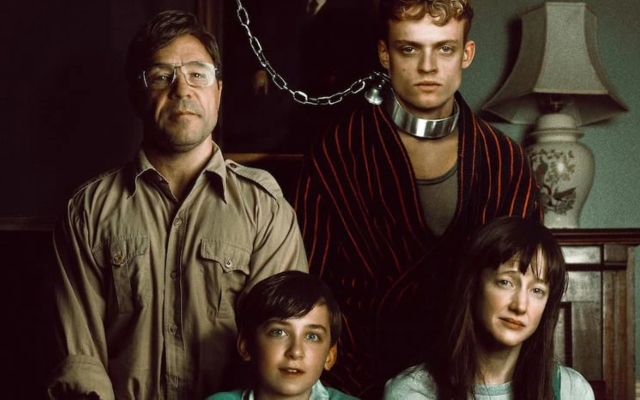
SYNOPSIS: In “Heel,” a new psychological thriller now on VOD and Digital, a suburban couple inflect their own brand of social rehabilitation on a 19-year-old criminal.
CAST: Stephen Graham, Andrea Riseborough, Anson Boon, Kit Rakusen. Directed by Jan Komasa.
REVIEW: A suburban riff on “A Clockwork Orange,” “Heel” (formerly known as “Good Boy” in the UK) is a darkly comedic morality play that starts strong but doesn’t stick the landing.
When we first meet Tommy (Anson Boon) he’s a violent 19-year-old who does drugs, gets into fights and posts about it on Instagram. One drunken night he gets separated from his friends and is abducted, only find himself chained to a wall like a dog in a dingy basement.
His captors, married couple Chris (Stephen Graham) and Kathryn (Andrea Riseborough) and their cute 10-year-old son, Jonathan (Kit Rakusen), are not quite what you might expect from kidnappers. Kathryn is standoffish, but Chris is stern but kind (mostly) presence who lectures Tommy on how to lead a better life, when he isn’t forcing his unwilling guest to watch educational videos or read novels. “We treat each other with respect in this house,” Chris tells him.
Meanwhile, Chris and Kathryn hire a Rina Macedonian housekeeper whose presence brings some unwanted attention to the house.
This story of rehabilitation—of attempting to bring Tommy to heel, so to speak—is an odd duck, one that surprises and confounds in equal measure. The unpredictable story offers no motive for Chris and Kathryn’s treatment of Tommy, which blunts whatever social commentary might have been lurking on the story’s dark corners.
Still, rock solid performances from Graham, Riseborough and particularly Boon, who effectively channels anger and anxiety, keep the stakes high enough to maintain interest.
 SYNOPSIS: In “Digger,” a new dark comedy now playing in theatres, Tom Cruise plays the title character, an oil tycoon who launches a campaign to become humanity’s savior before a disaster of his own making destroys the world. “If we can’t control the course of nature,” her says, “at least we can control the narrative.”