You don’t have to know or understand the role-playing game D&D to get the movie “Dungeons & Dragons: Honor Among Thieves.” Those who know that the acronym BBEG stands for Big Bad Evil Guy (or Gal) or that Monty Hall doesn’t refer to the game show host, but to a type of campaign based on accumulating as much wealth/magic items as possible, will have a better chance at deciphering the in-jokes and Easter Eggs, but for non-players, it still works as a fantasy action-comedy, complete with sorcerers, trolls and dragons.
The story begins with impish single father Edgin Darvis (Chris Pine) and barbarian Holga Kilgore (Michelle Rodriguez), making a daring escape from prison. They wound up behind bars when their planned robbery to steal the Tablet of Reawakening, an artefact with the power to resurrect the dead, went sideways. Their cohorts, Edgin’s daughter Kira (Chloe Coleman), conman Forge Fitzwilliam (Hugh Grant), Sofina (Daisy Head) and sorcerer Simon Aumar (Justice Smith), escaped justice, disappearing into the wind.
Upon their “release” they discover that Fitzwilliam double-crossed them, has taken custody of Kira and is now living the high life as the wealthy Lord of Neverwinter. When it becomes clear Fitzwilliam is no longer an ally, Edgin and Holga go on a quest to find the Tablet of Reawakening, resurrect Edgin’s dead wife, bring Kira back to the family and settle a score with Fitzwilliam.
But first they must find the Enchanted Helmut, a sideline aided by Sophia Lillis as Doric, a tiefling druid and shapeshifter and the heroic Xenk Yendar (Regé-Jean Page).
There’s more, like Red Wizards and necromancy and talking corpses, but for all the fantasy on board the movie, this is really a very earth-bound story of friendship and family. With dragons and magic.
What could have been another dull game adaption transcends the nasty reputation left behind by bombs that were not nearly as fun as the games that inspired them, like “Battleship” and “Candy Land: The Great Lollipop Adventure.”
Co-directors Jonathan M. Goldstein and John Francis Daley roll their twenty-sided dice (look it up) that audiences will value a fantasy story that uses humor as the backbone of the movie, the same way the “Lord of the Rings” flicks used allegories on the human condition to fuel theirs.
Luckily, mostly thanks to Pine’s nimble touch, it works really well. His performance sets a lighthearted tone followed by fun work from Rodriguez et al. Page also impresses as a handsome hero who feels like a combo of Dudley Do-Right and Errol Flynn.
We are so used to serious, heavy fantasy that the rambunctious “Dungeons & Dragons: Honor Among Thieves” feels like a breath of fresh sir. It is old-fashioned, an old-school action adventure that aims to entertain above all else. It doesn’t take itself seriously—although it is respectful to the world that inspired it—but does handle the action scenes, the world building, the characters, and the story with care.
The addictive puzzle video game “Tetris,” created by Soviet software engineer Alexey Pajitnov, couldn’t be simpler. Stack differently shaped pieces to form a whole and win points.
The story behind its success isn’t.
A new movie starring Taron Egerton and now playing on Apple TV+, tells the story of how Dutch video game designer Henk Rogers fit the differently shaped pieces of international intrigue and video game creation together to secure the intellectual property rights to popular game.
“The Soviet Union has worldwide rights,” says Rogers. “Nothing gets out easily.”
And how. In what is essentially a big business ticking clock story, Egerton is Rogers, an aggressive entrepreneur who discovers an early version of the simple game at the Consumer Electronics Show in the mid-1980s. An early adopter of video game technology, Rogers knows Tetris can be a hit.
“It was the most beautiful thing I’d ever seen,” he says. “I played for five minutes, and I still see falling blocks in my dreams. It is poetry. It is the perfect game.”
Developed by a Russian government software engineer Pajitnov (Nikita Efremov) in 1984, the game was an underground hit in the USSR, and starting to attract attention from other big players. The underdog Rogers finds himself up against Nintendo, media mogul Robert Maxwell (Roger Allam) and the Russian government.
“You want to play with the big boys?” threatens Maxwell. “This is how the world works.”
“Tetris” is a convoluted tale of how Rogers navigates dubious agreements, business backstabbing and the very real threat of Russian prison, to secure the rights to the game and a future for his family. Unlike the game, the movie’s pieces don’t fit together easily. Part business story, part spy thriller, it piles a great deal of information into every scene, beginning with an unloading of exposition off the top that sets the scene, but may try the patience.
Once past the initial mound of info, screenwriter Noah Pink keeps up the pace, piling double-crosses on top of political scheming on top of jet setting skullduggery. It zips along at the speed of level 10 game play, and while it is sometimes hard to keep track of who is zooming who, Pink keeps it fairly linear, mostly focusing on how the various deals affect Rogers. Told from this point of view, the complicated story of contract law and how the negotiations for a video game became a Cold War concern, is marginally easier to follow.
At the center of it all is the elaborately mustachioed Egerton. As Rogers he brings an energizer bunny approach to the entrepreneur’s unrelenting belief in the game and himself. As the story gets bigger and bigger—Henk against the world—it is Egerton that provides the human element, particularly in his friendship with Pajitnov. The surrounding performances are rather broad, but Egerton keeps it real.
Although it does feature 8-bit animation, “Tetris” isn’t a video game movie. Instead, it is a John Le Carre Lite political thriller, which could have used some of the simplicity of the game whose story it tells.
Chances are, if you came of age in the 1970s, you helped make Casablanca Records the most successful independent record label of all time. With artists like Donna Summer, Parliament, Gladys Knight, the Isley Brothers, the Village People, Bill Withers and KISS on the roster, founder Neil Bogart sold millions of records and helped define the sound of the 1970s.
“Spinning Gold,” a new biopic now playing in theatres, written, produced and directed by Bogart’s eldest son Tim, is the story of how it happened. Kind of.
“If what you’re after is the truth,” Bogart says, “and not just what happened, but how it happened, then you are just going to have to believe all of it, because every single bit of it is true. Even the parts that weren’t.”
The story of Casablanca Records begins in Los Angeles, 1974. In the late 1960s the former singer and one-hit-wonder Bogart was a successful music executive. His ear for talent accelerated the rise of bubblegum pop, but it was a shock rock band from New York City, with face paint and futuristic stage outfits, that inspired Bogart to start his own label.
Refusing to ever take no for an answer, even after a disastrous label launch featuring KISS, whose pyrotechnics set off the sprinklers, leaving all the music biz big shots in attendance soaked and unimpressed, Bogart took risks no other executive could. Or would.
Flashbacks to his youth detail how the son of a poor Brooklyn postman rose to become a record industry mover-and-shaker. A charming combo of talent and nerve, with a healthy (and occasionally unhealthy) disregard for money, he cut a path through popular culture, following his personal motto: “Why head for the mountaintop when you’re reaching for the sky?”
A kind of “What Makes Sammy Run” set in the music business, “Spinning Gold” is a fast-paced portrait of an old-school show business mogul, a high school drop-out who gambled as big as he dreamed. It is the stuff of dreams and, as such, plays like a kind of fantasy, with Bogart cast as a rock ‘n roll fairy godfather. As played with great energy by Broadway star Jeremy Jordan, he grants people’s wishes and his belief in his own ability to cast a spell over artists and executives alike, is almost supernatural. “We were in the business of making dreams come true,” he says.
It all feels heightened, like a look at the era through a telescope, enlarged to the point where the image is so big it doesn’t feel real anymore. But, unlike other music biopics—think “Bohemian Rhapsody” for instance—“Spinning Gold” has a meta self-awareness, and even breaks the fourth wall to acknowledge, “This never happened!” It’s a fun stylistic choice, but later, the fictional hagiographic elements are tempered by the drugs, money issues and organized crime that enter the story midway through and give the movie a slightly grittier feel.
“Spinning Gold” relies too heavily on voice over—sometimes it feels like there’s more VO than actual dialogue—but, like the man and the music it is based on, the movie is unapologetically large ‘n loud in its need to entertain the audience and it mostly works with an appealing combo of performances and lots of ear-wormy music.
Most of all, as a portrait of a more free-wheeling time—”I’m not saying it wasn’t sex, drugs and rock and roll, because it was, “Bogart says. “But it was sex before it was deadly.”—“Spinning Gold” succeeds not because it gets the details exactly right but because it captures the spirit of a time in the music industry when it was run by dreamers who had passion for the music, not MBA diplomas hanging on the wall.
“Space Oddity,” a new overstuffed feature directed by actor Kyra Sedgwick and now playing on VOD, flits around between space travel, trauma, the ecology, family dynamics and romance without ever settling on any one of them.
When we meet the McAllister family, Rhode Island flower farmers Jeff (Kevin Bacon) and Jane (Carrie Preston), daughter Liz (Madeline Brewer) and son Alex (Kyle Allen), they are dealing with great trauma. The death of their middle son has left the parents and sister lost, throwing themselves into work to cope with their loss.
Alex, however, has an out-of-this-world plan to escape his pain. He joins Mission to Mars, a private company—think Bezos and Musk—with plans to colonize Mars. It’s not a one-way trip either. Earth is dying, Alex says, so why hang around?
His family goes along with his pipe dream until he gets serious, and applies for insurance to help finance the journey. At the insurance office, however, he meets Daisy (Alexandra Shipp), a broker who just might give the rocket man a reason to come down to earth.
The subject of space travel is the method by which “Space Oddity” conveys its real message, about the state of our planet and what needs to be done to save our environment, but the addition of family drama and romance makes it feel like it is madly running off in several directions all at once.
It has the feel of an after school special. The lead, Alex, isn’t a teenager, but he behaves like one and Allen’s wishy-washy performance doesn’t do much to hold our interest at the center of the film. He isn’t aided by a script that telegraphs every plot twist in advance. If the film’s journey had been more interesting, the predictable destination wouldn’t be as bland.
“Space Oddity” simply bites off more than it can chew. The environmental messages are heavy-handed with no new ideas and, as a study of grief, it is far too light weight.
“Why don’t you just die?” screams one of the hundreds of people looking to kill the titular character in “John Wick: Chapter 4,” the wild new Keanu Reeves assassin movie now playing in theatres.
Why doesn’t he just die? Because he’s John Wick, a mix of Anton Chigurgh, Wile E. Coyote and the Energizer Bunny, that’s why.
If you’re a fan of the movies, you already know Wick can take a lickin’ and keep on tickin’. You don’t need the backstory to enjoy the new film, but it might help. Here’s a quick John Wick Wiki to get you up to speed.
The John Wick Universe is a place where an association of twelve crime lords, called the High Table, govern the underworld’s most powerful criminal organizations. They control the Continental, a hotel chain with exclusive branches sprinkled across the globe that serve as homebases for assassins. It is a place run by a strict set of rules, like never do “business” on the premises, by managers like Wick’s friend Winston Scott (Ian McShane) who runs the New York outlet.
Legendary hitman Wick ran afoul of the High Table, and was declared excommunicado. He is persona non grata and they want him dead. Trouble is, he’s hard to kill.
Also, he really loves dogs as much he loves killing people. There. You’re caught up.
At the beginning of the new film, High Table elder and all-round psychopath, Marquis de Gramont (Bill Skarsgård), displeased with Winston’s continuing connection to Wick, decommissions the Continental New York. “He is the face of your failure,” he sneers.
With one of his last allies rendered powerless, Wick must get to the Marquis before the Marquis can get to him.
Cue an amount of mayhem rarely seen this side of Russian car wreck videos on YouTube.
At 2 hours and 49 minutes “John Wick: Chapter 4” is by far the longest film in the franchise. Heck, it’s even longer than “Pulp Fiction,” “A Clockwork Orange” and “Raging Bull,” but director Chad Stahelski maintains interest, staging at least one major action sequence, more like a well-choreographed ballet for the blood thirsty, each hour. People get gone in spectacular ways, Wick defies the laws of physics and medical science to get his revenge and some of the world’s most beautiful locations become the backdrop to Wick style mayhem.
A scene staged in the roundabout circling Arc de Triomphe de l’Étoile is an eyepopper, one of the best big screen action scenes in recent years not directed by George Miller. A shoot out on the 200 steps of Paris’s Sacré-Cœur has an anarchic cartoon vibe that would make the Tasmanian Devil envious. Tom Cruise may be famous for his signature run, but after this, I think, Reeves will be remembered for falling down stairs. It’s a wild, extended ticking-clock sequence that uses slapstick humor to alleviate the tension as Wick violently makes his way to a date with destiny.
Adding to the action sweepstakes are Hong Kong martial arts superstar Donnie Yen as the blind assassin Caine, and legendary Japanese actor and martial artist Hiroyuki Sanada, last seen on screen with Reeves in 2013’s “47 Ronin,” who plays the manager of the Osaka Continental Hotel and an old friend of Wick. Yen is effortlessly cool, with an elegant and humorous fighting style that threatens to steal the show from Wick’s blunt force. Sanada has fighting skills and brings gravitas to the character, a man who values loyalty above all. The personality each bring to their scenes adds much to the effectiveness of the action.
Director Stahelski stages several all-timer action scenes with grace and inventiveness, always remembering to keep the frenetic battles clean and easy to follow.
Of course, the Wick movies are all about the central character, a man whose path to inner peace is littered with the bodies of the people he’s killed. Like a character straight out of a Sergio Leone film, he is a man of few words, and few motivations. In part, that is what makes the character and the movies so enjoyable. He may be the most lethal man on the planet, but, in each movie, his violent tendencies are in service of one objective. There is no muddled middle ground for Wick, no waffling, and that clarity of purpose keeps the movies from becoming cluttered, even at an epic 169-minute run time.
If “John Wick: Chapter 4” is the last film starring Keanu Reeves in the series—it is set-up for spin-offs within the Wickverse—then it goes out with a bang.
For better and for worse, “A Good Person,” the new drama, written and directed by Zach Braff, starring Florence Pugh and Morgan Freeman, and now playing in theatres, is a portrait of the messiness of addiction.
Pharmaceutical rep—and part time jazz singer—Allison’s (Pugh) happy, carefree life falls apart when the car she is driving veers off the road, leaving two relatives dead, her future sister-in-law Molly (Nichelle Hines), and Molly’s husband Jesse (Toby Onwumere). Allison survives, but to combat residual pain, is prescribed OxyContin painkillers.
Now, a year later, consumed with guilt, she is unemployed, living at home with her mother Diane (Molly Shannon), estranged from fiancé Nathan (Chinaza Uche) and addicted to the opioids.
Allison’s life shifts when she bumps into Daniel (Morgan), the father of her ex-fiancé and Molly, who perished in the crash, at an AA meeting. The stern, ex-cop—who leans into pronouncements like, “Better to be half-an-hour early, than one minute late.”—blames Allison for the accident, but attempts to find common ground with her and possibly chart a course through their shared grief.
“Neither of us chose this fate,” he says, “but perhaps we can find a way to love it.”
“A Good Person” features fine performances from Pugh and Freeman, but, despite its heavy subject matter, defaults to a feel-good vibe in scene after scene.
Pugh, even with her movie star glow, convinces as a person drained of the will to live and Morgan’s mix of grandpa and Dirty Harry is entertaining and occasionally moving, but they are undone by a script laced with platitudes. Written by Braff, the story brushes up against the edges of the emotionality required to give us all the feels, but every time it begins to feel authentic, it takes a turn to the artificial. Braff never met a manipulative moment he couldn’t exploit, and it blunts the effectiveness of the storytelling.
“A Good Person’s” set-up suggests a deep dive into survivor’s guilt, addiction and, ultimately, forgiveness, but the lack of jagged edges and grit feels more Hallmark than harrowing.
“The Lost King” is not the alternate title for Prince Harry’s recent tell-all book or a “Where’s Waldo” style game. It is the mostly true story of amateur historian Philippa Langley and her quest—some would call it an obsession—to find the remains of the last English king to die in battle, Richard “A horse! A horse! My kingdom for a horse!” the III.
A lowkey dramedy, now playing in theatres, “The Lost King” stars Sally Hawkins as Langley, a divorced sufferer of Chronic Fatigue Syndrome, who, becomes inspired to research the much-maligned monarch’s life and death after taking in a stage production of Shakespeare’s royal tragedy.
She reads everything there is on his life, joins a group of eccentric Ricardians, argues with historians and even converses with a vision of the King himself (Harry Lloyd). She feels he was judged unfairly in life, and is determined to find his remains and give him a proper burial.
In the course of tireless study, she determines that the King’s resting place is in a nondescript carpark in Leicester, once the home of a Franciscan Friary. Through sheer force of will (and considerable fund-raising ability) she manages to convince the naysayers, including the Deputy Registrar of the local university, to OK an excavation.
In September 2012 Langley’s theories were proved correct and the remains of the long-lost king were uncovered. “He was right where I said he’d be,” she says with amazement as the university experts scramble to take credit for her work.
“The Lost King” is a lowkey “National Treasure” style movie. Langley’s quest to rehabilitate King Richard’s dastardly reputation isn’t nearly as action packed as the Nic Cage movies, but her deep dive into history brings with it a determination that makes up for the lack of thrills.
Instead, it’s a personal story about an underdog, who, despite her intelligence, is passed over for promotions at work and treated like an outsider by academia. Langley’s journey to expose the truth about a misunderstood monarch is a lightweight human tale of empathy given heft by a compelling performance from Hawkins. Her work is grounded in reality, even during the magic realism scenes when she turns to King Richard for guidance.
“The Lost King” is the kind of Brit pic that is a little too black-and-white in its portrayal of the condescending bullies who tried to derail the plucky Langley, but as a portrait of a person who refused to be trampled on, who finds her voice, it is a warm and often funny feel-good flick.
“You Can Live Forever,” a new queer romance set against the backdrop of a Jehovah’s Witness community, is a restrained, poignant look at teenage love.
Set in the early 1990s, the story focusses on transplanted Thunder Bay teenager Jaime (Anwen O’Driscoll). She’s a typical teen of the time, with a taste for getting high, movies, Siouxie and the Banshees T-shirts and playing video games. She’s also gay, but hasn’t told anyone in her family.
Following her father’s sudden heart attack and her distraught mother’s subsequent nervous breakdown, she’s sent to live with her Aunt Beth (Liane Balaban) and Uncle Jean-Francois (Antoine Yared) at a Jehovah’s Witness community in Quebec’s Saguenay region.
Suffering claustrophobia within the tightly-knit community, Jamie feels repressed, like an outsider at the Kingdom Hall meetings she is forced to attend—”What am I supposed to do?” she asks. “Nobody wants me here.”—until she meets Marike (June Laporte).
There are several paths the low-key, deliberately-paced “You Can Live Forever” could have walked, but it chooses warmth and empathy over everything else. Co-directors Sarah Watts—who grew up in a Jehovah’s Witness community—and Mark Slutsky, take pains to paint a portrait of life inside the religious community, but from a thoughtful, not judgemental point of view. Ditto the relationship at the center of the movie. Their bond is taken seriously, not simply a high school fling.
It is not a complicated story but it is a delicate one, handled respectfully by Watts and Slutsky, who also wrote the script. The community’s beliefs are recognised in a story that sees Jamie disagree with her family’s dogmas, but still empathize with them as people. It is a tricky balance, and the way Jamie accepts Marike’s religious background is a tangible sign of the deep affection she has for her.
“You Can Live Forever” pays careful attention to the characters to avoid falling into stereotypes or hitting inauthentic notes. It is a little too methodical in its approach, but the emotional impact of this story of star-crossed lovers is hard to deny.
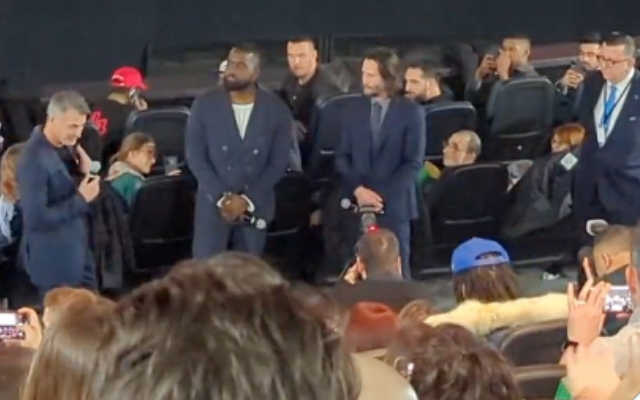
I introed the Canadian premier of “John Wick: Chapter 4” with stars Keanu Reeves and Shamier Anderson and director Chad Stahelski. Instead of the planned Q&A, they did a tribute to Lance Reddick, a co-star in all four Wick movies, who passed away earlier in the day.