The weird and wonderful Addams Family, Gomez (Oscar Isaac), Morticia (Charlize Theron), Wednesday (Chloë Grace Moretz), Pugsley (Javon ‘Wanna’ Walton) and their chrome domed Uncle Fester (Nick Kroll), are just like any other family. Sure, they live in a house of horrors and are “mysterious and spooky and all together ooky,” but underneath it all, they are a regular, loving family.
The latest instalment in their lengthy documentation of family life, the animated “The Addams Family 2,” now playing in theatres and premium VOD, sees Gomez and Morticia, like so many parents, concerned that their kids are growing up too fast.
The action begins at Wednesday’s high school science fair. When she only earns a participation award for her project—transferring octopus intelligence into her Uncle Fester—she becomes more withdrawn than usual. To bring the family back together, Gomez and Morticia plan a family road trip to—where else?—Death Valley.
Along the way complications arise, including Cyrus Strange (Wallace Shawn, son of editor William Shawn who ran the Addams Family cartoons for decades in the pages of the New Yorker), an evil scientist who convinces Wednesday she is not really part of the Addams Family.
“The Addams Family 2” has top flight voice work from Isaac, Theron and especially Moretz, who nails the detached but spirited tone of her death-obsessed character. Her empowerment—”I’m not a freak,” she says, “I’m a force of nature.”—will also likely strike a chord with anyone who has felt like an outsider.
What the film doesn’t nail, however, is that Addams Family X-factor, the sense of gleeful dread. This is mainstream family animation, padded with songs and dance numbers, that smooths out the offbeat, macabre heart and soul of the source material. It’s goofy, not ooky, with none of the eccentric charm of the 1960s TV show.
Directors Greg Tiernan and Conrad Vernon bring a light touch to the story, where none was needed.
“The Many Saints of Newark,” the sprawling big-screen prequel to the iconic television series “The Sopranos,” feels more like a pilot for a new show than the origin story of one of television’s most famous families.
Broken into three parts, “The Many Saints of Newark,” uses narration, courtesy of Tony Soprano’s late associate Christopher Moltisanti (Michael Imperioli), to break down the movie’s interconnected story shards.
Firstly, there is Dickie Moltisanti (Alessandro Nivola), Soprano Family soldier, father of Christopher, cousin to Carmela Soprano, uncle to Tony. He’s hooked up, wily and impulsive but also treacherous. When his father, the slick sociopath ‘Hollywood Dick’ (Ray Liotta), returns from Italy with a new bride (Michela De Rossi), it triggers chaos in the Moltisanti family.
In Dickie’s orbit is Harold McBrayer (Leslie Odom Jr.), an African-American numbers runner for the Mob, galvanized by the 1967 Newark race riots to go out on his own and, finally, Tony Soprano, played by William Ludwig as a youngster, Michael Gandolfini, the late James Gandolfini’s son, as a teenager. As Dickie’s thirst for power spins out of control, he becomes a surrogate father to Tony, hoping to pass along something good to the impressionable younger man as a way to atone for his sins.
“The Many Saints of Newark” is vivid in its portrayal of the period. Covering roughly four years, from 1967 to 1971, it uses the turmoil of that time in American life as a backdrop for the explosive nature of Dickie’s world. That atmosphere of uncertainty makes up for a story that, despite some glorious moments, often feels rushed as it careens toward an ending that doesn’t mine the rich psychological landscape of these characters, which is what we expect from David Chase and “The Sopranos.”
The actors are game.
Nivola brings equal parts charisma, danger and depth to a flawed character who is the ringmaster to the action. Unlike many of the other characters, like the conniving Junior Soprano (Corey Stoll), henchman Paulie Walnuts (Blly Magnussen) or consigliere Silvio Dante (John Magaro), who come with eighty-six episodes of baggage, Dickie is new and can be viewed through fresh eyes.
Michael Gandolfini takes on the Herculean task of revisiting a character his father made one of the most famous in television history and brings it home by showcasing the character’s volatility and, more importantly, his vulnerability. He’s a troubled kid, on the edge of turning one way or the other, and even though we know how the story goes, Gandolfini’s performance suggests there is more to know about Tony Soprano.
If there is a complaint, it’s that both Tony and McBrayer, two of the main cogs that keep this engine running, get lost in “The Many Saints of Newark’s” elaborate plotting. Ditto for the female characters. Despite tremendous work from Vera Farmiga as Tony’s poisonous mother Livia and De Rossi as Dickie’s step-mom, the women often feel peripheral to the tale, in service only to the men’s stories.
“The Many Saints of Newark” brings with it high expectations but falls short of coming close to the greatness of its source material. “The Sopranos” broke new ground, changing the way gangster stories (and all sorts of other stories) were told on television. “The Many Saints of Newark” settles for less as an exercise in nostalgia.
There is no mention of COVID-19 in “The Guilty,” the new Jake Gyllenhaal thriller now streaming on Netflix. But make no mistake, this is a pandemic movie, A remake of 2018 Danish film “Den skyldige,” it is essentially a one hander, shot on a just a handful of set with strict safety protocols in place. Gyllenhaal may be socially distanced from his castmates, but his performance is anything but distant.
Gyllenhaal plays Joe Baylor, an LAPD cop on 911 duty while he awaits a trial for police brutality. As wildfire ravage the city, he’s tied to a phone at the call center, where he makes his displeasure at his new assignment clear to anyone who calls in. Short tempered, he snaps at his co-workers and even berates his callers for their bad choices—“You did drugs!”—before offering assistance.
His attitude changes when he gets a call from Emily (Riley Keough, who does impressive voice work), a mother of two kidnapped by her abusive ex-husband (Peter Sarsgaard). Their conversation sets off a chain of events that causes Baylor to look inward and reassess the choices that led him to the 911 dispatch center.
Played out in real time, “The Guilty” builds tension as Baylor races against a ticking clock to bring the situation to a safe resolution for Emily. Director Antoine Fuqua amps up the sense of urgency, keeping his camera focused on Gyllenhaal’s feverish performance. The close-ups create a sense of claustrophobia, visually telegraphing Baylor’s feeling of helplessness and his crumbling mental state.
Gyllenhaal hands in a gripping performance that bristles with determination, ranging from brooding, to explosive to resigned. His expressive face fills the screen, and with the exception of some distracting eyebrow acting, carefully guides us down the rabbit hole of Baylor’s anxiety.
“The Guilty” is a no-frills thriller that allows the viewer to imagine most of the action, both in Emily’s plight and Baylor’s head. It breathes the same air as movies like the minimalist “Locke” that do a lot with a little.
Richard writes about the five most expensive cars ever sold at auction!
“For the super-rich, auctions are not about a semiconductor shortage. For years auctions have appealed to high-end car collectors who routinely pay eye-watering prices for the privilege of, as sportscarmarket.com writer Steve Ahlgrim said, ‘sitting in the seat and knowing some of the greatest drivers in history sat right where you are…’” Read the whole article HERE!
Richard joins the Toronto Mike’d Podcast to Kick out the Jams, play ten of his favourite songs and tell stories about each one. Click HERE to listen to the whole thing!
“Dear Evan Hansen,” the big screen adaptation of the Tony Award winning Broadway musical, is a mixed bag. The coming-of-age story of a misunderstanding that takes on a life of its own, has moments of pure emotion but is often sidelined by clunky presentation.
Ben Platt reprises his Tony winning role as Evan Hansen, a high school outcast with a history of Social Anxiety Disorder. His loving-but-absent nurse mom (Julianne Moore) encourages him to put himself out there and meet new people, but his nerves always get the best of him. Even his only friend Jared (Nik Dodani, who provides much needed comic relief) makes it clear that he only speaks to Evan because their mothers are friends.
Evan’s therapist has him write daily Stuart “Doggone It, People Like Me!” Smiley style affirmations, letters addressed Dear Evan Hansen, followed by paragraphs of “Today is going to be a good day,” style declarations. When one of his letters is taken by troubled classmate Connor Murphy (Colton Ryan), Evan worries it will end up on-line, bringing humiliation and ridicule. Instead, the letter takes on a life in a way Evan could never have imagined when Connor dies by suicide.
Connor’s parents, Cynthia and Larry (Amy Adams and Danny Pino) find the note and assume it is Connor’s last words to his best friend. “He wrote it to you,” Cynthia says. “These the words he wanted to share with you.” It’s not true, of course. Evan barely knew Connor, but he goes along with it to make the parents feel better. “I’ve never seen anyone so sad,” Evan says of Cynthia.
The misunderstanding—OK, let’s call it a lie—grows as Evan becomes close to the Murphys, and even begins to fake evidence of his relationship with Connor. The parents want to learn about their son through Evan, and he likes the warmth of the family and he likes their daughter Zoe (Kaitlyn Dever) even more.
At a high school memorial for Connor, Evan’s speech (actually a song) inspires people, goes viral, and, for the Murphys, gives meaning to Connor’s short life. But Evan’s on-line popularity is short-lived when people start asking questions about his friendship with the dead boy.
The flashy staging of the Broadway era “Dear Evan Hansen” is gone, replaced by a stripped down, more naturalistic treatment. That works well for Dever, Moore, Amandla Stenberg who plays student council dynamo Alana and Adams, who is the movie’s heart and soul, all of whom hand in warm, authentic performances. The effectiveness of Platt’s work is sometimes undone with work that feels as though it belongs on a stage and not the more intimate medium of film. His embodiment of teenage angst, the hunched over shoulders and doleful eyes, plays to the back of the house, breaking
There is a long history of twenty-somethings playing high schoolers in movies, sometimes it works, sometimes it doesn’t. Platt, at age twenty-seven, is just outside the window to effectively play his signature teenage character under the camera’s scrutiny. Occasionally his moony-eyed reveries, directed at Zoe, come across as creepy, not sweetly romantic.
Still, there are moments of undeniable power in “Dear Evan Hansen.” The transitions from dialogue to song aren’t always smooth, but the songs pack a punch. “Only Us,” Dever’s duet with Platt, understatedly plucks at the heartstrings and Stenberg’s “The Anonymous Ones,” a new song for the film, transcends the melodrama of the story with a beautiful recounting of the film’s themes of grief and loneliness. As it was on stage “You Will Be Found,” with the repeated line, “You are not alone,” is a show stopper.
It is a shame then, that a movie with potent moments ultimately feels like the titular character is guilty of exploiting Connor and his family. The movie acknowledges this, but it still doesn’t generate the kind of empathy for Evan necessary to make the film work on a deeper level.
There is a scene in “The Starling,” Melissa McCarthy’s maudlin new study of grief and ornithology, where a psychiatrist-turned-vet (that’s the kind of movie this is) tells Lilly (McCarthy), whose husband has spent almost a year in a psychiatric care home, that starlings “are different from other birds. They build a nest together. They’re just not meant to exist in the world alone, on their own.”
“That’s real subtle stuff,” she replies sarcastically but in truth, his remark is subtle compared to the rest of this well-meaning but ham-fisted movie.
Small town supermarket employee Lilly and her school teacher husband Jack (Chris O’Dowd) lives were changed when their baby daughter Kate passed away unexpectedly. Grief strikes each differently. Lilly looks forward, while Jack breaks down and checks into a mental health facility. Left alone, Lilly turns to tending her garden where a rogue starling attacks her every time she ventures outside.
Seeking guidance, she talks to Dr. Larry Fine (Kevin Kline) the psychiatrist-turned-vet reluctantly who councils her on grief and bird problems. As her relationship with the starling changes, so does Jack’s situation with his psychiatrist Dr. Manmohan (Ravi Kapoor) and the couple take steps toward reconciliation.
“The Starling” isn’t the first movie in recent memory to use a bird as a metaphor. “Penguin Bloom” covered similar territory last year and movies like “The Thin Red Line,” “Ladyhawke” and “Black Narcissus” have used birds as an emblem of freedom. It’s too bad that the CGI bird in “The Starling” doesn’t inspire the same kind of sense of wonder as it does in those other movies. As it is, the bird’s flitting and flirting only adds to the muddled feel of the story.
A strange mix of heartfelt drama and slapstick comedy, “The Starling” relies on very likable actors to try and bring a sense of balance to the material but not even McCarthy, Kline and O’Dowd can bend this mishmash of tones into a cohesive whole.
“Joe Bell,” a new based-on-true events drama starring Mark Wahlberg and now on VOD, is a film with a message and a disarming way of delivering it.
Wahlberg is the good man of the title, Joe Bell, husband to Lola (Connie Britton), father to sons Joseph (Maxwell Jenkins) and Jadin (Reid Miller), a young gay man who took his own life after repeated bullying from the jocks at his high school. Unable to resolve his feelings, Joe hits the road, vowing to walk from La Grande, Oregon to New York City, the city of Jadin’s dreams. It’s a time of solitude for Joe to wrestle with his own complicity in his son’s death and make stops along the way to mumble his way through halting speeches about bullying at local high schools.
Written by the “Brokeback Mountain” screenwriting team of Diana Ossana and Larry McMurtry, “Joe Bell” has its heart in the right place but makes missteps along Joe’s journey.
Told with flashbacks interspersed throughout the present-day action, (the story takes place in 2013), “Joe Bell” looks for new ways to tell the true story. Using Joe’s anguish as a starting point, it conjures up images from his imagination to fill the screen while he is on his solitary journey. (MILD SPOILER ALERT) Jadin appears as a device for Joe to ease his guilty mind. It’s a way of establishing what could have been, had Jadin not ended his life and mostly it works as Reid gives his character a youthful exuberance that makes his absence in real life more acute.
Minus those scenes “Joe Bell” is a slight film. The message, that kids are marginalized and bullied every day, everywhere, is potent and important but the film’s earnest repetitiveness threatens to reduce the point to a series of platitudes.
Good supporting performances from Miller, Britton and Gary Sinise as a sympathetic police officer, share the screen with Wahlberg who is, essentially, a one note character with a scraggly beard. His inability to truly articulate his feelings hinders the character’s effectiveness. A message movie should have a central character able to bring the moral to life. Wahlberg’s take on Bell is not that character.
“Joe Bell” is a movie about soul searching, with a good message, that never finds its way.
Reminders of real life were all around us at this year’s Toronto International Film Festival. From the digital screenings we watched at home to half empty, socially distanced screenings at venues like The Princess of Wales Theatre. But when my mind wanders back to September 2021, I won’t be thinking of having to show my proof of vaccination or the social distancing in theatres.
What will linger?
The images of Anya Taylor-Joy in “Last Night in Soho,” crooning an a cappella version of the Swingin’ Sixties anthem “Downtown,” and “Dune’s” Stellan Skarsgård doing his best impression of Marlon Brando in “Apocalypse Now,” come to mind immediately.
Those moments and others like them are the reason the movies exist. They transcend the vagaries of real life, transporting us away from a place where masks, vaccine passports are the reality.
And boy, did we need that this year.
Here a look back at some of the moments that made memories at this year’s TIFF:
“Night Raiders,” a drama from Cree-Métis filmmaker Danis Goulet, draws on the historical horrors of the Sixties Scoop and Residential Schools to create an unforgettable, dystopian scenario set in the new future. It effectively paints a somber portrait of totalitarian future, packed with foreboding and danger. The story is fictional but resonates with echoes of the ugly truths of colonization and forced assimilation. Goulet allows the viewer to make the comparisons between the real-life atrocities and the fictional elements of the story. There are no pages of exposition, just evocative images. Show me don’t tell me. The basis in truth of the underlying themes brings the story a weight often missing in the dystopian genre.
I asked Danis Goulet about having many of her characters in Night Raiders speak Cree: “It is everything to me,” she said. “My dad is a Cree language speaker. He grew up speaking Cree. He learned to speak English in school. His parents were Cree speakers. And coming down to my generation, I’m no longer a Cree speaker and there are entire universes, philosophies and poetry and beauty contained in the language. When we think of where our heritage lies, maybe some people think of museums. For me I think it is in the language. I think that richness doesn’t just offer Indigenous people something. I think if others looked closer at what the language tells us about the history of this land, they would be incredibly amazed. My dad has looked at references in the language that talk about the movement of the glaciers, so, foe me to have the Cree language on screen is everything. I’m in my own process. I go to Cree language camp to try and learn back the language and the language gives back in a way that is so healing and incredible. It is one of the greatest gifts in my life. So, the opportunity to put my dad’s first language on the screen, and the language of the Northern Communities where I come from, and my language that I lost, is the best. It’s incredible.”
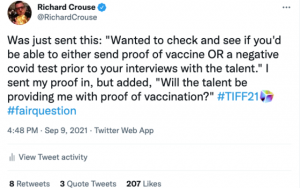
From Twitter: @RichardCrouse Was just sent this: “Wanted to check and see if you’d be able to either send proof of vaccine OR a negative covid test prior to your interviews with the talent.” I sent my proof in, but added, “Will the talent be providing me with proof of vaccination?” #TIFF21 #fairquestion 4:48 PM · Sep 9, 2021· 8 Retweets 3 Quote Tweets 206 Likes
There is no mention of COVID-19 in the Jake Gyllenhaal thriller “The Guilty.” But make no mistake, this is a pandemic movie, A remake of 2018 Danish film “Den skyldige,” it is essentially a one hander, shot on a just a handful of set with strict safety protocols in place. Gyllenhaal, as 911 operator Joe Baylor, may be socially distanced from his castmates, but his performance is anything but distant. Played out in real time, “The Guilty” builds tension as Baylor races against a ticking clock to bring the situation to a safe resolution for Emily. Director Antoine Fuqua amps up the sense of urgency, keeping his camera focused on Gyllenhaal’s feverish performance. The close-ups create a sense of claustrophobia, visually telegraphing Baylor’s feeling of helplessness and his crumbling mental state.
The sound of an audience laughing, applauding, crying, or whatever. Just being an audience. The big venues were socially distanced, and often looked empty to the eye, but when the lights went down and folks reacted to the opening speeches or the films, it didn’t matter. Roy Thomson Hall, with its 2600-person capacity, may have only had 1000 or so people in the seats, but for ninety minutes or two hours they formed a community, kindred souls brought together after a long break, and it was uplifting to hear their reactions.
“Flee” is a rarity, an animated documentary. A mix of personal and modern world history, it is a heartfelt look at the true, hidden story of the harrowing life journey of a gay refugee from Afghanistan. Except for a few minutes here and there of archival news footage, “Flee” uses animation to tell the story but this ain’t the “Looney Tunes.” Rasmussen used the animation to protect Amin’s identity, but like other serious-minded animated films like “Persepolis” and “Waltz with Bashir,” the impressionistic presentation enhances the telling of the tale. The styles of Rasmussen’s animation change to reflect and effectively bring the various stages of Amin’s journey to vivid life. It is suspenseful, heartbreaking and often poetic.
I asked “The Survivor” star Vicky Krieps about working opposite Ben Foster: “The first day I came [on set] I was very intimidated,” she said. “I wouldn’t say scared, but it felt like a wall to me. It began like this. There was no small talk. There was no, ‘How are you?’ He was already in character and it was very clear. I thought, ‘OK, I have to play his wife.’ And then, something really interesting happened. I like having a challenge and this felt like a challenge. So, I needed to find a way [to relate to him] because I knew I was going to be his wife. How do I do that? Imagine it as a wall, but then in the wall there are eyes. I used those eyes and I felt like I could open a window, and inside of those eyes was a horizon where I could go. I liked to say to Ben, ‘And then we would dance.’ Sometimes I wrote to him and said, ‘It was nice dancing today.’”
“Last Night in Soho,” from director Edgar Wright, is a love letter to London’s Swingin’ Sixties by way of Italian Giallo. Surreal and vibrant, and more than a little bit silly, its enjoyable for those with a taste for both Petula Clarke and murder. It begins with verve, painting a picture of a time and place that is irresistible. A mosaic of music, fashion and evocative set decoration, the first hour brings inventive world building and stunning imagery. Wright pulls out all the stops, making visual connections between his film and the movies of the era he’s portraying and even including sixties British icons Rigg, Tushingham and Stamp in the cast.
I asked “Dune” star Rebecca Ferguson why she said reading Frank Herbert’s novel was like doing a crossword puzzle: “Sometimes I wonder what comes out of my mouth,” she said. “My mother and many of my friends sit and do crosswords, but I have never been in that world. There is a way of thinking around it. It’s logical, mathematical. You need to be able to see rhythms. Whatever it is. Reading “Dune” was quite dense and I think for people who are immersed into the world of science fiction, they understand worlds and Catharism and this planet and that planet. It is just another picture, which, not to stupefy myself, I am intelligent enough to understand it, but there is a rhythm. I think it is me highlighting the fact that people who live and breathe science fiction, they get it at another level.”
“Dune,” the latest cinematic take on the Frank Herbert 1965 classic, now playing in theatres, is part one of the planned two-part series. “Dune” is big and beautiful, with plentiful action and a really charismatic performance from Jason Momoa as swordmaster Duncan Idaho. It is unquestionably well made, with thought provoking themes of exploitation of Indigenous peoples, environmentalism and colonialism.