On the Saturday April 12, 2025 edition of The Richard Crouse Show we’ll meet artist and musician Sean Ono Lennon. A new documentary called “One to One: John & Yoko,” is a look at New York City in the early 1970s through the actions of two of its most famous residents, John Lennon and Yoko Ono. Newly restored footage, with remastered audio overseen by Sean Ono Lennon, of John Lennon’s only full-length, post-Beatles concert is intercut with talk show appearance, home movies and news accounts to create a sense of time and place. In this conversation we talk about the film and how, for Sean, working on it is “almost like getting more time with my dad.”
Then, we’ll meet the creative team behind an intense new film called “Warfare.” Based on ex-Navy Seal Ray Mendoza’s real-life experiences during the Iraq War, “Warfare” is a harrowing portrait of modern warfare that sees a platoon of American Navy SEALs in battle with enemy combatants. On this show we meet co-directors Alex Garland and Rayn Mendoza and star D’Pharaoh Woon-A-Tai.
Each week on the nationally syndicated Richard Crouse Show, Canada’s most recognized movie critic brings together some of the most interesting and opinionated people from the movies, television and music to put a fresh spin on news from the world of lifestyle and pop-culture. Tune into this show to hear in-depth interviews with actors and directors, to find out what’s going on behind the scenes of your favourite shows and movies and get a new take on current trends. Recent guests include Chris Pratt, Elvis Costello, Baz Luhrmann, Martin Freeman, David Cronenberg, Mayim Bialik, The Kids in the Hall and many more!
All iHeartRadio Canada stations are available across Canada via live stream on iHeartRadio.caand the iHeartRadio Canada app. iHeartRadio Canada stations are also connected through Alexa, Siri, and Google Home smart speakers.
SYNOPSIS: Based on ex-Navy Seal Ray Mendoza’s real-life experiences during the Iraq War, “Warfare, now playing in theatres, is a harrowing portrait of modern warfare that sees a platoon of American Navy SEALs in battle with enemy combatants.
CAST: D’Pharaoh Woon-A-Tai, Will Poulter, Cosmo Jarvis, Kit Connor, Finn Bennett, Taylor John Smith, Michael Gandolfini. Directed by Ray Mendoza and Alex Garland.
REVIEW: “Warfare” is not a movie you “enjoy.” It’s one you experience.
Created from the memories of the actual combatants, “Warfare” is a gut-wrenching recreation of the Navy SEALs who oversaw the movement of U.S. forces through insurgent territory in Iraq in 2006.
It’s a visceral slice-of-life-and-death that strips away all the pretence of war movies by highlighting the sacrifices made by the Seals. The up-close-and-personal combat sequences provide an interesting take on warfare. The battle scenes are visceral, “you-are-there” in nature, with visuals of dismembered limbs and carnage that would make Hieronymus Bosch turn his face away, but it is the portrait of the personal toll paid by the soldiers that resonates.
The first half hour is all about quiet, nervous expectation as the soldiers prepare for the onslaught to come. Once shots are exchanged, it becomes a visceral, boots-on-the-ground story of modern warfare, told in real time.
A bomb blast leaves soldiers on fire, mutilated and screaming in agony. These scenes, which make up the majority of the film’s running time, are gorier than most horror films and left me jarred, unable to shake the intensity of the experience.
Am I glad I saw “Warfare”? Yes. Would I want to sit through it again? Hell no. It’s an antiwar film that very effectively makes its point by immersing the viewer in a world of violence. Not an easy watch, but it isn’t meant to be.
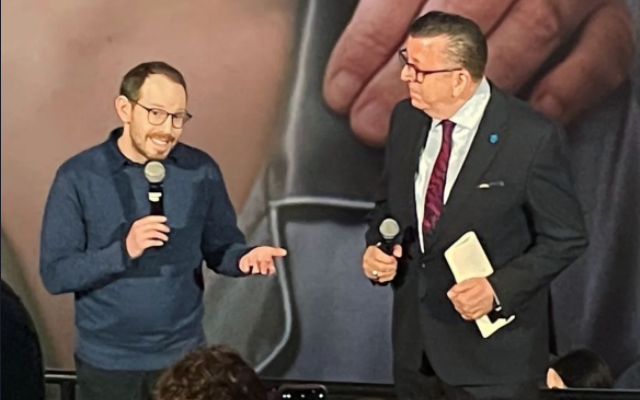
I hosted a live Q&A with director Ari Aster in front of a sold-out crowd at the Scotiabank Theatre in Toronto on Wednesday night. For a taste, check out my radio show on the iHeartRadio Network Saturday night at 8 pm t0 9 pm for a recorded interview with the director.
Magnificent and confounding in equal measure, “Beau is Afraid,” a new, three-hour epic from “Midsommar” director Ari Aster and now playing in theatres, is a nightmarish trek through a mishmash of mommy issues, anxiety and tragedy. Imagine a paranoid “Lord of the Rings” style quest reimagined by Luis Buñuel with a darkly comedic “After Hours” vibe and a hint of Thomas “You Can’t Go Home Again” Wolfe and you’ll be on the road to understanding Beau’s surreal journey.
Joaquin Phoenix plays the title character, a neurotic, over-medicated man whose father died at the moment of his son’s conception. The loss forever colored his life, leaving him lost in a sea of paranoia and uncertainty. “I am so sorry for what your daddy passed down to you,” says his overbearing mother Mona (Patti LaPone).
Beau’s already chaotic life is forever changed by a missed plane, a new prescription and a home invasion. Set off on an odyssey to return home for his mother’s funeral, circumstance continually keep him off track. First, he finds himself the reluctant patient of affable suburban caregivers Roger and Grace (Nathan Lane and Amy Ryan), their troubled daughter (Kylie Rogers) and a war vet with PTSD.
Then, a narrow escape finds him in the embrace of a travelling experimental theater troupe whose storytelling transports him into an animated folk tale of searching, struggle and solace.
Finally, bloodied and bruised, he arrives home to confront his past, face his fears and come to grips with the trauma that hangs over his life like a shroud.
“Beau is Afraid” is a complicated movie, laden with allegory and symbolism, that confronts the aftereffects of loss and grief. It’s familiar terrain for Aster, whose previous films, “Hereditary” and “Midsommar,” were also studies in intergenerational trauma.
But the new movie is anything but familiar.
It is a psychological dramedy that dives deep into how Beau’s trauma has molded every aspect of his life and lead to a breakdown, one we witness from his point-of-view, in real time. It’s a harrowing trip as Beau slowly loses his grip on reality, and his paranoia shapes the movie’s narrative.
Aster is uncompromising in his portrayal of Beau’s state of mind. His previous movies were more visually shocking, featuring images more aligned to traditional horror. “Beau is Afraid” has less overt horror. It’s more concerned with the psychological, the confusion, fear and anxiety that drives Beau. To convey this, Phoenix, in an internal performance, plays the character as a shell. The movie revolves around him and his state of mind, but he is a reactive character, one who responds to, rather than instigates, the action. It’s interesting, deeply felt work but the closed down, Chauncey Gardiner nature of the character makes him difficult to embrace.
Given the unsettled nature of the real world, audiences may understand, relate or sympathize with Beau’s all-encompassing fear, but the absurdism woven into Phoenix’s childlike performance, particularly in the film’s second half, wears thin.
“Beau is Afraid” is the weirdest film on Aster’s already proudly weird IMDB page. It may be the definition of a film that is not for everyone, but it cannot be faulted for its uncompromising vision. As a search for meaning in life, for closure from trauma, for freedom from fear, from relief from distended testicles (Yup! You read that right), it was never going to be a feel-good flick. So, instead, it swings for the fences, burrowing in on its grandiose emotional ideas even if it often feels like a three-hour panic attack.
Unpredictable, unexpected and ultimately, unexplainable, it’s challenging cinema that connects on a subconscious level.
“The Many Saints of Newark,” the sprawling big-screen prequel to the iconic television series “The Sopranos,” feels more like a pilot for a new show than the origin story of one of television’s most famous families.
Broken into three parts, “The Many Saints of Newark,” uses narration, courtesy of Tony Soprano’s late associate Christopher Moltisanti (Michael Imperioli), to break down the movie’s interconnected story shards.
Firstly, there is Dickie Moltisanti (Alessandro Nivola), Soprano Family soldier, father of Christopher, cousin to Carmela Soprano, uncle to Tony. He’s hooked up, wily and impulsive but also treacherous. When his father, the slick sociopath ‘Hollywood Dick’ (Ray Liotta), returns from Italy with a new bride (Michela De Rossi), it triggers chaos in the Moltisanti family.
In Dickie’s orbit is Harold McBrayer (Leslie Odom Jr.), an African-American numbers runner for the Mob, galvanized by the 1967 Newark race riots to go out on his own and, finally, Tony Soprano, played by William Ludwig as a youngster, Michael Gandolfini, the late James Gandolfini’s son, as a teenager. As Dickie’s thirst for power spins out of control, he becomes a surrogate father to Tony, hoping to pass along something good to the impressionable younger man as a way to atone for his sins.
“The Many Saints of Newark” is vivid in its portrayal of the period. Covering roughly four years, from 1967 to 1971, it uses the turmoil of that time in American life as a backdrop for the explosive nature of Dickie’s world. That atmosphere of uncertainty makes up for a story that, despite some glorious moments, often feels rushed as it careens toward an ending that doesn’t mine the rich psychological landscape of these characters, which is what we expect from David Chase and “The Sopranos.”
The actors are game.
Nivola brings equal parts charisma, danger and depth to a flawed character who is the ringmaster to the action. Unlike many of the other characters, like the conniving Junior Soprano (Corey Stoll), henchman Paulie Walnuts (Blly Magnussen) or consigliere Silvio Dante (John Magaro), who come with eighty-six episodes of baggage, Dickie is new and can be viewed through fresh eyes.
Michael Gandolfini takes on the Herculean task of revisiting a character his father made one of the most famous in television history and brings it home by showcasing the character’s volatility and, more importantly, his vulnerability. He’s a troubled kid, on the edge of turning one way or the other, and even though we know how the story goes, Gandolfini’s performance suggests there is more to know about Tony Soprano.
If there is a complaint, it’s that both Tony and McBrayer, two of the main cogs that keep this engine running, get lost in “The Many Saints of Newark’s” elaborate plotting. Ditto for the female characters. Despite tremendous work from Vera Farmiga as Tony’s poisonous mother Livia and De Rossi as Dickie’s step-mom, the women often feel peripheral to the tale, in service only to the men’s stories.
“The Many Saints of Newark” brings with it high expectations but falls short of coming close to the greatness of its source material. “The Sopranos” broke new ground, changing the way gangster stories (and all sorts of other stories) were told on television. “The Many Saints of Newark” settles for less as an exercise in nostalgia.