SYNOPSIS: The third film in the “28 Days Later” post-apocalyptic horror franchise, “28 Years Later” takes place, as the title suggests, thirty years after the Rage virus devastated the UK. A small group of survivors lives in isolation on a fortified island accessible only by a causeway connected to the mainland. When one of the islanders and his son goes to the mainland, they discover the grim reality of the outside world. “There are strange people on the mainland,” says Jamie (Aaron Taylor-Johnson). “That’s why our home is so precious.”
CAST: Jodie Comer, Aaron Taylor-Johnson, Ralph Fiennes, Jack O’Connell, Erin Kellyman, Edvin Ryding. Directed by Danny Boyle, written by Alex Garland.
REVIEW: A grisly coming-of-age story, “28 Years Later” has elements of graphic horror, but director Danny Boyle and screenwriter Alex Garland focus on the emotional travails of its twelve-year-old protagonist Spike (Alfie Williams) to provide the film’s bleak tone. A mix and match of pulse racing action scenes and earnest introspection, it’s as much about the horror of growing up and learning about the harder edges of life as it is about the terror of the infected zombies.
Divided into two expeditions as Spike ventures into the mainland on a rite of passage with his father Jamie (Aaron Taylor-Johnson) to learn how to kill the infected—“The more you kill,” Jamie tells Spike, “the easier it gets.”—and later, as he goes back on a journey of discovery with his mother Isla (Jody Comer), the storytelling is episodic but bonded by the study of death in all its forms.
In a kill or be killed world, death is around every corner, and young Spike learns to process the existential idea of death as necessary to his own survival. His lessons deepen when death becomes personal and he learns to find meaning in loss, something that transcends the primal urge to survive.
Through death and loss, he learns about life and resilience. It’s this exploration of personal growth that separates “28 Years Later” from the previous films in the franchise which leaned into survival and systemic failures over emotional evolution.
“28 Years Later” features some unforgettable imagery. Partially shot on iPhone 15 Pro Max cameras, Boyle and cinematographer Anthony Dod Mantle adopt a guerilla style that adds a frenetic intensity to the action sequences.
An abandoned Shell petrol station with a sign missing the “S,” is a playful reminder of the terrible situation that transpired as the Rage virus turned the area into a living hell.
Later, a long sequence in Dr. Ian Kelson’s (a terrific Ralph Fiennes) “Memento Mori,” a wooded area decked out with bones as a loving tribute to the dead, infected or otherwise, is visually stunning as an eerie reminder of mortality.
Despite some choppy storytelling, and a sequel ready ending, “28 Years Later” is a welcome addition to the franchise. More reflective, it is both intellectually and emotionally intense.
On the Saturday April 12, 2025 edition of The Richard Crouse Show we’ll meet artist and musician Sean Ono Lennon. A new documentary called “One to One: John & Yoko,” is a look at New York City in the early 1970s through the actions of two of its most famous residents, John Lennon and Yoko Ono. Newly restored footage, with remastered audio overseen by Sean Ono Lennon, of John Lennon’s only full-length, post-Beatles concert is intercut with talk show appearance, home movies and news accounts to create a sense of time and place. In this conversation we talk about the film and how, for Sean, working on it is “almost like getting more time with my dad.”
Then, we’ll meet the creative team behind an intense new film called “Warfare.” Based on ex-Navy Seal Ray Mendoza’s real-life experiences during the Iraq War, “Warfare” is a harrowing portrait of modern warfare that sees a platoon of American Navy SEALs in battle with enemy combatants. On this show we meet co-directors Alex Garland and Rayn Mendoza and star D’Pharaoh Woon-A-Tai.
Each week on the nationally syndicated Richard Crouse Show, Canada’s most recognized movie critic brings together some of the most interesting and opinionated people from the movies, television and music to put a fresh spin on news from the world of lifestyle and pop-culture. Tune into this show to hear in-depth interviews with actors and directors, to find out what’s going on behind the scenes of your favourite shows and movies and get a new take on current trends. Recent guests include Chris Pratt, Elvis Costello, Baz Luhrmann, Martin Freeman, David Cronenberg, Mayim Bialik, The Kids in the Hall and many more!
All iHeartRadio Canada stations are available across Canada via live stream on iHeartRadio.caand the iHeartRadio Canada app. iHeartRadio Canada stations are also connected through Alexa, Siri, and Google Home smart speakers.
SYNOPSIS: Based on ex-Navy Seal Ray Mendoza’s real-life experiences during the Iraq War, “Warfare, now playing in theatres, is a harrowing portrait of modern warfare that sees a platoon of American Navy SEALs in battle with enemy combatants.
CAST: D’Pharaoh Woon-A-Tai, Will Poulter, Cosmo Jarvis, Kit Connor, Finn Bennett, Taylor John Smith, Michael Gandolfini. Directed by Ray Mendoza and Alex Garland.
REVIEW: “Warfare” is not a movie you “enjoy.” It’s one you experience.
Created from the memories of the actual combatants, “Warfare” is a gut-wrenching recreation of the Navy SEALs who oversaw the movement of U.S. forces through insurgent territory in Iraq in 2006.
It’s a visceral slice-of-life-and-death that strips away all the pretence of war movies by highlighting the sacrifices made by the Seals. The up-close-and-personal combat sequences provide an interesting take on warfare. The battle scenes are visceral, “you-are-there” in nature, with visuals of dismembered limbs and carnage that would make Hieronymus Bosch turn his face away, but it is the portrait of the personal toll paid by the soldiers that resonates.
The first half hour is all about quiet, nervous expectation as the soldiers prepare for the onslaught to come. Once shots are exchanged, it becomes a visceral, boots-on-the-ground story of modern warfare, told in real time.
A bomb blast leaves soldiers on fire, mutilated and screaming in agony. These scenes, which make up the majority of the film’s running time, are gorier than most horror films and left me jarred, unable to shake the intensity of the experience.
Am I glad I saw “Warfare”? Yes. Would I want to sit through it again? Hell no. It’s an antiwar film that very effectively makes its point by immersing the viewer in a world of violence. Not an easy watch, but it isn’t meant to be.
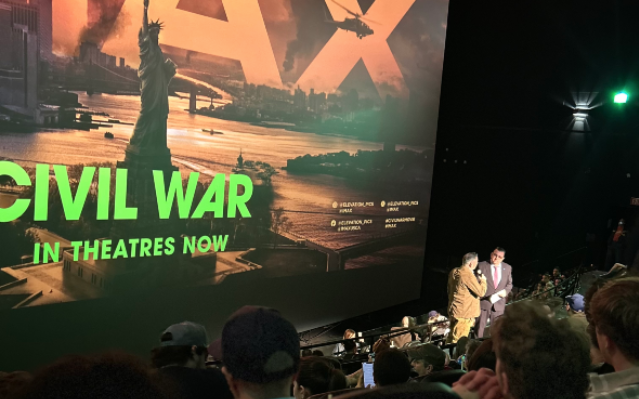
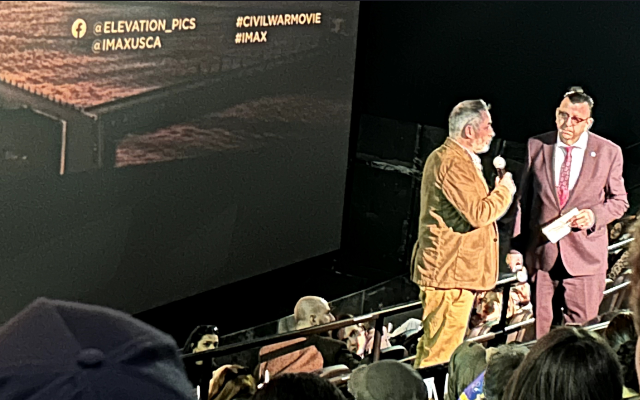
I hosted a special IMAX screening of “Civil War,” a new antiwar film. set in a dystopian future America, in which a team of military-embedded journalists race against time to reach Washington, D.C., before rebel factions descend upon the White House. AP calls it the “year’s most explosive movie,” while the Toronto Star calls it “the year’s most divisive movie.”
Director Alex garland joined me after the screening for a twenty minute Q&A where we discussed why he set the film in the United States, made the bold statement of blowing up the Lincoln Memorial and much more.
“Civil War,” a new, near-future vision of dystopia from director Alex Garland, now playing in theatres, is an emotional and intellectual experience that plays like a stark prediction of what could happen if division and hate are allowed to run unchecked.
At the film’s beginning the President of the United States (Nick Offerman) predicts victory for the American government over the separatist “Western Forces” led by Texas and California. In reality, the Second American Civil War is waning as the rebellious W.F. cut a path to Washington, while the “Florida Alliance” leaves a bloody mark on other parts of the country.
How bad is it? In the movie’s sole light moment, to Canadian audiences at least, it’s revealed that the Canadian dollar is more valuable, and more in demand than USD. That’s how bad the situation is.
In the midst of this, journalists capture the story on film and in words. Kirsten Dunst is Lee, a seasoned photojournalist, who with writer Joel (Wagner Moura) has an eye on getting the biggest scoop of the conflict, an interview with the President.
“Interviewing him is the only story left,” she says.
As Lee and Joel, along with veteran New York Times journalist Sammy (Stephen McKinley Henderson) and ambitious combat photographer Jesse (Cailee Spaeny), set off on the 857-mile journey from New York to D.C., the full impact of the war’s destruction, on property and people, becomes clear.
“Every time I survived a war zone, I thought I was sending a warning home, ‘Don’t do this,’” Lee says, “but here we are.”
There are no monsters or supernatural aspects in “Civil War,” but make no mistake, this is a horror film. The horrors of war are detailed in a visceral and chaotic way—the rat-a-tat-tat of gun battles is deafening, while the cinema verité style shots of carnage and bodies left abandoned to rot in the sun stick in the imagination—but it is the idea of a societal collapse that haunts. “No one is giving orders,” says a soldier. “Someone is trying to kill us, and we’re trying to kill them.”
Garland uses thrilling, in-your-face imagery that brings to mind everything from classic war films to the handheld coverage of the Capitol attack of January 6, 2021 to paint a portrait of a country in combat with itself.
The director, who also wrote the script, is decidedly non-partisan in his approach to the story, emphasizing the cruelty of the movement, and the actions of the extremist militias, not the politics. In this version of civil war, the population are divided by ideology. Friends turn on friends, state on state, and wearing an orange “Press” Kevlar vest won’t keep the journalists safe. “They shoot journalists on sight at the capitol,” says Sammy. The ravages of this war, set against ordinary backdrops, like an abandoned Christmas theme park, or a deserted highway, are unsettling in a profound, unnerving way.
The jarring visuals—an opening protest scene is a jaw-dropper—enhanced by a pulsating, anxiety inducing electronic soundtrack are almost overwhelming, but underscore the importance of the journalists who risk their lives to record history in real time. The occasionally shocking situations and images—the final shot is a doozy, provocative and bound to be controversial—are powerful reminders of the risks undertaken by reporters on the search for the truth.
That risk factor, at a time when journalism is under fire, is highlighted in “Civil War,” but takes a backseat to Garland’s bravura, pulse-racing filmmaking.
You can’t spell “menacing” without the word “men.”
The new Jessie Buckley psychological thriller, now playing in theatres, takes a look at toxic relationships and gender politics through the lens of British folk horror and surreal body terror.
Buckley is Harper, a young widow smarting from the death of her husband James (Pappa Essiedu) by suicide. To heal her soul, she rents a 500-year-old house in the English countryside. Miles from anywhere—“The pub is ten minutes down the road,” says her socially awkward landlord Geoffrey (Rory Kinnear), “thirty minutes on the way back.”—the tranquil surroundings should be a balm, but she is haunted by visions of the last moments she spent with her controlling, abusive husband.
On the verge of a divorce he didn’t want, they argued. “I’ll kill myself,” he says, “and you’ll have to live with my death. That’s not a threat, it’s a warning.”
Minutes later, he plunges to his death, changing Harper’s life forever.
At the rental house Harper has a close call with a scarred, bloodied and naked man she thinks is stalking her. The local police assure her she is not in danger, and yet unsettling things continue to happen, including a run in with a rude boy in a Marilyn Monroe mask, microaggressions, stand-offish men in town and the world’s most unhelpful vicar, whose advice is not exactly welcome.
The trip to the country culminates in a hallucinogenic sequence that combines body horror (the kind that might make David Cronenberg envious), British folk horror, pagan imagery and even some stunt driving.
“Men” feels like two movies. The first half is a domestic drama, a divorce turned ugly, played out in flashbacks. The idyll of the country retreat, featuring long dialogue-free sequences, is briefly interrupted by memories and some rather creepy men. It is uncomfortable but earthbound.
The second part, which makes up the film’s last third, is a grotesque, surreal psychological thriller with images best seen after you’ve finished your popcorn and Twizzlers. Director and writer Alex Garland gruesomely and memorably (perhaps a little too memorably) illustrates a never-ending cycle of male rebirth into crisis and toxicity. It’s never clear where the metaphor starts or ends and the head trip begins, but the message of menacing toxic masculinity is made bloody clear (literally).
Both sides of the story have interesting moments, most courtesy of Buckley, the rare effortless performer whose face contains multitudes, but despite some memorable flourishes, they don’t feel like a whole. It’s like there is a puzzle piece missing in the storytelling. As a result, “Men” is interesting, but isn’t exactly an effective genre film or study of trauma.
The new Blake Lively movie The Age of Adaline sees its star play a woman who was frozen in time at age twenty-nine, never to age another day. No laugh lines, stiffness in the bones or grey hair for her. She drifts through life, an eternal twenty-something as her pals age and eventually die.
How does she compare to friends and family? Well, in the film the youthful centenarian Lively has a daughter played by Ellen Burstyn, a veteran actress fifty-five years her co-star’s senior.
It’s a romantic fantasy that brings up an interesting question. Sure, the idea of defying age sounds intriguing, but why would you want to fall in love when there is no possibility of growing old together? That’s the dreamy question at the heart of the film; the notion that allows director Lee Toland Krieger to explore the mushier side of the story, but what about the engine that drives the tale—immortality?
With characters like Wolverine and Edward Cullen pulling in big box office bucks it’s not shocking that movies seem infatuated with eternal life. Nor should it come as a shock that actors are drawn to immortal characters. The obsession with youth is one thing, that’s a job requirement—perhaps that’s why the USA, with Los Angeles at the epicenter, is the world capitol of plastic surgery—but I think it goes beyond that.
With visions of an ageless Adaline dancing in my head I posed a simple question to Alex Garland, the director and screenwriter of this weekend’s artificial intelligence drama Ex Machina: “Why have movies about immortality been so popular with actors and filmmakers?” I got an intriguing answer.
“There is an interest floating around which is as much to do with longevity, as it is immortality,” he said, “but it contains immortality as a long-term goal.
“Broadly speaking what I would say, at least where filmmakers are concerned, is that they’re subject to the same zeitgeist things that everybody else is so what they will do is manifest it in their job.”
Perhaps that’s why in the coming months we’ll see eternal characters in everything from The Avengers: Age of Ultron and Terminator Genisys to Pan and Crimson Peak.
The rich and famous have always dreamed of extending natural life. For instance, although it’s an urban legend that Walt Disney was frozen cryogenically to be thawed later it makes a good and almost true sounding story. While doing working on Ex Machina Garland says he discovered tales of wealthy people looking to find immortality through science.
“The researchers might be quite realistic about what artificial intelligence can promise but the funders may be less realistic about it. One of the things that some of the funders are looking for, and I’ve heard this expressed very explicitly, not in a coded way but an absolutely straightforward way, is the ability to download yourself and for you to survive long as a result of your enormous wealth.
“Powerful people don’t want to die. Everyone else figures they don’t have a choice but the really powerful people figure they do have a choice and they are going to explore it just in case.”
I think Hollywood may be obsessed with immortality for one other reason. Film stock offers it’s own kind of eternity, where one never ages and on the screen Blake Lively will be the twenty-nine-year-old Adaline forever.
“Ex Machina” is a high tech thriller that by and large ignores the tech to get down to the nitty gritty. Director and screenwriter Alex Garland (who previously scripted “28 Days Later” and “Sunshine”) places the story firmly in the world of artificial intelligence and then showcases the humanity (or lack thereof) of his characters, both flesh-and-blood and robotic.
When we first meet Caleb Smith (Domhnall Gleeson) he is a young, talented programmer at Bluebox, the world’s leading search engine. He is also the winner of a company wide contest to spend a week with Bluebook’s reclusive CEO, Nathan “The Mozart of Code” Bateman (Oscar Isaac). He arrives at Bateman’s remote complex to discover he is to take part in a Turing Test (named for “The Imitation Game’s” subject Alan Turing) to evaluate the ability of an automaton named Ava (Alicia Vikander) to show intelligent behaviour equal to, or undifferentiated from, that of a human being. Over seven sessions Caleb forms a deep connection with Ava as his relationship with alpha-male Nathan crumbles. In the end the young man must undergoes the greatest test of all—figuring out who to trust, man or machine.
With the cool austerity of Stanley Kubrick director Garland creates the antiseptic world of Bateman’s lair. Clinical and precise, it’s a stark backdrop for a sci fi story that is more concerned with ideas than special effects. It’s a “Frankenstein” story that is, as Bateman says, not interested in what people are thinking, but how people think.
And it will make you think. The Turing Test premise is an excuse to hang a thriller on, one that uses Ava’s artificial intelligence to have a look at how people can be manipulated with the bat of an eye or tilt of a head. Coupled with that it raises real issues regarding internet security—how much should your internet provider really know about your habits, likes and dislikes?—and surveillance.
I have to be deliberately sketchy with the plot details so as not to spoil the climax, but it’s a story that will stimulate conversation but does not ignoring the emotional elements of the Caleb’s tale.
Isaac once again proves to be a quiet but potent on-screen force as Bateman, always the smartest guy in the room, but one lacking the interpersonal skills to truly connect with people. Gleeson (who will next be seen alongside Isaac in “Star Wars: Episode VII – The Force Awakens”) is sympathetic and determined but it is Vikander who really impresses. She’s equal parts warmth and chilly precision as a robot who wants more than to be a machine.
“Ex Machina” is being presented as sci fi, but it really is a human drama; a human drama where the main character has a fibre optic nervous system.
28 Days Later begins with a great horror movie premise. A group of British activists free infected animals from their cages, unleashing a deadly “rage” virus on the human population. Twenty-eight days after the virus took hold of the city, a bicycle courier named Jim awakens from a coma, unaware of the devastation. In one of the year’s best cinematic sequences, horror or otherwise, Jim leaves the hospital to find a deserted London. Director Danny Boyle (Trainspotting, Shallow Grave) infuses the shots of the empty streets with a sense of dread. As Jim wanders through the vacant Piccadilly Circus the feeling of foreboding grows as he realizes that something catastrophic has happened here. And that’s just the first ten minutes. (The scenes of London’s deserted streets were shot just after dawn on weekdays. Because of the traffic, they could only shoot for a couple of minutes each day. Crewmembers frequently had to stop and ask clubbers not to walk into shots.)
Boyle deftly juggles two distinct ideas in 28 Days Later. It is a full blown Halloween flick, complete with drooling angry zombies, (although hard-core gore fans will be disappointed, most of the horror here is psychological) but at its core it is also a compelling study of human nature and the will to survive. Each character is fully rounded, and none are superfluous in this tough drama.
Selena (Naomie Harris), for example, isn’t a damsel in distress, nor is she simply a hard-nosed zombie killer. She is a layered character, a normal person who is placed in an unimaginable circumstance and is dealing with it on an instinctual level. She isn’t a killer, but she’ll kill to survive. “Staying alive is as good as it gets,” she says grimly.
Boyle (and screenwriter Alex Garland) give a wide berth to the stereotypical character traits found in horror movies – the screaming girlfriend, the witless teen, the gung-ho monster slayer – and instead concentrate on developing believable characters and situations in an unbelievable scenario.
In addition to believable characters 28 Days Later also re-invents the cinematic zombie. Gone are the lumbering, “We’re coming to get you,” living dead from years past. Boyle’s ghouls move with frightening speed, hissing at the scent of human flesh, and attacking at random. These are the zombies that nightmares are made of.
Shooting on digital video this time out, Boyle has left behind the visual showiness of Trainspotting and the austere picture-postcard look of The Beach, trading those in for a grainy, almost documentary feel. The jagged feel of the video gives the movie a sense of urgency and energy which seems appropriate for the subject matter. Unlike Soderbergh’s Full Frontal this material actually benefits from the use of video.
28 Days Later runs out of steam as the third act winds down, but up until its closing minutes it is as good as speculative fiction gets.