SYNOPSIS: In the new animated movie “Smurfs,” starring the voice of Rihanna and now playing in theatres, what begins as No Name Smurf’s (James Corden) search for identity becomes a more traditional rescue mission when Papa Smurf (John Goodman) is abducted by the evil wizard Razamel (JP Karliak).
CAST: Rihanna, James Corden, Nick Offerman, JP Karliak, Daniel Levy, Amy Sedaris, Natasha Lyonne, Sandra Oh, Jimmy Kimmel, Octavia Spencer, Nick Kroll, Hannah Waddingham, Alex Winter, Maya Erskine, Kurt Russell, and John Goodman. Directed by Chris Miller.
REVIEW: A fun but ultimately underwhelming addition to the “Smurf” film series, the fourth franchise instalment “Smurfs” brings the whimsy and some good messages for kids but mostly feels like a rehash of their other films.
The action, which is pedal to the metal, begins with No Name Smurf’s (James Corden) identity crisis. Rather, his lack of identity crisis. Like the Seven Dwarfs, all the other Smurfs have names that reflect their personality. There’s Brainy Smurf (Xolo Maridueña), Vanity Smurf (Maya Erskine), Worry Smurf (Billie Lourd) and so on. When No Name suddenly develops the ability to summon magic from his fingertips, he feels he has found his purpose.
Problem is, his new powers attract the attention of evil wizard Razamel (JP Karliak) who kidnaps Papa Smurf (John Goodman) to get his evil hands on a magical book hidden in Smurf Village.
That sets off a rescue mission. Led by No Name and Smurfette (Rihanna, who produced the film plus wrote and recorded an original song for the soundtrack) the merry band of Smurfs travel the world. From a crazy claymation world and the inside of a mirror ball to real world (i.e. not animated) hotspots like France and Germany, they leave no stone unturned in their search.
To use Smurf vernacular, “It’s a load of smurf.”
That is to say, there’s a lot going on, often at a pace that resembles a blue streak smeared across the screen. Many of the sequences are imaginative, bordering on psychedelic—I think I now understand why the Smurfs live in magic mushrooms, er… make that mushroom houses—that entertain the eye and display a level of craft, but it’s as if director Chris Miller and screenwriter Pam Brady amped up the action to supersonic speeds to distract from the fact that story wise this is as basic as it gets.
Tone wise, it’s a different story. There’s a handful of heartfelt, radio friendly pop songs, and while they’re good tunes, there’s not enough of them to be able to call this a musical.
There are laughs, although at least some of them are of a decidedly adult nature. The film’s biggest giggle, for the grown-ups anyway, comes near the end with some judiciously applied censor bleeps courtesy of Sound Effects Smurf (Spencer X).
Like I said, “It’s a load of smurf.” A hodgepodge of music, gentle mayhem, intergenerational humour and good messages about respect, community, resilience and being yourself, it’s well performed by an interesting array of voice actors (Rihanna, John Goodman, James Corden, Nick Offerman, Daniel Levy, Amy Sedaris, Natasha Lyonne, Sandra Oh, Kurt Russell to name a few) but the scattershot storytelling may leave you feeling blue, but not in the way the filmmakers intended.
SYNOPSIS: Based on real events, “Sovereign,” a new psychological true crime drama now playing in theatres, sees a Sovereign Citizen father and his teenage son (Nick Offerman and Jacob Tremblay) travel the country doing anti-establishment seminars. On their journey to sovereignty, a routine traffic stop brings tragedy. “Power is in the people,” Jerry tells his son Joe. “Always remember that.”
CAST: Nick Offerman, Jacob Tremblay, Thomas Mann, Nancy Travis, Martha Plimpton, and Dennis Quaid. Written and directed by Christian Swegal.
REVIEW: A tragic portrait of radicalization and manipulation, “Sovereign” features fine performances from Nick Offerman as an anti-establishment father and Jacob Tremblay as his son. “He says he wants me to be an independent thinker,” Joe Kane (Tremblay) says.
Offerman is best known as Ron Swanson in the sitcom “Parks and Recreation,” a character that echoes “Sovereign’s” Jerry Kane’s endless distrust of government. Both are no-nonsense and skeptical of authority but that’s where the comparisons end.
Offerman played Swanson for laughs, but Kane’s behavior is no laughing matter.
In “Sovereign,” Offerman ups the paranoia and pedantic anti-government wordplay to create a character ground down by the system, a man who would rather die as a “sovereign citizen” than surrender any of his tightly held beliefs. “What we’re after here is not fighting” he says, “it is conquering. I don’t want to have to kill anybody. But if they keep messing with me than I’m afraid that’s what it is going to come down to. And if I have to kill one, I’m not going to be able to stop, I just know it.”
He’s a walking, talking conspiracy theory, a frustrated result of the pain of falling between the cracks and, in his search for autonomy, Offerman gives him a quiet intensity. As he slowly becomes unglued, he’s a coiled spring, ready to pounce, and in his conviction Offerman makes him tragically compelling.
In a mature performance, Tremblay breathes life into Joe’s predicament, stuck between his father’s ideology and his want for a normal teenage life. As his situation spirals out of control Tremblay sees to it that Joe coming-of-age has depth.
The provocative performances are “Sovereign’s” strong point. It’s a slow burn, driven by character and ideas, not by action. Along the way the story drifts, splintering off to include plot shards that distract from the film’s main focus but the chilling portrait of extremism ushers the story along to a tragic and inevitable conclusion.
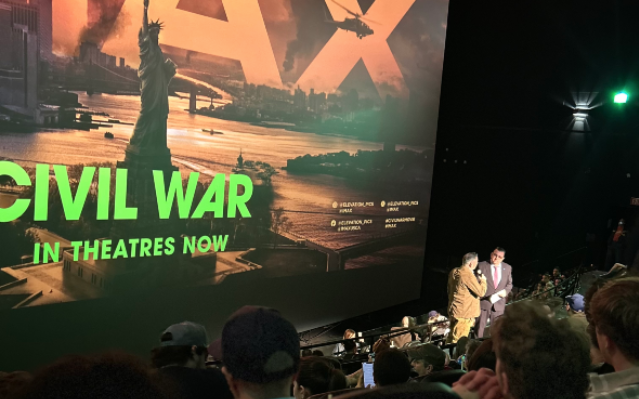
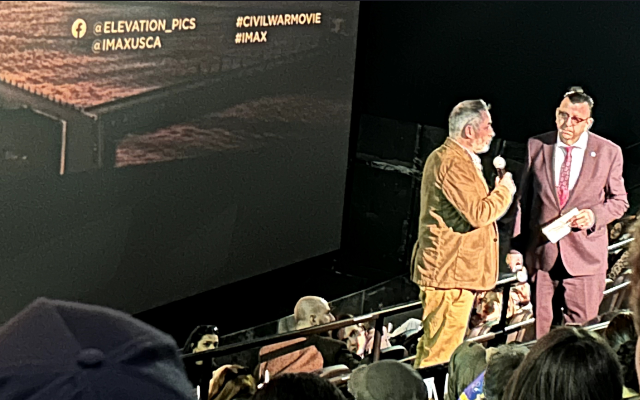
I hosted a special IMAX screening of “Civil War,” a new antiwar film. set in a dystopian future America, in which a team of military-embedded journalists race against time to reach Washington, D.C., before rebel factions descend upon the White House. AP calls it the “year’s most explosive movie,” while the Toronto Star calls it “the year’s most divisive movie.”
Director Alex garland joined me after the screening for a twenty minute Q&A where we discussed why he set the film in the United States, made the bold statement of blowing up the Lincoln Memorial and much more.
“Civil War,” a new, near-future vision of dystopia from director Alex Garland, now playing in theatres, is an emotional and intellectual experience that plays like a stark prediction of what could happen if division and hate are allowed to run unchecked.
At the film’s beginning the President of the United States (Nick Offerman) predicts victory for the American government over the separatist “Western Forces” led by Texas and California. In reality, the Second American Civil War is waning as the rebellious W.F. cut a path to Washington, while the “Florida Alliance” leaves a bloody mark on other parts of the country.
How bad is it? In the movie’s sole light moment, to Canadian audiences at least, it’s revealed that the Canadian dollar is more valuable, and more in demand than USD. That’s how bad the situation is.
In the midst of this, journalists capture the story on film and in words. Kirsten Dunst is Lee, a seasoned photojournalist, who with writer Joel (Wagner Moura) has an eye on getting the biggest scoop of the conflict, an interview with the President.
“Interviewing him is the only story left,” she says.
As Lee and Joel, along with veteran New York Times journalist Sammy (Stephen McKinley Henderson) and ambitious combat photographer Jesse (Cailee Spaeny), set off on the 857-mile journey from New York to D.C., the full impact of the war’s destruction, on property and people, becomes clear.
“Every time I survived a war zone, I thought I was sending a warning home, ‘Don’t do this,’” Lee says, “but here we are.”
There are no monsters or supernatural aspects in “Civil War,” but make no mistake, this is a horror film. The horrors of war are detailed in a visceral and chaotic way—the rat-a-tat-tat of gun battles is deafening, while the cinema verité style shots of carnage and bodies left abandoned to rot in the sun stick in the imagination—but it is the idea of a societal collapse that haunts. “No one is giving orders,” says a soldier. “Someone is trying to kill us, and we’re trying to kill them.”
Garland uses thrilling, in-your-face imagery that brings to mind everything from classic war films to the handheld coverage of the Capitol attack of January 6, 2021 to paint a portrait of a country in combat with itself.
The director, who also wrote the script, is decidedly non-partisan in his approach to the story, emphasizing the cruelty of the movement, and the actions of the extremist militias, not the politics. In this version of civil war, the population are divided by ideology. Friends turn on friends, state on state, and wearing an orange “Press” Kevlar vest won’t keep the journalists safe. “They shoot journalists on sight at the capitol,” says Sammy. The ravages of this war, set against ordinary backdrops, like an abandoned Christmas theme park, or a deserted highway, are unsettling in a profound, unnerving way.
The jarring visuals—an opening protest scene is a jaw-dropper—enhanced by a pulsating, anxiety inducing electronic soundtrack are almost overwhelming, but underscore the importance of the journalists who risk their lives to record history in real time. The occasionally shocking situations and images—the final shot is a doozy, provocative and bound to be controversial—are powerful reminders of the risks undertaken by reporters on the search for the truth.
That risk factor, at a time when journalism is under fire, is highlighted in “Civil War,” but takes a backseat to Garland’s bravura, pulse-racing filmmaking.
Ambitious, audacious and just a little messy, “Origin,” the new film from director Ava DuVernay, now playing in theatres, is a study of the caste system told through the lens of a writer played by Aunjanue Ellis-Taylor. Part biography, part intellectual journey, it mixes the emotional with the academic.
Ellis-Taylor is bestselling author Isabel Wilkerson, who, in real life is the first woman of African-American heritage to win the Pulitzer Prize in journalism. Happily married to Brett (Jon Bernthal), she is considering taking some time off writing and lecturing to look after her aging and ailing mother.
But tragedy and her restless intellectual curiosity push her into exploring how the unspoken caste system has shaped America, and how people are still classified to this day by a pecking order of human classifications. To that end she travels the world and history, making stops in the American South, Berlin, and India to study which groups of people have power, and which do not.
Based on Wilkerson life and the writing of the book “Caste: The Origins of Our Discontents,” “Origin” is narrative film that feels stuck between two worlds. The blend of Wilkerson’s biography, mixed with dramatic re-creations of the historical events that feed into her research, is a mix of personal and the political, but it seems as if the film is trying to decide if it is a narrative or a documentary.
Still, the choppy presentation is chock full of thought-provoking ideas. DuVernay, who also wrote the script, crafts a unique movie about connectivity, one that isn’t afraid to swing for the fences. As the film skips through world history and Wilkerson’s life, a portrait of systemic subjugation eventually comes into focus, against a backdrop of personal loss. The film’s two prongs don’t feel like a natural fit, but Ellis-Taylor’s rock-solid performance anchors the film, providing a bridge between the emotional and intellectual.
“Origin” is an interesting movie, one that bristles with the spirit of discovery, but sometimes gets allows lucidity to get lost in its execution.
Despite the title, “Dumb Money,” a new ripped-from-the-headlines dramedy starring Paul Dano, now playing in theatres, is a smart take on how an on-line investment blogger led the French Revolution of Wall Street.
Dano is Keith Gill. By day he’s a financial trader, at night he’s Roaring Kitty, host of a quirky on-line show broadcast from his Brockton, Massachusetts basement. Wearing tie-dyed cat t-shirts, topped with a red headband, he offers up stock advice for a tiny audience, who respond with torrents of abuse. In early 2021 he makes waves when he goes all in, sinking his life’s savings, into an unorthodox hunch.
“Yo! What up everybody,” he says on the show. “Roaring Kitty here. I’m going to pick a stock and talk about why I think it is interesting, and that stock is GameStop.”
Wall Street hedge funders had been short selling the video game retailer’s stock, hoping to profit if the stock fails, but Gill thinks the stock is undervalued, that there is life left in the company. His passion for the GameStop slowly wins over his handful of viewers, who snap up the cheap stock. As more and more people buy, the stock rises, and soon rockets to upwards of $500 a share.
The ”retail traders,” the students and restaurant workers who take Roaring Kitty’s advice, get rich while the billionaire hedge funders, in particular Gabe Plotkin (Seth Rogen) of Melvin Capital, begin to lose money, to the tune of $1 billion a day.
Roaring Kitty becomes an internet sensation, an underdog David against Wall Street’s Goliath.
“A lot of people feel the system is broken,” he says. “The whole idea of the stock market is if you’re smart, and maybe with a little luck, you can make your fortune. Certainly not anymore. There’s no hope for the little guy. But maybe now there is.”
As the stock soars, the mainstream media takes notice, as does the White House and Congress.
“You got the rich dudes pissing their pants,” says Keith’s brother Kevin (Pete Davidson). “They’re coming after you.”
Once you get past the dense financial jargon about short selling, etc, “Dumb Money” is a fist-in-the-air crowd pleaser. It’s a very specific story, based on true events, but there is a Frank Capra-esque quality to the account of outsiders giving the middle finger to power, and, for the most part, winning.
Dano is nicely cast as Gill, an outside who, as an agent of chaos, briefly fought against a rigged system and emerged victorious. In addition to bearing a remarkable resemblance to the real Gill, Dano brings forth the resolute nature of the character, a man who valued the power of the class movement he started more than the dollars that accumulated in his portfolio.
Stealing scenes is Davidson as Keith’s wild card younger brother Kevin. He is as brash as Keith is reserved, as impulsive as his brother is methodical, and provides a blast of energy every time he’s one screen.
“Dumb Money” doesn’t get too bogged down by the financial verbiage, although it may be worth a trip to the “short sell” Wikipedia page before buying a ticket. It’s a rousing, high energy story of leveling the playing field that captures the spirit of the time.
My desire to see 2014’s “The Lego Movie” was on par with my wish to step on a Lego brick in my bare feet. How could a movie starring plastic, singing mini figs possibly appeal to anyone who graduated Saturday morning cartoons decades ago? But I’m a professional so I put my bias of toy story movies aside and went to the screening.
Later, as I left the theatre humming “Everything is Awesome” I was own over. Directors and co-writers Phil Lord and Christopher Miller had pulled off something great, they made a movie with wide appeal using the Legos as a muse to do what the bricks have always done, light imaginations on fire.
Question is, five years later will everything be awesome in the sequel “The Lego Movie 2: The Second Part”?
The last movie ended with the revelation that the movie’s Lego Land frenetic action had actually taken place in 8-year-old Finn’s (Jadon Sand) imagination. The new one focuses on Finn’s sister Bianca (“The Florida Project’s” Brooklyn Prince) disrupting her brother’s carefully built world of fancy with her Duplo-Block creations.
In the make-believe world Duplo aliens, led by shape-shifting villain Queen Watevra Wa-Nabi (Tiffany Haddish) declare war on Bricksburg. Fast-forward five years. Optimistic construction worker Emmet (Chris Pratt) and Master Builder Lucy’s (Elizabeth Banks) home is now a smoking ruin called Apocalypseburg where if you show any weakness you will be destroyed. Dave is now called Chainsaw Dave and Sewer Babies live under the streets.
When Lucy, Batman (Will Arnett), Unikitty (Alison Brie), Benny (Charlie Day) and MetalBeard (Nick Offerman) are kidnapped and transported to the Systar System by General Mayhem (Stephanie Beatriz) Emmet and intergalactic archaeologist / Snake Plissken look-a-like Rex Dangervest (Pratt again) set off to rescue them. “Don’t worry Lucy,” says Emmett, “everything will still be awesome.”
“The Lego Movie 2: The Second Part” is a pure pop art blast as though designed by kids. A mix of non-sequiturs, silly jokes, attention deficit editing, CPDs (Convenient Plot Devices) and music it zips along but isn’t as awesome as the original. The first film was a powerhouse of imagination and adventure. “The Second Part” has its moments—like the “Catchy Song” sequence—but feels like a dim bulb that doesn’t burn as brightly as it once did.
Like the first film the mayhem of Lego Land is tempered with real life lessons. In this case it takes an existential turn in the last third, expanding the mini fig story to shine a light on the fraught relationship between Finn and Bianca and their struggle to find a way to play together. When they learn to be kind and tolerant of one another their lives improve, as do those of their plastic figures.
“The Lego Movie 2: The Second Part’s” convoluted third reel paints the screen with too much frenetic CGI action but maintains the lesson of the first film, that NOT putting away childish things, like Lego blocks, is the key to making everything awesome, no matter what age. That the message doesn’t feel like a commercial for the brightly coloured blocks is a pleasant plus even if the movie feels like diminished returns.
Six years ago writer/director Drew Goddard deconstructed the slasher movie genre with the whimsical and exhilarating “Cabin in the Woods.” A mash-up of horror and humour, of post-modern self-awareness and gruesome gags, it simultaneously adopted and challenged the conventions of the slasher genre. He returns to the big screen—his day job is writing, producing and directing TV shows like “Daredevil” and “The Good Place”—with “Bad Times at the El Royale,” an inversion of a 1990s broken timeline crime drama.
The El Royale is the kind of seedy hotel that dotted the highways and byways of 1960s America. Split down the middle by the California/Nevada border, it’s a perfect slice of mid-century kitsch, like the same guy who decked out Elvis’s rec room designed it. When we first lay eyes on it a shady character (Nick Offerman) with a bulging suitcase and a gun wrenches up the floorboards and hides a case of money before replacing the carpet and the furniture. It’s an act that establishes the El Royale as a home-away-from-home for transients and ne’er-do-wells and sets up much of the action to come.
As for the action to come, you’ll have to go see the film to find out what happens. I will tell you that the film takes place ten years after the suitcase was hidden in the hotel and begins with a disparate group of folks checking in well after the El Royale’s heyday. There’s slick talking vacuum cleaner salesman Laramie Seymour Sullivan (Jon Hamm), Reno-bound singer Darlene Sweet (Cynthia Erivo), Father Daniel Flynn (Jeff Bridges), a priest with tired eyes and hippie chick Emily Summerspring (Dakota Johnson). All three pay front desk manager Miles (Lewis Pullman) the $8 deposit and take to their rooms.
Secrets are revealed about the guests and the hotel as an aura of menace clouds the sunny California/Nevada border. “We’re in a bit of a pickle,” says Father Flynn in what may be the understatement of the year.
Goddard takes his time setting up the narrative drive of “Bad Times at the El Royale.” He bobs and weaves, playing with time, slowly revealing the intricacies of the story. For the patient—it runs two hours and 21 minutes—it’s a heck of a ride but may prove too opaque for casual viewers. Large conspiracies are hinted at, secrets are kept and no one is really who they seem to be. For those willing to submit to the grimly funny and admittedly indulgent proceedings, it’s a Tarantino-esque web of intrigue and unexpected violence that plays both as a crime drama and a metaphor for the decay of 1960s idealism.
“Bad Times at the El Royale” is a good movie filled with bad people. It asks you to care about people who do terrible things and by the end, thanks to inventive storytelling and good performances—Erivo is s standout—you just might.
Sam Elliott, he of the easy drawl, smoky voice and horseshoe moustache, has made almost fifty films but has rarely ever been the above-the-title star. In “The Hero” he plays Lee Hayden, an aging Western film star, diagnosed with cancer. He’s in almost every frame, bringing an easy charm that solidifies his leading man status while smoothing over the film’s rough patches.
“The Hero” is a story of a man who can see the end of the road. Well known but underemployed and living off residual cheques from his heyday, the one time movie star now does voice overs for commercials to pay the bills. When he isn’t shilling for Lone Star BBQ Sauce—“The perfect pard’ner for your ribs.”—he’s smoking dope with his friend, former “Cattle Drive” co-star and drug dealer Jeremy (Nick Offerman). Through Jeremy the seventy-one-year-old meets Charlotte (Laura Prepon), a stand-up comic more than half his age.
As a new life of sorts is beginning with Charlotte a cancer diagnoses—“One of the worst you could hope for,” he says.—prompts him to look for a “chance to write another chapter” with his estranged daughter Lucy (Krysten Ritter) and possibly find some career defining work to leave behind as a legacy.
Writer/director Brett Haley knows how to make the most of Elliott’s weary but stately presence. The pair worked together on Haley’s last film, “I’ll See You In My Dreams,” another look at aging and legacy. Both films rely on clichés to forward their stories, but both films are saved by strong central performances from their stars—Blythe Danner in “I’ll See You In My Dreams,” Elliott in “the Hero”—who bring warmth and believability, not to mention high powered and often untapped star power, to their roles.
When the film falls into the romantic / comeback template already established by films like “Tender Mercies” and “The Wrestler,” Elliott’s quest for redemption keeps it from becoming a maudlin look at Hayden’s twilight years.