I sit with NewsTalk 1010 host Deb Hutton to talk about Nathan Fielder look-a-likes, getting the ball (or sphere) rolling with Rush, some honors for Paul Anka and David Foster and I review the John Malkovich and Sam Rockwell film “Wild Horse Nine.”
I join “CTV News Toronto at Five” with guest anchor Sean Leathong to talk about the the biopic “Being Heumann,” the dark comedy “Wild Horse Nine” and the epic “Godzilla Miinus Zero.”
I join CP24 Breakfast anchor Nick Dixon toi talk about the biopic “Being Heumann,” the dark comedy “Wild Horse Nine,” the historical Crave soap opera “The Gilded Age” and the Appple TV series “Knife Edge: Chasing Michelin Stars.”
I sit in on the CFRA Ottawa morning show with host Bill Carroll to talk about the biopic “Being Heumann,” the dark comedy “Wild Horse Nine” and the epic “Godzilla Minus Zero.”
Fast reviews for busy people! Watch as I review three movies in less time than it takes to wind your watch. Have a look as I race against the clock to tell you about the biopic “Being Heumann,” the dark comedy “Wild Horse Nine” and the epic “Godzilla Minus Zero.”
SYNOPSIS: In “Wild Horse Nine,” a new black comedy now in theatres, John Malkovich and Sam Rockwell star as CIA operatives on vacation on Easter Island shortly before the 1973 Chilean coup d’etat. “They got all these big stone heads here,” says Lee (Sam Rockwell). “They remind me of you actually, except they’re quiet.”
CAST: John Malkovich, Sam Rockwell, Steve Buscemi, Tom Waits, Parker Posey. Written and directed by Martin McDonagh.
REVIEW: Writer director Martin McDonagh specializes in finding the absurdist black comedy in the stories of odd couple male relationships. His new film, “Wild Horse Nine,” a tale of two longtime CIA partners nearing the end of their time together, sits on the shelf beside “In Bruges” and “The Banshees of Inisherin,” capturing the complicated affection that comes with years of shared history.
John Malkovich and Sam Rockwell are CIA officers Chris Carlisle and Lee Chesterfield. Chris is the veteran with a checkered past that may, or may not, include an involvement with the Kennedy assassination. “I’ve killed people in countries you can’t even spell,” he says.
He has terminal cancer and is working on a memoir, much to the consternation of CIA bureau chief MJ (Steve Buscemi) who urges Lee to keep Chris from sharing delicate agency secrets by any means necessary.
The freewheeling Chris has loose lips. At the airport in Santiago he chats up two women, college student Monica (Mariana di Girolamo) and her friend Alicia (Ailín Salas), admitting to being a CIA agent.
When word gets back to MJ, the urgency to silence Chris intensifies.
“Wild Horse Nine” is, first and foremost, about the relationship between Chris and Lee. These two eccentric characters are given life by Malkovich and Rockwell, who play them without a hint of caricature. Instead, they provide a portrait of a lived-in friendship, complete with unspoken affection, loyalty and the kind of good-natured bickering that can typify male friendship.
It’s the platonic love story that’s ultimately more important than the political backdrop, or the exotic location. Once again McDonagh, with the help of two award-worthy performances, finds the humanity of fringe characters and allows us to bask in it for the 119-minute runtime. It’s more of a hang-out movie than either “In Bruges” and “The Banshees of Inisherin,” but the pitch-black humor and back-and-forth banter make it time well spent.
LOGLINE: In “Thelma,” a new comedy thriller now playing in theatres, June Squibb plays a 93-year-old grandmother who falls prey to a grandma phone scam. Conned out of $10,000, with the help of a friend (Richard Roundtree) and his motorized scooter, she sets out to find the scammers and get her money back by any means necessary. “What about my money?” she says. “Am I supposed to just let them have it?”
CAST: June Squibb, Fred Hechinger, Richard Roundtree, Parker Posey, Clark Gregg, Malcolm McDowell. Written and directed by Josh Margolin.
REVIEW: “Thelma” is something you don’t see very often, a thriller starring a 93-year-old action hero. From a low-speed scooter chase and a show down with the bad guys, to the acquisition of a weapon and a high-octane heist musical score, the movie has all the elements of an edge of your seat suspense film.
But its biggest asset is Squib, who brings steely determination, vulnerability and humor to the title character. She may not exactly be Ethan Hunt, but she’s more endearing and delightful than Jack Ryan and Jason Bourne combined. She’s easy to root for, even if her high stakes mission seems impossible.
At her side is Ben, Richard Roundtree, a.k.a. Shaft, in his final role. His presence is a cool callback to action movies of years gone by, but here he’s a charismatic sidekick, allowing Squibb to mostly take matters into her own hands.
There are also subplots involving Thelma’s grandson Daniel (Fred Hechinger) daughter Gail (Parker Posey) and son-in-law Alan (Clark Gregg), but at the film’s core is an exploration of old age, and how, as Ben says, “People these days don’t care about old things.” “Thelma” confronts that idea, dismissing it with panache, humor and some genuine excitement.
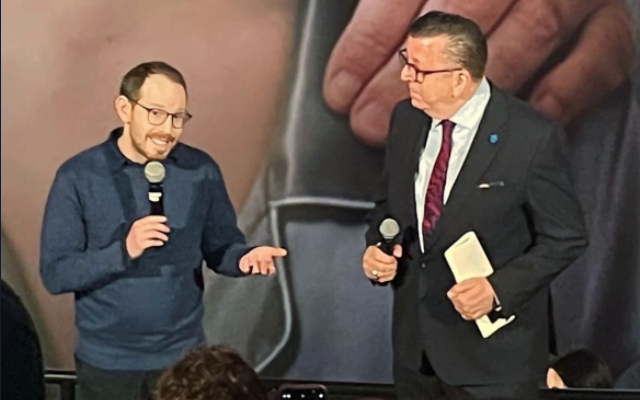
I hosted a live Q&A with director Ari Aster in front of a sold-out crowd at the Scotiabank Theatre in Toronto on Wednesday night. For a taste, check out my radio show on the iHeartRadio Network Saturday night at 8 pm t0 9 pm for a recorded interview with the director.
Magnificent and confounding in equal measure, “Beau is Afraid,” a new, three-hour epic from “Midsommar” director Ari Aster and now playing in theatres, is a nightmarish trek through a mishmash of mommy issues, anxiety and tragedy. Imagine a paranoid “Lord of the Rings” style quest reimagined by Luis Buñuel with a darkly comedic “After Hours” vibe and a hint of Thomas “You Can’t Go Home Again” Wolfe and you’ll be on the road to understanding Beau’s surreal journey.
Joaquin Phoenix plays the title character, a neurotic, over-medicated man whose father died at the moment of his son’s conception. The loss forever colored his life, leaving him lost in a sea of paranoia and uncertainty. “I am so sorry for what your daddy passed down to you,” says his overbearing mother Mona (Patti LaPone).
Beau’s already chaotic life is forever changed by a missed plane, a new prescription and a home invasion. Set off on an odyssey to return home for his mother’s funeral, circumstance continually keep him off track. First, he finds himself the reluctant patient of affable suburban caregivers Roger and Grace (Nathan Lane and Amy Ryan), their troubled daughter (Kylie Rogers) and a war vet with PTSD.
Then, a narrow escape finds him in the embrace of a travelling experimental theater troupe whose storytelling transports him into an animated folk tale of searching, struggle and solace.
Finally, bloodied and bruised, he arrives home to confront his past, face his fears and come to grips with the trauma that hangs over his life like a shroud.
“Beau is Afraid” is a complicated movie, laden with allegory and symbolism, that confronts the aftereffects of loss and grief. It’s familiar terrain for Aster, whose previous films, “Hereditary” and “Midsommar,” were also studies in intergenerational trauma.
But the new movie is anything but familiar.
It is a psychological dramedy that dives deep into how Beau’s trauma has molded every aspect of his life and lead to a breakdown, one we witness from his point-of-view, in real time. It’s a harrowing trip as Beau slowly loses his grip on reality, and his paranoia shapes the movie’s narrative.
Aster is uncompromising in his portrayal of Beau’s state of mind. His previous movies were more visually shocking, featuring images more aligned to traditional horror. “Beau is Afraid” has less overt horror. It’s more concerned with the psychological, the confusion, fear and anxiety that drives Beau. To convey this, Phoenix, in an internal performance, plays the character as a shell. The movie revolves around him and his state of mind, but he is a reactive character, one who responds to, rather than instigates, the action. It’s interesting, deeply felt work but the closed down, Chauncey Gardiner nature of the character makes him difficult to embrace.
Given the unsettled nature of the real world, audiences may understand, relate or sympathize with Beau’s all-encompassing fear, but the absurdism woven into Phoenix’s childlike performance, particularly in the film’s second half, wears thin.
“Beau is Afraid” is the weirdest film on Aster’s already proudly weird IMDB page. It may be the definition of a film that is not for everyone, but it cannot be faulted for its uncompromising vision. As a search for meaning in life, for closure from trauma, for freedom from fear, from relief from distended testicles (Yup! You read that right), it was never going to be a feel-good flick. So, instead, it swings for the fences, burrowing in on its grandiose emotional ideas even if it often feels like a three-hour panic attack.
Unpredictable, unexpected and ultimately, unexplainable, it’s challenging cinema that connects on a subconscious level.