Personal details run deep in Woody Allen’s films. His life has been fodder for his stories. Sometimes overt, occasionally self-indulgently, most always accompanied by some sort of neurosis his writing reveals much about who he is. “Wonder Wall,” however, may top everything that came before with its story of a man who carries on with both mother and stepdaughter.
Set on Coney Island in the 1950s, “Wonder Wheel” stars Jim Belushi as Humpty, a carousel operator with Kate Winslet as Ginny, his actress-turned-waitress wife. They live in a dowdy apartment with budding pyromaniac Richie (Jack Gore), her son from a previous marriage. It’s a miserable existence. He’s an unhappy recovering alcoholic who prefers fishing to his wife’s company. Approaching forty, she’s unhappily working at a local clam house, battling migraines caused by the endless din from the surrounding amusement parks. “I am not a waitress in a clam bar,” she says. “There’s more to me than that. I’m playing the part of a waitress in a clam bar.”
Ginny’s only consolation is lifeguard and wannabe playwright Mickey (Justin Timberlake). He’s “poetic by nature with hopes of one day writing a classic,” and
she eats it up until Carolina (Juno Temple), Humpty’s estranged daughter shows up, on the run from some nasty mobsters (Steve Schirripa and Tony Sirico).
Woody Allen has made almost fifty films ranging from lush romantic comedies and introspective dramas to art house explorations and musicals. “Wonder Wheel” feels like a combination of all of the above, and yet less because it feels as though its been cobbled together from fragments of his other, better movies. Nostalgia, over-romanticized sense of place, dangerous relationships, psychiatry and highbrow set decoration like references to “Hamlet and Oedipus” abound but it is all been-there-done-that.
Once upon a time Allen’s films clocked in at a svelte 90 minutes but in recent years have grown flabby. “Wonder Wheel” times out at 101 minutes but feels much longer. The stagey, heightened acting style recalls amateur hour Tennessee Williams and seems not only stuck in time, but actually have the ability to stop time. As Humpty Belushi only reminds us how good a role this might have been for John Goodman. Winslet seems to be channelling a heroine from a more interesting movie and Timberlake, as the movie’s in-demand love interest and Greek Chorus, shows none of the ease and grace so amply on display in his singing and dancing. Only Temple fights her way through the muck to emerge as a compelling character.
At the beginning of the film Mickey warns us that what we are about to see will be filtered through his playwright’s point of view. Keeping that promise, Allen uses every amount of artifice at his disposal—including cinematographer Vittorio Storaro’s admittedly sumptuous photography—to create a film that is not only unreal but also unpleasant. “Oh God,” Ginny cries out at one point. “Spare me the bad drama.” Amen to that.
“I knew her very well,” says Penelope Cruz, “but in a way she was not exactly the same person because so many things happened to her and she changed over time, like we all do.”
Cruz isn’t talking about an old friend or a long lost relative. The Spanish superstar is referring to Macarena Granada, a character she first played a decade ago and revisits in the new film The Queen of Spain.
“She has a very intense life,” continues Cruz, “so that was the tricky thing. For the people who knew Macarena, how do I make her recognizable and what are the changes we can see in her after all these years?”
Audiences first met Macarena in 1998 when Cruz played her as an upcoming Spanish movie star in a frothy little confection called The Girl of Your Dreams. It’s years later in real and reel life as Cruz brings the character back to the screen.
Set in 1956, The Queen of Spain portrays Macarena as a huge international star lured back to her home country to star in the first American movie to be shot there since the Franco took power. It’s a wild production but complicating matters is the appearance—and subsequent disappearance—of Macarena’s former director and the man who made her a star.
“The first film was set at a time of interaction with Germany and Macarena had to protect herself from Goebbels,” says Cruz. “This time she is up against Franco. In a way every time she is acting in a film she is just not acting, she is some kind of political heroine. She is fighting for justice. What a life this woman has had! Every time she goes into making a movie she has to save somebody’s life or do something life changing for everybody. If we ever do the third one I don’t know who she’ll have to deal with. Depends on what country. Hopefully the third one will happen someday. Let’s see who she has to encounter this time.”
The Queen of Spain marks the third time Cruz has worked with Fernando Trueba, the Spanish auteur who directed her break out film Belle Époque.
“The knowledge he has of cinema, the passion he has for cinema is very contagious,” she says. “With Fernando it is always more than just entertainment. He is such a great filmmaker and he always talks about so many big subjects at the same time.
“I think Belle Époque is a masterpiece. The film was amazing and for me to start with somebody as brilliant as Fernando, well, it was a year that made it impossible for me not to fall in love with movies.”
The chance to show what goes on behind the scenes in The Queen of Spain’s film-within-the-film was another reason she decided to come back to Trueba and Macarena.
“There are not enough movies about that,” she says. “When I am on the set everything is so crazy and chaotic but at the same time it works. I feel like we need that chaos for it to work. It is magical that things happen and movies get done and get finished. I’m always on the set thinking, ‘These three days of shooting is enough material for three more movies.’”
It’s hard to know exactly how to categorize “The Trip” movies. Since 2010 Steve Coogan and Rob Brydon have co-starred in a series of British television travel shows, later cut down to feature length movies for North America.
The first saw the dynamic duo do a restaurant tour of northern England, then came “The trip to Italy” where they followed in the footsteps of early 19th century English poets on the Grand Tour. This time around trade plates of pasta for pintxos and paella in “The trip to Spain.”
The films are semi-fictional ad libbed culinary road trip adventures that have become increasingly melancholy as the odometer clocks each passing mile. They aren’t documentaries nor are they Food Network style travel shows. They are funny, although the laughs are fewer and further a part in the new, but they also contain moments of profound despondency. Sometimes they seem to be little more than a showcase for Coogan and Brydon’s prodigious gifts of celebrity mimicry, other times they are pathos dipped examinations of aging.
The third course on their culinary trip sees these two—imagine an intellectual version of The Two Ronnies—sample the best of Spain’s New Traditional restaurants, take in the sights but they spend most of their time not appreciating the beautiful coastal scenery but hilariously poking fun at a who’s who of Hollywood, including Al Pacino, Sean Connery and Woody Allen.
Wedged between the jokes and Michael Caine impressions is Coogan’s dissatisfaction, both personal and professional. Contrasted with Brydon’s happy family life and career, Coogan’s fear of becoming last week’s news as he enters his fifties gives the film an edge the others haven’t had. That means “The Trip to Spain” isn’t nearly all-out funny as the others, but it does have more substance. The others weren’t exactly empty calories but this one feels weightier.
“The Trip to Spain” features much of the stuff fans expect—Brydon’s “small man in a box” voice makes an appearance and Coogan’s way with words gives us culinary descriptions like, “life affirming butter”—but director Michael Winterbottom is clearly in a Cervantes state of mind as he sets his Don Quixote and Sancho Panza off on a new Spanish adventure.
In this mixed-up, shook-up world there are fewer and fewer things we can count on as absolutes. One of them is that there will be a new Woody Allen movie every year with a jaunty jazz soundtrack and credits written in the Windsor Light Condensed font. His new film, “Café Society,” the story of a frantic young romantic trying to find himself in 1930s Hollywood, is slice of comfort cinema with all of Allen’s trademarks intact.
Bobby Dorfman (Jesse Eisenberg) is a native New Yorker who jumped coasts to take up in Los Angeles. The slightly neurotic east coaster is not a natural fit in Tinsel Town, but his powerhouse uncle Phil (Steve Carell) helps out, giving him a job at his powerhouse talent agency and introducing him to a beautiful secretary named Vonnie (Kristen Stewart). By day he does odd jobs for Phil—“Menial errands are my specialty,” Bobby says, “but I don’t see a great future in it.”—while on the weekends he slowly falls for Vonnie. They share a disdain for industry talk and Hollywood’s catty innuendo and a love of cheap Mexican food but she doesn’t share his feelings. Unfortunately (for Bobby) Vonnie has a mostly absent boyfriend.
Enter romantic plot complications and Bobby hightails it back to New York where he goes into the nightclub business with his gangster brother Ben (Corey Stall). Finally successful, he marries and has a child with Veronica (Blake Lively), who he nicknames Vonnie, betraying the feelings he harbours for his west coast love. When Vonnie number one returns to New York for a visit the film offers up a line that sums the situation up, “Life is a comedy written by a sadistic comedy writer.”
A light-hearted tapestry, “Café Society” is embroidered with the odd punch line and hints of melancholy. It’s a comedy tinted with heartbreak, a look at true love and unsatisfactory options. It returns Allen to the fertile ground he ploughed with “Annie Hall” and “Manhattan” and while this film isn’t a classic on those terms, it’s an engaging look at life and love buoyed by great performances.
Eisenberg does the best Woody Allen impression we’ve seen on screen in some time, but there’s more to him than simply aping the master. His journey from nebbish to notable is believable and gives the movie its heart.
Co-star Stewart hands in what may be her first truly adult role. She plays Vonnie as level-headed in a sea of dreamers. When Bobby describes Joan Crawford as “larger-than-life” she replies, simply but compellingly, “I think I’d be happier life-sized.” It’s the line that sums up her character and Stewart makes the most of it and Vonnie.
“Café Society” is a welcome uptick after Allen’s last two films, “Magic in the Moonlight” and “Irrational Man.” For Woody’s fans it may feel familiar but in the most soothing of ways.
Steve Martin, who studied philosophy at California State University once joked, “If you’re studying Geology, which is all facts, as soon as you get out of school you forget it all, but Philosophy you remember just enough to screw you up for the rest of your life.”
Such is the case with Abe (Joaquin Phoenix) the eponymous “Irrational Man” of Woody Allen’s fiftieth movie. A university professor about to start a new job at a new university, he’s brilliant but has fallen into the kind of existential funk that can only come from a lifetime spent studying philosophy. He’s the kind of guy who uses “As Simone de Beauvoir pointed out…” as a conversation starter and drinks single malt scotch from a flask in public.
He’s lost his zest for life, but not his appeal to women. Within days of the beginning of the semester he’s sleeping with the age appropriate but married Rita (Parker Posey) and is fighting off the advances of a student, Jill (Emma Stone). “He’s a sufferer,” she says with stars in her eyes, “and very conservative in a liberal sort of way.”
When he and Jill overhear a conversation regarding a crooked judge, suddenly his life has meaning. He decides to “make the world a better place” by getting rid of the judge. Planning the perfect murder, a crime he feels will benefit humanity, brings zest back into his life and puts a spring in his step.
From here “Irrational Man” becomes part character study and part romance and while it’s not exactly a whodunnit—more of a whydunnit—there is a procedural element to the last quarter of the film.
Subject wise Allen is in his element here, giving a raft of characters a chance to talk philosophy and the meaning of life but while the story should have forward momentum the farce ever escalates. Instead Allen relies too heavily on narration slowing down the action to a crawl.
Despite appealing performances from all, the story feels like a talky celebration of Abe’s dysfunction—the poor tortured genius—than a true study of a person pushed to extremes in search of happiness. Allen makes a movie a year, and while he often hits pay dirt there are years when it feels like he should have taken some time off, maybe vacationed in the South of France and recharged. This is one of those years.
Early on in “Irrational Man” Abe says, “Much of philosophy is verbal masturbation.” I said the same thing about the movie as the closing credits rolled.
The generation gap that lies at the heart of “While We’re Young,” the latest film from “Squid and the Whale” director Noah Baumbach, can be summed up in one short but clever scene.
Twenty-something hipster Jamie (Adam Driver) offers up a pair of headphones to Josh (Ben Stiller), a forty-five-year-old documentary filmmaker. As “Eye of the Tiger” blares on the soundtrack Josh says, “I remember when this song was just supposed to be bad.”
Josh and Cornelia (Naomi Watts) are a childless married couple living in Manhattan. They’re comfortably easing into middle age when they meet Jamie and Darby (Amanda Seyfried), an impossibly hip married couple who live in a Harlem loft stuffed with vinyl records, manual typewriters and good vibes.
The young’uns lead an intoxicating life, connected to every neo-New York trend. They eat at artisanal restaurants, raid thrift shops for clothes and partake in ayahuasca ceremonies (which leads to one of my favourite lines: “Maybe don’t flirt with the shaman.”). While Josh and Cornelia bash away on the latest smart phones, Jamie and Darby have embraced the retro chic of VHS. They’re so cool they don’t even use Google. When Josh pulls out his phone to search for a word they’ve all blanked on, Jamie and Darby demur. “Let’s just not know,” Jamie says.
The relationship between the two couples is one of mutual mentorship. Josh and Cornelia go to hip hop classes and bourbon tastings, feeling young again alongside their new found friends while Jamie and Darby look to the older couple for help with a film Jamie is trying to make.
The dramatic conflict comes late in the movie when it becomes clear that Jamie isn’t as easy going as everyone first thought.
It’s a bit too easy to compare writer/director Baumbach to Woody Allen, but it’s apt. Both are New York filmmakers to the core and both, at their best, comment on life in the microcosm of that city’s life. Their stories are both specific and universal, micro and macro, and hone in on the behaviour that makes us human, for better and for worse.
In “While We’re Young” Baumbach inhabits Allen’s turf, making a comedy for adults that by turns skewers and embraces the very people he’s making the movie for. It’s a grown up look at growing up. Intelligent and funny, it highlights the insecurities attached to middle age, while celebrating the wisdom and sense of purpose that can only come with experience.
Bambauch is generous with his characters–Jamie and Darby aren’t caricatures of trendoid NYC dolts but nicely etched portraits of Generation Y kids struggling to find a place in the world—and is aided by terrific performances. Nobody does pent up anxiety like Stiller and for Driver this is the next step up the ladder to huge mainstream success. Watts and Seyfried aren’t given as much to do, although they have some of the film’s best lines. “If I stay here any longer I’ll Girl, Interrupt,” says Darby with mock seriousness. Charles Grodin has a small but important part as a legendary documentarian—think vérité hero D. A. Pennebaker—whose caustic charm and way with a line—”You just showed me a six-and-a-half hour long film that felt seven hours too long.”—is worth the price of admission alone.
“While We’re Young” is a terrific film with razor sharp insights to the differences and similarities between Gen X and Y.
“Magic in the Moonlight” feels like a Woody Allen movie. The main character, played by Colin Firth, is a misanthropic man, there’s a muse in the form of Emma Stone, there’s even a psychoanalyst and lots of talk of Freud and Nietzsche.
So far, so good, but there’s also a tepid romance and one liners that have Allen’s trademark rhythm—“I always thought the unseen world was a good place for a restaurant,” says Stanley (Firth). “Spirits get hungry.”—but few of the laughs we would expect.
Set in 1928 Firth is Stanley, a world famous stage magician with “all the charm of a typhoid epidemic.” He is also a genius with a special interest in debunking fraudulent spiritualists. When his friend and fellow magician Howard (Simon McBurney) approaches him to investigate a mystic named Sophie Baker (Stone) who he thinks is bilking a wealthy ex-pat American family out of their money, Stanley gladly accepts. Travelling to the south of France the skeptical magician meets Sophie—described by her love-sick suitor Brice (Hamish Linklater) as “a visionary and a vision.”—and is soon won over by her mental abilities and physical charms. “I’ve always believed that the dull, tragic reality of life is all there is,” he says. He comes to believe Sophie is proof there is more, but will his change of heart last?
Despite tackling some of life’s big questions, “Magic in the Moonlight” feels like a trifle. At his best Allen illuminates the human condition, using equal parts humor and pathos to shine a light on how and why people do things they do.
Here he asks, “Is the rational choice always the best choice? Is a dash of rationality is what makes life interesting?” but frames those queries with a story so light and fluffy it threatens to float off the screen and into the ether with every passing scene.
Too many easy twists—He’s a skeptic. Now he’s not! Now he is again, but he’s also in love!—mar a story that is already just barely as plausible as Sophie’s psychic ability. “Here comes the usual theatrical fertilizer,” Stanley smirks during one of Sophie’s trances, but he could just as easily been talking about the movie.
Firth and Stone, with their Allenesque twenty-eight year age difference, anchor the movie easily enough; he with his stiff upper lip, she with eyes the size of saucers. The real magic, however, comes from the lush set and costume design—Stone looks like she was born to wear the floppy hats that frame her open face—and the supporting actors.
Simon McBurney is spot on as the baffled illusionist Howard and Eileen Atkins as Stanley’s Aunt Vanessa is all warmth and life, despite several overlong stagy speeches.
Thematically “Magic in the Moonlight” suggests delusions are essential to a happy life. Movies, by their nature, are delusions, but this time around director Allen may not make audiences as happy as he’s done in the past.
Diane Keaton’s latest film, the romance And So It Goes, brings the star back to her roots.
As a beginner, long before she won an Academy Award for Annie Hall, or starred in the controversial Looking for Mr. Goodbar or inspired romantic rivalry between her Reds leading men, Warren Beatty and Jack Nicholson, Keaton dreamed of being a singer.
“I had a fantasy of being a nightclub singer that I carried through even into my early 20s,” she says.
“I sang a couple of gigs, as they call them, but I was not very good. I began to understand that I was not going to be a singer. I’ve always loved to sing but I’m aware of the limitations of my voice. It was always a disappointing voice. I took singing lessons for years, but it was a very small voice. It’s worse than it ever was. It’s smaller than ever. But I have this love of it. I love music. I love singing ballads and sad songs, it’s just so much fun.”
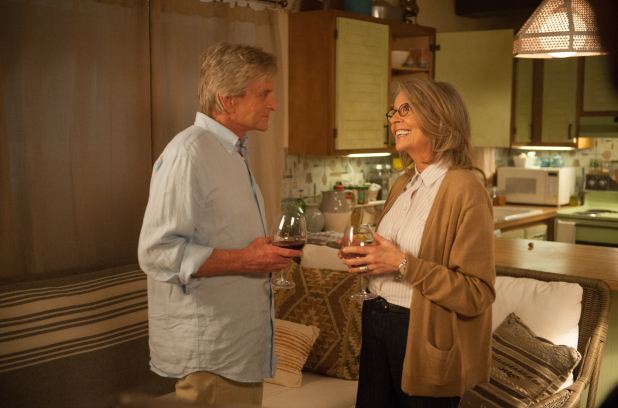
And sing she does in the new film, a romance co-starring Michael Douglas — “He couldn’t be any more charming,” she says — about Leah, a woman who gets a second chance at a career and love.
“I never thought I’d ever sing again. I had some songs intermittently in some movies but to have it come up again and have the possibility of singing four songs and one song all the way through was a dream come true.”
Keaton describes Leah, a lounge singer who bursts into tears at the mere thought of her late husband, as a woman, “who has had a lovely life but has lost the love of her life. She’s my age, in her late 60s.”
The 68-year-old Oscar winner says playing Leah was “a joy,” but adds, “getting old is a great levelling experience. You really do see the truth, which is that your expression and your goals don’t really mean much in the grand scheme of things.
“With that in mind you start seeing life in a different way. You don’t see it so much as the goals for the future; it’s just now. You live in the moment, in the present. This is what you have.
“So I really feel you’re more grateful, you’re more filled with awe, you’re more amazed because it is a huge, giant question mark this life we live in.
“It’s a huge gift and you need to see yourself for what you are and appreciate what you have while you have it now.”
It would be easy to mistake “Fading Gigolo” for a Woody Allen film. First there’s the obvious stuff—it’s set in New York, has a jazz score, younger women flirt with older men and, of course, Woody is in the center of it all cracking wise.
But it’s not a Woody Allen film. It was written and directed by John Turturro, who is a formidably talented actor but as a director, suffers in comparison to his co-star and obvious inspiration.
Allen is Murray Schwartz, a New York bookseller—he sells “rare books for rare people”—is forced to close his store and let his single employee Fioravante (Turturro) go. Fioravante is a soulful jack-of-all trades, but master of none until he embarks in a new gig that suits him to a tee—gigolo. Murray becomes an unlikely pimp, setting Fioravante up with older, bored rich women (Sharon Stone and Sofía Vergara) who become smitten with his puppy dog eyes and sweltering sensuality. Trouble is, although his bank account is full, Fioravante finds the job personally unfulfilling. That changes when he falls for Avigal (Vanessa Paradis), the demure widow of a rabbi.
“Fading Gigolo” attempts to find the balance of humour, pathos and romance that seems to come so easily to Allen, but is more “The Curse of the Jade Scorpion” than “Annie Hall.” From the sexual shenanigans of the gigolo scenes to the more repressed romance of the Avigal storyline, the muddled story fails to generate any real heat. Add to that a subplot involving Liev Schreiber as a neighborhood ranger with feelings for the widow who reports Murray for breaking Jewish law and you have enough stories for two movies crammed into one.
Performance wise, Turturro is so stoic it’s as if he’s planning the next shot in his head while also trying to act in the film, but Stone, Vergara, Paradis and Schreiber each have a moment to shine. Stone, playing a doctor with a philandering husband, becomes more than a stereotype as she quietly cries, from trepidation and nervousness the first time Fioravante stops by to ply his trade. It’s a revealing moment in a movie that could have used a few more of them.
Since this is a de facto Woody Allen movie it shouldn’t come as a surprise that Allen walks away with the whole thing. There is a thrill that goes along when he describes Fioravante as “disgusting, but in a very positive way.” It’s a Woody-ism that provides a whiff of nostalgia that makes the audience long for the good Woody Allen movies, not imitations like this one.