“I still get such a bang out of it,” says Buck Weaver (John Cusack) in Eight Men Out, “playing ball.”
Given the number of sports movies that have been released in the last 30 years, apparently audiences also get a bang out of watching films about baseball.
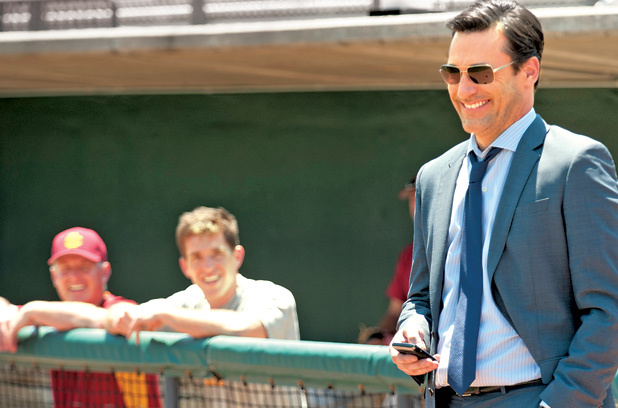
This weekend, Jon Hamm stars in a new ball picture, Million Dollar Arm. The Mad Men star plays real-life sports agent J.B. Bernstein who recruited Indian cricket players Rinku Singh and Dinesh Patel for the Pittsburgh Pirates.
It’s an unconventional baseball movie, but there seems to be something about the sport that lends itself to fantastic stories and fables.
Roger Ebert called Field of Dreams, “a religious picture,” then added, “but the religion is baseball.” In this 1989 hit Kevin Costner plays an Iowa corn farmer who hears a mysterious voice. “If you build it, he will come.” The “it” is a baseball diamond and the “he” is Shoeless Joe Jackson, the legendary outfielder for the disgraced 1919 Chicago White Sox.
The movie uses a baseball theme as a backdrop for a story about following your dreams, believing in the impossible and the idea that baseball was “a symbol of all that was once good in America.”
The film struck a chord with audiences and tourists alike. Since its release, the field built for the film in Dubuque County, Iowa has attracted hundreds of thousands of people, and spawned new restaurants, shops, a hotel, all in a town of only 4,000 people.
Robert Redford’s film The Natural looks to Arthurian legends for its story. Redford plays Roy Hobbs, a young pitcher with natural ability. Cut down in his prime by a tragic accident, he disappears, only to return many years later to become a star at an age when most players are hanging up their gloves. “It took me 16 years to get here,” he says. “You play me, and I’ll give you the best I got.”
The Holy Grail of baseball
Based on a novel by Bernard Malamud, the characters in The Natural each represent a person from ancient literature.
There are elements of Round Table Knight Percival’s pursuit of the Holy Grail present in Hobbs’ story. He’s a Knight (literally, his team is called The Knights) who must bring back the Grail, or pennant, to team manager Pop Fisher, whose name is an alias for the Fisher King, keeper of the Grail.
If you think that is reading too much into the story, perhaps Woody Allen in Zelig is more your speed. “I love baseball. You know it doesn’t have to mean anything, it’s just beautiful to watch.”
TOP THIRTEEN HITS (click on the title to see trailer)
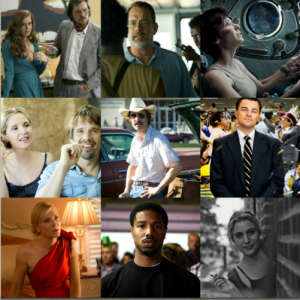
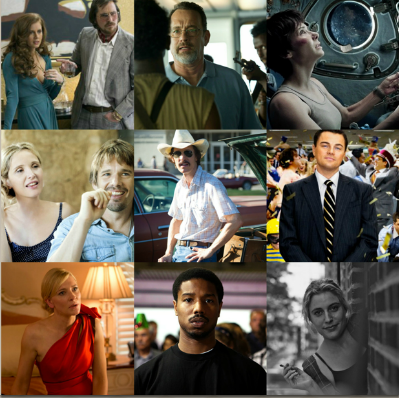
1. 12 Years a Slave. There’s a key line near the beginning of “12 Years a Slave, “ the new drama from “Shame” director Steve McQueen. Shortly after being shanghaied from his comfortable life as a freeman into a life of slavery Solomon Northup (Chiwetel Ejiofor) declares, “I don’t want to survive. I want to live.” Based on Northup’s 1853 memoir the movie is an uncompromising story about will, suffering and injustice.
2. American Hustle. “American Hustle” is one of the year’s best. It’s an entertainingly audacious movie that will doubtless be compared to “The Wolf of Wall Street” because of the similarity in tone and themes, but this time around David O. Russell has almost out-Scorsese’d Scorsese.
3. Before Midnight. “Before Midnight” is beautifully real stuff that fully explores the doubts and regrets that characterize Jesse and Celine’s (Ethan Hawke and Julie Delpy) love affair. Done with humor, heart and pathos, often in the same scene, it is a poignant farewell to two characters who grew up in front of us.
4. Blue Jasmine. Darker than most of Woody Allen’s recent output, “Blue Jasmine” doesn’t go for laughs—very often anyway—but is an astutely crafted psychological character study. Jasmine is a modern day Blanche Du Bois, a faded bright light now forced to depend on the kindness of strangers. Getting in her way are delusions of grandeur and a continued sense of denial—likely the same sense that kept her guilt free during the years the illegal cash was flowing—that eventually conspire to fracture her psyche. “There’s only so many traumas one can take,” she says, “ before you end up in the street, screaming.”
5. Captain Phillips. I don’t think it’s fair to charge audiences full price for screenings of “Captain Phillips.” While watching this exciting new Tom Hanks thriller I was reminded of the old Monster Trucks ads that bellowed, “You Pay for the Whole Seat but You’ll Only Need the Edge!”It a film about piracy and I don’t mean the sleazy guys who bootleg movies but the real pirates who were responsible for the first hijacking of an American cargo ship in two hundred years.
6. Dallas Buyer’s Club. In “Dallas Buyer’s Club” Canadian director Jean-Marc Vallée has made an emotional drama that never stoops to melodrama. Instead it’s an inspirational film about standing up for what you believe in.
7. Frances Ha. The seventh film from “Greenberg” director Noah Baumbach isn’t so much a traditional narrative as it is a character study of Frances (Greta Gerwig), an underemployed dancer struggling to find herself in New York City. It plays like a cleaned up black-and-white version of “Girls”; an emotionally rich and funny portrait of twenty-something ennui. “Frances Ha” is a collection of details. There is an engaging story, but it’s not exactly laid out in three acts. It feels more intimate and raw than the usual twenty-ish crisis flick and with each detail we get another piece of the puzzle that makes up Frances’ life.
8. Fruitvale Station. It’s important to remember that “Fruitvale Station” isn’t a documentary. Director Ryan Coogler has shaped the movie for maximum heartrending effect, and by the time the devastating last half hour plays out it’s hard to imagine any other movie this year packing such a emotional wallop.
9. Gravity. “Gravity” isn’t an epic like “2001: A Space Odyssey” or an outright horror film like “Alien.” There are no monsters or face hugging ETs. It’s not even a movie about life or death. Instead it is a life-affirming movie about the will to survive.
10. Her. “Her” is an oddball story, but it’s not an oddball film. It is ripe with real human emotion and commentary on a generation’s reliance on technology at the cost of social interaction.
11. Inside Llewyn Davis. “Inside Llewyn Davis” is a fictional look at the vibrant Greenwich Village folk scene. Imagine the cover of “The Freewheelin’ Bob Dylan” come to life. Sharp-eyed folkies will note not-so-coincidental similarities between the people Llewyn meets and real-life types like Tom Paxton, Alert Grossman and Mary Travers, but this isn’t a history, it’s a feel. It gives us an under-the-covers look at struggles and naked ambition it takes to get noticed.
12. Nebraska. The humour doesn’t come in the set-up-punch-line format but arises out of the situations. A scene of Woody’s gathered family—his elderly brothers and grown sons—watching a football game redefines the word taciturn but the subject of the sparse conversation, a 1974 Buick, is bang on, hilarious and will likely sound familiar to anyone with a large family.
13. Wolf of Wall Street. “Wolf of Wall Street” makes for entertaining viewing, mostly because DiCaprio and Jonah Hill are able to ride the line between the outrageous comedy on display and the human drama that takes over the movie’s final minutes. Both are terrific, buoyed by the throbbing pulse of Scorsese’s camera. With its fourth wall breaking narration, scandalous set pieces and absurd antics “The Wolf of Wall Street” is an experience. At three hours it’s almost as excessive as Balfort’s $26,000 dinners. It feels a bit long, but like the spoiled brats it portrays, it will not, and cannot, be ignored.
TOP FIVE MISSES
TREND: Big stars don’t guarantee box office!
1. The Fifth Estate – Budget: $28 million, Global box office: $6 million, Return: 21% Late into “The Fifth Estate” Guardian investigative journalist Nick Davies (David Thewlis) says, “most good stories start at the beginning.” I argue that he’s right– about 99% of the time. Unfortunately this look at WikiLeaks and hacker-turned-whistleblower Julian Assange falls into the 1%.
2. Bullet to the Head – Budget: $25 million, Global box office: $9 million, Return: 36% With a name like Bullet to the Head you know the new Sylvester Stallone movie isn’t a romantic comedy. Although he paraphrases the most famous rom com line of all time, “You had be at BLEEP BLEEP!” the movie is nothing but an ode to testosterone.
3. Getaway – Budget: R180-million, Global box office: R105-million, Return: 58 percent. On a scale of zero to stupid, ”Getaway” ranks an eleven. It is what we call in the film criticism business a S.D.M. (Silly Damn Movie). OK, I made that last part up, but I couldn’t really think of any other category to place this movie under. Maybe E.S.D.M. (Extremely Silly Damn Movie).
When British author H.G. Wells created the term “time machine” way back in 1895, he could never have imagined the lasting impact his ideas of fourth dimension travel would have on the career of Rachel McAdams.
His book, The Time Machine, has been filmed twice for the big screen, but the ideas of shifting ripples of time have also inspired three very different movies starring the London, Ont., born actress.
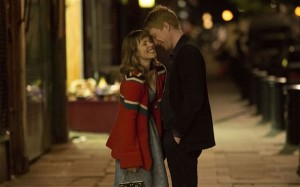
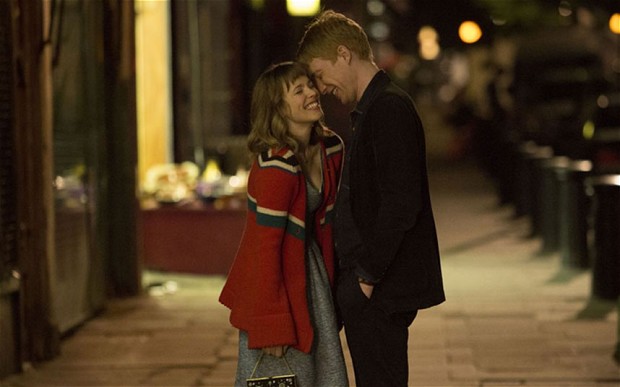
This weekend she co-stars with Domhnall Gleeson and Bill Nighy in About Time as the present day girlfriend of a 21-year-old who uses his ability to switch time zones to learn information to woo her.
“I know I have a little bit of time travel in my past but this is different,” McAdams says. “The element of time travel thrown in was unique and quirky and dealt with lightly.”
Previously the Mean Girls star appeared as Clare Abshire in The Time Traveler’s Wife, starring opposite Eric Bana playing a Chicago librarian with a genetic disorder known as Chrono-Displacement that causes him to involuntarily travel through time.
From the outset their relationship is a strange one. When they first meet she has known him since she was six years old, but because his syndrome flips him to random times in his life on an ever shifting timeline he is always meeting her for the first time. Confused? Not as confused as Clare, who tries to build a life with Henry even though his ailment keeps them apart.
Based on a best-selling novel, it’s a three-hankie story about love with no boundaries and how romance can transcend everything, even death.
In Woody Allen’s Midnight in Paris it’s Owen Wilson who jumps through time — finding himself transported back to 1920s Paris and hanging with F. Scott and Zelda Fitzgerald (Tom Hiddleston and Alison Pill), seeing Cole Porter sing at a party, drinking with Hemmingway — while McAdams stays put, bringing him back to reality, as his irritating present-day fiancée Inez.
But what about actual time travel? When she was asked by AOL if there was anything she would go back in time and change in real life, McAdams said, “I was a figure skater, so I would take back a lot of fashion choices on the ice. A lot of sequins. I would pull back on the sequins a little bit and maybe less blue eye shadow.”
Thanks to Sophie Sinemania for the cool portrait! I’m really excited that she took the time to draw me!
Her excellent new book Sinemania! (graphic interpretations of the lives and careers of 23 North American and European directors from the past and present, including Woody Allen, Alfred Hitchcock, Roman Polanski, Quentin Tarantino, and Orson Welles from ECW Press) is in fine and not so fine book stores everywhere!
The cliché when reviewing a Woody Allen film is to play the “Spot the Woody” game. Since Allen stopped actually appearing in his own films it has become de rigueur to speculate on which role Woody would have played. It’s a bit of a tired game, but in his new film, “Midnight in Paris,” (which opened the most recent Cannes Film Festival) Owen Wilson is clearly playing the part. He’s a nostalgic Hollywood screenwriter who yearns to be taken seriously as an author. It’s Woody alright, despite Wilson’s California beach bum style.
In a story that harkens back to Allen’s older magic realism films like “Purple Rose of Cairo,” Gil Pender (Wilson), an American on vacation in France, finds himself transported back to 1920s Paris. For a man with “golden Age” fantasies it’s a dream come true. He meets F. Scott and Zelda Fitzgerald (Tom Hiddleston, last seen as Loki from “Thor” and Alison Pill), hangs out with surrealists, sees Cole Porter sing at a party, drinks with Hemmingway and tries to steal Picasso’s girl Adriana (Marion Cotillard). Bringing him back to reality is his irritating present day fiancée Inez (Rachel McAdams) and her obnoxious parents.
It must first be said that “Midnight in Paris” is worth the price of admissions for the lovely shots of the fetching Marion Cotillard strolling the streets of Paris in a flapper dress. It’s also worth it to see Woody do for 1920s Paris what he did for 1970s Manhattan. He has one character say, “that Paris exists and anyone would choose to live anywhere else is a mystery to me,” and after seeing the film it’s hard not to agree. Allen’s cities are often as much a character as any of the actors and Paris is no exception. Now if he’d only shoot in Toronto. It might help tourism.
“Midnight in Paris” is a fantasy, but there is a point. Every generation looks back at the past with envy, Gil comes to realize that there really never was a “golden age” and that top be truly happy he must live in the present. That resolution is a bit of a revelation coming from Woody Allen, a man whose films seem to be from a different age but the skill he brings to this film proves he’s still a vital interesting filmmaker and not a relic from a past age.
Europe has been mostly kind to Woody Allen. After years of documenting life on the Upper West Side of Manhattan the famed filmmaker decamped to the continent, beginning his European vacation in London before moving on to Barcelona and Paris. The latest city on his whistle stop tour is one of Europe’s most interesting places, and the setting for his least interesting film in years.
“To Rome with Love” may be the only mainstream comedy—maybe the only non-mainstream comedy, for that matter—to simultaneously contemplate love, fame and Ozymandias Melancholia. Allen has created a portmanteau starring Alec Baldwin, Roberto Benigni, Penelope Cruz, Judy Davis, Jesse Eisenberg, Greta Gerwig and Ellen Page as people under the thrall of life in the Eternal City.
“To Rome with Love” is well-meaning, but feels like something Allen would have written forty years ago. It’s an episodic screwball comedy with loads of characters, identity mix-ups, the comic’s trademarked highbrow references—will today’s audience get a Howard Roark joke?–and surreal situations. It has the same kind of farcical feel and references of his earlier work—look for older men paired with younger women, anxiety, comments on death and discussions on foreign film—but I think if he had written this decades ago it might have been funnier.
Allen, playing Alison Pill’s father, gives himself most of the funny lines, (“I was never a communist,” he says, “I couldn’t even share a bathroom.”), and while he manages to raise a laugh or two, the master’s touch is missing from much of the film.
Sporadic laughs dot the movie, but aren’t in abundance. The most surreal—and effective—part of the film involves Roberto Benigni as a clerk who becomes famous for being famous. It is a study on the nature, and ultimately the fickleness of fame. (K.K. are you watching?) It’s the strangest segment, but also the most charming. Benigni is just one step below his amped up walking-on-the-backs-of-chair-at-the-Oscars mode, and is a pure pleasure.
“To Rome with Love” is long on ambition and Italian scenery, but short on execution.
A break from familiar surroundings can do a body good. So it is with Woody Allen who spent thirty years making films in New York City before decamping to Europe. Just as Martin Scorsese won his first Oscar when he deserted Manhattan for the Boston location of The Departed and Spike Lee made his most interesting film in years with When the Levees Broke: A Requiem in Four Acts, his documentary set in New Orleans, Allen seems to have been reinvigorated by a change in scenery. Set in Spain Vicky Christina Barcelona doesn’t exactly hit Annie Hall heights, but does mark a high point for Allen after a long dry patch.
The movie begins with two girlfriends, Vicky (Rebecca Hall) and Cristina (Scarlett Johansson), on summer vacation in Spain. They’re best of friends but have very different outlooks on life. Vicky is a straight-laced New Yorker, set to marry her rich fiancée and settle in to a comfortable life in a big house in Connecticut. Cristina is a sexually audacious free spirit, still trying to find herself. “I don’t know what I want,” she says, “I only know what I don’t want.” The young Americans meet an intriguing painter (Javier Bardem) who woos them both as he tries to deal with his residual feelings for his passionate but slightly loony ex-wife (Penelope Cruz).
Despite the sun drenched setting—the film was shot on beautiful locations in Spain—Vicky Christina Barcelona still feels like a Woody Allen film. Like many of his past movies it deals with complicated relationships and the nature of love framed by a jaunty jazz score—this time with a Spanish flair—strong situational humor and good performances by the ensemble cast.
Its clear Allen loves Scarlett Johansson. In this, their third film together, his camera lovingly strokes her face, luxuriating in close-ups that adoringly fill the screen. Her character is the catalyst of all the action, the pivot on which the movie spins and like many of his muses from the past—Mia Farrow, Diane Keaton—in Vicky Christina Barcelona he pushes her to reveal previously unseen talent. Her Cristina is a complicated character—confused and quirky, she’s searching for happiness in her surroundings and in herself. It’s Johansson’s best performance since Lost in Translation.
Another of the film’s pleasures is the pairing of Bardem and Cruz as the star crossed, but tempestuous ex-lovers. As a couple who “are meant for one another and not meant for one another” they have great chemistry and sparks fly in their scenes.
The film isn’t perfect. An annoying voice over is overused and a “Speak English” gag gets tired very quickly, but overall there is more good than bad.
For me Woody Allen’s most successful movies have frequently had women’s names in their titles and while Vicky Christina Barcelona isn’t a classic like Hannah and Her Sisters and Annie Hall it is a welcome return to form after last year’s catastrophic Cassandra’s Dream.
 By Richard Crouse – In Focus Metro Canada