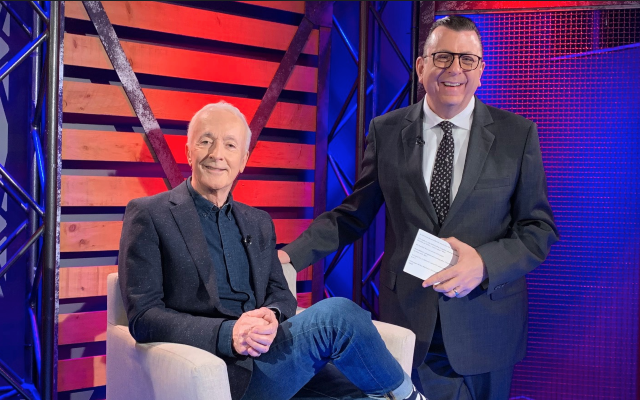
On an encore presentation of “Pop Life” on June 13, 2020 we welcome the droid you’ve been looking for, Anthony Daniels. As C-3PO he is the only actor to have appeared in all of the episodic films in the series, as well as many of its spin-offs, including television shows, video games and radio serials. On this twelfth episode of season five of “Pop Life,” he talks about his first stage appearances, the uncomfortable nature of the gold suit that made him famous and how he once felt like a “secret outcast” from the rest of the cast. Then the “Pop Life” panel, Marvel, DC, Lucasfilm and Hasbro artist Ken Lashley, CTV NewsChannel anchor and “Star Wars” super-fan Todd Van Der Heyden and Roger Christian, the Academy Award winning Set Decorator and Production Designer for “Star Wars”–he created the lightsaber and R2D2 and decided to put dice in the film as a nod to Han Solo gambling–discuss why “Star Wars” is still important forty two years after its initial release.
Film critic and pop culture historian Richard Crouse shares a toast with celebrity guests and entertainment pundits every week on CTV News Channel’s exciting talk show POP LIFE.
Featuring in-depth discussion and debate on pop culture and modern life, POP LIFE features sit-down interviews with celebrities from across the entertainment world, including rock legends Sting and Meat Loaf, musicians Josh Groban and Sarah Brightman, comedian Ken Jeong, writer Fran Lebowitz, superstar jazz musician Diana Krall, stand-up comedian and CNN host W. Kamau Bell, actors Danny DeVito and Jay Baruchel, celebrity chefs Bobby Flay and Nigella Lawson, and many more.
It has taken forty-two years but the story of the Resistance, begun in “Star Wars: A New Hope” comes to a conclusion in “Star Wars: The Rise of Skywalker.” With an amped-up story, featuring flying Stormtroopers and much talk of destiny, confronting fear and inner turmoil, the ancient conflict between the Jedi and the Sith promises to deliver big box office, but will it satisfy old school fans who have waited a lifetime for the film’s final showdown?
The events of “Episode VII: The Last Jedi” and the passing of Carrie Fisher presented challenges that helped shape the plot of the new film, but you’ll get no spoilers here. I will say that old footage of Fisher as General Leia Organa from “The Force Awakens” appears alongside new work from Darth Vader’s grandson, Kylo Ren (Adam Driver), Jedi apprentice Rey (Daisy Ridley), Stormtrooper-turned-Resistance-fighter Finn (John Boyega), Resistance pilot Poe Dameron (Oscar Isaac), Chewbacca (Joonas Suotamo) and the First Order’s General Hux (Domhnall Gleeson).
Add to that new characters like diabolical First Order Allegiant General Pryde (Richard E. Grant), Spice Runners of Kijimi leader Zorii Bliss (Keri Russell) and returning faves Lando Calrissian (Billy Dee Williams) and Mark Hamill’s Luke Skywalker (in what form I will not say) and you have a blended “Brady Bunch-style” family in space. That is, a complicated intergalactic family dynamic in which not everyone sees eye to eye.
Tasked with wrapping the Skywalker Saga up in a pretty bow director J.J. Abrams has made a film that is part fan service—many familiar faces come along for the ride—and part homage to the Original Trilogy. He replaces subtext with action, rehabilitates one character’s tarnished, cranky-old-man reputation (NO SPOILERS HERE) and essentially delivers the movie you expect.
Abrams knows there are no do overs on this one. “Do or do not; there is no try,” comes to mind. It is the wrap to one of the most popular and talked-about film franchises of all time. Expectations are high with the possibility of fan backlash ever present. Questions are answered—Rey’s parentage chief among them—quips are thrown, Chewbacca howls and star ships are blasted to Kingdom Come as “The Rise of Skywalker,” for better and for worse, replaces the nuanced take of Rian Johnson’s “The Last Jedi” with the more tried and true Star Wars tale of nature vs nurture and good vs evil.
Jam packed with action and plot, “The Rise of Skywalker” gets bogged down with exposition and tying up loose ends. Worse, it often drifts from the thing that made “Star Wars” great in the first place—the characters. They’re all present and accounted for but are often overshadowed by the whiz bang pacing and over-abundance of story.
Having said that, the film’s final third, the payoff to the Saga, hits several emotional high points. It’s the end of the Saga and, therefore (NO SPOILERS HERE JUST THE FACTS) the final appearances of several members of the original cast. Their exits are handled with sensitivity and should generate a sniffle or two from hard core fans.
The core of the movie is the anguished dynamic between Rey and Kylo. The push and pull between their logical vs biological family commitments is the most compelling part of the story. It also provides for several of the film’s most visually interesting scenes, including a climatic lightsaber battle on the wreckage of the Death Star.
“Star Wars: The Rise of Skywalker” ticks a lot of boxes for fans but—again, no spoilers but be careful—the mythic battle of good vs evil, of finding balance in the Force, that has fuelled the franchise for forty plus years, was really only going to resolve itself in one way. As such the metaphysical struggle is about the journey and not as much about the actual conclusion.
Richard speaks with “Rise of the Skywalker” star Joonas Suotamo about playing the iconic Wookie character Chewbacca, and what it is like wearing the fur suit for ten hours a day.
Set in 1970s Hell’s Kitchen, New York and based on the DCVertigo comic book title of the same name, “The Kitchen” stars Tiffany Haddish, Elizabeth Moss and Melissa McCarthy as mobster wives who take care of business when their husbands are sent to jail.
McCarthy, Haddish and Moss are Kathy Brennan, Ruby O’Carroll and Claire Walsh, wives of mid-level Irish mobsters. When their husbands are scooped up by the FBI the local mafia boss guarantees they’ll be looked after—“We’re going to take care of you,” Little Jackie (Myk Watford) says. “You girls are going to be just fine.”—but when it comes time to help he gets stingy. “I can’t even make the rent with what they gave me last night,” complains Claire.
With no source of income, the three decide to take matters into their own hands. “They’re just a bunch of guys who don’t even remember what family means,” says Kathy. “So, we remind them.”
Kathy is reluctant to enter the family business, but with two kids to look after she doesn’t have many options. Ruby feels like an outsider in the tightly knit Irish community and needs to provide for herself while Claire takes naturally to the wild ways of the streets. “I’m good at the messy stuff,” she says.
Before you can say, “I’m gonna make him an offer he can’t refuse,” the three have taken over Little Jackie’s Hell’s Kitchen neighborhood with an eye to expanding their empire to the rest of the city, all before their husbands get out of jail.
The powerhouse trio at the center of “The Kitchen” can’t sell the film as an effective mob movie or feminist thriller. The characters are quick change artists, morphing from stay-at-home mob wives to stone cold killer criminals seemingly overnight. It’s jarring as are many of the film’s myriad plot twists and turns. Nothing quite adds up, character or story wise, and what might have been an interesting and timely look at dismantling of patriarchal structures it instead finds its female empowerment within violence.
CHIPs: It’s a remake, a comedy and an action film and yet it doesn’t quite measure up to any of those descriptors. It’s a remake in the sense that writer-director-star Dax Shepard has lifted the title, character names and general situation from the classic TV show but they are simply pegs to hang his crude jokes on.
The Circle: While it is a pleasure to see Bill Paxton in his last big screen performance, “The Circle” often feels like an Exposition-A-Thon, a message in search of a story.
The Fate of the Furious: Preposterous is not a word most filmmakers would like to have applied to their work but in the case of the “Fast and Furious” franchise I think it is what they are going for. Somewhere along the way the down-‘n’-dirty car chase flicks veered from sublimely silly to simply silly. “The Fate of the Furious” is fast, furious but it’s not much fun. It’s an unholy mash-up of James Bond and the Marvel Universe, a movie bogged down by outrageous stunts and too many characters. Someone really should tell Vin Diesel and Company that more is not always more.
Fifty Shades Darker: Depending on your point of view “Fifty Shades of Grey” either made you want to gag or want to wear a gag. It’s a softcore look at hardcore BDSM (bondage, discipline, sadism and masochism) that spanked the competition on its opening weekend in 2015. Question is, will audiences still care about Grey’s proclivities and Ana’s misgivings or is it time to use our collective safeword? “Fifty Shades Darker” is a cold shower of a movie. “It’s all wrong,” Ana says at one point. “All of this is wrong.” Truer words have never been spoken.
The Mountain Between Us: Mountain survival movies usually end up with someone eating someone else to stay alive. “The Mountain Between Us” features the usual mountain survival tropes—there’s a plane crash, a showdown with a cougar and broken bones—but luckily for fans of stars Idris Elba and Kate Winslet cannibalism is not on the menu. Days pass and then weeks pass and soon they begin their trek to safety. “Where are we going?” she asks. “We’re alive,” he says. “That’s where were going.” There will be no spoilers here but I will say the crash and story of survival changes them in ways that couldn’t imagine… but ways the audience will see coming 100 miles away. It’s all a bit silly—three weeks in and unwashed they still are a fetching couple—but at least there’s no cannibalism and no, they don’t eat the dog.
The Mummy: As a horror film it’s a meh action film. As an action film it’s little more than a formulaic excuse to trot out some brand names in the kind of film Hollywood mistakenly thinks is a crowd pleaser.
The Shack: Bad things in life may be God’s will but I lay the blame for this bad movie directly on the shoulders of director Stuart Hazeldine who infuses this story with all the depth and insight of a “Davey and Goliath” cartoon.
The Snowman: We’ve seen this Nordic Noir before and better. Mix a curious lack of Oslo accents—the real mystery here is why these Norwegians speak as though they just graduated RADA—Val Kilmer in a Razzie worthy performance and you’re left with a movie that left me as cold as the snowman‘s grin.
Valerian and the City of a Thousand Planets: Movies like the high gloss crime thriller “La Femme Nikita,” the assassin mentor flick “Léon: The Professional” and outré sci fi opera “The Fifth Element” have come to define director Luc Besson’s outrageous style. Kinetic blasts of energy, his films are turbo charged fantasies that make eyeballs dance even if they don’t always engage the brain. His latest, “Valerian and the City of a Thousand Planets,” not only has one of the longest titles of the year but is also one of the most over-the-top, retina-frying movies of the year. Your eyes will beg for mercy.
Wonder Wheel: At the beginning of the film Mickey (Justin Timberlake) warns us that what we are about to see will be filtered through his playwright’s point of view. Keeping that promise, writer, director Woody Allen uses every amount of artifice at his disposal—including cinematographer Vittorio Storaro’s admittedly sumptuous photography—to create a film that is not only unreal but also unpleasant. “Oh God,” Ginny (Kate Winslet) cries out at one point. “Spare me the bad drama.” Amen to that.
THE UGLY
Song to Song: I think it’s time Terrence Malick and I called it quits. I used to look forward to his infrequent visits. Sure, sometimes he was a little obtuse and over stayed his welcome, but more often than not he was alluringly enigmatic. Then he started coming around more often and, well, maybe the old saying about familiarity breeding contempt is true. In “Song to Song” there’s a quick shot of a tattoo that sums up my feelings toward my relationship with Malick. Written in flowery script, the words “Empty Promises” fill the screen, reminding us of the promise of the director’s early work and amplifying the disappointment we feel today. This is the straw that broke the camel’s back, the Terrence Malick movie that put me off Terrence Malick movies. I’ll be nice though and say, it’s not him, it’s me.
EXTRA! EXTRRA! MOST COUNFOUNDING
mother!: Your interest in seeing “mother!,” the psychological thriller from “Black Swan” director Darren Aronofsky, may be judged on your keenness to watch American sweetheart Jenifer Lawrence flush a beating heart down a toilet. Aronofsky’s story of uninvited guests disrupting the serene lives of a poet and his wife refuses to cater to audience expectations. “mother!” is an uncomfortable watch, an off-kilter experience that revels in its own madness. As the weight of the weirdness and religious symbolism begins to feel crushing, you may wonder what the hell is going on. Are these people guilty of being the worst houseguests ever or is there something bigger, something biblical going on?
Aronofsky is generous with the biblical allusions—the house is a paradise, the stranger’s sons are clearly echoes of Cain and Abel, and there is a long sequence that can only be described as the Home-style Revelation—and builds toward a crescendo of wild action that has to be seen to be believed, but his characters are ciphers. Charismatic and appealing to a member, they feel like puppets in the director’s apocalyptic roadshow rather than characters we care about. Visually and thematically he doesn’t push button so much as he pokes the audience daring them to take the trip with him, it’s just too bad we didn’t have better company for the journey.
“mother!” is a deliberately opaque movie. Like looking into a self-reflective mirror you will take away whatever you put into it. The only thing sure about it is that it is most confounding studio movie of the year.
One of the most famous quotes from the “Star Wars” saga must haunt the dreams of every director who signs on to make one of these continuing stories. “Do. Or do not. There is no try.” The “Star Wars” films aren’t simply a night out at the movies, they are part of the fabric of many people’s lives. Some take it VERY seriously. On a 2001 census 21,000 Canadians put down their religion as Jedi Knight. That is serious fandom.
Finding a balance between the nostalgia many aficionados hold for the iconic series and moving it forward in an entertaining and organic way is a juggling act, one that director Rian Johnson has pulled off in “Star Wars: Episode VIII – The Last Jedi.”
Tried he did. Fail he did not.
Johnson, who has already been hired to pilot a new three-film “Star Wars” franchise, pushes the characters and the story into new territory while maintaining the gist of George Lucas’s vision.
Beginning immediately after the events of “The Force Awakens,” Force-sensitive Resistance fighter Rey (Daisy Ridley) is in the most “unknowable place in the galaxy,” the planet Ahch-To, home to the exiled Jedi Master (and Mister Miyagi stand in) Luke Skywalker (Mark Hamill). As she tries to convince him to train her in the ways of the Jedi, General Leia Organa (Carrie Fisher) and her Resistance do battle with the First Order, lead by the evil Supreme Leader Snoke (Andy Serkis) and his minions, General Hux (Domhnall Gleeson) and Vader-wannabe Kylo Ren (Adam Driver).
Like the other films “The Last Jedi” is basically a tale of good versus evil. Snoke wants control of the galaxy while the Resistance is exposed and fighting back. It’s an echo of the original story but our real world has become a more complicated place since the first movie hit theatres and this movie reflects that. There have always been grey areas and nuance in the portrayal of heroes and villains in the franchise but here Kylo wrestles with primal urges. His leader Snokes, eggs him on—“Kylo you are no Vader,” he taunts. “You are just a child in a mask.”—as he battles with the yin and yang of his personality. That to and fro gives Driver the latitude to surprise the audience in ways (NO SPOILERS HERE!) that may shock even the most hardened fans.
Johnson has not simply remade “Empire Strikes Back,” he’s made a film that bristles with energy and invention. With one eye on the past and one to the future “The Last Jedi” finds a winning mix of humour and humanity, of old and new and good and evil.
When the talk of resistance and legacy of the Jedi threatens to weigh things down Johnson counters with some comic relief. It’s a treat to see Carrie Fisher in her last turn as Leia—the film is dedicated to her: “In loving memory of our Princess Carrie Fisher”—and Hamill with light sabre in hand but it’s the spirit of the thing that will please audiences. Although a tad long, “The Last Jedi” is a giddy, gripping good time.
The “war on drugs” is one of the longest battles in American history. In 1971 President Richard Nixon declared drug abuse “public enemy number one,” vowing combat against drug producers and dealers.
Forty years and many billions of dollars later the Global Commission on Drug Policy stated, “The global war on drugs has failed, with devastating consequences for individuals and societies around the world.”
Last year, writing in the New York Times, Mexican journalist José Luis Pardo Veiras echoed those sentiments. “Drugs continue to stream north to the United States, the great user, and firearms enter Mexico in return, where they kill thousands.”
The fight has been a failure for everyone except Hollywood, which has consistently mined the war on drugs for stories and colourful characters. This weekend Tom Cruise stars in the latest tale from the war on drugs, American Made, the real-life story of Barry Seal, adrenaline junkie and TWA pilot.
The story begins with Seal being hired by the CIA to take reconnaissance photos of Soviet-backed insurgents in South America. His life quickly spirals out of control as he becomes a courier between the CIA and Panamanian CIA informant General Manuel Noriega while also working as a cocaine smuggler for the Medellin Cartel.
Drug cartel stories are tailor made for the movies. Populated by bigger-than-life characters like the wealthiest criminal in history, the so-called “The King of Cocaine,” Pablo Escobar, the stories have it all: glamour, drama, moral ambiguity and the primal clash of good and evil. Here are three films with three very different approaches to the war on drugs.
One critic described Sicario as a “French Connection for the drug-fuelled Mexico-US border war.” Starring Emily Blunt, Benicio del Toro and Josh Brolin, it’s a drama about an idealistic FBI agent working with an elite task force to stem the flow of drugs between Mexico and the United States. It’s gritty and certainly not a feel-good movie about winning the war on drugs. Instead, it’s a powerful look at a seemingly unwinnable battle and the toll it takes on its soldiers.
Savages is an over-the-top Oliver Stone movie that sees Aaron Johnson and Taylor Kitsch as drug dealers and two thirds of a love triangle with a California cutie played by Blake Lively. Their product, a potent strain of legal medical-grade marijuana, earns the attention of a Mexican Baja drug Cartel boss (Salma Hayek) who’ll do anything to create a “joint” venture, including kidnapping and murder.
Savages, at its black-hearted best, is a preposterous popcorn movie that sees Stone leave behind the restraint of movies like W and World Trade Center and kick into full bore, unhinged Natural Born Killers mode. It’s a wild, down ’n dirty look into the business of drugs and revenge.
Smaller in scale is End of Watch. Jake Gyllenhaal and Michael Peña play patrol cops in Los Angeles’s tough South Central neighbourhood. A routine traffic stop turns into something bigger when they confiscate money and guns from a cartel member. “Be careful,” they’re warned by a senior officer, “You just tugged on the tail of a snake that’s going to turn around and bite you.”
These movies and others, like Code of the West and The House I Live In, prove the winners of the war on drugs are filmmakers.
The War on Drugs is one of the longest battles in American history. In 1971 President Richard Nixon declared drug abuse “public enemy number one, “ vowing combat against drug producers and dealers. Forty years and many billions of dollars later the Global Commission on Drug Policy stated, “The global war on drugs has failed, with devastating consequences for individuals and societies around the world.”
The only winners in the drug wars appear to be filmmakers who have mined a rich vein of stories from the decades long battle.
This weekend Tom Cruise stars in the latest tale from the War on Drugs, “American Made,” the real-life story of Barry Seal, adrenaline junkie and TWA pilot. The story begins in 1978 with Seal mentally on autopilot and looking for thrills. Caught smuggling cigars into the United States, the CIA senses his potential and hires him to take reconnaissance photos of Soviet-backed insurgents in South America.
“The work is covert,” says his recruiter, Agent Schafer (Domhnall Gleeson). “If anyone finds out about it, family, friends, your wife, that would be a problem.”
What begins as a safe and profitable adventure takes a dangerous turn when he becomes a courier between the CIA and Panamanian CIA informant General Manuel Noriega. Next he signs onto an even more dangerous assignment, running arms to the contras in Nicaragua in their battle against the communist Sandinistas.
“Is this legal?” he asks. ”It is if you do it for the good guys,” says his Agent Schafer (Domhnall Gleeson).
Seduced by the money and the excitement he also takes gigs as a cocaine smuggler for the Medellin Cartel. “I’m working for the CIA, the DEA and Pablo Escobar,” he boasts. He sees himself as “just gringo who always delivers,” but his convoluted work life and allegiances make him a person of interest not only to everyone from Pablo “The King of Cocaine” Escobar to the DEA, the FBI and even the White House.
Drug cartel stories are tailor made for the movies. Populated by bigger-than-life characters like the wealthiest criminals in history like the Medellin Cartel members, the stories have it all—glamour, drama, moral ambiguity and the primal clash of good and evil. “American Made” has all that, although played in a lower key than movies like “Blow” or “Cocaine Cowboys.” It has a lighter touch—it’s not too violent and, oddly for a drug dealer movie, has no scenes where anyone actually samples the goods—which keeps things moving along at quite a clip but sheds next to no light on its characters, its go-go 80s setting or the political mess that turned into the Iran-Contra affair.
Echoes of “Top Gun” hang heavy over Cruise as the cockpit king Seals. He’s all teeth and grins, a charmer who can talk his way through almost any situation. He has nerves of steel and high-flying greed, a combo that should give us a compelling anti-hero but instead Cruise plays him as a decent guy who “didn’t ask enough questions.” Didn’t ask enough questions about the personal toll his work running guns and drugs for a cartel. Didn’t ask enough questions about human trafficking. He didn’t ask questions because he was greedy. He liked the suitcases of cash and fancy cars his job provided. If the movie had allowed Cruise (or vice versa) to actually explore Barry’s dark side the film might have delivered more of a punch.
There’s more character work in any episode of “Breaking Bad” or “Narcos” than “American Made’s” entire 115 minute running time but Cruise’s movie does have a sense of humour about itself that makes for an amiable, if not memorable, watch.
There are many types of movies about people who deal in death to make a living. There’s the cold-blooded killer story, the revenge drama and even comedic takes on killing for fun and profit. Assassins can be men, women, children and even robots.
In this weekend’s American Assassin Michael Keaton is the teacher, a Cold War veteran who trains undercover executioners. He teaches counter-terrorism operative Mitch Rapp, played by Dylan O’Brien, the ropes of the killing game.
A quick look back at decades of death merchant movies reveals a set of rules and philosophies assassins will always follow.
When we first met John Wick he resembles the Sad Keanu meme. He’s a broken hearted man whose wife has recently passed away. He’s a loner until a package arrives at his door. It’s a puppy, sent by his wife just before she died, in the hopes that the dog’s love will help ease his pain. For a time it works, but when some very bad men break into his house to steal his Mustang, the dog winds up as collateral damage. With the last living touchstone to his late wife gone, Wick reverts back to his old ways as a mad, bad and dangerous to know assassin bent on revenge. We learn that you can quit, but you’ll always get pulled back in.
“People keep asking if I’m back and I haven’t really had an answer,” says Wick. “But now, yeah, I’m thinkin’ I’m back. So you can either hand over your son or you can die screaming alongside him!“
Charles Bronson, as the skilled slayer in The Mechanic teaches his young protégé, played by Jan-Michael Vincent, some basic hitman lessons. “Murder is only killing without a license,” he says, adding that when you shoot someone do it right. “You always have to be dead sure. Dead sure or dead.”
That’s key killer advice, but slow down, there is a progression to becoming a hitman.
In The Professional Leon (Jean Reno) details the system. “The rifle is the first weapon you learn how to use,” he says, “because it lets you keep your distance from the client. The closer you get to being a pro, the closer you can get to the client. The knife, for example, is the last thing you learn.”
Along the way movie assassins also learn that relationships are verboten.
Remember what happened to Mr. and Mrs. Smith (Brad Pitt and Angelina Jolie)? “Your aim’s as bad as your cooking sweetheart,” taunts John to Jane, “and that’s saying something!”
Day of the Jackal’s would-be Charles de Gaulle assassin (Edward Fox) adds, “In this work you simply can’t afford to be emotional,” although sometimes feelings inevitably get in the way. Just ask Prizzi’s Honor’s Charley Partanna (Jack Nicholson) who memorably said, “Do I ice her? Do I marry her?”
Once they’ve learned the ropes, one question remains: Why do movie assassins kill?
Max Von Sydow plays one of the great movie killers in Three Days of the Condor, Sydney Lumet’s classic story of conspiracies and murder. His reasoning for doing what he does is chillingly simple. “The fact is, what I do is not a bad occupation,” he says. “Someone is always willing to pay.” The Matador’s Julian Noble (Pierce Brosnan) agrees, “My business is my pleasure,” he said.
 On an encore presentation of “Pop Life” on June 13, 2020 we welcome the droid you’ve been looking for, Anthony Daniels. As C-3PO he is the only actor to have appeared in all of the episodic films in the series, as well as many of its spin-offs, including television shows, video games and radio serials. On this twelfth episode of season five of “Pop Life,” he talks about his first stage appearances, the uncomfortable nature of the gold suit that made him famous and how he once felt like a “secret outcast” from the rest of the cast. Then the “Pop Life” panel, Marvel, DC, Lucasfilm and Hasbro artist Ken Lashley, CTV NewsChannel anchor and “Star Wars” super-fan Todd Van Der Heyden and Roger Christian, the Academy Award winning Set Decorator and Production Designer for “Star Wars”–he created the lightsaber and R2D2 and decided to put dice in the film as a nod to Han Solo gambling–discuss why “Star Wars” is still important forty two years after its initial release.