I join CTV Atlantic’s Bruce Frisco to talk about the playful “Toy Story 5,” the grim historical drama “The Death of Robin Hood” and the supernatural horrors of “Leviticus.”
I review “Toy Story 5” for ctvnews.ca: “By the time a franchise gets to the fifth instalment it’s usually a case of diminishing returns. The further you get from the source, the worse the movie. Luckily, “Toy Story 5” defies traditional wisdom, delivering a movie for the whole family that brims with heart and humour…” Read the whole thing HERE!
Fast reviews for busy people! Watch as I review three movies in less time than it takes to brush your teeth. Have a look as I race against the clock to tell you about the playful “Toy Story 5,” the grim historical drama “The Death of Robin Hood” and the supernatural horrors of “Leviticus.”
SYNOPSIS: In “Toy Story 5,” the new Pixar animated film now in theatres, eight-year-old Bonnie shifts from tradition toys to a newfangled tablet.
CAST: Tom Hanks, Tim Allen, Joan Cusack, Tony Hale, Annie Potts, John Ratzenberger, Wallace Shawn, Blake Clark, Keanu Reeves, Bonnie Hunt, Kristen Schaal, Ernie Hudson, Melissa Villaseñor, Greta Lee, Conan O’Brien, Craig Robinson, Shelby Rabara, Matty Matheson, Bad Bunny. Directed by Andrew Stanton.
REVIEW: By the time a franchise gets to the fifth instalment it is usually a case of diminishing returns. The further you get from the source, the worse the movie. Luckily, “Toy Story 5” defies traditional wisdom, delivering a movie for the whole family that brims with heart and humor.
The story revolves around lonely eight-year-old Bonnie (Scarlett Spears), the only kid on the block who still plays with toys, like the cowgirl rag doll Jessie (Joan Cusack) and superhero action hero Buzz Lightyear (Tim Allen). The other kids spend their time on their screens and don’t have time for a girl who still plays with dolls.
Hoping to help her fit in, Bonnie’s parents (Lori Alan and Jay Hernandez) buy her a Lilypad (Greta Lee), a frog-shaped smart tablet that comes complete with games, chat rooms, social media and a very assertive attitude.
“Once tech enters your home,” says tech-phobic toy Dr. Nutcase (voiced by Matty Matheson), “it’s over.”
As Bonnie plays games and joins chat rooms on the device she spends less and less time with Jessie and the other toys.
“Extinction!” yelps Rex the dinosaur (Wallace Shawn). “Not again!”
With the help of a team of Buzz Lightyears and cowboy ragdoll Woody (Tom Hanks), who returns from rescuing abandoned toys, Jessie sets off to make sure Bonnie makes new friends, without forgetting about her toy pals.
“Playing games isn’t play,” Woody says.
“Toy Story 5” isn’t the old man of the franchise, yelling at tech to get off their lawn. Nor is it a story about the evils of tech. Instead, it’s a testament to the power of imagination.
It’s about screens vs. imagination and the joys that come when an unstructured young mind is allowed to run wild, to create and learn. But the screenplay, by Andrew Stanton and Kenna Harris, doesn’t dismiss the place of passive tech in the modern world, it simply favors playtime over screen time.
As a movie, “Toy Story 5” has a sense of play about itself. Like the best of Pixar, it tackles real world issues like on-line bullying, insecurity (“What if am I just no good at being a toy?” asks Jessie.), the value of childhood memories and what true friends are but does so in a way that never feels maudlin. Director Stanton keeps things lively, pulling fun voice work from the returning cast, plus new additions like Conan O’Brien who has a blast voicing Smarty Pants, a toilet training tablet, and inserting some self-aware jokes, like depicting Woody, presumably the oldest of the toys, with a bald spot.
Add to that, beautiful cinematic visuals, with state-of-the-art 3D computer animation embellished with a lovely, handcrafted look for the imagination scenes, and you have a fine addition to the “Toy Story” franchise, rich in timely themes of the effects of tech on blossoming minds but never preachy or pedantic.
SYNOPSIS: A likeable documentary about a likeable subject, “John Candy: I Like Me” is a straightforward look at a comedian whose work is still entertaining audiences three decades after his passing.
CAST: John Candy, Dan Aykroyd, Catherine O’Hara, Steve Martin, Tom Hanks, Martin Short, Eugene Levy, and Macaulay Culkin. Directed by Colin Hanks.
REVIEW: Martin Short told “John Candy: I Like Me” documentary producer Ryan Reynolds and director Colin Hanks (whose famous father co-starred with Candy in “Splash”), they would not be able to find anyone with anything bad to say about John Candy. Short was right. Everyone in the doc speaks glowingly of Candy, his generosity of spirit and luminous talent, but this isn’t a straight up hagiography.
Those nearest and dearest to the late comic actor, like his children Jennifer and Chris, widow Rose, Steve Martin, Tom Hanks, Martin Short, Eugene Levy, Macaulay Culkin, Dan Aykroyd and Catherine O’Hara, paint a colorful portrait of a larger-than-life character who battled weight issues and an anxiety disorder.
Thirty years after his passing on a film shoot in Durango, Mexico, Candy’s work remains as funny and endearing as it was when first released. Hanks’s film offers up copious evidence in the form of clips from “SCTV,” “Uncle Buck,” “Splash,” “Spaceballs,” “Home Alone,” “Planes, Trains and Automobiles” (it’s a line in the latter that gives this movie its name: “I like me,” Candy says as Del Griffith. “My wife likes me.”) and many others, and while it’s lovey to revisit those moments, it’s the picture of Candy off screen that compels.
New interviews with school friends, family and colleagues like Dan Aykroyd, Catherine O’Hara, Martin Short and Steve Martin tell the tale. From growing up in a working-class Toronto family, to his father’s passing of heart disease at age 35 when John was four years old, to putting his dreams of football stardom aside after a knee injury to discovering acting in college, we learn how each of these events shaped the trajectory of his life and career from the people who were there with him.
Everyone describes him as a charismatic character, the first one to pick up the tab in the early days, even though they were all making the same money. He was a people pleaser, but as Conan O’Brien points out, “The hazard of this business is that it’s very unhealthy for people pleasers.”
More up-close-and-personal are the remembrances of his Chris, Jennifer and Rose. They provide an intimate, behind-the-scenes glimpse of a man who, as his daughter says, “took care of people” but didn’t necessarily take care of himself. He liked a drink, a cigarette and, as anxiety entered his life, became convinced he would die early, just as his father had.
Ultimately, “John Candy: I Like Me” is a straightforward, heartfelt documentary with a bittersweet ending. Candy passed at age 43, but the wealth of material he left behind, the TV shows and movies, still entertains, three decades after his passing.
SYNOPSIS: A likeable documentary about a likeable subject, “John Candy: I Like Me” is a straightforward look at a comedian whose work is still entertaining audiences three decades after his passing.
CAST: John Candy, Dan Aykroyd, Catherine O’Hara, Steve Martin, Tom Hanks, Martin Short, Eugene Levy, and Macaulay Culkin. Directed by Colin Hanks.
REVIEW: Martin Short told “John Candy: I Like Me” documentary producer Ryan Reynolds and director Colin Hanks (whose famous father co-starred with Candy in “Splash”), they would not be able to find anyone with anything bad to say about John Candy. Short was right. Everyone in the doc speaks glowingly of Candy, his generosity of spirit and luminous talent, but this isn’t a straight up hagiography.
Those nearest and dearest to the late comic actor, like his children Jennifer and Chris, widow Rose, Steve Martin, Tom Hanks, Martin Short, Eugene Levy, Macaulay Culkin, Dan Aykroyd and Catherine O’Hara, paint a colorful portrait of a larger-than-life character who battled weight issues and an anxiety disorder.
Thirty years after his passing on a film shoot in Durango, Mexico, Candy’s work remains as funny and endearing as it was when first released. Hanks’s film offers up copious evidence in the form of clips from “SCTV,” “Uncle Buck,” “Splash,” “Spaceballs,” “Home Alone,” “Planes, Trains and Automobiles” (it’s a line in the latter that gives this movie its name: “I like me,” Candy says as Del Griffith. “My wife likes me.”) and many others, and while it’s lovey to revisit those moments, it’s the picture of Candy off screen that compels.
New interviews with school friends, family and colleagues like Dan Aykroyd, Catherine O’Hara, Martin Short and Steve Martin tell the tale. From growing up in a working-class Toronto family, to his father’s passing of heart disease at age 35 when John was four years old, to putting his dreams of football stardom aside after a knee injury to discovering acting in college, we learn how each of these events shaped the trajectory of his life and career from the people who were there with him.
Everyone describes him as a charismatic character, the first one to pick up the tab in the early days, even though they were all making the same money. He was a people pleaser, but as Conan O’Brien points out, “The hazard of this business is that it’s very unhealthy for people pleasers.”
More up-close-and-personal are the remembrances of his Chris, Jennifer and Rose. They provide an intimate, behind-the-scenes glimpse of a man who, as his daughter says, “took care of people” but didn’t necessarily take care of himself. He liked a drink, a cigarette and, as anxiety entered his life, became convinced he would die early, just as his father had.
Ultimately, “John Candy: I Like Me” is a straightforward, heartfelt documentary with a bittersweet ending. Candy passed at age 43, but the wealth of material he left behind, the TV shows and movies, still entertains, three decades after his passing.
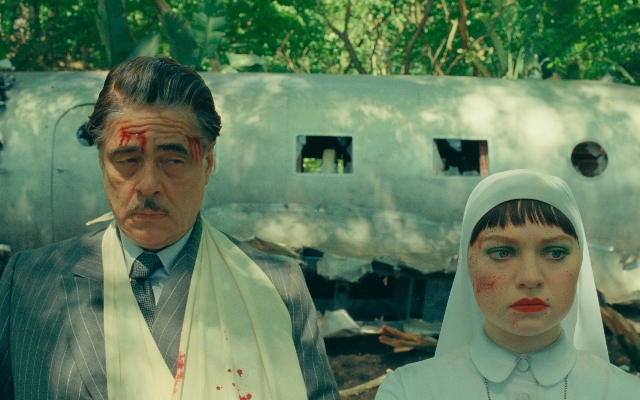
SYNOPSIS: In “The Phoenician Scheme,” a new Wes Anderson film now playing in theatres, Benicio del Toro is Zsa-zsa Korda, a shady businessman who made his fortune through “unholy mischief.” On the verge of a new venture, he finds himself in the crosshairs, literally, of tycoons, foreign terrorists and determined assassins. “Why do you need to keep assassinating me all the time?” he asks.
CAST: Benicio del Toro, Mia Threapleton, Michael Cera, Riz Ahmed, Tom Hanks, Bryan Cranston, Mathieu Amalric, Richard Ayoade, Jeffrey Wright, Scarlett Johansson, Benedict Cumberbatch, Rupert Friend, Imad Mardnli and Hope Davis. Directed by Wes Anderson.
REVIEW: There was a time when I loved Wes Anderson’s movies. His holy trinity, “Bottle Rocket,” “Rushmore,” and “The Royal Tenenbaums,” were all unconventional gems; movies with a singular point-of-view that examined the lives of misfits and oddballs.
Then I stopped loving and stared merely liking Anderson’s movies as his signature whimsical style began to squeeze the life out of his stories of self-discovery and community. Still, his stop-motion “Fantastic Mr. Fox,” for example, was mannered but also hilarious and poignant.
These days, I long for the days of the relative restraint of “The Darjeeling Limited” and “Moonrise Kingdom.” Perhaps it’s a case of familiarity breeding contempt (although think that is too harsh a word), but to me Anderson’s films have lost the humanity of his earlier work. They still cover much of the same thematic ground, commenting on family dysfunction, failure and redemption, but they now feel as though they arrive covered in bubble wrap like precious museum pieces.
Such is the case with his latest, “The Phoenician Scheme,” a stylish story of big money, attempted assassinations and family, it features a topflight cast, who all seem to be having a swell time slotting themselves into Anderson’s carefully crafted, artisanal film. But there is an air of artificiality that settles over the movie like a shroud which sucks way much of the emotional depth.
“The Phoenician Scheme” is pretty, occasionally amusing and the commitment to deadpan performances is unparalleled, but even though I’ll watch anything with Benicio del Toro, it is more concerned with style than substance. As a result, its well-worn take on the evils of capitalism, as personified by del Toro, feels academic rather than authentic.
SYNOPSIS: In “Here,” a new, experimental intergenerational family drama starring Tom Hanks and Robin Wright, and now playing in theatres, director Robert Zemeckis sets a century of love, loss and life in the living room of a one-hundred-year-old American home.
CAST: Tom Hanks, Robin Wright, Paul Bettany, and Kelly Reilly. Directed by Robert Zemeckis.
REVIEW: At one point near the end of “Here,” Richard Young (Tom Hanks) says, “Time flies,” as he reflects on his daughter’s progress in life. In reply, his increasingly exasperated wife Margaret (Robin Wright) snaps, “You always say things that are kind of obvious.”
Richard is not alone in the expression of easy platitudes. Director Robert Zemeckis may be daring in his use of “Here’s” technology, but the story takes no chances.
Based on the 2014 graphic novel by Richard McGuire, the film chronicles thousands of years, on one piece of land, from rampaging dinosaurs to the building of a house in 1900 whose front room provides the location for 99.9% of the action. With the camera locked into position, Zemeckis ping pongs through history, focusing on three generations of the Young family in the one setting.
Major historical events are seen on television, or heard on the radio, but this isn’t a history lesson, it’s an “if these walls could talk” look at the lives lived in the cozy home. It’s a clever idea, but you can’t help but wish “Here” would narrow its focus. The constant transition from one era to the next prevents any one of the stories to work up a head of steam or make us care about the characters.
From a technical point of view, Zemeckis’s transition from one time frame to the next are sometimes clever—a Halloween party, with Richard dressed as Benjamin Franklin, that morphs into a colonial era scene works—and sometimes silly, as in the scene where a leaking roof, dripping puddles on the floor, transitions into Maragret’s water breaking on the same spot. It’s in those moments, and there are many of them, that the movie feels trapped, unable to cast off the restraints of its concept and truly come to life.
Most of the families on display are given a short shrift. The Harter’s (Michelle Dockery and Gwilym Lee) turn of the century story, for example, is meant to provide some emotional heft but falls short because of the film’s inability to make us care much about characters we hardly know. I would have liked more time with Leo and Stella Beekman (David Fynn and Ophelia Lovibond), the inventor and pin-up model who make the most of their vignettes, but the brief glimpses of their free-spirited time in the house are short lived.
It is nice to see Hanks and Wright together, but for much of the runtime they are rendered digitally de-aged and dead-eyed, which takes some of the fun out of the “Forrest Gump” reunion.
“Here” is ambitious, but its technical prowess overwhelms whatever heart is embedded in the story.