Fast reviews for busy people! Watch as I review three movies in less time than it takes to brush your teeth. Have a look as I race against the clock to tell you about the anarchy of “Minions & Monsters,” the relationship woes of “The Invite” and the music bio “Peter Asher: Everywhere Man.”
I join CTV Atlantic’s Stephanie Tsicos to talk about anarchy of “Minions & Monsters,” the relationship woes of “The Invite” and the music bio “Peter Asher: Everywhere Man.”
I join CTV NewsChannel anchor Akshay Tandon to talk about the new releases in theatres, including The anarchy of “Minions & Monsters,” the relationship woes of “The Invite” and the music bio “Peter Asher: Everywhere Man.”
SYNOPSIS: The documentary “Peter Asher: Everywhere Man” details musician, manager and producer Asher’s impact on popular culture from the 1960s to today.
CAST: Peter Asher, Paul McCartney, James Taylor, Carole King, Steve Martin, John Lennon, Eric Idle, Twiggy, Pattie Boyd, Yoko Ono. Directed by Daniel Geller and Dayna Goldfine.
REVIEW: Dripping with nostalgia, “Peter Asher: Everywhere Man” is an appealing time capsule of twentieth century popular music, from the point of view of one of the people who shaped era defining sounds.
Fans of British Invasion period act Peter & Gordon and folks who read album liner notes will likely be familiar with Peter Asher. Others, less so. An influential but shadowy character, the documentary shines a light on his lifetime of success.
Son of a doctor and music professor, brother to actress Jane Asher (who dated Paul McCartney as Beatlemania took hold), child actor, pop star whose song “A World Without Love” went to number one around the world, head of Apple Studio’s A&R department and producer of singer-songwriters like James Taylor, Linda Ronstadt and Bonnie Raitt, his impact on pop culture is undeniable.
His life hasn’t been as documented as his famous friends, like Paul McCartney (who wrote four Peter & Gordon chart toppers), James Taylor and Linda Ronstadt, so this guided tour through his Zelig-like life offers up much previously unearthed material.
Hung around the framework of one of Asher’s live storytelling and music shows, directors Daniel Geller and Dayna Goldfine intercut the new material and interviews with rare archival footage to create an entertaining but buy by-the-numbers biography.
We learn that McCartney gave “A World Without Love” to Peter & Gordon because John Lennon didn’t think it was strong enough for The Beatles. That his father was the doctor who identified and named Munchausen syndrome, and how he owned the gallery where John Lennon first met Yoko Ono. He introduced Marianne Faithfull to Mick Jagger and signed the unknown James Taylor to Apple Records.
He was at the spearhead of the British Invasion, and later, massaged and shaped the LA singer-songwriter sound through a mix of determination, great timing and an ability to grab opportunities as they presented themselves.
The show biz stories are fun and filled with bold-faced names, but the film skims the surface of its subject, content to let his cultural legacy stand front and center. A bit more insight as to why things happened rather than a chronological list of how they happened would have deepened the story and the appreciation for Asher’s accomplishments. Still, as a tribute film, it’s a snappy, if superficial, look at a remarkable career.
SYNOPSIS: A likeable documentary about a likeable subject, “John Candy: I Like Me” is a straightforward look at a comedian whose work is still entertaining audiences three decades after his passing.
CAST: John Candy, Dan Aykroyd, Catherine O’Hara, Steve Martin, Tom Hanks, Martin Short, Eugene Levy, and Macaulay Culkin. Directed by Colin Hanks.
REVIEW: Martin Short told “John Candy: I Like Me” documentary producer Ryan Reynolds and director Colin Hanks (whose famous father co-starred with Candy in “Splash”), they would not be able to find anyone with anything bad to say about John Candy. Short was right. Everyone in the doc speaks glowingly of Candy, his generosity of spirit and luminous talent, but this isn’t a straight up hagiography.
Those nearest and dearest to the late comic actor, like his children Jennifer and Chris, widow Rose, Steve Martin, Tom Hanks, Martin Short, Eugene Levy, Macaulay Culkin, Dan Aykroyd and Catherine O’Hara, paint a colorful portrait of a larger-than-life character who battled weight issues and an anxiety disorder.
Thirty years after his passing on a film shoot in Durango, Mexico, Candy’s work remains as funny and endearing as it was when first released. Hanks’s film offers up copious evidence in the form of clips from “SCTV,” “Uncle Buck,” “Splash,” “Spaceballs,” “Home Alone,” “Planes, Trains and Automobiles” (it’s a line in the latter that gives this movie its name: “I like me,” Candy says as Del Griffith. “My wife likes me.”) and many others, and while it’s lovey to revisit those moments, it’s the picture of Candy off screen that compels.
New interviews with school friends, family and colleagues like Dan Aykroyd, Catherine O’Hara, Martin Short and Steve Martin tell the tale. From growing up in a working-class Toronto family, to his father’s passing of heart disease at age 35 when John was four years old, to putting his dreams of football stardom aside after a knee injury to discovering acting in college, we learn how each of these events shaped the trajectory of his life and career from the people who were there with him.
Everyone describes him as a charismatic character, the first one to pick up the tab in the early days, even though they were all making the same money. He was a people pleaser, but as Conan O’Brien points out, “The hazard of this business is that it’s very unhealthy for people pleasers.”
More up-close-and-personal are the remembrances of his Chris, Jennifer and Rose. They provide an intimate, behind-the-scenes glimpse of a man who, as his daughter says, “took care of people” but didn’t necessarily take care of himself. He liked a drink, a cigarette and, as anxiety entered his life, became convinced he would die early, just as his father had.
Ultimately, “John Candy: I Like Me” is a straightforward, heartfelt documentary with a bittersweet ending. Candy passed at age 43, but the wealth of material he left behind, the TV shows and movies, still entertains, three decades after his passing.
SYNOPSIS: A likeable documentary about a likeable subject, “John Candy: I Like Me” is a straightforward look at a comedian whose work is still entertaining audiences three decades after his passing.
CAST: John Candy, Dan Aykroyd, Catherine O’Hara, Steve Martin, Tom Hanks, Martin Short, Eugene Levy, and Macaulay Culkin. Directed by Colin Hanks.
REVIEW: Martin Short told “John Candy: I Like Me” documentary producer Ryan Reynolds and director Colin Hanks (whose famous father co-starred with Candy in “Splash”), they would not be able to find anyone with anything bad to say about John Candy. Short was right. Everyone in the doc speaks glowingly of Candy, his generosity of spirit and luminous talent, but this isn’t a straight up hagiography.
Those nearest and dearest to the late comic actor, like his children Jennifer and Chris, widow Rose, Steve Martin, Tom Hanks, Martin Short, Eugene Levy, Macaulay Culkin, Dan Aykroyd and Catherine O’Hara, paint a colorful portrait of a larger-than-life character who battled weight issues and an anxiety disorder.
Thirty years after his passing on a film shoot in Durango, Mexico, Candy’s work remains as funny and endearing as it was when first released. Hanks’s film offers up copious evidence in the form of clips from “SCTV,” “Uncle Buck,” “Splash,” “Spaceballs,” “Home Alone,” “Planes, Trains and Automobiles” (it’s a line in the latter that gives this movie its name: “I like me,” Candy says as Del Griffith. “My wife likes me.”) and many others, and while it’s lovey to revisit those moments, it’s the picture of Candy off screen that compels.
New interviews with school friends, family and colleagues like Dan Aykroyd, Catherine O’Hara, Martin Short and Steve Martin tell the tale. From growing up in a working-class Toronto family, to his father’s passing of heart disease at age 35 when John was four years old, to putting his dreams of football stardom aside after a knee injury to discovering acting in college, we learn how each of these events shaped the trajectory of his life and career from the people who were there with him.
Everyone describes him as a charismatic character, the first one to pick up the tab in the early days, even though they were all making the same money. He was a people pleaser, but as Conan O’Brien points out, “The hazard of this business is that it’s very unhealthy for people pleasers.”
More up-close-and-personal are the remembrances of his Chris, Jennifer and Rose. They provide an intimate, behind-the-scenes glimpse of a man who, as his daughter says, “took care of people” but didn’t necessarily take care of himself. He liked a drink, a cigarette and, as anxiety entered his life, became convinced he would die early, just as his father had.
Ultimately, “John Candy: I Like Me” is a straightforward, heartfelt documentary with a bittersweet ending. Candy passed at age 43, but the wealth of material he left behind, the TV shows and movies, still entertains, three decades after his passing.
“Home,” is an alien invasion movie for kids. Imagine a cute “War of the Worlds” with messages about courage and the meaning of family and you get the idea.
Oh (voice of Jim Parsons) is a Boov, an alien from a skittish race of ETs who flee at the slightest sign of trouble. Constantly on the run from their mortal enemies, this time their fearful leader Captain Smek (voice of Steve Martin) has found them refuge on Earth, moving the planet’s inhabitants to an interment camp called Happy Human Town to make room for the Boov. Oh isn’t aware of the camp. “Boov do not steal and abduct,” he says naively, “we liberate and befriend.”
Tip” Tucci (voice of Rihanna) is a teenager who managed to avoid the Boov, but is now in search of her mother (voice of Jennifer Lopez). When Oh accidentally invites the entire universe—including the Boov’s enemies—to his housewarming, he flees the angry aliens, running into Tip. The odd couple become friends and soon Oh is helping Tip find her mother while Tip teaches Oh about bravery and the importance of family.
You’d have to be particularly grim faced to deny “Home’s” cute factor. The audience I saw it with seemed to have their collective fingers permanently poised on the “Ahhhh” button but cute doesn’t mean it’s a great film. It makes the most of its modest charms, seeming content to pitch the movie at an audience young enough to not be aware of many of the clichés on display. I won’t list them all here, but suffice to say that five minutes in you know this is the kind of kid’s flick that will end with some kind of dance number.
On the plus side there is action mild enough for the young ones—although they do mostly destroy Paris, which might upset Parisian tots—with low jeopardy and nothing that should inspire nightmares.
Parsons probably has the most cartoon friendly voice on television today and he uses it to good effect as the gullible extra-terrestrial. He speaks in alien doubletalk, a kind of Yoda speak mixed with the “I Can Has Cheezburger?” meme. “I do not fit in,” he says, “I fit out.”
“Home” contains good moral lessons wrapped up in a shiny package with giggles for the kids and even a laugh or two for parents who will have top accompany the little ones.
“You’re a con artist,” wrote Karina Halle in Sins & Needles. “A liar. A thief. An unredeemable soul.”
She might also have added to that colourful list really interesting movie character.
As despicable as flim flam artists may be, there is no denying they make good film subjects.
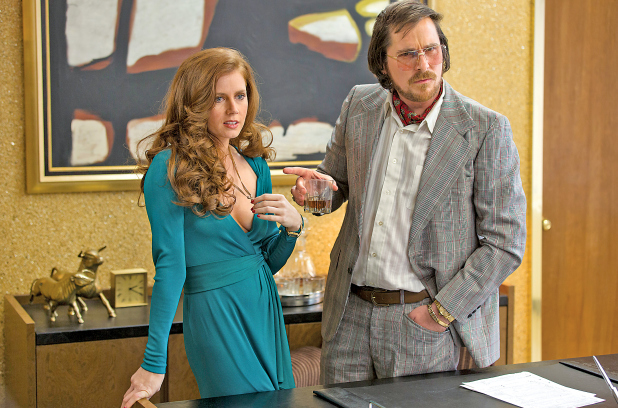
This weekend in American Hustle, Christian Bale plays Irving Rosenfeld, a con man forced to help the FBI ensnare a group of corrupt politicians in the ABSCAM sting operation.
Although American Hustle director David O. Russell says his film is a fictionalized account of events, the ABSCAM operation was headline news in the early 1980s and Hollywood took notice.
In 1982 director Louis Malle was making plans for a May start date on an ABSCAM film called Moon Over Miami starring Dan Aykroyd and John Belushi. Belushi was to play Melvin Weinberg, based on the same man as Bale’s character in American Hustle.
The movie was scuttled following Belushi’s death in March of that year.
That con man film never saw the light of day, but many others have.
Everyone knows The Sting and The Grifters, but lesser seen is David Mamet’s The Spanish Prisoner, a complicated story starring Campbell Scott as Joe Ross, a man who invents a process “to control the world market.” Concerned that he will not be properly compensated for his work he contacts Jimmy Dell (Steve Martin), a wealthy businessman who offers to help. Little does Ross know that he has just stepped into a world of deception that will change his life.
Steve Martin’s performance in The Spanish Prisoner was Oscar worthy, but it wasn’t the first time he played a confidence man on film.
In the comedy Dirty Rotten Scoundrels he starred opposite Michael Caine as a scruffy con man trying to muscle in on some high end business on the French Riviera. Caine’s suave grifter makes a bet with Martin. Whoever can con Soap Queen Janet Colgate (Glenne Headley) first will walk away with $50,000.
The movie was written for Mick Jagger and David Bowie who were looking to do a project together after the success of their Dancing in the Street video. The rock stars dropped out before cameras rolled — Bowie later said both were, “a bit tweezed that we lost out on a script that could have been reasonably good” — and replaced by Martin and Caine whose hilarious performances earned the movie a spot on Bravo’s 100 Funniest Movies list.
Not since The Beverly Hillbillies’ Miss Jane has there been such a bird crazy character. “The Big Year,” a new comedy starring the tryptic of comics Steve Martin, Jack Black and Owen Wilson, is based on a true story of birders trying to break a world record.
“This is a true story,” the opening credit reads. “Only the facts have been changed.” Wilson is Bostick, the world’s best birder (they don’t like being called bird watchers). He is the king of The Big Year, an annual competition to see the greatest amount of birds in North America in a calendar year. There’s no prize other than bragging rights, but, jokes Brad Harris (Jack Black), “the bird seed endorsements are huge.” The film follows Bostick and the efforts of two newcomers to the Big Year, Stu (Martin), a wealthy CEO who is finally taking time to smell the roses and look at the birds, and Harris, an unhappy office grunt who loves anything that flies, as they vie for the top spot.
Whether or not audiences will migrate to “The Big Year” depends on their tolerance for a soundtrack stuffed like a Thanksgiving turkey with bird songs like a jazz version of “Blackbird,” and the trio of leading men.
Each plays to his strength. Black provides the slapstick, martin is the silver haired charmer and Wilson plays the edgy jerk he’s perfected in movies like “Drillbit Taylor.” The three different styles work well together even though nothing about it really feels fresh. Despite its subject it never really takes flight. There’s a more ripple of giggles throughout but the big laughs are fewer and further between. Surely some Blue Footed Booby jokes could have spiced things up just a bit.
Having said that, “The Big Year” is enjoyable enough, particularly if you like footage of our fine feathered friends. The final third tugs at the heart strings when it becomes more about the characters than their birding obsession. Not really memorable, but at least it’s not another installment of Martin’s dreadful Inspector Clouseau series.