I sit with NewsTalk 1010 guest host Mark Towhey on NewsTalk 1010 to talk about the US Army offering time off to play a new video game, how Janet Jackson got Matthew McConaughey to quit weed, then I review “The Rivals of Amziah King” and the fantasy flick “The Magic Faraway Tree.”
I join CTV NewsChannel anchor Akshay Tandon to talk about the fantasy of “The Magic Faraway Tree,” the horrors of “Insidious: Out of the Further,” the character study of “The Rivals of Amziah King” and the drama of “Late Fame.”
Fast reviews for busy people! Watch as I review three movies in less time than it takes to make a sandwich. Have a look as I race against the clock to tell you about the fantasy of “The Magic Faraway Tree,” the character study of “The Rivals of Amziah King” and the drama of “Late Fame.”
I join the Bell Media Radio Network national night time show “Shane Hewitt and the Night Shift” to talk about the collaboration between KFC and French wine brand La Vieille Ferme, the return of Indiana Jones, Robin Williams’s reactivated Instagram account and, on Booze & Reviews I talk about Matthew McConaughey in “The Rivals of Amziah King” and suggest some good old Oklahoma cocktails to enjoy with the movie.
SYNOPSIS: In “The Rivals of Amziah King,” a new crime thriller now playing in theatres, Matthew McConaughey stars as a beekeeper whose life is upended by the return of his estranged stepdaughter and violent business rivals. “Get ready, my little chickadee. Bees only swarm when they are ready for a fight.”
CAST: Matthew McConaughey, Angelina LookingGlass, Jake Horowitz, Scott Shepherd, Rob Morgan, Tony Revolori, Kurt Russell. Directed by Andrew Patterson.
REVIEW: Set in the backwoods of rural Oklahoma, “The Rivals of Amziah King” stars Matthew McConaughey as the title character, a beekeeper and bluegrass musician who runs the biggest honey operation in his area. “I know the weather. I know the bees. I know the point where anyone else would give up and I won’t.”
His life is changed for the better when his foster daughter Kateri (Angelina LookingGlass) reappears in his life. As the pair become reacquainted, making the most of their second chance at having a meaningful relationship, Amziah opens his heart and business to the young women.
But as their efforts to create a true family business are threatened by powerful rivals looking to undo everything Amziah and Kateri have built.
“This isn’t just theft. There’s a design and a cruelty to this. Someone loaded up everything he built and took it all away. And I’m going to find them and I’m going to take it all back.”
“The Rivals of Amziah King” feels like two films.
With no spoilers I can tell you that the first hour is a hang out movie disguised as a character study of Amziah. In McConaughey’s hands he is a bigger-than-life man, who doesn’t speak, but rather pontificates, on bees, life and whatever else strikes his fancy. He’s a William Faulkner-esque character, a distinctly southern person, poetically earthy with a deep reservoir of humanity and spirituality.
Director Andrew Patterson takes his time, allowing us to get to know Azmiah, Kateri and other members of the tight knit community through storytelling, music and lots of talk about bees. In fact, it sometimes feels like “Everything You Ever Wanted to Know About Bees but Were Afraid to Ask” would be a better title but there’s a sanctity to Amziah’s connection with the bees that is intriguing.
Which is why it comes as such a surprise when around the hour mark, the movie drops its tone poem tendencies in favor of shift toward crime thrills and revenge. It’s not an easy fit, and the movie loses much of its heartfelt charm as it becomes about stolen bee colonies and amateur sleuthing.
Up until that part, however, “The Rivals of Amziah King” is a wonderfully offbeat movie that creates a beautiful portrait of community that sprouted up around its central character.
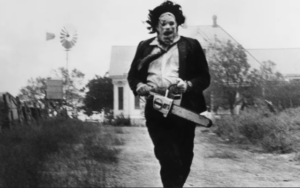
Two far flung events inspired director Tobe Hooper to write The Texas Chain Saw Massacre, the down-and-dirty 1974 indie film that spawned sequels, prequels and last year’s splashy 3D remake–the imaginatively titled Texas Chainsaw 3D.
In November 1957 police raided the home of Plainfield, Wisconsin farmer Ed Gein, uncovering some gruesome evidence that would lead to charges of murder and body snatching. After two trials he spent the rest of his life in a mental facility, but his story would go on to inspire three memorable movie characters–Norman Bates from Psycho, Buffalo Bill from The Silence of the Lambs and one other that would serve as the basis for six films.
Gunnar Hansen, who played Leatherface in Texas Chain Saw Massacre, says Hooper and co-writer Kim Henkel based the character of the hooded chainsaw killer on Gein.
“When they set out to write this movie,” he said, “they decided to have a family of killers who had some of the characteristics of Gein: the skin masks, the furniture made from bones, the possibility of cannibalism.”
Hooper adds the story was also partially inspired by “the massacres and atrocities in the Vietnam War” and a display of chainsaws in the hardware section of a crowded Montgomery Ward’s department store.
“The idea popped,” he remembered. “I said, ‘Ooh, I know how I could get out of this place fast — if I just start one of these things up and make that sound.’”
That nerve jangling noise–the revving of a chainsaw–has been the soundtrack of terror ever since. The original is an atmospheric gem, a white-knuckle movie that made Leatherface the first icon of modern horror.
The apron-wearing cannibal has appeared in five more films–most of which don’t veer too far from the original plot line of unsuspecting kids falling prey to a family of demented, cannibalistic inbreds. There’s The Texas Chain Saw Massacre 2, directed by Tobe Hooper and starring Dennis Hopper, Leatherface: TCM III, TCM: The Next Generation (starring the then unknown Matthew McConaughey and Renée Zellweger), The Texas Chain Saw Massacre, TCM: The Beginning and the new 3D version.
Leatherface’s scares don’t always happen on screen, however. At the Kingsway Theatre in Toronto the flick inspired audience participation when someone dressed in a butcher’s outfit ran down the aisle brandishing a real, revving chainsaw.
SYNOPSIS: Based on the non-fiction 2021 book “Paradise: One Town’s Struggle to Survive an American Wildfire” by Lizzie Johnson, “The Lost Bus” sees Matthew McConaughey navigate a bus full of children through one of California’s deadliest wildfires.
CAST: Matthew McConaughey, America Ferrera, Yul Vazquez, and Ashlie Atkinson. Directed by Paul Greengrass.
REVIEW: The old saying that something “spread like wildfire” is brought to literal life by director Paul Greengrass and stars Matthew McConaughey and America Ferrera. Shot cinema verité style, “The Lost Bus’s” story of heroism amid the burning inferno of the 2018 California Camp Fire is an intense, you-are-there experience.
McConaughey is Kevin McKay, a struggling, divorced dad living in small town California. His son Shaun (Levi McConaughey) would rather live with McKay’s estranged wife, his elderly mother (played by McConaughey’s real-life mom Kay McCabe McConaughey) is in failing health, and even his dog is ill. His job as a school bus driver gives him barely enough hours to make ends meet.
When a spark from a downed power line erupts into an out-of-control wildfire, McKay is pressed into service. What begins as a straightforward pick-up of twenty-two kids and their teacher, Mary Ludwig (America Ferrera), becomes a life-and-death drive into the blazing heart of the inferno.
Greengrass’s restless camera is in constant motion as he captures the fiery action, but this isn’t an action film. Instead, it’s a horror film that casts the relentless fire as the monster. If you have ever wondered how a fire can spread so quickly, so intensely, wonder no more. Greengrass’s powerful images show the flaming rampage in vivid detail. From a spark to a living hell, you can almost feel the heat coming off the screen as the flames rapidly eat up everything in their path.
Driven by the intensity of the images, the movie is an immersive experience. Add to that the inherent peril for the kids on the bus who risk being cooked alive inside the 18-ton oven and you have relentless, high stakes storytelling.
Greengrass’s visuals are top shelf, urgent depictions of the hellish inferno so it’s unfortunate the dialogue and character development don’t keep pace. McConaughey’s McKay is all struggle and furrowed brows, but the character feels like a generic everyman hero plucked from a 90s-era disaster movie.
Made for Apple TV+, “The Lost Bus” will get a short run in theatres before moving to streaming, but Greengrass clearly had the big screen in mind when composing the film’s visuals. The epic nature of the film’s fire scenes may not translate well onto smaller screens.
Anyone who thinks the Guy Ritchie of old has disappeared, crushed under the weight of the huge box office grosses of the family-friendly “Aladdin,” need look no further than the blood splattered pint mug of “The Gentlemen’s” opening scene for proof to the contrary.
Highly stylized crime comedies like “Lock, Stock and Two Smoking Barrels” and “Snatch” made Ritchie the king of fast-paced, politically-incorrect stories of life on the streets. The big budget movies, his Sherlock Holmes series and “Aladdin,” among others, made more money but lacked the visceral thrills of his early work. His new film, “The Gentlemen,” starring Matthew McConaughey, Henry Golding, Michelle Dockery, Colin Farrell and Hugh Grant, feels like a hybrid of the two phases of his career. A spiritual cousin to “Lock, Stock” and ”Snatch,” it brings Ritchie back to London’s underworld, a place populated by Saville Row suit-wearing tough guys, ruthless tabloid editors and henchmen who speak like down-on-their-heels Oxford drop outs.
Matthew McConaughey is Mickey Pearson, an American who built a weed empire in his adopted home country of England. Intelligent and ruthless—qualities matched only by his wife Rosalind (Dockery)—he’s now middle-aged and looking to cash out. His offers to sell the business to billionaire drug lord Matthew Berger (a very mannered Jeremy Strong) for $400 million attracts unwanted attention from Dry Eye (Golding), the ruthless youngest nephew of an aging crime lord.
There’s more, but this is a pretzel of a story, twisted and tied in knots.
“The Gentlemen” is not a sequel or a reboot but it feels like one. The hyper-masculine story telling style, inventive use of swear words and spider-web plotting, while audacious, will be very familiar to Ritchie-philes. It’s “Snatch 2.0” with the same kind of big name cast who seem to be having fun mouthing Ritchie’s profanity laden dialogue but no amount of fast cutting and fast talking can replace real energy. As rock ‘n rolling as the filmmaking is, the story acts as an anchor, bogging things down as it gets more and more convoluted.
It’s too bad because Ritchie takes pains to create the very specific world his characters inhabit, and it is a colourful place but it seems that he never met a plot twist he didn’t love. As the plot thickens, and it does thicken almost to the point of impenetrability, the movie begins to feel overstuffed. To help the audience along Ritchie binds everything together with a silly framing device involving Fletcher (Grant), a private eye/blackmailer who unfurls the complicated story to Pearson’s right-hand-man Raymond (Charlie Hunnam). It’s time consuming and adds little to the picture except for Hugh Grant’s exaggerated accent as he delivers flowery lines like, “Our antagonist explodes on the scene, like a millennial firework.”
“The Gentlemen” feels like an exercise in nostalgia, back to era of Ritchie’s frenetic jump cuts and outdated attitudes about race disguised as quippy dialogue.
Based on a 1927 science fiction/horror story by H. P. Lovecraft, “Color Out of Space” is a strange film starring everyone’s favorite purveyor of strange performances, Nicolas “Dad’s been acting weird” Cage.
Cage is Nathan Gardner, a former artist living on his late father’s remote farm near the fictional town of Arkham, one of Lovecraft’s favorite settings. His family, Wiccan practitioner Lavinia (Madeleine Arthur), weed aficionado Benny and youngster Jack (Brendan Meyer and Julian Hilliard) and mother Theresa (Joely Richardson), leads a quiet if unconventional life until late one night when a meteorite crash lands on their front lawn. Unsure of what it is, Nathan calls the police. “I’m sorry about the smell,” he says. “Can you smell it? It’s like somebody lit a dog on fire.”
The smell will turn out to be the least of his problems.
The meteorite disappears over time but the effects of the crash landing linger. The Gardeners and their animals—they raise alpacas—begin acting strangely. Mom cuts her own fingers off as psychedelic hallucinations shroud the family’s thoughts. Hydrologist Ward (Elliot Knight), in the area surveying for a future dam project, thinks the water is poisoned but the real answer is a little more out there, as in outer space alien brain, out there.
Directed by Richard Stanley, who hasn’t made a feature since infamously being fired from 1996’s “The Island of Dr. Moreau,” “Color Out of Space” is a trippy, darkly humorous descent into madness. Lovecraft has proven tricky to adapt to the screen but Stanley does a good job here, building a sense of unease with a clever mix of CGI and practical special effects that build upon the natural disorienting nature of the story. Add to that body horror and cosmic terror, each heightened by the committed—read unhinged—performances from the leads and you have a movie that keeps the viewer as off-kilter as the characters they are watching.
“Color Out of Space” is a little uneven, cramming too many ideas into the mix, but the mix of two gonzo artists like Cage and Stanley offers up a movie that amps up the cinematic anxiety in unpredictable ways.