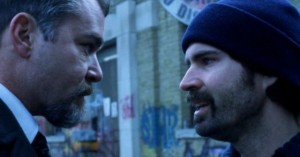
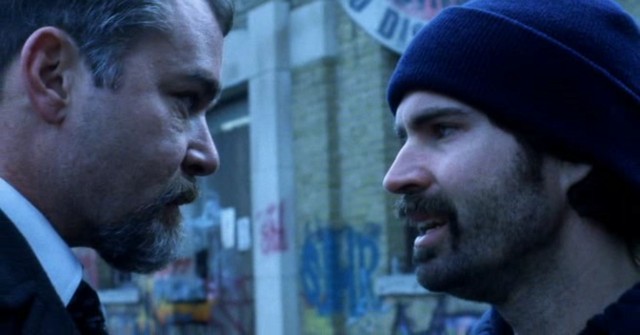
SYNOPSIS: Set against the backdrop of the Los Angeles riots following the Rodney King verdict, the action thriller “1992,” sees a factory worker, played by Tyrese Gibson, caught up in a dangerous heist to steal catalytic converters, which contain valuable platinum, from the factory where he works.
CAST: Tyrese Gibson, Scott Eastwood, Ray Liotta, Michael Beasley, Christopher Ammanuel, Dylan Arnold, Ori Pfeffer, Oleg Taktarov. Directed by Ariel Vromen.
REVIEW: A heist movie wrapped around a family drama, the generic action of “1992” is given some added oomph by its historical backdrop.
Gritty and dark, “1992” recounts the events following the Rodney King verdict, which saw four LAPD officers acquitted of charges of excessive force in the arrest of King, despite videotaped evidence. In the days that followed anarchy erupted in Los Angeles, resulting in 63 deaths, more than 12,000 arrests and over $1 billion in property damages.
Thrown into the middle of the chaos, former gang-member-turned-factory-worker Mercer (Gibson), wants to get his son to the relative safety of the factory. Another father and son, played by Ray Liotta and Scott Eastwood, see the riots as a convenient distraction, and plan to rob the factory while the police are busy trying to bring order to the streets.
The resulting clash and family dynamics provide an easy metaphor for the good vs. evil that drives the plot.
Gibson plays Mercer as a man who has had a reckoning with his past and wants to set a good example for his son. Gibson pulls off the action—when pushed, he occasionally uses his special set of skills to solve problems—but it is in the relationship with his son that the character is at his most interesting. He’s been-there-done-that and uses his life experience like a sword to cut through the tough guy nonsense his son spouts.
Liotta on the other hand is far more one dimensional. It’s fun to see Liotta go full-on mad dog, and he is effective, but his character is less nuanced and supplies far fewer surprises than Gibson.
As a crime drama “1992” doesn’t plough much new ground. The robbery, and resulting complications, are straight out of the Heist 101 Handbook for Screenwriters, but the family drama and contrasting parenting skills freshen up what otherwise may have been a standard b-movie.
My review of “Cocaine Bear” is quoted in this article from Screen Rant.
“Before buying a ticket to “Cocaine Bear” ask yourself this question: Am I likely to enjoy a movie called “Cocaine Bear”? I can tell you authoritatively that it is the best stoned bear movie of the year. Admittedly, it is a small field, but if that turns your crank, by all means check it out…” Read the whole thing HERE!
“Cocaine Bear,” a grisly new hybrid of “Scarface” and “Yogi Bear” starring Keri Russell, O’Shea Jackson Jr. and Ray Liotta in his last filmed performance, and now playing in theatres, delivers on the promise of its premise. Like “Snakes on a Plane,” another movie whose entire plot was contained in the title, “Cocaine Bear” lives up to its name. There’s a bear and he is tweaked on the devil dust, but is that enough to get people in theatres, or will audiences just say no?
The movie plays fast-and-loose with the true 1985 story of a 79-kilogram American black bear who, while wandering the Georgia wilderness, stumbled across and ate a discarded duffle bag of cocaine. Later nicknamed Pablo Escobear, in real life the poor unfortunate beast overdosed immediately and spent its afterlife stuffed and on display at a local mall.
Director Elizabeth Banks uses the real-life set up as a kick off for her story. In her retelling, drug smuggler Andrew C. Thornton II (Matthew Rhys), in a bid to avoid police, dumps 40 kilos of cocaine in the forests of Georgia. When the bear finds it and ingests it, instead of keeling over he becomes a character out of a Bret Easton Ellis novel, setting off on a bloody, coke fueled rampage through the forest in search of more drugs.
Along the way the Cocaine Bear (one character actually calls him that) gets her paws on a variety of folks, including a concerned mom (Keri Russell), a mob boss (Ray Liotta) and his henchmen (Alden Ehrenreich and Jackson Jr.) and a park ranger (Margo Martindale).
Before buying a ticket to “Cocaine Bear” ask yourself this question: Am I likely to enjoy a movie called “Cocaine Bear”? I can tell you authoritatively that it is the best stoned bear movie of the year. Admittedly, it is a small field, but if that turns your crank, by all means check it out.
If you need convincing, then “Cocaine Bear” may not be for you. On the fence? Read on.
The one-joke premise aside, the movie is a throwback to the slasher films of the 1980s. The gruesome stuff is outlandish, bloody and the kind of thing that you know you shouldn’t be laughing at, but here you are, laughing out loud at the misfortune of others.
Unfortunately, although there is a good vibe between Ehrenreich and Jackson Jr, most other characterization is kept to a bare minimum—many of the characters are essentially sentient slabs of bear food—and the dialogue isn’t nearly as camp or funny as it should be. It feels choppy—there is a good pun to be made here about chopping up lines of cocaine, but I’m too lazy to make it—and the gaps between the action sequences stretch on a bit too long.
However, “Cocaine Bear” has quite a few solid laughs. That makes up for the lack of satire or deeper meaning. This isn’t about anything other than truth in advertising. It’s about a bear and a bunch of cocaine and is only about 90 minutes long. If that appeals, make like the bear and snort it up.
“The Many Saints of Newark,” the sprawling big-screen prequel to the iconic television series “The Sopranos,” feels more like a pilot for a new show than the origin story of one of television’s most famous families.
Broken into three parts, “The Many Saints of Newark,” uses narration, courtesy of Tony Soprano’s late associate Christopher Moltisanti (Michael Imperioli), to break down the movie’s interconnected story shards.
Firstly, there is Dickie Moltisanti (Alessandro Nivola), Soprano Family soldier, father of Christopher, cousin to Carmela Soprano, uncle to Tony. He’s hooked up, wily and impulsive but also treacherous. When his father, the slick sociopath ‘Hollywood Dick’ (Ray Liotta), returns from Italy with a new bride (Michela De Rossi), it triggers chaos in the Moltisanti family.
In Dickie’s orbit is Harold McBrayer (Leslie Odom Jr.), an African-American numbers runner for the Mob, galvanized by the 1967 Newark race riots to go out on his own and, finally, Tony Soprano, played by William Ludwig as a youngster, Michael Gandolfini, the late James Gandolfini’s son, as a teenager. As Dickie’s thirst for power spins out of control, he becomes a surrogate father to Tony, hoping to pass along something good to the impressionable younger man as a way to atone for his sins.
“The Many Saints of Newark” is vivid in its portrayal of the period. Covering roughly four years, from 1967 to 1971, it uses the turmoil of that time in American life as a backdrop for the explosive nature of Dickie’s world. That atmosphere of uncertainty makes up for a story that, despite some glorious moments, often feels rushed as it careens toward an ending that doesn’t mine the rich psychological landscape of these characters, which is what we expect from David Chase and “The Sopranos.”
The actors are game.
Nivola brings equal parts charisma, danger and depth to a flawed character who is the ringmaster to the action. Unlike many of the other characters, like the conniving Junior Soprano (Corey Stoll), henchman Paulie Walnuts (Blly Magnussen) or consigliere Silvio Dante (John Magaro), who come with eighty-six episodes of baggage, Dickie is new and can be viewed through fresh eyes.
Michael Gandolfini takes on the Herculean task of revisiting a character his father made one of the most famous in television history and brings it home by showcasing the character’s volatility and, more importantly, his vulnerability. He’s a troubled kid, on the edge of turning one way or the other, and even though we know how the story goes, Gandolfini’s performance suggests there is more to know about Tony Soprano.
If there is a complaint, it’s that both Tony and McBrayer, two of the main cogs that keep this engine running, get lost in “The Many Saints of Newark’s” elaborate plotting. Ditto for the female characters. Despite tremendous work from Vera Farmiga as Tony’s poisonous mother Livia and De Rossi as Dickie’s step-mom, the women often feel peripheral to the tale, in service only to the men’s stories.
“The Many Saints of Newark” brings with it high expectations but falls short of coming close to the greatness of its source material. “The Sopranos” broke new ground, changing the way gangster stories (and all sorts of other stories) were told on television. “The Many Saints of Newark” settles for less as an exercise in nostalgia.
“No Sudden Move,” a new Steven Soderbergh film starring Don Cheadle and Benicio del Toro and now playing on Crave, is a film noir that gets lost in its knotty plot, but is kept on track by a top-notch cast.
Set in 1954 Detroit, the action begins with Jones, a shady character played by Brendan Fraser, recruiting three low level criminals, Curt (Cheadle), Ronald (del Toro) and Charley (Kieran Culkin), for a job that pays too much to be as easy as he says it will be. They all agree, just so long as someone named Frank (Ray Liotta) won’t be involved.
Their job is to invade General Motors accountant Matt Wertz’s (David Harbour) home, keep his family quiet for an hour while he retrieves a document from his boss’s safe.
Sounds simple, but this is Detroit in 1954. Industrial espionage between the Big Three car companies is a dangerous game, and, of course, Frank is involved. “Everybody has a problem with Frank these days.”
As things spin out of control, greed kicks in and the fast cash the small-time criminals hoped to make causes big time problems.
Soderbergh immerses his characters and the viewer in a world that where secrets propel the action. No one is who they seem and motives are even murkier. It makes for a twisty-turny story that is part crime story, part social history of the spark that ignited the slow decline of Detroit.
To add to the disorientation, Soderbergh shoots the action through a fish eye lens that blurs the edges of the screen, mimicking the script’s moral fog.
“No Sudden Move” almost bites off more than it can chew. It’s occasionally clunky, with too many double-crosses and characters vying for screen time, but the star-studded cast cuts through the script’s noise with ease. The result is a caper that flier by, buoyed by surprises (including a big-name uncredited cameo), snappy dialogue and a great debt to Elmore Leonard.
“Marriage Story” is not a first date movie. It is a three hankie, emotionally fraught movie about appealing but damaged people whose divorce is filled with a sense of loss and a growing shroud of incivility.
Adam Driver is Charlie, a hotshot avant-garde theatre director living and working in Brooklyn, New York with his wife Nicole (Scarlett Johansson). She is a former movie star with a list of teen comedies to her credit. They met at a party, instantly fell in love, had son Henry (Azhy Robertson) all was well until it wasn’t. Charlie may have slept with a stage manager but it’s Nicole’s growing dissatisfaction that widen the chasm between them. “I never really came alive for myself,” she says. “I was only feeding his aliveness.”
What begins as a simple conscious uncoupling becomes complicated when Nicole accepts a starring role on a television series based in Los Angeles, taking Henry to live with her. The family, stretched between two coasts and two careers, wears thin and soon the pressures of the split take their toll. “It’s not as simple as not being in love anymore,” says Nicole.
On my way into the press screening for “Marriage Story” a publicist handed me a small package of Kleenex branded with the movie’s logo. “I won’t need these,” I thought. “I’m a professional, here to dispassionately judge this film on its merits. I made it through ‘Kramer vs. Kramer’ like a dry-eyed superman and if I can do that, I can do anything.” I’m not too proud to tell you that I was glad I had the Kleenexes. “Marriage Story” is so agonizingly vivid, so without melodrama, that I felt at times as though I was a voyeur, that I shouldn’t be watching some of these emotionally charged scenes. As Charlie and Nicole drift apart and lawyers, like the ruthless Nora Fanshaw (Laura Dern in full beast mode), become involved the idea that they might have a chance of staying friends once this is all said and done becomes heartbreakingly remote.
Driver and Johansson convincingly play the bond that made them a couple and as it unravels both reveal the fatal flaws that drove a wedge between them. The two actors, unshackled from the constraints of the blockbusters that pay for their Italian castle retreats, dig deep, wallowing in their character’s self-absorption and anger.
Johansson, in full monologue mode, thrills in a lengthy speech detailing her state of mind. And do not even get me started by Driver’s final scene with his son as he reads a long-forgotten note. (NO SPOILERS HERE) Director Noah Baumbach keeps those scenes—and the entire movie for that matter—uncluttered. Simple and direct, he allows the actors to do the heavy lifting with naturalistic performances and both pack a wallop.
“Marriage Story” may not be a great choice for a first date but the emotional, sincere truth Baumbach and cast wring out of the material is best seen with a companion, or at the very least a package of Kleenex.
Behind every good scandal there is a good journalist. Washington Post reporters Bob Woodward and Carl Bernstein gave us Watergate while muckraker Nick Davies of The Guardian uncovered the phone hacking scandal that proved the News of the World had ears and eyes in the cell phones of some very famous and powerful people. Lesser known is Gary Webb, an investigative reporter for the San Jose Mercury News played by Jeremy Renner in the new film “Kill the Messenger.”
When we meet Webb he’s just broken the biggest story of his career. An exposé on the inequity of the justice system’s habit of stripping suspected drug dealers of their homes and vehicles, whether they are proven guilty or not. The article attracts the attention of Coral Baca (Paz Vega), the girlfriend of a drug dealer. She contacts Webb with some the potentially explosive information that the government has drug dealers on their payroll.
Following the clues he travels to Nicaragua to meet drug lords (Andy Garcia) and crooked bankers (Brett Rice) and to Washington to meet DC insiders (Michael Sheen) to piece together the story of CIA involvement in the smuggling of cocaine into the U.S., and how that money was laundered and used arm rebels fighting in Nicaragua. His articles won him acclaim, but also started a campaign to discredit him by some very powerful people. “Some stories,” he is warned, “are too true to tell.”
Crusading journalists make good characters. They says cool tings like, “The bad guys are usually more honest than the good guys,” put themselves in peril and refuse to take no for an answer. Renner embodies the swagger necessary to play Webb the journalist and, as things fall a part for him professionally and personally, is suitably hangdog. Why then, is “Kill the Messenger” such an endurance test to sit through?
It starts off well enough, piecing the clues together, building to the aha moment when the complicated clues begin to make sense as a whole, but then loses momentum when the movie becomes more about lionizing Webb than it does following the Nicaragua story. Thrown into the mix is a sad indictment of what passes for courage in the journalism racket, which only serves to move Webb closer to the glow of the heroic spotlight.
Renner and the supporting cast, including Rosemarie DeWitt (who is good but wasted in an under-written “wife” role), Tim Blake Nelson as a lawyer whose favorite word is “allegedly” and Ray Liotta (who has an all-too-brief cameo) perform admirably but are weighed down by the script. Webb would have reported the facts and only the facts and “Kill the Messenger” would be a better movie if it took his example and stuck to the truth without the prosthetizing on journalistic ethics.
Narc is the kind of movie that makes you forget the dark patches on both Jason Patrick and Ray Liotta’s resumes. You remember Patrick in Rush, and forget about Liotta in Operation Dumbo Drop.
The story is simple enough, and almost clichéd. When the trail on a murder investigation of a policeman goes cold, an undercover narcotics officer, Detective Sgt. Nick Tellis (Patrick), is teamed with loose-cannon detective Henry R. Oak (Liotta) to solve the case. It’s old hat – the good cop teamed with a out-of-control cop – we’ve seen it in movies and on television for as long as there have been police dramas, but when it is treated with the kind of conviction and intensity that Liotta and Patrick bring to their roles it seems fresh and compelling. Both play cops who cross the line into unlawful behavior in order to do their jobs, and have both become tainted by their experiences. Narc explores what happens to a good cop when he is forced to break the law.
Visually director Joe Carnahan captures the feel of the mean streets, using a grainy film stock and handheld cameras to underline not only the dirt, but the energy of the street and the sleazy underbelly in which these two men operate.
Narc is a great cop movie, but it has a generic title, and a grainy feel to it that I don’t think audiences will connect with because they want to see something glitzy, something happy, something that is going to make them feel a little better. Hopefully it’s the kind of movie that will build a nice cult following on DVD.
Observe and Report comes hot on the heels of January’s box office champ Paul Blart: Mall Cop. On the surface they have a lot in common. Both center on suburban mall security guards with something to prove. Both star funny chubby guys who first made their mark on television and both feature blonde love interests. But as similar as they may be at first glance, Paul Blart and Observe and Report are as similar as apples and oranges. Imagine comparing The Three Stooges to Woody Allen and you get the idea.
Seth Rogen, in what will likely be his last heavy-weight film role, as he has now slimmed down for his part in The Green Hornet, plays mall security guard, er… make that Forest Ridge Mall “Head of Security” Ronnie Barnhardt. He’s a stickler for the rules, dreaming of the day when he can trade up and turn in his flashlight for a policeman’s gun. When a flasher begins terrorizing the mall Ronnie sees it as a chance to go from zero to hero, show his cop chops, earn a spot at the police academy and, as an added bonus, impress Brandi (Anna Faris), a hot, but bubble-headed make-up counter clerk at the mall. “This disgusting pervert may be the best thing that has ever happened to me,” he says. The only thing in his way is the surly Detective Harrison of the Conway Police (Ray Liotta) a motivated cop who is determined to break the case before Ronnie does.
Observe and Report was written and directed by Jody Hill, a relative newcomer who has quickly become Hollywood’s new King of Crude. In this film and his controversial HBO series Eastbound & Down Hill has established a reputation for envelope pushing. No joke is too offensive, no situation too outrageous.
Bad behavior is his canvas and Observe and Report is his masterpiece, his Mona Lisa.
This is not only probably one of the darkest comedies ever made, but also one of the most foul-mouthed and surprising. Think of Paul Blart: Mall Cop as directed by Sam Peckinpah with the action scenes staged by Martin Scorsese and you’ll have an idea of the tone of the film.
The lovable Seth Rogen of Knocked Up and The Forty Year Old Virgin is gone, replaced by a dead eyed borderline psycho who takes himself too seriously and is messed up enough to fail the police academy’s psyche test. It’s a strange and inspired performance that shows off his range, but isn’t for everyone.
I overheard two women at the screening sighing with relief that they didn’t pay for their own tickets. “I liked him so much better when he was with Kathyrn Heigl,” one moaned, pining for the days before Rogen turned into Norman Bates.
Any movie that bills itself as a comedy and yet gives second billing to Ray Liotta—the intense star of Goodfellas—is going to be dark, but Observe and Report redefines comedy noir, from Rogen and Anna Faris’s horrifying love scene to its violent finale, it is one of a kind. Not for everyone, but with show stopping work from Faris and an unexpected comedic performance from the usually very serious Michael Peña—“Sometimes I drink out of the volcano,” he says—it should please fans of extreme humor.
In other words, if you enjoyed Paul Blart: Mall Cop, then stay away from Observe and Report.