Fast reviews for busy people! Watch as I review three movies in less time than it takes to reanimate the dead. Have a look as I race against the clock to tell you about the monstrous and messy “The Bride!,” PIxar’s “Hoppers” and the hockey drama “Youngblood.”
SYNOPSIS: In “The Bride!,” a new gothic story of love and crime loosely inspired by “The Bride of Frankenstein,” and now playing in theatres, a lonely Frankenstein’s monster finds companionship with the recently murdered, reanimated Bride. “What do you want with a dead girl?” she asks. “I’m the same. Born from the dead,” he says. “I am… a monster.”
CAST: Jessie Buckley, Christian Bale, Peter Sarsgaard, Annette Bening, Jake Gyllenhaal, Penélope Cruz. Written and directed by Maggie Gyllenhaal.
REVIEWS: A mix of classic horror and “Bonnie and Clyde,” with a side of “Wild at Heart,” “The Bride!” is a modern and monstrous, but messy, take on what it means to challenge expectations just by being alive.
Set in the 1930s Chicago, “The Bride!” begins with a lovelorn monster (Christian Bale) asking scientist Dr. Euphronius (Annette Bening) for a cure for his loneliness. He wants a companion; someone to love.
The pair dig up the dearly departed Ida and jolt her back to life as the fragmented Bride (Jessie Buckley), a woman possessed by the spirit of her former persona, a take-no-prisoners flapper (“I would prefer not to,” is her catchphrase.), and the ghost of nineteenth century English novelist Mary Shelley, author of the Gothic novel “Frankenstein; or, The Modern Prometheus.”
“The bride… of Frankenstein,” “Frankie” calls her. “No,” she replies, “just The Bride.”
Rebellious and powerful, she’s far from a demure monster’s mate. As romance blossoms, they connect during a chaotic crime wave that turns The Bride into an accidental folk hero. Their monstrous crime spree inspires women nationwide to break the law, coming together as a community of vigilantes marked with The Bride’s distinctively stained lips and cheek trademark.
On the run from detectives Det. Jake Wiles (Peter Sarsgaard) and Myrna Mallow (Penélope Cruz) “Frankie” says, “There is nothing left to do now, except live.”
There is no shortage of ideas in “The Bride!” Director Maggie Gyllenhaal, who also wrote the script, packs the movie with thoughts on bodily autonomy, identity, feminist reclamation, loneliness and what it means to be truly alive.
Unfortunately, these notions feel stitched together as randomly as the roughhewn sutures and staples that bind Frankenstein’s creature together. A more-is-more take on the story of a woman living a second life, an existence forced upon her by Dr. Euphronius and the creature, the film becomes muddled in a sea of ideas that ultimately feel unsupported by the nuts-and-bolts of the story.
At the film’s heart is Jessie Buckley’s uninhibited performance. As a vessel for Ida, Mary Shelley and The Bride, she flip-flops between the characters randomly, spitting out rapid fire lines in various accents, often nonsensically, depending on which of her personas is in the forefront.
Buckley’s commitment to it will be seen as brave, or annoying, depending on your tolerance for over-the-top theatrics. Either way, channeling the three characters doesn’t really work, even in Buckley’s skilled hands.
Gyllenhaal and Bale lend a more restrained hand to the creature. The lovesick “Frankie” is both tender and volatile, and Bale, under an inch of make-up, brings real humanity to the character.
“The Bride!” is an audacious movie. The title’s exclamation mark suggests a movie made with urgency, and Gyllenhaal embraces that sense of excitement in her reimagination of The Bride character, but her enthusiasm for the topic overwhelms the film’s storytelling.
On the Saturday November 30, 2024 edition of The Richard Crouse Show we’ll meet multi-award-winning journalist, author and broadcaster Carol Off. For almost 16 years, she co-hosted CBC Radio’s flagship current affairs program, As It Happens. As a television journalist, writer and radio host it’s estimated she did 25,000 interviews with newsmakers and noticed that as politics became more polarized than ever before, words that used to define civil society were being put to work for completely different political agendas.
In her new book, “At a Loss for Words: Conversation in the Age of Rage,” she analyzes six terms—freedom, democracy, truth, woke, choice and taxes—and how their meanings have been twisted.
Then, we meet a guest who began his career as a child actor, appearing in everything from “Back tio the Future II” to Internal Affairs opposite Richard Gere. He became an international star after playing Frodo Baggins in the acclaimed “Lord of the Rings” trilogy. He’s Elijah Wood, and his extensive filmography now includes “Bookworm,” an intriguing film about a 12-year-old named Mildred whose life is turned upside down when her mother lands in hospital and estranged, American magician father, Strawn Wise, played by Elijah Wood, comes to look after her. Hoping to entertain the bookish tween, Strawn takes Mildred camping in the notoriously rugged New Zealand wilderness, and the pair embark on the ultimate test of family bonding — a quest to find the mythological beast known as the Canterbury Panther.
Finally, we meet director Tim Fehlbaum. He’s an award-winning Swiss filmmaker whose previous films, like “Tides” and “Hell,” focused on post-apocalyptic and science fiction stories. He returns to the real world with “September 5,” a new thriller starring Peter Sarsgaard and Ben Chaplin, and now playing in select theatres, an American sports broadcasting crew finds itself thrust into covering the hostage crisis involving Israeli athletes at the 1972 Munich Olympics.
Each week on the nationally syndicated Richard Crouse Show, Canada’s most recognized movie critic brings together some of the most interesting and opinionated people from the movies, television and music to put a fresh spin on news from the world of lifestyle and pop-culture. Tune into this show to hear in-depth interviews with actors and directors, to find out what’s going on behind the scenes of your favourite shows and movies and get a new take on current trends. Recent guests include Chris Pratt, Elvis Costello, Baz Luhrmann, Martin Freeman, David Cronenberg, Mayim Bialik, The Kids in the Hall and many more!
All iHeartRadio Canada stations are available across Canada via live stream on iHeartRadio.caand the iHeartRadio Canada app. iHeartRadio Canada stations are also connected through Alexa, Siri, and Google Home smart speakers.
SYNOPSIS: In “September 5,” a claustrophobic new thriller starring Peter Sarsgaard and Ben Chaplin, and now playing in theatres, broadcast executive Roone Arledge oversees the ABC coverage of the terrorist attack on Israeli Olympic team members at the 1972 summer games in Munich, West Germany.
CAST: Peter Sarsgaard, John Magaro, Ben Chaplin, Leonie Benesch, Zinedine Soualem, Corey Johnson, Georgina Rich, Benjamin Walker, Rony Herman. Co-written and directed by Tim Fehlbaum.
REVIEW: Early on in “September 5” television producer Roone Arledge (Peter Sarsgaard) says this about his television coverage of the Olympics: “It’s not about politics, it’s about emotion.”
The same could be said about the film.
Of course, echoes of the ongoing conflict between Israel and Palestine reverberate throughout, but this is more a frantically paced, behind the scenes look at high-stakes newsgathering and the ethics of how the stories are told.
It rewinds the clock to a time when society was more a monoculture, when the news was watched by, well, pretty much everyone. We’re told that more people watched the ABC coverage of this terrorist attack than watched Neil Armstrong’s walk on the moon.
The eyes of the world were on them, and in a brisk 94 minutes, director Tim Fehlbaum tells the story of a complicated terrorism situation the ABC crew, by virtue of their proximity to the action, were in a unique position to cover and broadcast the first acts of terrorism ever shown on live TV.
It’s a closed room drama where 90% of the action takes place in a broadcast control room. Tensions fray, shots are called, and news is made, but what Fehlbaum doesn’t concentrate on is the act itself, the massacre by the group Black September.
Instead “September 5” asks if, by showing the hostage situation live on television where the terrorists could watch themselves and the police’s response, they were fulfilling the public’s right to know or making the situation worse. Screenwriters Moritz Binder, Alex David and Fehlbaum present this and other big ethical questions regarding the job and responsibility of journalism but leave the task of answering them up to the audience.
However you feel about the decisions made on that day, in our era of “fake news” and an eroded trust of mainstream newsgathering it’s thrilling to see the nuts and bolts of how breaking stories unfold and the quick decisions that form the news we see on television.
On the downside, “September 5” is more interested in whip fast editing and forward momentum than characters. The main cast effectively hold our attention, but don’t offer up much in terms of characterization. They are the blunt instruments Fehlbaum uses to create tension, and while it works, it would have been nice to have more of a sense of who these people are.
Perhaps “September 5’s” most interesting aspect, however, is in its ability to wring suspense and tension out of well-known historical events. We know how this story will end, and yet Fehlbaum and editor Hansjörg Weißbrich have us inching toward the edge of our seats as each minute of this tautly rendered story passes. They clearly took Arledge’s maxim, “It’s not about politics, it’s about emotion,” to heart.
“Memory,” a poignant new drama now playing in select theatres and starring Jessica Chastain and Peter Sarsgaard, is a difficult, delicate story about how the past impacts the present.
Chastain is Sylvia, a self-reliant social worker and overprotective single mother to Anna (Brooke Timber). Sober for a dozen years and counting, she wears her emotions on her sleeve, and when she isn’t working, she’s often at AA meetings, sometimes with Anna in tow.
The story kicks in when Sylvia reluctantly attends a high school reunion with sister Olivia (Merritt Wever). Sitting alone, she’s alarmed when a bearded stranger stares blankly at her, before sitting at her table. Unnerved, she bolts, with the man in pursuit. He follows her home to her rough Brooklyn neighborhood, parking himself outside while she hurriedly goes inside and bolts the door.
The next morning it’s revealed he is a middle-aged man with early onset dementia named Saul (Sarsgaard) who lives in a fancy townhouse with brother Isaac (Josh Charles) and niece Sara (Elsie Fisher). When Sylvia takes on the job of Saul’s caregiver, a relationship blossoms, as she confronts memories of her young life, while Saul strains to remember the day-to-day.
“Memory” is a simply rendered, quiet movie with powerhouse performances from Chastain and Sarsgaard. Director Michel Franco is a fly-on-the-wall, keeping the camera at arm’s length, with no fancy cinematography to distract from the performances. Ditto the soundtrack. Or, should I say lack thereof. Franco doesn’t manipulate emotion with music, save for repeated spins of Saul’s favorite song, Procol Harum’s “A Whiter Shade of Pale.”
The no-frills approach is in service to the characters and the story. With no distractions, the narrative, which details sexual abuse and trauma, unfolds in an unexpectedly warm way. That is thanks to Chastain, who plays Sylvia with emotional bluntness and Sarsgaard, who won the Volpi Cup for Best Actor at the Venice Film Festival, who brings vulnerability to Saul, but never forgets his strength of character.
They share remarkable chemistry, and even when “Memory” drifts into implausibility, the story of two outsiders who find redemption in one another packs an emotional wallop.
On some level Batman has always been escapist entertainment. The comics, TV shows and movies have always tackled big topics like morality, vengeance and the razor’s edge between anarchy and order but between Adam West’s grin, Michael Keaton’s gadgets and Christian Bale’s colorful foes, escapism is always part of the mix.
“The Batman,” starring Robert Pattison as the Caped Crusader, and now playing in theatres, is three hours of entertaining Bataction but the real-world themes of distrust in elected officials, our constitutions and each other, provide anything but escapism.
The story begins on Halloween night, as costumed criminals swarm Gotham City. As chaos reigns on the streets, the Bat-Signal illuminates the sky. “When the light hits the sky it’s not just a beacon,” says Batman (Pattison), “it’s a warning… to them. Fear is a tool.”
It’s a tool Batman uses effectively. His masked presence, his fists of fury and habit of snarling, “I’m vengeance,” have made him a fearsome presence in Gotham City. The rank-and-file police don’t know what to make of the Caped Crusader, but Detective James Gordon (Jeffrey Wright) sees him as an asset, particularly when high ranking city officials begin dying at the hands of The Riddler (Paul Dano), a psychopath whose costume suggests he is a fan of the Gimp from “Pulp Fiction.”
At each grisly murder the Riddler leaves behind a cutesy card for Batman, inscribed with a riddle, like “What does a liar do when he dies?” that could serve as a clue to solve the crime.
As the evidence, and the bodies, pile up, Batman’s investigation leads him to a wide-ranging conspiracy involving a local crime boss (John Turturro), his minion Oswald Cobblepot a.k.a. The Penguin (Colin Farrell doing a pretty good impression of James Gandolfini), a long-held Wayne family secret and nightclub worker and cat burglar Selina Kyle a.k.a. Catwoman (Zoë Kravitz).
“The Batman’s” almost three-hour running time may seem daunting, particularly in the wake of several overly long superhero movies that haven’t delivered the goods. I’m happy to report that director Matt Reeves has crafted a movie that flies by in the bat of an eye.
This is not an origin story, that tale has been told over and over. It is more of a coming-of-age tale. As played by Pattison, Bruce Wayne is a dour and sour hero who, when asked, “Are you hideously scarred?” replies “Yeah.” His scars, however, are all on the inside.
He is driven by a sense of vengeance to clean up the streets of the kind of people who killed his parents. That, he says, is his legacy, not the fabulously wealth of Wayne Enterprises. As the story progresses his mood doesn’t change—it’s as if Pattison’s perfect cheekbones would shatter if he ever cracks a smile—but his outlook does. Batman may be the face of vengeance, but by the time the end credits roll, he realizes hope trumps vengeance. “People need hope,” he says. “To know someone is out there for them. The city is angry. The city won’t change, but I have to try.”
After five “Twilight” movies Pattison understands how to brood on screen. He is comfortable with the stillness the character requires, which works well to emphasize the Batman’s loner status. The stillness of the character, when he isn’t running, jumping or jackhammering a bad guy, suggests a calm but that sense is betrayed by the simmering rage behind Pattison’s eyes. It is that anger that gives him an unspoken reason to exist.
This is a Batman who is still figuring things out, who is fueled by his single-minded need for revenge, but working to funnel his energies in a way that will benefit him, the people he loves and Gotham City. He doesn’t have superpowers, just a powerful drive and a handful of gadgets. He’s a one-man army, and Pattison does a good job of showing us, not telling us, the complexity of the character.
Director Reeves has stripped away much of the slickness of the Christopher Nolan and Zack Snyder films in favor of a grittier vision. Think 1970s movies like “Chinatown,” “The French Connection” or “Taxi Driver.” Reeves has made a boiled down detective noir that scales back the theatrics of previous versions to concentrate on the personal stuff.
But that doesn’t mean there isn’t action to spare. The new Batmobile, now a muscle car, makes its debut in a wild car chase and Pattison’s Batman doesn’t kill people, unlike Affleck’s take on the character, but that doesn’t mean he isn’t willing to pummel the heck out of his adversaries.
“The Batman” is an interesting new direction for the Caped Crusader movies. There have been better villains in other films and the sins of the father angle has been explored before, but this movie captures the zeitgeist in a very interesting way. It confronts hot button topics like the alt right, agents of chaos and lying politicians, issues ripped from the headlines, but is tempered with a message of hope, of rebuilding belief in the world around us.
I suppose every generation gets the Batman they deserve. Our hard knock world has delivered us a Batman with an edge; a troubled hero who almost succumbs to his worst tendencies, but, in the end, looks toward a horizon of hope. It’s a powerful message for our world gone mad, particularly when it comes from a guy in a mask.
There is no mention of COVID-19 in “The Guilty,” the new Jake Gyllenhaal thriller now streaming on Netflix. But make no mistake, this is a pandemic movie, A remake of 2018 Danish film “Den skyldige,” it is essentially a one hander, shot on a just a handful of set with strict safety protocols in place. Gyllenhaal may be socially distanced from his castmates, but his performance is anything but distant.
Gyllenhaal plays Joe Baylor, an LAPD cop on 911 duty while he awaits a trial for police brutality. As wildfire ravage the city, he’s tied to a phone at the call center, where he makes his displeasure at his new assignment clear to anyone who calls in. Short tempered, he snaps at his co-workers and even berates his callers for their bad choices—“You did drugs!”—before offering assistance.
His attitude changes when he gets a call from Emily (Riley Keough, who does impressive voice work), a mother of two kidnapped by her abusive ex-husband (Peter Sarsgaard). Their conversation sets off a chain of events that causes Baylor to look inward and reassess the choices that led him to the 911 dispatch center.
Played out in real time, “The Guilty” builds tension as Baylor races against a ticking clock to bring the situation to a safe resolution for Emily. Director Antoine Fuqua amps up the sense of urgency, keeping his camera focused on Gyllenhaal’s feverish performance. The close-ups create a sense of claustrophobia, visually telegraphing Baylor’s feeling of helplessness and his crumbling mental state.
Gyllenhaal hands in a gripping performance that bristles with determination, ranging from brooding, to explosive to resigned. His expressive face fills the screen, and with the exception of some distracting eyebrow acting, carefully guides us down the rabbit hole of Baylor’s anxiety.
“The Guilty” is a no-frills thriller that allows the viewer to imagine most of the action, both in Emily’s plight and Baylor’s head. It breathes the same air as movies like the minimalist “Locke” that do a lot with a little.
Reminders of real life were all around us at this year’s Toronto International Film Festival. From the digital screenings we watched at home to half empty, socially distanced screenings at venues like The Princess of Wales Theatre. But when my mind wanders back to September 2021, I won’t be thinking of having to show my proof of vaccination or the social distancing in theatres.
What will linger?
The images of Anya Taylor-Joy in “Last Night in Soho,” crooning an a cappella version of the Swingin’ Sixties anthem “Downtown,” and “Dune’s” Stellan Skarsgård doing his best impression of Marlon Brando in “Apocalypse Now,” come to mind immediately.
Those moments and others like them are the reason the movies exist. They transcend the vagaries of real life, transporting us away from a place where masks, vaccine passports are the reality.
And boy, did we need that this year.
Here a look back at some of the moments that made memories at this year’s TIFF:
“Night Raiders,” a drama from Cree-Métis filmmaker Danis Goulet, draws on the historical horrors of the Sixties Scoop and Residential Schools to create an unforgettable, dystopian scenario set in the new future. It effectively paints a somber portrait of totalitarian future, packed with foreboding and danger. The story is fictional but resonates with echoes of the ugly truths of colonization and forced assimilation. Goulet allows the viewer to make the comparisons between the real-life atrocities and the fictional elements of the story. There are no pages of exposition, just evocative images. Show me don’t tell me. The basis in truth of the underlying themes brings the story a weight often missing in the dystopian genre.
I asked Danis Goulet about having many of her characters in Night Raiders speak Cree: “It is everything to me,” she said. “My dad is a Cree language speaker. He grew up speaking Cree. He learned to speak English in school. His parents were Cree speakers. And coming down to my generation, I’m no longer a Cree speaker and there are entire universes, philosophies and poetry and beauty contained in the language. When we think of where our heritage lies, maybe some people think of museums. For me I think it is in the language. I think that richness doesn’t just offer Indigenous people something. I think if others looked closer at what the language tells us about the history of this land, they would be incredibly amazed. My dad has looked at references in the language that talk about the movement of the glaciers, so, foe me to have the Cree language on screen is everything. I’m in my own process. I go to Cree language camp to try and learn back the language and the language gives back in a way that is so healing and incredible. It is one of the greatest gifts in my life. So, the opportunity to put my dad’s first language on the screen, and the language of the Northern Communities where I come from, and my language that I lost, is the best. It’s incredible.”
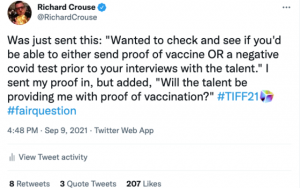
From Twitter: @RichardCrouse Was just sent this: “Wanted to check and see if you’d be able to either send proof of vaccine OR a negative covid test prior to your interviews with the talent.” I sent my proof in, but added, “Will the talent be providing me with proof of vaccination?” #TIFF21 #fairquestion 4:48 PM · Sep 9, 2021· 8 Retweets 3 Quote Tweets 206 Likes
There is no mention of COVID-19 in the Jake Gyllenhaal thriller “The Guilty.” But make no mistake, this is a pandemic movie, A remake of 2018 Danish film “Den skyldige,” it is essentially a one hander, shot on a just a handful of set with strict safety protocols in place. Gyllenhaal, as 911 operator Joe Baylor, may be socially distanced from his castmates, but his performance is anything but distant. Played out in real time, “The Guilty” builds tension as Baylor races against a ticking clock to bring the situation to a safe resolution for Emily. Director Antoine Fuqua amps up the sense of urgency, keeping his camera focused on Gyllenhaal’s feverish performance. The close-ups create a sense of claustrophobia, visually telegraphing Baylor’s feeling of helplessness and his crumbling mental state.
The sound of an audience laughing, applauding, crying, or whatever. Just being an audience. The big venues were socially distanced, and often looked empty to the eye, but when the lights went down and folks reacted to the opening speeches or the films, it didn’t matter. Roy Thomson Hall, with its 2600-person capacity, may have only had 1000 or so people in the seats, but for ninety minutes or two hours they formed a community, kindred souls brought together after a long break, and it was uplifting to hear their reactions.
“Flee” is a rarity, an animated documentary. A mix of personal and modern world history, it is a heartfelt look at the true, hidden story of the harrowing life journey of a gay refugee from Afghanistan. Except for a few minutes here and there of archival news footage, “Flee” uses animation to tell the story but this ain’t the “Looney Tunes.” Rasmussen used the animation to protect Amin’s identity, but like other serious-minded animated films like “Persepolis” and “Waltz with Bashir,” the impressionistic presentation enhances the telling of the tale. The styles of Rasmussen’s animation change to reflect and effectively bring the various stages of Amin’s journey to vivid life. It is suspenseful, heartbreaking and often poetic.
I asked “The Survivor” star Vicky Krieps about working opposite Ben Foster: “The first day I came [on set] I was very intimidated,” she said. “I wouldn’t say scared, but it felt like a wall to me. It began like this. There was no small talk. There was no, ‘How are you?’ He was already in character and it was very clear. I thought, ‘OK, I have to play his wife.’ And then, something really interesting happened. I like having a challenge and this felt like a challenge. So, I needed to find a way [to relate to him] because I knew I was going to be his wife. How do I do that? Imagine it as a wall, but then in the wall there are eyes. I used those eyes and I felt like I could open a window, and inside of those eyes was a horizon where I could go. I liked to say to Ben, ‘And then we would dance.’ Sometimes I wrote to him and said, ‘It was nice dancing today.’”
“Last Night in Soho,” from director Edgar Wright, is a love letter to London’s Swingin’ Sixties by way of Italian Giallo. Surreal and vibrant, and more than a little bit silly, its enjoyable for those with a taste for both Petula Clarke and murder. It begins with verve, painting a picture of a time and place that is irresistible. A mosaic of music, fashion and evocative set decoration, the first hour brings inventive world building and stunning imagery. Wright pulls out all the stops, making visual connections between his film and the movies of the era he’s portraying and even including sixties British icons Rigg, Tushingham and Stamp in the cast.
I asked “Dune” star Rebecca Ferguson why she said reading Frank Herbert’s novel was like doing a crossword puzzle: “Sometimes I wonder what comes out of my mouth,” she said. “My mother and many of my friends sit and do crosswords, but I have never been in that world. There is a way of thinking around it. It’s logical, mathematical. You need to be able to see rhythms. Whatever it is. Reading “Dune” was quite dense and I think for people who are immersed into the world of science fiction, they understand worlds and Catharism and this planet and that planet. It is just another picture, which, not to stupefy myself, I am intelligent enough to understand it, but there is a rhythm. I think it is me highlighting the fact that people who live and breathe science fiction, they get it at another level.”
“Dune,” the latest cinematic take on the Frank Herbert 1965 classic, now playing in theatres, is part one of the planned two-part series. “Dune” is big and beautiful, with plentiful action and a really charismatic performance from Jason Momoa as swordmaster Duncan Idaho. It is unquestionably well made, with thought provoking themes of exploitation of Indigenous peoples, environmentalism and colonialism.
“Mr. Jones,” a new drama starring James Norton and Vanessa Kirby that comes to VOD this week, is a period piece set in the years leading up to World war II but the themes it explores, fake news and media corruption are just as timely today as they were in the 1930s.
The action in “Mr. Jones” begins in 1933 after idealistic Welsh journalist Gareth Jones (James Norton) used his connections as foreign advisor to prime minister David Lloyd George to score a sit-down with Adolph Hitler. The resulting story, warning of Hitler’s ambitions, costs him his government job, leaving him free to explore his next story, a proposed interview with Joseph Stalin to discuss the truth of the Communist Party’s five-year plans for the development of the national economy of USSR. “The Soviets have built more in five years than our government can manage in a hundred.” He’s determined to find out how the poor country is funding such large scale technical and military achievements. What is being sacrificed in return?
Upon arrival in Moscow Jones is stymied at every turn. With no access to the leader the journalist, although a teetotaler, dips his toe into Moscow’s hedonistic nightlife scene where he meets the decadent Walter Duranty, the Pulitzer Prize-winning New York Times journalist Walter Duranty (Peter Saarsgard), a man as blind to the truth as Jones is open to it.
His search leads him to train, with a Communist minder, bound for Ukraine. Slipping away, he escapes into Stalino (now Donetsk) to uncover the unimaginable horrors of the Holodomor, a famine that killed at least 7.5 million people between 1932 and 1933. “They are killing us. Millions, gone,” says one townswoman. “Men thought they could come and replace the natural laws.”
What had been portrayed in the press as “the breadbasket of the world”—”Grain is Stalin’s gold,” says Duranty. “The 5-Year Plan has doubled the output.”—is in fact a hellscape of death where bodies are stacked on horse carts, abandoned houses dot the landscape and families eat tree bark and resort to cannibalism to survive.
Upon his capture he makes a deal with the devil to ensure the safety of six engineers arrested by the Russian state. As long as he promises to return to England and “tell the truth about what he saw;” to tell stories about the “happy and proud farmers and the remarkable efficiently of our collective farms,” and ensure the world that any rumors of a famine are just that. Rumors.
Back in England Jones says, “I do have a story but if I tell it six innocent men will die. But if I write the story millions of lives may be saved.”
“Mr. Jones” is an unevenly paced but haunting account of one man’s search for truth. At the center of it is Norton who effectively portrays Jones’ steeliness and his frustration at not being able to do his job but it is his time in Stalino that resonates. The long section, shot in desaturated black and white, with very little dialogue, allows the actor to portray the true horror of his surroundings. For the most part he keeps his revulsion internal, there are no hysterics here, just the soul crushing realization of the savagery of the surroundings.
Director Agnieszka Holland is no stranger to this subject matter or time frame. “Europa Europa” and “In Darkness” are compelling examples of her documentation of the worst events of the 20th century. She brings a similar gravitas to “Mr. Jones” and her unwavering sense of outrage at the atrocities is undiminished. It makes for forceful filmmaking but there are other choices that siphon some of the film’s power.
The opening moments, as Jones warns about Hitler’s threat, feel like something out of Masterpiece Theatre but quickly lead to more captivating material. It’s the inclusion of passages from George Orwell’s 1945 political satire “Animal Farm” that help bog down the film’s final forty minutes. Orwell was influenced by Jones’ reporting but didn’t write the book for a decade after the events portrayed in the film and his inclusion feels wedged in.
Despite some slack pacing “Mr. Jones” is an absorbing history lesson with a timely message for today. It’s a rejection of fake news and those who belittle the life-saving value of journalism.