CTV NEWS CHANNEL: RICHARD’S SUNDAY MORNING MOVIE REVIEWS FOR AUGUST 24!
I join CTV NewsChannel anchor Renee Rogers to talk about the thriller “Relay,” the neo-noir “Honey Don’t” and the rock doc “DEVO” on Netflix.
Watch the whole thing HERE!
I join CTV NewsChannel anchor Renee Rogers to talk about the thriller “Relay,” the neo-noir “Honey Don’t” and the rock doc “DEVO” on Netflix.
Watch the whole thing HERE!
SYNOPSIS: Ron Howard’s “Eden” is a star-studded—Ana de Armas, Vanessa Kirby, Sydney Sweeney, Jude Law and Daniel Brühl— story of backstabbing, ego and survival set against the unforgiving landscape of a deserted Galápagos Island. Based on a true story, it’s a heart of darkness tale done on an operatic level.
CAST: Jude Law, Ana de Armas, Vanessa Kirby, Sydney Sweeney, Daniel Brühl, Felix Kammerer, Toby Wallace and Richard Roxburgh. Directed by Ron Howard.
REVIEW: Based on a true story, “Eden” is an ambitious psychological thriller from director Ron Howard about a utopia that echoes the savagery and societal collapse of “Lord of the Flies.”
The film begins in the early 1930s with Dr. Friedrich Ritter (Jude Law) and his wife Dora Strauch (Vanessa Kirby) leaving the chaos of post-World War I Germany behind in favor of the solitude of Floreana Island in the Galápagos. Ironically, the misanthropic Ritter spends his days writing a philosophical manifesto about the betterment of humanity.
His dispatches to Europe attract the attention of the open-hearted Heinz and Margaret Wittmer (Daniel Brühl and Sydney Sweeney) who, much to Ritter’s annoyance, arrive with the hope of creating a community on the remote island.
Ritter’s solitude is further interrupted when the flamboyant Baroness Eloise Bosquet de Wagner Wehrhorn (Ana de Armas), and her two lovers land on the island with the idea of opening a luxury hotel on the beach.
A tale of survival, jealousy, betrayal, and violence, “Eden” is about the collapse of idealism. Director Ron Howard and screenwriter Noah Pink explore human nature through a jaundiced lens. The film takes its time escalating the power struggles that eventually erupt into violence, building tension as it does so, but a lack of energy in the film’s first half, as jealousy, deception, and betrayal blossom, makes our introduction to the story a bit of a slog.
Despite Jude Law’s full-frontal nudity and grotesque infected tooth, things liven up considerably when the larger-than-life Baroness and entourage show up. It’s a reset for the staid storytelling of the first half. Not only do her hedonistic ways alienate the island’s occupants, but she actively attempts to pit the Friederichs against the Wittmers. Her actions are the match to the powder keg, leading to the film’s more sordid aspects. The Baroness’s luridly glamorous presence adds some much-needed zip and Ana de Armas steals every scene she appears in with a deadly mix of charm and menace.
There is much to recommend in “Eden.” Gorgeous cinematography by Mathias Herndl and a tense score from Hans Zimmer go a long way to sell the story, but slack storytelling mars what could have been a fascinating trip to Floreana Island and the human condition.
SYNOPSIS: Set on the 1960s-inspired parallel Earth-828, “The Fantastic Four: First Steps,” the new Marvel movie now playing in theatres, sees Reed Richards/Mister Fantastic (Pedro Pascal), Sue Storm/Invisible Woman (Vanessa Kirby), Johnny Storm/Human Torch (Joseph Quinn), and Ben Grimm/The Thing (Ebon Moss-Bachrach) defend Earth from the gargantuan planet-devouring villain Galactus (Ralph Ineson) and his emissary, the cosmic surfboard riding Silver Surfer (Julia Garner).
CAST: Pedro Pascal, Vanessa Kirby, Ebon Moss-Bachrach, Joseph Quinn, Julia Garner, Natasha Lyonne, Paul Walter Hauser, and Ralph Ineson. Directed by Matt Shakman.
REVIEW: Like a lot of great speculative fiction, “The Fantastic Four: First Steps” isn’t really about the spectacle or the saving the world. Sure, there’s a humungous villain who makes the Statue of Liberty look like a Lego Minifig and the fate of mankind hangs is in the hands of the Four, but that stuff is there simply to act as a delivery system for a story about community, hope and family.
A standalone film—you won’t need to read the MCU wiki page to get up to speed—it dispenses with the origin story in a zippy newsreel that explains how scientists Reed Richards and Sue Storm, Johnny Storm and test pilot and astronaut Ben Grimm gained superpowers after exposure to radiation cosmically altered their DNA during a space mission, transforming them into Mr. Fantastic, Invisible Woman, Human Torch, and The Thing.
With that out of the way, director Matt Shankman gets to the world building.
Set in a retro-chic 1960s-inspired New York City, the film’s look is part “Mad Men,” part “Jetsons,” and reflects the Camelot style optimism of the era.
That it’s a tip of the hat to 1961, the year “The Fantastic Four” debuted, and visually sets the film apart from all other MCU movies, are nice thematic and visual bonuses.
More importantly, director Shakman and screenwriters Josh Friedman, Eric Pearson, Jeff Kaplan, and Ian Springer blend the existential threat of the end of the world (What’s a superhero movie without the threat of the end-of-the-world?) with a surprisingly intimate portrait of The Fantastic Four as a close-knit family.
Sue and Reed are expectant parents, managing the anxiety of having their first child who may, or may not, inherit their altered DNA. Sue’s brother, the hot-headed Johnny, who can burst into flame at will, and family friend Ben, who has permanently morphed into the gentle giant The Thing, are set up to be doting uncles when they aren’t goofing around or saving the world.
None of it would work if the cast didn’t click.
Pascal brings intelligence and emotional depth to Reed while Quinn plays Human Torch as an impulsive but warm-hearted character. The movie’s heart and soul, however, comes from Moss-Bachrach’s motion-capture performance and Kirby’s portrayal of a mother who will sacrifice everything to protect her child.
Even under a digital mountain of CGI, Moss-Bachrach finds pathos in Ben/The Thing’s situation. He’s a genial presence in the family unit, bringing warmth and humour, but it’s the truncated scenes with love interest Rachel Rozman (Natasha Lyonne) that humanizes the craggy, 500-pound character. They’re brief and under-written, but Moss-Bachrach makes the most of them.
Fierce yet vulnerable, compassionate yet steely, Kirby delivers a version of Sue Storm that has depth, as a maternal character and a superhero.
The emphasis on family, community and character are at the very heart of the film. There is spectacle, and the movie ultimately submits to a busy climax, but it’s not an all-out Action-A-Rama. The fireworks come from the characters, not the battle scenes, and while it may be a tad earnest and a bit straightforward for fans looking for loud ‘n proud battle scenes, it succeeds because it takes interesting, thoughtful first steps into a new superhero franchise.
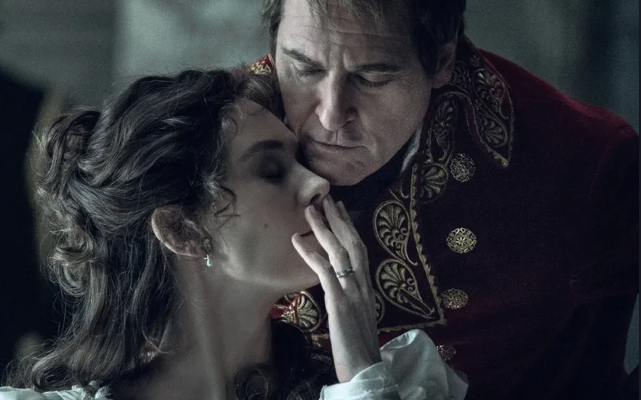
Director Ridley Scott and star Joaquin Phoenix team to present a portrait of Napoleon Bonaparte you are unlikely to find in any history book. Both epic and intimate, “Napoleon,” now playing in theatres before moving to Apple TV+, chips away at the character’s historical veneer to reveal an insecure, lovesick, petulant, pompous man with an emperor complex.
Covering roughly twenty years, the film begins in 1789 with the beheading of Marie Antoinette, the queen who lost her head during the French Revolution as the people rose up to abolish the monarchy. In the crowd is Napoleon Bonaparte (Phoenix), a young Corsican soldier with a plan to reclaim the port of Toulon by forcing the Anglo-Spanish fleet to withdraw. It is his first great triumph, revealing his strategic genius and setting him on a path to become the Emperor of France. “I’m not built like other men,” he says.
The small man in his ever-present, big bicorne hat has none of the social graces of French aristocracy, but his power gets him noticed by Josephine de Beauharnais (Vanessa Kirby), a widow whose upper-crust husband fell victim to France’s Reign of Terror. For Napoleon, it’s love at first sight, for her, it’s an opportunity that may one day be accompanied by real feelings. “Has the course of my life just changed, Napoleon?” she asks seductively when they first meet.
Despite not being able to produce an heir and very publicly cuckolding her husband, Josephine has a tight grip on Napoleon’s emotions. “You’re just a tiny little brute that is nothing without me. Say it,” she commands as he nods in agreement. Emotionally she is every bit the tactician as her spouse is on the battlefield and Kirby nails both her ruthlessness and her vulnerabilities.
When his dreams of controlling Europe incur massive loss of life on the battlefield, Napoleon finds himself exiled from the country and woman he loves.
It is hard to decipher exactly what Scott and Phoenix had in mind for “Napoleon.” The battle scenes are undeniably epic, shot on a grand scale while retaining the up-close-and-personal horrors of war. The Battle of Austerlitz sequence, in particular, is horrifying in its execution, brilliant in its design. Scott’s camera captures not only the ambush on a frozen lake, but the cunning mind it took to plan and implement a mission of that size. It’s the kind of thing that could reasonably be expected from the director given the subject.
Less expected is the portrayal of Napoleon, which often borders on satire. The obvious cliches are avoided—he is never seen slipping his hand into his coat, for example—but other choices make for choppy viewing. The general who is a strongman in battle, is also played for laughs in several scenes and I can’t figure out whether the humor is intentional or not.
When he flees the French Directory, the staid committee that governed France until November 1799, his physicality and shrieks of, “They’re trying to kill me,” are more Benny Hill than battleground hero. During another kind of battle, a food fight with Josephine, he throws a hunk of meat her way, bellowing, “Destiny has brought me this lamb chop.” Later, he “seduces” his wife with an odd humming sound that is the opposite of sexy.
Those playful, lighter scenes are intermittently entertaining, but feel at odds with the impassive warrior portrayed in the rest of the film. Perhaps the rumored four hour cut, slated to stream on Apple TV+ after the theatrical run, will add more context, but as it is, these scenes give the two-hour-forty-five-minute theatrical cut a choppy, inconsistent feel as its main character flip flops between stoicism, emotional openness and frivolity.
“Napoleon” will not be accused of being a reverent depiction of its subject, but neither will it be regarded as the definitive portrayal.
When the “Mission: Impossible” franchise began in 1996 the movies were big, prestige spy thrillers, heavy on the intrigue and supported by large action sequences. Then came 2011’s “Mission: Impossible – Ghost Protocol,” a popcorn flick built around an eye-popping sequence featuring star Tom Cruise scaling the world’s tallest building, the Burj Khalifa in Dubai, with only a pair of suction gloves and courage coming between him and certain death.
That sequence made audience’s eyeballs dance and changed the focus of the franchise. It also turned Cruise into the Evel Knievel of cinematic risk taking.
Since then, the movies have been driven by the death-defying stunts performed by their star, the seemingly fearless Cruise, rather than the convoluted plots of the first batch of films. In the world of “Mission: Impossible” there is no building is too high for Tom to climb, no chasm too wide for him to jump.
The new film, “Mission: Impossible—Dead Reckoning Part One,” files the actual story down to a nub—”I’m going to need a few more details,” says glamourous international thief Grace (Hayley Atwell), as if commenting on the script. “They tend to get in the way,” replies Benji, nodding his head.—while letting it rip with wild action sequences.
The catalyst for the action is artificial intelligence run amok. Called The Entity, it is an all-powerful machine, “who is everywhere and nowhere” and has no center. “We don’t want to kill it,” says Eugene Kittridge (Henry Czerny), the former director of the Impossible Missions Force, “we want to control it.”
The key to controlling it is, well, a key. Split into two halves, the key only works when made whole. Kittridge’s best chance of intercepting the key is the IMF, a secret group of expert spies made up of Ethan Hunt (Cruise), computer technician Luther Stickell (Ving Rhames), field agent Benji Dunn (Simon Pegg) and sometimes member Ilsa Faust (Rebecca Ferguson).
The IMF’s mission, should they choose to accept it, is to retrieve one half of the key from glamourous international thief Grace (Hayley Atwell) before she can sell it to black market arms dealer Alanna Mitsopolis (Vanessa Kirby). The fear is Mitsopolis will pass the key’s combined halves to terrorist Gabriel (Esai Morales). “None of our lives can matter more than the mission,” says Stickell.
Cue feats of daring-do and wild action.
“Mission: Impossible—Dead Reckoning” is the ne plus ultra of modern, big-budget studio filmmaking. Director Christopher McQuarrie manages the breathless, super-sized movies with an expert hand, blending old school action movie filmmaking with real stakes.
Whether it is Cruise flying through the air on a motorcycle or navigating through the streets of Rome in a tiny, but speedy European car or hanging on for dear life as a train car disintegrates around him, the green-screenless action scenes seem to be saying, “Take that Marvel.” The organic stunts, no matter how foolhardy they may be, up the stakes, have real danger to them and set “Dead Reckoning” apart from most action flicks. It is escapism at an eye-watering level.
Tempering the action is some humor and an emphasis on the connections between the characters. Loyalty to the cause has always been paramount in these movies, but the bond between the characters has been tempered, probably because we are near the end of the franchise, by a dose of nostalgia and sentimentality.
Still, this is, first and foremost, an action movie, the characters each have an archetype to fill. Rhames and Pegg are the playful foils, Vanessa Kirby is a deliciously vampy femme fatale and Esai Morales is the kind of baddie who makes grand pronouncements like, “I will disappear like smoke in a hurricane.”
Most notable is the latest lead addition, Grace. She is a slippery character whose motives shift and change with the wind, which makes her interesting. Unlike Isla (Rebecca Ferguson), however, who could handle herself in any situation, Grace is more a damsel in distress, although in the arena of self-preservation, she is a master. She is the kind of character that franchises are built around.
“Mission: Impossible—Dead Reckoning Part One” isn’t all played at 11. It has peaks and valleys, of course, but the valleys are welcome respite from the sensory overload provided by the spectacle and adrenaline. It is a heckuva mission, satisfying, even if we have to wait a year or more, for the story’s conclusion.
“The Son,” director Florian Zeller’s follow-up to the Oscar winning “The Father,” is the story of a fractured family and a son struggling with mental illness.
The drama, adapted for the screen by Christopher Hampton from Zeller’s stage play, involves Peter (Hugh Jackman), a high-flying New York City lawyer with political aspirations. He is the father of 17-year-old Nicholas (Zen McGrath) and ex-husband of Kate (Laura Dern), but has rebooted his life, marrying Beth (Vanessa Kirby), a much younger woman who is the mother to their baby, Theo. Peter has a new baby and a new life that doesn’t leave much room for his older son.
When Nicolas begins skipping school, acting out and cutting himself as a way to channel his pain, Kate asks if Peter can step up and give the boy some guidance and a place to stay. “He needs you Peter,” she says. “You can’t abandon him.”
Life is weighing Nicholas down. “I can’t deal with any of it,” he says. “I want something to change, but I don’t know what.”
With Nicolas in the spare room, Peter attempts to “fix” him, searching for an explanation for his son’s behavior, trying to be a better father to the teen than his own father, played by Anthony Hopkins, was to him. An unapologetically bad father, Hopkins snarls, “Your daddy wasn’t good to you or your mama. Who cares? Get over it.”
“The Son” is the story of intergenerational trauma, of the sins of a father (Hopkins is despicable in a fiery cameo) being visited upon his son and grandson, and a child’s cry for help.
Compassion abounds in “The Son,” and Jackman astounds wit work that is tinged with vulnerability, tragedy and guilt, but the script offers few surprises. Zeller telegraphs the film’s biggest moments, as if he doesn’t trust the audience to follow along. Those early revelations mute the story’s emotional power, despite the fine, compassionate performances.
There are compelling moments in “The Son.” A showdown between Peter and Nicholas packs emotional heft, and Jackman’s struggle to understand his son’s acute depression is tempered with equal parts empathy and frustration.
Jackman delivers a remarkable and authentic portrait of a desperate father in a well-intentioned film, that, by and large, feels manipulative by comparison.
“Pieces of a Woman,” now steaming on Netflix, begins with happy, loving couple Martha (Vanessa Kirby) and Shawn (Shia LaBeouf) on what should be one of the happiest days of their lives. In the scene, shot mostly in long takes, Martha is in labor, minutes away from giving birth to their daughter. With their midwife indisposed a replacement named Eva (Molly Parker), unfamiliar with their case, is sent in her place. By the end of the twenty five-minute pre-credit sequence tragedy has struck, and their lives are forever changed.
Director Kornél Mundruczó sets the bar very high in the opening moments of the film. It is riveting filmmaking, intimately showing Martha and Shawn’s anticipation, pain and anguish in real time. The bulk of the film deals with the aftermath as the couple are driven apart by grief and recrimination and it’s very strong, but cooler in tone than the opening.
It is interesting to note that “Piece of a Woman” was originally conceived as character sketches by Kata Wéber meant for the stage. You can feel the attention to detail that was lavished on each of the characters. They are richly drawn and carefully portrayed by the actors.
A trio of performances tell the story.
Kirby, best known as Princess Anne on “The Crown,” digs deep to create a portrait of a person devastated by the loss of her child; someone whose world stopped turning that day. As she looks for closure, there is an intensity that comes from her rage and sorrow manifesting themselves as heartbreak. It is layered, emotionally-draining, award worthy work.
LaBeouf plays Shawn as an attention hungry husband. A man trying to move on by forcing his attentions on Martha and when that doesn’t work, he looks elsewhere. LaBeouf is a bubbling cauldron of frustration, about to overflow.
As Martha’s mother, an imperious woman hell bent on assigning blame, Ellen Burstyn delivers a tour-de-force monologue about the way mothers raise their daughters that could be a short film all on its own.
“Pieces of a Woman” isn’t an easy watch. The performances are raw, real and uncomfortable that exhaust and exhilarate in equal measure.
“Mr. Jones,” a new drama starring James Norton and Vanessa Kirby that comes to VOD this week, is a period piece set in the years leading up to World war II but the themes it explores, fake news and media corruption are just as timely today as they were in the 1930s.
The action in “Mr. Jones” begins in 1933 after idealistic Welsh journalist Gareth Jones (James Norton) used his connections as foreign advisor to prime minister David Lloyd George to score a sit-down with Adolph Hitler. The resulting story, warning of Hitler’s ambitions, costs him his government job, leaving him free to explore his next story, a proposed interview with Joseph Stalin to discuss the truth of the Communist Party’s five-year plans for the development of the national economy of USSR. “The Soviets have built more in five years than our government can manage in a hundred.” He’s determined to find out how the poor country is funding such large scale technical and military achievements. What is being sacrificed in return?
Upon arrival in Moscow Jones is stymied at every turn. With no access to the leader the journalist, although a teetotaler, dips his toe into Moscow’s hedonistic nightlife scene where he meets the decadent Walter Duranty, the Pulitzer Prize-winning New York Times journalist Walter Duranty (Peter Saarsgard), a man as blind to the truth as Jones is open to it.
His search leads him to train, with a Communist minder, bound for Ukraine. Slipping away, he escapes into Stalino (now Donetsk) to uncover the unimaginable horrors of the Holodomor, a famine that killed at least 7.5 million people between 1932 and 1933. “They are killing us. Millions, gone,” says one townswoman. “Men thought they could come and replace the natural laws.”
What had been portrayed in the press as “the breadbasket of the world”—”Grain is Stalin’s gold,” says Duranty. “The 5-Year Plan has doubled the output.”—is in fact a hellscape of death where bodies are stacked on horse carts, abandoned houses dot the landscape and families eat tree bark and resort to cannibalism to survive.
Upon his capture he makes a deal with the devil to ensure the safety of six engineers arrested by the Russian state. As long as he promises to return to England and “tell the truth about what he saw;” to tell stories about the “happy and proud farmers and the remarkable efficiently of our collective farms,” and ensure the world that any rumors of a famine are just that. Rumors.
Back in England Jones says, “I do have a story but if I tell it six innocent men will die. But if I write the story millions of lives may be saved.”
“Mr. Jones” is an unevenly paced but haunting account of one man’s search for truth. At the center of it is Norton who effectively portrays Jones’ steeliness and his frustration at not being able to do his job but it is his time in Stalino that resonates. The long section, shot in desaturated black and white, with very little dialogue, allows the actor to portray the true horror of his surroundings. For the most part he keeps his revulsion internal, there are no hysterics here, just the soul crushing realization of the savagery of the surroundings.
Director Agnieszka Holland is no stranger to this subject matter or time frame. “Europa Europa” and “In Darkness” are compelling examples of her documentation of the worst events of the 20th century. She brings a similar gravitas to “Mr. Jones” and her unwavering sense of outrage at the atrocities is undiminished. It makes for forceful filmmaking but there are other choices that siphon some of the film’s power.
The opening moments, as Jones warns about Hitler’s threat, feel like something out of Masterpiece Theatre but quickly lead to more captivating material. It’s the inclusion of passages from George Orwell’s 1945 political satire “Animal Farm” that help bog down the film’s final forty minutes. Orwell was influenced by Jones’ reporting but didn’t write the book for a decade after the events portrayed in the film and his inclusion feels wedged in.
Despite some slack pacing “Mr. Jones” is an absorbing history lesson with a timely message for today. It’s a rejection of fake news and those who belittle the life-saving value of journalism.
The “Fast & Furious” movies have gone, in less than twelve movies, from veered from sublimely silly car chase flicks to simply silly. They get bigger and badder each time out, revving up the action to include international intrigue, crazier stunts, more stars and more pedal-to-the-metal action. This weekend the core franchise splinters off with the majestically titled “Fast & Furious Presents: Hobbs & Shaw.”
The new film is a showcase for two returning characters, Diplomatic Security Service agent Luke Hobbs (Dwayne Johnson) and Deckard Shaw (Jason Statham), former British Special Forces assassin-turned-mercenary. But this isn’t Butch and Sundance. These guys do not like one another and with good reason. Years before Hobbs had arrested Shaw, throwing him in prison for the vehicular murder of Han Lue. Since then they have never missed an opportunity to trade blows and witty one-liners.
After cyber-genetically enhanced anarchist Brixton “I am the future of mankind.” Lore (Idris Elba) threatens to unleash a bio-hazard—“It’ll turn your body into a bag of hot soup.”—framing MI6 agent (and Shaw’s sister) Hattie Shaw (Vanessa Kirby) in the process, the titular enemies reluctantly team up.
At one point Hattie says to Hobbs, “There is nothing subtle about you,” and she may as well have been talking about the movie, not the character. “Hobbs & Shaw” is a wild rumpus of a movie. First gun shot and grenade blast happen within the first minute. First casualty and car crash in three minutes. First self-tazing and assault with a champagne bottle within five minutes.
This is the kind of movie you get when you mix and match “The Terminator,” a low-key Thanos wannabe—ie: a villain who thinks over population is destroying the world—and some bodybuilding action stars. It’s the kind of movie summer was invented for. Loud and proud, its most redeeming feature is that it will play in luxurious air-conditioned theatres on blistering hot days.
It’s a bit of fun, a generic movie that succeeds through volume, slapstick action and the charisma of its three leads. The only connection it has to “Fast & Furious,” aside from the element of community between outlaws is well represented, is in title only. “Fast & Furious Presents: Hobbs & Shaw” is a vehicle for Johnson, Statham and Kirby and by the time The Rock’s mother is threatening people with her flip-flop, the movie developes a severe case of the sillies from which it (or the franchise, because, yes, this is set up for a sequel) may never recover.
“Hobbs & Shaw” manages to both rev its engine and spin its wheels, providing some hare-brained action and charming actors but not much else.