Less a biopic than an intimate character study, “Jackie,” sees Natalie Portman play one of the most famous women of the twentieth century, first lady Jacqueline Bouvier Kennedy. DirectoPablo Larraín personalizes the reaction to assassination of John F. Kennedy, presenting a portrait of grief that values rawness over slick sentimentality.
Focussing on the events immediately following November 22, 1963, the film cuts through the carefully constructed image Jacqueline Kennedy presented to the world. Instead it shows her as a grieving widow struggling to fulfil her personal responsibilities under the scrutiny of the American people and White House staff.
Larraín employs a standard biopic starting point—an interview with a journalist (Billy Crudup)—to frame the tale, but then throws all other familiar biographical approaches out the window. Kennedy’s story is a tragic one played out on the world stage and yet the film is never mawkish. It is a look at the end of “Camelot”—the musical and the ideological state of mind it personified for the Kennedy administration—as a psychological portrait of the woman at the very centre of it all.
Portman plays Kennedy not from the point of view of history—she is remembered for her grace and dignity—but as a woman fraying around the edges as she ponders the gravity of her situation and the legacy that will be left behind. She doesn’t look like Kennedy but, in a performance largely captured in close up, creates a portrait that seamlessly blends the poised, public Kennedy persona with a woman on the verge of a breakdown. It is often harrowing and certainly shows a different side of Kennedy than any other look at the subject.
“Jackie” is a bold film that values visceral feelings over glossy convention. It presumes much in its efforts to peer into the cracks of history, taking abundant artistic licence with what some will see as an intrusive look into Kennedy’s life. This is not “Camelot,” it’s the flipside of that romantic fairy tale.
Why did director Antoine Fuqua decide to remake the legendary 1960 western The Magnificent Seven? “I wanted to see Denzel Washington on a horse,” he jokes.
The story of seven men who come together to protect a town from a vicious robber baron looks back further than the 1960 film to the 1954 epic Japanese historical drama Seven Samurai. Often cited as one of the greatest films ever made, Akira Kurosawa’s Seven Samurai provided what Fuqua described as the DNA of his film, but he also noted, “Westerns change with the time we’re in, so we made our film based on the world we are living in.”
To that end he has assembled the most diverse cast for a western ever. In addition to top billed stars Washington, Chris Pratt, Ethan Hawke and Vincent D’Onofrio the seven magnificent leading actors include South Korean star Lee Byung-hun, the Mexican born Manuel Garcia-Rulfo and Martin Sensmeier, an American actor of Tlingit, Koyukon-Athabascan and Irish descent.
“You can’t do the same thing every era,” says Fuqua. “Westerns change all the time. If we were sticking to just one way of doing something then all westerns would be all white guys looking like John Wayne in a John Ford movie.”
“My idea was, if Denzel walks into a room, the room stops,” he says. “If Clint Eastwood walks into a room, the room stops. Is it because he’s a gunslinger or is it because of the colour of his skin? We’ll let the audience decide.”
When asked if The Magnificent Seven is proof that Hollywood is becoming more diverse the director says, “You have to give the studio credit when they do something like this. This becomes the new definition of what a western is.”
Chris Pratt, who plays gunslinger Josh Faraday says despite the film’s title The Magnificent Seven has more to do with another well known western.
“I don’t know how many movies there are in the world,” he said at the TIFF opening night press conference. “What would you guess, several hundred thousand? Millions? Eventually you just run out of names. If I have a son and name him Chad, is he a remake of somebody else who was named Chad? No. We could have called this The Cowboys or something, but [The Magnificent Seven title] has reach,” he continued, “it gets people engaged. But [this movie] is probably more Wild Bunch than it is [1960’s] The Magnificent Seven. We use the title, we use the story. It’s a bunch of guys. There are seven of us. And we’re all [bleeping] magnificent. We’ve got that going for us, but let that movie be that movie. This is a different movie.”
Star Denzel Washington says he’s never seen the 1960 film. “I didn’t keep away from it,” he says. “I just didn’t know how it would help me. I had never seen it as a kid or whatever. People say, ‘You’re the so and so character,’ I don’t even know who that is. I think it allowed me to do whatever I wanted to do instead of trying to not do what someone else did.”
Why did he sign on? “Well, Antoine asked me. It’s as simple as that. Obviously, it’s a good story and a good script but most importantly it was Antoine.”
Director Antoine Fuqua’s remake of “The Magnificent Seven” literally starts with a bang.
A series of mine explosions echo through Rose Creek, signalling unrest in the tiny mining town. Bartholomew Bogue (Peter Sarsgaard) has taken over, terrorizing the town with hired goons. He’s a cruel man who guns down citizens and says to his henchmen, “Leave the bodies where they lie. Let them look at them for a few days.” Bad Bart wants the land but is only will to pay a pittance per parcel. “Those of you who signed the deeds will get your $20,” he sneers. “And those who don’t, God help you.”
The townsfolk are helpless. Bogue has killed a half dozen men and with the sheriff on his payroll will continue to do as he pleases. Fed up and recently widowed, Emma Cullen (Haley Bennett) turns to hired gun Sam Chisolm (Denzel Washington) for help. “You don’t need a bounty hunter,” he says, “you need an army.” Despite the massive odds against them Chisolm assembles a rag tag team of killers, gamblers and outlaws—Josh Farraday (Chris Pratt), Goodnight Robicheaux (Ethan Hawke), Jack Horne (Vincent D’Onofrio), Billy Rocks (Byung-hun Lee), Vasquez (Manuel Garcia-Rulfo), and Red Harvest (Martin Sensmeier)—to go up against the ruthless robber baron in what promises to be a better than OK gunfight at the corral.
“The Magnificent Seven” is a classic looking western with a modern pace. Fuqua chooses not to mess with the key oater elements. He papers the screen with acres of open land, seven tough men, one or two resilient women and a sea of cowboy hats. He is respectful to the form and doesn’t try to bring the genre into the twenty-first century with frenetic editing—I’m looking at you Timur “Ben-Hur” Bekmambetov—or contemporary language. It’s a western, with all that entails; good vs. evil with some moral ambiguity thrown in for good measure.
Also thrown in for good measure is a heap of star power. Washington is a cool character, quietly deadly. He says cool stuff—“Chisolm, should I know that name?” he’s asked. “You should know it from your obituary,” he replies.—and is the movie’s charismatic center. Chris Pratt’s easy charm gives Washington a run for his money, but this is really Denzel’s movie from top to bottom.
Hawke and D’Onofrio do interesting character work. As the shell-shocked Robicheaux Hawke is equal parts swagger and skittishness while D’Onofrio is practically unrecognizable as the squeaky-voiced Jack Horne.
The remaining member of the seven aren’t given much to do other than pull triggers and nod in agreement to Chisolm’s plans, but they are an interesting bunch nonetheless.
At a little over two hours “The Magnificent Seven” could be leaner and well, maybe not meaner—I would not be surprised if it had the highest body count in a western ever—but tighter. There is a mid-movie sag as the plans for the final shootout are being finalized but the ballet of bullets at the end is epic, if not a little excessive, putting a fitting cap on a story that is slight but entertaining for most of the running time.
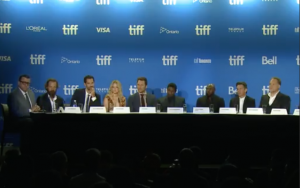
Richard hosts the “Magnificent Seven” TIFF press conference with (from left to right) Richard, Peter Sarsgaard, Manuel Garcia-Rulfo, Haley Bennett, Chris Pratt, Denzel Washington, Antoine Fuqua, Ethan Hawke, Vincent D’Onofrio, Lee Byung-hun and Martin Sensmeier.
There was a time when one of the best-known sportsmen in the world didn’t wear a uniform, cleats or throw a ball. As unlikely as it seems in the summer of 1972 chess master Bobby Fischer held the world transfixed, battling against Soviet grandmaster Boris Spassky.
Tobey McGuire is Fischer, a child chess prodigy determined to be recognized as the best player in the world. As a young, cocky player he easily decimates his opponents, earning national ranking and the opportunity to play the best players in the world.
At Fischer’s side are Paul Marshall (Michael Stuhlbarg) as a shadowy government figure who sees Fischer’s triumph over the Russians as a Cold War triumph for all of America and a chess whiz priest (Peter Sarsgaard) who provides guidance, both personal and professional.
Between Fischer and his goal is Spassky (Liev Schreiber), a stately Russian genius who thoroughly unnerves the American, highlighting his descent into mental illness and paranoia. By the time to two face off at the 1972 World Chess Championship in Reykjavík, Iceland, Fischer’s obsessions—anti-Semitism (even though he himself is Jewish) and a deep seeded distrust of his Russian opponents—threaten to incapacitate him.
Considering Fischer’s ability to think several steps ahead of his opponents, “Pawn Sacrifice” is surprisingly straightforward. Fischer’s life is divided into major events laid out end to end, from prodigy to world champion to eccentric recluse. McGuire transcends the basic biopic structure with a nuanced performance that breathes life into Fischer’s brilliance and demons. The reason for his torments aren’t examined as deeply as it might have been—his issues with identity seem to only stem from his mother’s taunts about his absent father—which may have deepened the character but McGuire plays him with confidence and vulnerability.
Also strong is Schreiber, performing here in Russian, as the august but human grandmaster.
“Pawn Sacrifice” kicks into gear in its final third as Fischer and Spassky go mano e mano over a chess board as the world watches.
In Black Mass, Dakota Johnson has a high profile role as the steely-but-sweet girlfriend to notorious gangster James “Whitey” Bulger but for much of her life she was simply known as a child of Hollywood, the daughter of Melanie Griffith and Don Johnson.
Despite an acting career that stretches back to 1999, the 25-year-old became a sensation just last year when she landed the lead role in one of the most anticipated films of the decade.
She beat out half of young Hollywood to play Anastasia Steele in the fastest selling R-rated title ever, Fifty Shades of Grey. She bared all, physically and emotionally; and became famous enough to have designers create clothes for her and an avalanche of interesting scripts to tumble her way. She’ll soon be seen in a Fifty Shades sequel and a remake of the legendary Italian horror film Suspiria.
This week she stars opposite her 21 Jump Street co-star Johnny Depp — they appeared in the 2012 film — as Lindsey Cyr, mother of Bulger’s son and the only person in South Boston who would stand up to the infamous killer.
Cyr is still alive but Johnson didn’t think it was a good idea to meet with her.
“It would have been if my goal had been to be extremely accurate but my goal was to bring out a different side of Jimmy. We talked about meeting her but we decided that it would have added a bunch of components. You wouldn’t see them. You wouldn’t see the stories she was telling because it wasn’t part of our story.”
Instead she studied footage of the former diner waitress and lawyer’s assistant.
“I did as much research as was available to me,” she says, “but the majority of the footage I found on her was pretty recent and it was her looking back on her time with Jimmy Bulger.
“Obviously the time that we see them together (in the film) is when she is quite young. A lot of that came from working it out with (director) Scott Cooper and Johnny.”
In her most intense scene she stares down and out-manoeuvres the controlling gangster after personal tragedy strikes the couple.
“There was a very heavy atmosphere on set but because Johnny was really not himself, he was a completely different person and because I’m not a mother and have never experienced anything as profoundly devastating as losing a child, I think we both completely slipped away from ourselves. That allowed us to create the scene the way it was.”
On acting: Edgerton portrays former FBI agent as a ‘bad dude’
Joel Edgerton didn’t meet the inspiration for his character in Black Mass, former FBI agent John Connolly.
“He’s alive and with us, albeit in federal prison and a little hard to reach,” said the Australian actor. The real-life Connolly was convicted of racketeering and obstruction of justice charges stemming from his relationship with gangster James “Whitey” Bulger.
“His version of events doesn’t line up with our version…. I felt like it was a little unfair to go and visit him in federal prison and say, ‘You stay in here while I’m over here making you look like a bad dude.’ It felt like it wasn’t a very genuine thing to do.”
Black Mass sees Johnny Depp playing Jimmy ‘Whitey’ Bulger, a crime lord-turned-FBI-informant who ruled South Boston and was also the inspiration for Jack Nicholson’s character in The Departed.
Bulger was a community minded cold-blooded killer. He loved his neighbourhood, kids, cats and choking people to death with his bare hands.
Depp says “a responsibility to history and truth to some degree” was very important to him going into the project.
“When you’re playing someone who exists or existed,” he says, “there’s a tremendous kind of amount of responsibility, at least for me, no matter whether they’re deemed good or bad or whatever. You have a responsibility to that person.”
The fifty-two year old actor’s performance is already earning early Oscar buzz for the chilling authenticity he brings to a man described in the film as “ripened psychopath.”
Director Scott Cooper says, “I don’t think people come to narrative features for the facts, or for truth. I think you go to documentaries for that. What you do come to narrative features for is psychological truth, emotion and deep humanity. I did not want to make a film strictly about criminals who happened to be humans. I wanted to make a film about humans who happened to be criminals.”
Like many underworld figures, Bulger created his own mythology based on his exploits, making it difficult for co-screenwriter Mark Mallouk and Cooper to discern what was true and what wasn’t.
“Jimmy Bulger had his version of the truth which was different from (accomplice) Stephen Flemmi’s,” said the director, “that was different from (henchman) Kevin Weeks and (hitman) John Martorano. I had to determine what was the story I was going to tell… and tell it as accurately as I could from a very emotional place.”
It’s a hard-edged tale to be sure, fuelled by Bulger’s violent and grim behaviour, but Depp found it best not to judge the character.
“I don’t think any of us wake up in the morning and say, ‘I’m so evil. I’m so horrible,’” Depp said. “I approached James Bulger as a human being, who’s multi-faceted and did have a side to him that was human and loving.”
Depp’s performance and the work of his co-stars Dakota Johnson and Joel Edgerton among others, ensure that Black Mass is a complex study of human behaviour, but hopefully, according to Mallouk, not a glamorous one.
“None of wanted anyone walking out of the theatre to go, ‘I want to be Whitey Bulger,’” said Mallouk. “You feel that way after Scarface or Goodfellas or after The Godfather, and I love those movies, but there is a responsibility to not do that here. It feels more like Donnie Brasco. We did not want to create more fuel for the Whitey Bulger myth.”
Cooper says his responsibility as a filmmaker and storyteller was with “the victim’s families because Jimmy Bulger and the men we chronicle in this film left a deep emotional scar on the city of Boston that is still very fresh and widely felt.
“I care what they think about the film and I hope I didn’t trivialize these events.”
In real life Bulger, now eighty-six years old and serving two life terms plus five years at a penitentiary in Florida, was convicted of racketeering, money laundering, extortion, weapons charges and was found to have been involved in 11 murders.
“You talk about six degrees of Kevin Bacon,” says Cooper. “In South Boston or Boston in general it’s two degrees of Whitey Bulger. Everybody had a story and everybody knew him.”
“Southie kids went from playing cops and robbers in the playground to doing it for real on the streets,” says Kevin Weeks (Jesse Plemons), “and like on the playground sometimes it was hard to tell who was who.”
It’s not that hard, really. Not in “Black Mass” anyway. The story of Jimmy ‘Whitey” Bulger (Johnny Depp), the crime lord-turned-FBI-informant who ruled South Boston and was the inspiration for Jack Nicholson’s character in “The Departed,” is populated by bad men who do terrible things.
Bulger himself was a community minded cold-blooded killer. He loved his neighbourhood, kids, cats and choking people to death with his bare hands. He was, in the words of FBI agent Charles McGuire (Kevin Bacon) a “ripened psychopath.”
“It’s not what you do,” Bulger says, “it’s when and where you do it. If no one sees it didn’t happen.”
“Black Mass” is a gangster thriller in the same vein as ”Goodfellas.” It follows a familiar pattern, the rise, fall and eventual ratting out of a crime boss, but provides more than enough underworld intrigue to keep things interesting. Depp is all coiled menace, a dark-eyed malevolent force capable of helping an old neighbourhood woman with her groceries one moment and killing an old friend the next. He’s unpredictable in the most predictable of ways, but Depp makes sure that Bulger isn’t just an echo of Michael Corleone or Tony Montana by giving him some tender moments with his family, son, mother and brother. It’s terrific work and a welcome change from his recent, extended Caribbean trip.
This is very much Depp’s movie but it is populated by an array of interesting and well-performed characters.
Joel Edgerton is John Connolly, a Southie kid who grew up to become the FBI agent who convinced Bulger to become an informant. Edgerton is always interesting, often in supporting roles. Here in a large, showy part he is all swagger and Brut cologne.
As the assorted bad guys and crooked FBI agents Jesse Plemons, Rory Cochrane, Peter Sarsgaard bring the scuzz, but while this is a very male movie, there are three solid performances from the female cast. As Connolly’s wife Julianne Nicholson brings the right amount of scepticism about being airlifted into a world she doesn’t understand and Juno Temple is heartbreaking as a street waif who makes the mistake of trusting Whitey. Dakota Johnson, as Bulger’s common law wife Lindsey Cyr, stands out, riding the line between steeliness and sweetness in her scenes with Depp.
The gangster saga may be the great American movie genre. From Howard Hawks and William A. Wellman to Martin Scorsese and Francis Ford Coppola, bullets and bangers have been a staple on the big screen. “Black Mass” is another piece of that puzzle, but unlike “Scarface” or “The Godfather” it doesn’t glamourize gang life—this is the underworld’s more down-and-dirty side—but neither does it break much new ground. Perhaps given the extensive Hollywood history of on-screen thuggery there aren’t many new ways to present the rise-and-fall story but director Scott Cooper, Depp and cast at least keep it compelling.
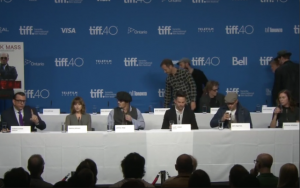
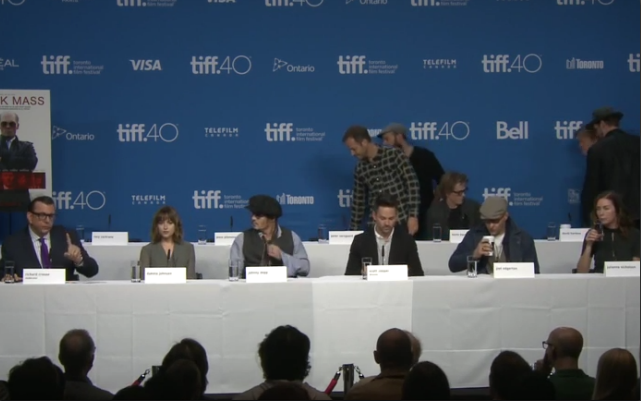
Richard hosted the press conference for the movie Black Mass held during the 2015 Toronto International Film Festival on Monday September 14 with Dakota Johnson, Johnny Depp, Joel Edgerton, Peter Sarsgaard, Kevin Bacon, Julianne Nicholson, Jesse Plemons, Rory Cochrane, as well as director Scott Cooper.