I join CTV Atlantic’s Bruce Frisko to talk about the absurdist environmental dramedy “Digger,” the suburban gothic “Verity” and the psychological thriller “Heel.”
Fast reviews for busy people! Watch as I review three movies in less time than it takes to wind your watch. Have a look as I race against the clock to tell you about the absurdist environmental dramedy “Digger,” the suburban gothic “Verity” and the psychological thriller “Heel.”
SYNOPSIS: In “Digger,” a new dark comedy now playing in theatres, Tom Cruise plays the title character, an oil tycoon who launches a campaign to become humanity’s savior before a disaster of his own making destroys the world. “If we can’t control the course of nature,” her says, “at least we can control the narrative.”
CAST: Tom Cruise, Riz Ahmed, John Goodman, Sandra Hüller, Michael Stuhlbarg, Jesse Plemons. Directed by Alejandro G. Iñárritu.
REVIEW: A study in justification of one’s actions, “Digger” is a dark satire, touched by farce, of narrative control in the face of crisis.
Tom Cruise, disguised by an inch of aging make-up, fake teeth and an elaborate comb-over, plays Digger Rockwell, the world’s most powerful oil tycoon. Eccentric, greedy and immoral—“Mr. Rockwell is a man who would roast our children alive if he thought he could sell them for a dime,” says scientist Ganesh (Riz Ahmed)—he does not like bad news.
When he gets bad news about the stability of one of his oil platforms, he ignores it and the resulting explosion causes havoc, creating aa ice shelf then size of Washington, D.C. on a collision course with Western Europe. “Digger here got us into this mess,” says the President of the United States (John Goodman), “and Digger’s gonna dig us out again.”
Rather than accept blame for the worldwide chaos Digger treats the situation not as a catastrophe but as a branding problem. “Panic is a resource,” he says. “When you’re running away from a house fire no one cares who left the toaster on.”
With the fate of the world hanging in the balance, Digger tries to save his company and himself by controlling the narrative. “They know the facts,” he says. “The story is yet to be told.”
Echoes of “Dr. Strangelove” reverberate throughout “Digger.” Both are absurdist nightmare comedies that skewer the egos and ideologies of powerful men, and both focus on managing the narrative of a crisis rather than dealing with it. But the cool, deadpan vibe of Stanley Kubrick’s film is replaced by a passionate, outlandish feel that will certainly divide audiences.
It’s a big movie, filled with big ideas, even if they sometimes get lost in the sheer grandiosity of the filmmaking. Director Alejandro G. Iñárritu, who co-wrote the script with Alexander Dinelaris, Nicolás Giacobone and Sabina Berman, presents a riff on the old saying, “power tends to corrupt, and absolute power corrupts absolutely,” but in Digger Rockwell’s world corruption goes hand in hand with control because that’s where the power is. Controlling the narrative is more important than solving the problem.
“They know the facts,” he says, “but the story has yet to be told.”
Digger’s a bad guy, ignorant, tacky and narcissistic, but he’s the hero of his own invented narrative and in an era of fake news and misinformation, it’s a timely and scary reality check.
The absurd and often jaundiced take on the machinery of power from Digger’s house to the White House and beyond is not subtle. Iñárritu takes big swings here narratively and stylistically. His ambition pays off in fits and starts. Some scenes, like a sequence of Digger, the President of the United States (John Goodman) and various generals, watching the iceberg collision with land is darkly hilarious, or Cruise’s ten-minute amphitheater monologue, fire on all cylinders.
But overall “Digger” values audacity, ambition and theatrics over narrative clarity. Not funny enough to be a satire, too outrageous to be straight drama, it lands in a tonal wasteland, wavering between silly and sincerity.
The parts of “Digger” that work, however, work very well. John Goodman lets his freak flag fly as the beleaguered POTUS and Riz Ahmed, as the pushed-to-the-brink climate scientist, hands in a career best performance. Cruise nails both the farcical elements of the character but lets the more intimate, realistic moments breathe in a performance that will likely draw attention from the Academy at Oscar time.
Digger Rockwell brags that the world is powered by his fossil fuels, but his movie is fueled by something else: audacity. It is a truly unique film, the kind that doesn’t usually feature such high-priced talent, but this audacious environmental drama is bordered self-indulgence and by times is a chore to sit through.
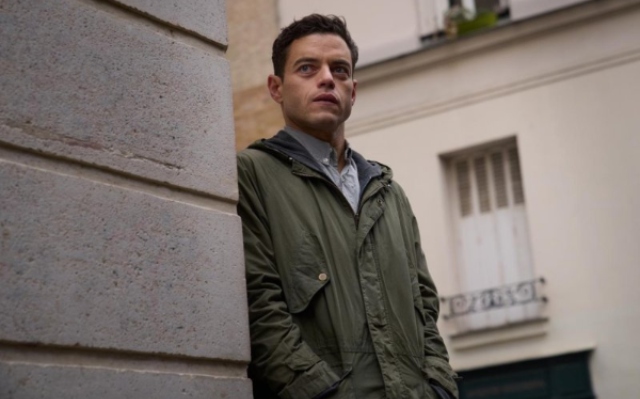
SYNOPSIS: In “The Amateur,” a new thriller now playing in theatres, Rami Malek plays a CIA cryptographer whose life is touched by tragedy when his wife is killed in a terror attack. When the agency refuses to investigate he takes matters into his own hands. Despite being “just a nerdy guy who works on computers,” he vows to use his unique set of skills to get vengeance. “I want to face my wife’s killers,” he says, “look them in the eyes, and balance the scales.”
CAST: Rami Malek, Rachel Brosnahan, Caitríona Balfe, Jon Bernthal, Michael Stuhlbarg, Holt McCallany, Julianne Nicholson, Adrian Martinez, Danny Sapani and Laurence Fishburne. Directed by James Hawes.
REVIEW: “The Amateur,” based on the 1981 novel of the same name by Robert Littell, is a workmanlike thriller, with loads of style but few actual thrills.
The story of vengeance, set into motion after CIA cryptographer Charles Heller’s (Rami Malek) wife is murdered in a terror attack, aspires to be a layered look at grief, anger, the integrity of institutional organizations and the ethics of revenge, is instead a slackly paced movie that is all surface and no depth.
It begins with promise. There’s a cast headlined by Oscar, Tony and Emmy winners, a premise that reflects government conspiracy theories and worldwide unrest, and who doesn’t love a revenge drama? But as the story unfolds it becomes a jumble of ideas that are never pulled together in a tight enough package to become truly engaging.
Malek is in virtually every scene and acquits himself well as the smartest-guy-in-the-room-with-a-grudge, but there’s never any real heat around the character. We are told over and over how brilliant he is, so while he plays a life-and-death game of “Survivor” with the baddies, it’s almost a certainty that he will Outwit, Outplay and Outlast everyone. The predictable nature of his near misses and close scrapes becomes less interesting with every minute of the film’s runtime.
And don’t get me started on the underuse of Rachel Brosnahan, who is barely given any screen time, and when she is, is relegated to playing an idealized version of Charles’ wife. Laurence Fishburne fares better but is still a stock character. He plays a no-nonsense tough guy, ripe with gravitas. It feels like the original script called for a “Laurence Fishburn type” and then they were lucky enough to get Laurence Fishburn. It’s a shame they don’t give him more to do.
As a thriller “The Amateur” rarely raises the pulse rate, but it is as a vehicle for its supporting actors that it really disappoints.
SYNOPSIS: In “The Instigators,” a new heist comedy film now streaming on Apple TV+, Matt Damon and Casey Affleck play desperate father Rory and ex-con Cobby, unlikely partners thrown together to rob a corrupt politician’s war chest. When the caper goes sideways, the inept thieves hit the road, doing whatever it takes to stay one step ahead of the police, the mayor’s henchman and a vengeful crime boss. “We’ve got to find these guys before the cops do,” says kingpin Dechico (Michael Stuhlbarg), “and put them down before they can talk.”
CAST: Matt Damon, Casey Affleck, Hong Chau, Michael Stuhlbarg, Alfred Molina, Jack Harlow, Ving Rhames, Ron Perlman, Paul Walter Hauser, Toby Jones. Directed by Doug Liman.
REVIEW: Fresh off their success in “Oppenheimer,” Damon and Affleck reteam in a movie that mixes-and-matches a caper with a political satire, action with a buddy comedy. It’s a laundry list of genres, but it works, aided by a terrific ensemble cast and the steady hand of director Doug Liman.
Liman and Damon, of course, first worked together twenty-two years ago on “The Bourne Identity.” While their new movie features some action, a really solid car chase and exploding buildings, the two characters, super spy Jason Bourne and the down-on-his-luck Rory, are polar opposites.
Bourne suffered from psychogenic amnesia, and used his special set of skills to rediscover his past. Rory is very much aware of his past, of his failings as a father, and Damon plays him as an everyman, a desperate guy who’ll do whatever it takes to make a few extra bucks for his estranged family, no matter the cost to him personally. Damon skilfully balances the character’s backstory with the increasing absurdity of his present-day situation.
In a rare humorous performance, Affleck is the more obviously funny character, and yet, Cobby is not just comedic construct. He’s a small-timer, used to things going sideways, and much of the humor in the film comes from his deadpan reactions as their situation worsens.
In a strong supporting cast, featuring heavy-weights like Michael Stuhlbarg and Alfred Molina in what are essentially extended cameos, Hong Chau as Rory’s psychiatrist, is a standout, both empathetic and hilarious.
“The Instigators” has everything you expect from a film about a heist gone wrong, but really, it’s not about the robbery or the explosions. It’s about the budding friendship between Rory and Cobby. Brought together by adversity and desperation, they become unlikely allies in a film that cleverly and humorously breathes new life into the failed-criminals-on-the-run genre, through interesting characters, some high-powered action and genuinely funny situations.
Usually, it is fairly easy to pigeonhole a movie. Comedy, drama, romance, sci fi, horror, action. Those are the easy ones. It gets slightly more complicated as you branch off into hybrids like dramedy, Menippean satire, docufiction or rom com. Then, along comes a movie like “Bones and All,” a new, queasy genre buster starring Timothée Chalamet, Taylor Russell and Mark Rylance, and now playing in theatres.
Based on the 2015 novel of the same name by Camille DeAngelis, it is something I’ve never seen before, a romcanrofi, ie: a romantic, coming-of-age cannibal road film.
When we first meet Maren (Taylor Russell), she is a seventeen-year-old high schooler, being raised by single father Frank (André Holland). She appears to be a normal teen, sneaking out to a slumber party with schoolmates and the like, but when her taste for human flesh reveals itself, Maren and her dad have to hit the road before the police turn up.
When Maren turns eighteen, her father disappears, tired of hiding her terrible secret. Leaving the teen to fend for herself, he leaves behind some money, her birth certificate and a tape recording describing her life, from her first cannibalistic incident when she was just three-years-old, to providing details about Janelle (Chloë Sevigny), the mother who abandoned Maren when she was an infant.
On a search for answers, Maren hits the road, landing in Ohio, where she meets Sully (Mark Rylance), an older cannibal who says he could smell a fellow “eater” from blocks away. Like Maren, Sully is a drifter, but he’s not looking to answer life’s questions, he’s on the hunt for food. “Life is never dully with Sully,’ he snorts.
Sully teaches her the tricks of the trade, how to pick victims and feed without attracting attention, but something about him makes Maren uncomfortable and she moves on to Indiana where she meets Lee (Chalamet), a fine young cannibal who becomes her partner in life and death.
“Bones and All” isn’t exactly a horror film. The subject matter might be horrifying and there are some stomach-churning sound effects that won’t easily be forgotten, but this is more a coming-of-age love story as Maren adapts to her ever-changing circumstances.
The blood and guts are kept to a minimum, mostly serving as a vehicle for the movie’s metaphor of cannibals as anyone who has ever felt like an outcast. Maren and Lee are the ultimate others, a compulsive couple who aren’t treated as monsters, but as two people living outside of collective norms. Come for the cannibals, stay for the languid, sensitive essay on life on the fringes of society.
Seductive and strange, director Luca Guadagnino anchors the movie with his two leads, Chalamet and Russell. Both are driven to extremes by their appetites, while, at the same time, searching for acceptance and a place to call home. Both actors bring humanity to their characters, concentrating on their personal journeys rather than the monstrous aspects of their personalities. Their performances give the eccentric story a universal feel even if it is a very specific topic.
“Bones and All” has more to do with relationship road movies like “Two-Lane Blacktop” and “Badlands” than it does “Cannibal Holocaust.” It’s a haunting tale, if a little languorous for its own good, that makes a meal out of its allegory.
The “Doctor Strange” movies are the trippiest in the Marvel Cinematic Universe. The mystical superhero’s introduction, 2016’s “Doctor Strange,” was a kaleidoscopic mix of images and ideas. The new film, “Doctor Strange in the Multiverse of Madness” starring Benedict Cumberbatch and now playing in theatres, kicks it up a notch. With a visual style that suggests M.C. Escher on an acid trip, it is a hallucinogenic ride that will make your eyeballs spin.
The action begins in Dr Stephen Strange’s (Cumberbatch) universe with the introduction of America Chavez (Xochitl Gomez), a teenager with the ability to navigate the multiverse and access portals into alternate realities. In the search for her parents, she has explored 73 universes, each with their own, unique sets of rules, all the while pursued by a demon who wants to steal her powers.
This is not sorcery, Strange says. As old Blue Eyes once sang, it’s witchcraft, so who better to consult than Wanda (Elizabeth Olsen), former Avenger and powerful practitioner of witchcraft?
He’s looking for advice that will help him save America, but instead is sent off on a wild and dangerous trip into a series of alternate realities to fight a power that threatens to subjugate the entire multiverse.
“Doctor Strange in the Multiverse of Madness” begins with a bang. A loud and proud action scene kicks things off with an exaggerated H.P. Lovecraft creature terrorizing Chavez. It sets the wild and wacky tone that applies to most of the picture. A mix of action, horror and comic book comedy, it recalls the sweet spot that made director Sam Raimi’s “Evil Dead” movies such a blast. Raimi brings a kind of anarchy here that is missing from the carefully controlled Marvel films and when it is fun, it’s really fun. There’s even a battle of the bands, a musical showdown, that is equal parts ridiculous and rad.
But there is much more to the story than interdimensional shenanigans.
At its heart “Doctor Strange in the Multiverse of Madness” isn’t a story about magic, it’s a tale about the things we do for love. Whether it is Wanda’s search for family, ably brought to life by Olsen’s poignant performance, or Strange’s attraction to Christine Palmer (Rachel McAdams), this story has a strongly beating heart.
Unfortunately, it also has a bumpy, uneven script. As it careens toward the Marvel friendly climax it loses steam as the action becomes muddied and the script begins to sew up any loose ends left dangling across then universes.
“Doctor Strange in the Multiverse of Madness” doesn’t have the weight of “Everything Everywhere All At Once,” another recent examination of the multiverse, but despite its unevenness, it’s a good, and sometimes gory, time at the movies.
When reclusive author Shirley Jackson died in 1965 she left behind a body of work, including “The Haunting of Hill House,” a supernatural horror novel sometimes called one of the best ghost stories ever written. An influence on two generations of speculative fiction writers like Neil Gaiman, Stephen King, Sarah Waters and Richard Matheson, she is brought to vivid life in a new fictionalized drama, now on VOD, starring Elisabeth Moss.
Set just after the publication of “The Lottery,” a controversial short story about the ritual sacrifice of a town citizen to ensure good crops, published in a 1948 issue of The New Yorker, the film sees Shirley (Moss) paralyzed by the expectations that hang heavy over “Hangsaman,” a novel she is struggling to complete. Prickly and quick with a line, she is less than pleased when Stanley (Michael Stuhlbarg), her college professor husband, arranges for his new assistant Fred Nemser (Logan Lerman) and his pregnant wife Rose (Odessa Young) to live in their house while the young couple searches for a place of their own.
As the days and weeks stretch into months the relationship between the two couples becomes a blend of art and reality, a claustrophobic rabbit hole where Rose becomes the model for Shirley’s new main character, a college student who went walking on Vermont’s Long Trail hiking route and never returned.
“Shirley” uses elements of Jackson’s life but places them in context of one of her novels. The result is a psychological drama; a haunting look at a person driven to agoraphobia by the weight of her success and a domineering, philandering husband.
Moss is fascinating as the title character. Her take on Shirley is that of a woman who has lived under years of oppression by her bullying husband, a man whose misogyny has left her embittered, desperate and anxious. “To our suffering,” Stanley says as a toast to his wife. “There’s not enough Scotch in the world for that,” Shirley snorts, in a line that could have been borrowed from “Who’s Afraid of Virginia Woolf?” She’s vulnerable and filled with rage, compassionate and spiteful, often in the same scene.
Shirley and Stanley, as compelling as they are as characters, do not comprise the film’s defining relationship. Director Josephine Decker feeds on the psychological aspects of Jackson’s work to tease out a story of Shirley and Rose, two women drawn together by frustration, talent and obsession over the missing woman at the heart of the new novel. “Let’s pray for a boy,” Shirley says to the pregnant Rose, “The world is too cruel for girls.” Their time on screen together is complicated, occasionally unsettling as reality and imagination meld. It’s fascinating work in a film that is a slow burn.
“Shirley” takes its time to get where it is going, building an atmosphere of oppression slowly and carefully. Decker’s distorted dream-like visual approach is often beautiful, as though we’re watching the film through a psychological prism. It creates atmosphere but doesn’t provide the thrills that Jackson herself might have been able to infuse into the telling of this tale.
Baby Driver: Although it contains more music than most tuneful of movies “Baby Driver,” the new film from director Edgar Wright, isn’t a musical in the “West Side Story,” “Sound of Music” sense. Wallpapered with 35 rock ‘n roll songs on the soundtrack it’s a hard driving heist flick that can best be called an action musical.
The Big Sick: Even when “The Big Sick” is making jokes about terrorism and the “X-Files” it is all heart, a crowd-pleaser that still feels personal and intimate.
Call Me By Your Name: This is a movie of small details that speak to larger truths. Director Luca Guadagnino keeps the story simple relying on the minutiae to add depth and beauty to the story. The idyllic countryside, the quaint town, the music of the Psychedelic Furs and the languid pace of a long Italian summer combine to create the sensual backdrop against which the romance between the two blossoms. Guadagnino’s camera captures it all, avoiding the pitfalls of melodrama to present a story that is pure emotion. It feels real and raw, haunted by the ghosts of loves gone by.
Darkest Hour: This is a historical drama with all the trappings of “Masterpiece Theatre.” You can expect photography, costumes and period details are sumptuous. What you may not expect is the light-hearted tone of much of the goings on. While this isn’t “Carry On Churchill,” it has a lighter touch that might be expected. Gary Oldman, not an actor known for his comedic flourishes, embraces the sly humour. When Churchill becomes Prime Minister his wife, Clementine (Kristin Scott Thomas) makes an impassioned speech about the importance of the work he is about to take on. He raises a glass and, cutting through the emotion of the moment, says, “Here’s to not buggering it up!” It shows a side of Churchill not often revealed in wartime biopics.
The Disaster Artist: The key to pulling off “The Disaster Artist” is not recreating “The Room” beat for beat, although they do that, it’s actually about treating Wiseau as a person and not an object of fun. He’s an outrageous character and Franco commits to it 100%. From the marble-mouthed speech pattern that’s part Valley Girl and part Beaker from The Muppets to the wild clothes and stringy hair, he’s equal parts creepy and lovable but underneath his bravado are real human frailties. Depending on your point of view he’s either delusional or aspirational but in Franco’s hands he’s never also never less than memorable. It’s a broad, strange performance but it may also be one of the actor’s best.
Dunkirk: This is an intense movie but it is not an overly emotional one. The cumulative effect of the vivid images and sounds will stir the soul but despite great performances the movie doesn’t necessarily make you feel for one character or another. Instead its strength is in how it displays the overwhelming sense of scope of the Dunkirk mission. With 400,000 men on the ground with more in the air and at sea, the sheer scope of the operation overpowers individuality, turning the focus on the collective. Director Christopher Nolan’s sweeping camera takes it all in, epic and intimate moments alike.
The Florida Project: This is, hands down, one of the best films of the year. Low-budget and naturalistic, it packs more punch than any superhero. Director Sean Baker defies expectations. He’s made a film about kids for adults that finds joy in rocky places. What could have been a bleak experience or an earnest message movie is brought to vivid life by characters that feel real. It’s a story about poverty that neither celebrates or condemns its characters. Mooney’s exploits are entertaining and yet an air of jeopardy hangs heavy over every minute of the movie. Baker knows that Halley and Moonie’s well being hangs by a thread but he also understands they exist in the real world and never allows their story to fall into cliché.
Get Out: This is the weirdest and most original mainstream psychodrama to come along since “The Babadook.” The basic premise harkens back to the Sidney Poitier’s classic “Guess Who’s Coming to Dinner.” In that film parents, played by Spencer Tracy and Katharine Hepburn, have their attitudes challenged when their daughter introduces them to her African American fiancé. The uncomfortable situation of meeting in-laws for the first time is universal. It’s the added layers of paranoia and skewered white liberalism that propels the main character’s (Daniel Kaluuya) situation into full-fledged horror. In this setting he is the other, the stranger and as his anxiety grows the social commentary regarding attitudes about race in America grows sharper and more focussed.
Lady Bird: Greta Gerwig’s skilful handling of the story of Lady Bird’s busy senior year works not just because it’s unvarnished and honest in its look at becoming an adult but also, in a large degree, to Saoirse Ronan’s performance. I have long called her ‘Lil Meryl. She’s an actor of unusual depth, a young person (born in 1994) with an old soul. Lady Bird is almost crushed by the weight of uncertainty that greets her with every turn—will her parents divorce, will there be money for school, will Kyle be the boy of her dreams, will she ever make enough cash to repay her parents for her upbringing?—but Ronan keeps her nimble, sidestepping teen ennui with a complicated mix of snappy one liners, hard earned wisdom and a well of emotion. It’s tremendous, Academy Award worthy work.
The Post: Steven Spielberg film is a fist-pump-in-the-air look at the integrity and importance of a free press. It’s a little heavy-handed but these are heavy-handed times. Director Spielberg and stars Tom Hanks and Meryl Streep are entertainers first and foremost, and they do entertain here, but they also shine a light on a historical era whose reverberations are being felt today stronger than ever.
The Shape of Water: A dreamy slice of pure cinema. Director Guillermo del Toro uses the stark Cold War as a canvas to draw warm and vivid portraits of his characters. It’s a beautiful creature feature ripe with romance, thrills and, above all, empathy for everyone. This is the kind of movie that reminds us of why we fell in love with movies in the first place.
Three Billboards Outside Ebbing, Missouri: The story of a mother’s unconventional war with the world is simple enough, it’s the complexity of the characters that elevates the it to the level of great art.
Wonder Woman: Equal parts Amazon sword and sandal epic, mad scientist flick, war movie and rom com, it’s a crowd pleaser that places the popular character front and centre. As played by Gal Gadot, Diana is charismatic and kick ass, a superhero who is both truly super and heroic. Like Superman she is firmly on the side of good, not a tortured soul à la Batman. Naïve to the ways of the world, she runs headfirst into trouble. Whether she’s throwing a German tank across a battlefield, defying gravity to leap to the top of a bell tower, tolerating Trevor’s occasional mansplaining or deflecting bullets with her indestructible Bracelets of Submission, she proves in scene after scene to be both a formidable warrior and a genuine, profoundly empathic character.