SYNOPSIS: In “I Play Rocky” Sylvester Stallone won’t take no for an answer. “I’m not giving this up. Not for a million bucks. Not for 10.”
CAST: Anthony Ippolito, AnnaSophia Robb, Toby Kebbell, P. J. Byrne, Stephan James, Jay Duplass, Robert Morgan, Tracy Letts, Matt Dillon. Directed by Peter Farrelly.
REVIEW: “I Play Rocky” is not a reinvention of Sylvester Stallone’s original story or the movie “Rocky,” it’s simply a crowd-pleasing reminder of a true underdog phenomenon.
The story begins in 1970s New York City with Mike Stallone (Anthony Ippolito) eking out a living with odd jobs while unsuccessfully auditioning for film roles. At his movie theatre usher gig he meets Sasha Czack (AnnaSophia Robb), who quickly becomes his girlfriend and biggest booster. She also encourages him to be himself and use his real name. “There are a lot of Mikes in the world,” she says. “There’s only one Sylvester. Sylvester Stallone.”
To be closer to the action, the new couple moves to Los Angeles. On a night off from his valet job, Stallone watches a heavyweight championship match between Muhammad Ali and part-time liquor salesman Chuck Wepner. Watching the underdog Wepner take a beating but never giving up inspired Stallone to write his own script. “Write a script.” Says Sasha, “and give yourself the best part.”
Working day and night he bangs out the script for what would become “Rocky” in just three and a half days. When producers Irwin Winkler (P. J. Byrne) and Robert Chartoff (Toby Kebbell) got hold of it they thought it would be a perfect film for Clint Eastwood or Charles Bronson. But despite a Brinks Truck of studio money backed up to Stallone’s apartment, he refused to sell the script unless he was cast in the lead. “I won’t sell it for $1 million,” he says. “Not $10 million. I play Rocky”
His persistence pays off, and the rest is Hollywood history.
An inspirational film about an inspirational movie, “I Play Rocky” is an audience friendly (i.e. formulaic) underdog tale that captures the spirit of the 1976 original film, even when it leans into sentimentality and exposition.
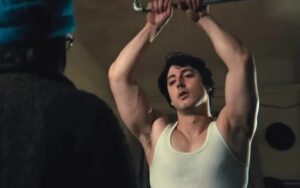
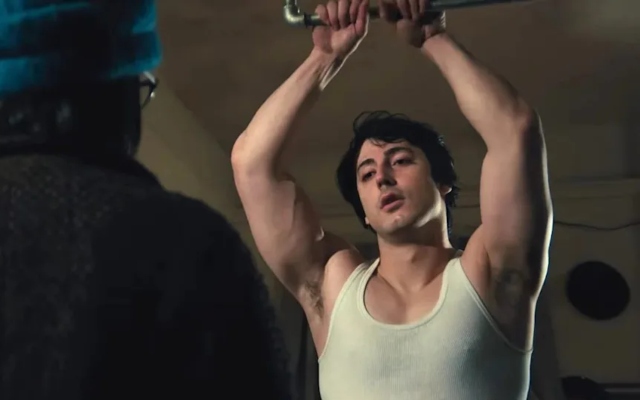
As Stallone, Anthony Ippolito does great work, handing in a performance that doesn’t feel like an imitation. Stallone is a pop culture staple, so we expect the marble-mouthed voice and muscles bursting out of his white tank top, and Ippolito nails that. More importantly, however, he captures the character’s ambition and underdog tenacity.
Ippolito is supported by a good ensemble, particularly Tracey Letts as an increasing frustrated studio executive.
“I Play Rocky’s” underdog story is so potent, that even though we know how it ends it still packs an emotional (but, it must be said, not intellectual) punch.
I sit with “I Play Rocky” director Peter Farrelly and stars Anthony Ippolito, who plays Sylvester Stallone in the feel good flick and Stephan James who plays Carl Weathers.
Fast reviews for busy people! Watch as I review three movies in less time than it takes to wind your watch. Have a look as I race against the clock to tell you about the biopic “Being Heumann,” the dark comedy “Wild Horse Nine” and the epic “Godzilla Minus Zero.”
“Deep Water,” the new movie from Ben Affleck and Ana de Armas, now streaming on Prime Video, is an erotic thriller in name only.
Neither erotic or thrilling, it lacks the smoldering energy of director Adrian Lyne’s previous work. Movies like “9 ½ Weeks” and “Unfaithful” established him as a steamer of screens, but that was then.
This is now. A better title for “Deep Water” may have been “Cold Water.”
Affleck plays Vic, a retired software developer who made a fortune designing a chip that helps drones locate and destroy targets. He spends his days with his daughter while his wild wife Melinda (de Armas), having grown bored of their routine, entertains herself with a series of very public affairs. For the most part Vic bites his lip but when one of Melinda’s flings winds up dead, face down in their pool, cuckold Vic becomes a suspect and their already tenuous situation comes closer to the breaking point.
Lyne, in his first film in twenty years, seems unable to tease out the tension from the love-hate story, sexual or otherwise. The repeated affair/disappearance cycle gets old fast and Lyne does little to make us care about any of them, Vic, Melinda or her unfortunate boyfriends.
I can say that Affleck has one of the best scowls in movies, but that’s not enough to hang an entire performance on. A Sad Affleck meme come to life, for much of the movie it appears he’s given up, Ben, not Vic. It’s as though he stopped caring after the first reel. Vic should display hidden reserves of resolve but Affleck’s performance is as inert as the film.
De Armas, so wonderful in “Knives Out” and “No Time to Die,” is reduced to an eye-batting subject for Lyne’s male gaze.
A tepid psychosexual cuckold tale with a side of murder and loose ends galore, “Deep Water” wastes its stars in a movie that does not rise to the challenge of exploring the story’s themes of morality, murder and marriage.
In adapting “The Woman in the Window,” a new thriller starring Amy Adams, now streaming on Netflix, director Joe Wright borrows liberally from the Hitchcock playbook, paying visual tribute to everything from “Foreign Correspondent” and “Psycho” to “Vertigo” and, of course, “Rear Window.” There are so many Hitch lifts in the look of the movie it makes Brian DePalma’s myriad Hitchcock homages look like petty thievery.
Adams plays child psychologist Anna Fox who lives alone in a rambling brownstone on 124th Street in Manhattan. Agoraphobic, she gets panic attacks at the idea of going outside, let alone actually stepping over her front threshold to the big bad world. Her only regular contact with the outside comes with her weekly visit from her therapist (Tracy Letts) and a downstairs tenant (Wyatt Russell).
When her new neighbors from across the street drop by unexpectedly, she reluctantly lets teenager Ethan (Fred Hechinger) in for a get-to-know-you visit. A day or so later Jane (Julianne Moore) swings by to chat, ask nosy questions and have a glass of wine.
After the visits Anna becomes voyeuristically invested in their lives, watching them from the safety of her apartment as they go about their day to days lives, exposed by two large windows that showcase their living areas.
One night, after mixing wine with her anxiety medication, she witnesses what appears to be an ugly domestic dispute that turns fatal. Trouble is, no one believes the “drunken, pill popping, cat lady.”
Question is, did she really witness a murder or was it a hallucination?
Anna is a classic unreliable narrator, a character whose credibility is questioned at every step of the way. Adams keeps her interesting, bringing a human face to trauma, anxiety and grief. We’re never sure if what we’re seeing is filtered through a haze of medication or actually happening and while Wright finds flashy visual ways to portray this, it is Adams who connects emotionally.
There are moments of supercharged filmmaking in “The Woman in the Window” but the tonal shifts and pacing get in the way of making this edge of your seat viewing. Director Joe Wright brings his trademarked visual style to illustrate Anna’s anxiety. Unusual angles and lurid colours illustrate Anna’s disconnected moments, wide shots of her empty apartment represent her isolation. It’s effectively and inventively done, but the slack pacing sucks much of the energy out of the storytelling.
“The Woman in the Window” has moments that truly work but it is dulled by its deliberate pace, repetitive nature and typical confessional ending.
Director Greta Gerwig keeps the bones of Louisa May Alcott’s “Little Women” in the new big screen treatment of the 19th century story, but reshapes the March sisters’ coming-of-age in fresh and exciting ways.
Set at the time of the Civil War, the eighth film adaptation of the tale sees the March’s, debutant Meg (Emma Watson), strong willed Jo (Saoirse Ronan), sickly and sweet Beth (Eliza Scanlen) and self-centerd Amy (Florence Pugh), with mother Marmee (Laura Dern), living a threadbare existence. The war has stripped them of whatever money they once had but they remain committed to charity—helping a destitute family down the road—and one another as they wait for the return of their father (Bob Odenkirk) from the battlefield.
As the story jumps through time their lives intersect with Theodore ‘Laurie’ Laurence (Timothée Chalamet), a charming, wealthy lay-about neighbor who has designs on Jo, his millionaire uncle (Chris Cooper), acid-tongued Aunt March (Meryl Streep) and Mr. Dashwood, the terse-talking newspaper publisher.
Told on a broken timeline, “Little Women” forgoes the linear structure of the novel to jump back-and-forth in time. It’s a clever device that takes some getting used to—at first it’s not immediately obvious the story is skipping around like a flat rock skimming across a lake—but ultimately it provides insightful perspective on the characters and why they make the decisions they do. Gerwig has fiddled with the story’s collision of feminism, romance and family dynamics just enough to amplify its resonance for a modern audience. Playing around with a well loved and well-worn classic is risky, but Gerwig pulls it off with panache, aided by an extraordinary cast who bring the material to vivid life.
As a collective the cast of “Little Women” are as finely tuned as the piano Beth practices on, pitch perfect with no sour notes.
Chalamet, reteaming with Ronan and Gerwig after the success of “Lady Bird,” drips charisma as the foppish and devoted friend/love interest Laurie. He’s equal parts awkward and arrogance, putting a new spin on a character that’s been played by everyone from Peter Lawford to Christian Bale.
Streep and Letts drop in for some comic relief but it is the chemistry between the sisters that is the film’s biggest success. Previous adaptations have tilted in Jo’s favor, giving her the most screen time and the juiciest character arc. Gerwig recalibrates, allowing each of the sisters to shine. The story still revolves around Jo’s interactions with each of the women, but here each of them push the story forward. Watson beings kindness and empathy to Meg. In Scanlen’s hands Beth is sweetly realistic about her lot in life. Ronan and Pugh leave the largest impression, imprinting the tale with their steeliness, humor and humanity.
“Little Women” is a rarity. It’s an adaptation of an often told tale that manages a rethink while still holding true to what made the source material so beloved.
The cars of the early 1960s were sexy beasts. Sleek and metallic on the outside, perfumed with the sweet smell of fine Corinthian leather on the inside, they tore along the highways and byways like, to paraphrase Bruce Springsteen, like big old dinosaurs. The action in “Ford v Ferrari,” however, begins in 1963 with the least sexy things ever, a failed corporate takeover.
Suffering a slump in sales the Ford Motor Company tries unsuccessfully to take over the infinitely more seductive Ferrari. The Italian car company, on a winning streak with at the 24 Hours of Le Mans, replies in no uncertain terms. “Ford makes ugly little cars in ugly factories,” says Enzo Ferrari (Remo Girone).
That’s a no.
Insulted, Henry Ford II (Tracy Letts) flip-flops an old maxim. If he can’t join ‘em, he can beat ‘em. “This isn’t the first time Ford Motors’ gone to war,” he says. “We know how to do more than push papers. When early attempts to create a race car to take the wind out of Ferrari’s sails fails Ford marketing executive Lee Iacocca (Jon Bernthal) brings in car designer Carroll Shelby (Matt Damon) to make a Ford that will rule at La Mans. “My name is Carroll Shelby and performance is my business.” A former racer—he won the Le Mans in 1959 with partner Roy Salvadori—heart problems forced him off the track.
Shelby asks hot-headed British racer Ken Miles (Christian Bale) to help. “How long did you tell them that you needed?” he asks. “Two, three hundred years?” Together they work to make a sports car that will appeal to young consumers and “go like hell.”
Some basic knowledge of how cars work may enhance your enjoyment of “Ford v Ferrari” but the resonate part of the story has nothing to do with horsepower or Gurney flaps. At its fuel Injected heart the James Mangold-directed movie is a Davey and Goliath story about friendship and burning rubber.
The bromance angle comes in the bond between Shelby and Miles. The two men are like brothers who fight and love in almost equal measure. Damon and Bale share an easy camaraderie, fuelled by their character’s love of the art of racing and the desire to stick it to the big guys, the Ford Motor Company. Shelby is the diplomat, Miles the one more likely to punch a Ford executive, but both are underdogs who take pleasure in making the suits squirm.
“Ford v Ferrari” is formulaic in laying out the story. It’s a longshot tale with revving engines and many predictable twists and turns but Mangold injects some real excitement in the extended racing scenes.
Earlier this week Northern Michigan’s Lake Superior State University added the term “fake news” to its 43rd annual List of Words Banished from the Queen’s English for Misuse, Overuse and General Uselessness. According to dictionary.com those two toxic words, popularized by Donald Trump and adopted by, well, almost everyone, denote “false news stories, often of a sensational nature, created to be widely shared online for the purpose of generating ad revenue via web traffic or discrediting a public figure, political movement, company, etc.”
A new film, The Post, is a time capsule back to a time before exhortations of “fake news” created an atmosphere where the press is perceived as an enemy rather than the voice of the people.
Meryl Streep plays Katharine Graham, the first female publisher of a major American newspaper. With the paper bordering on insolvency she has tough decisions to make.
When the New York Times breaks the story of a massive cover-up and is shut down by the Nixon White House, hardnosed editor Ben Bradlee (Tom Hanks) sees an opportunity to scoop the Times and make a splash. “Are any of you tired of reading the news,” he asks his staff, “instead of reporting on it?” Trouble is, the story involves several people close to Graham, most notably former Secretary of Defense Robert McNamara (Bruce Greenwood), who prolonged the Vietnam War despite knowing it was a no-win situation.
Graham must make the decision to publish or not. Running the so-called Pentagon Papers would expose years of government secrets, make an enemy of President Nixon and could scare off the investors she’s been courting. Not reporting could endanger young the Americans who were still being drafted and sent to fight an unwinnable war. “The only way to assert the right to publish is to publish,” argues Bradley.
The Post is a historical tale that feels as timely as any front-page story in today’s paper. A high-stakes look at journalism before the age of fake news, it reminds us of the importance of objective, investigative reporting in an era of secrecy, lies, and leaks. It’s an ‘if you don’t know your past, you don’t know your future” message movie that shines a light on a watershed but mostly forgotten slice of our past.
The Pentagon Papers were a significant turning point in our recent history. They were proof of a credibility gap between what politicians say and what they are doing. For Bradlee, publishing these documents sent a message that the White House had no influence on what stories made the front page and which don’t. “The press must serve the governed not the governors.”
Combined, all these elements add up to a movie that aims to make a statement while avoiding preaching to its audience. Director Steven Spielberg and stars Hanks and Streep are entertainers first and foremost, and they do entertain here, but they also portray a period whose reverberations in the time of fake news are being felt stronger than ever.
The air of paranoia that hung over All the President’s Men, another movie centered on the investigative reporting of The Washington Post, is missing in The Post. Instead, Spielberg film’s is a fist-pump-in-the-air look at the integrity and importance of a free press. It’s a little heavy-handed but these are heavy-handed times.
The air of paranoia that hung over “All the President’s Men,” another movie centered on the investigative reporting of The Washington Post, is noticeably missing in “The Post.” Instead, the new Steven Spielberg film is a fist-pump-in-the-air look at the integrity and importance of a free press. It’s a little heavy-handed but these are heavy-handed times.
Meryl Streep plays Katharine Graham, the first female publisher of a major American newspaper. The socialite inherited The Washington Post following her husband Phil Graham’s death in 1963. “Kate throws a great party but she’s only here because her husband died,” harrumphs board member Arthur Parsons (Bradley Whitford). With the paper bordering on insolvency she has tough decisions to make.
Meanwhile hardnosed editor Ben Bradlee (Tom Hanks) is looking for a story that will help the paper break out of its local market and go national. “Are any of you tired of reading the news,” he asks his staff, “instead of reporting on it?”
When the New York Times breaks the story of a massive cover-up and is shut down by the Nixon White House, Bradlee sees an opportunity to scoop the Times and make a splash. Trouble is, the story involves several people close to Graham, most notably former Secretary of Defense Robert McNamara (Bruce Greenwood), who prolonged the Vietnam War despite knowing it was a no-win situation.
Graham must make the decision to publish or not. Running the so-called Pentagon Papers would expose years of government secrets, make an enemy of President Nixon and could scare off the investors she’s been courting. Not reporting could endanger young the Americans who were still being drafted and sent to fight an unwinnable war. “The only way to assert the right to publish is to publish,” argues Bradley.
No spoilers here, but the historical record shows that bombshell revelations were made and today The Washington Post is still a going concern.
“The Post” is a historical tale that feels as timely as any front-page story in today’s paper. A high-stakes look at journalism before the age of fake news, it reminds us of the importance of objective, investigative reporting in an era of secrecy, lies, and leaks. It’s a ‘if you don’t know your past, you don’t know your future” message movie that shines a light on a watershed but mostly forgotten slice of our past.
The Pentagon Papers were a significant turning point in our recent history. They were proof of a credibility gap between what politicians say and what they are doing. For Bradlee, publishing these documents sent a message that the White House had no influence on what stories made the front page and which don’t. “The press must serve the governed not the governors.”
Hanks and Streep, the two most trusted people in Hollywood, are solid as the two most trusted people in Washington.
As Graham, Streep is a woman who transcends the attitudes of her male advisors to do the right thing regardless of the repercussions. It’s a slow burn performance as she slowly sheds the weight of her socialite upbringing to embrace an outgoing and progressive point of view. As she grapples with publishing and possibly losing everything versus playing it safe, she becomes one of the film’s few characters with an arc.
Hanks plays Bradlee with bluster. As a noted collector of old school typewriters in real life, Hanks must have relished the chance to surround himself with the clickety-clack soundtrack of a newsroom in full tilt boogie. He is the movie’s reckless moral code, barking orders and making larger-than-life pronouncements on the importance of a free press. Hanks is at the Spencer Tracey stage of his career, an actor who brings with him an aura of decency and strength; the epitome of American exceptionalism made flesh. Despite the character being one-note Hanks breathes life into him, even if only as a spokesperson for the power of the first amendment.
“The Post” is propped up by good supporting performances, although fine actors like Sarah Paulson and Tracy Letts are stranded in roles that don’t give them much to do. Bob Odenkirk as Ben Bagdikian, one of the architects of the plan to publish the Pentagon Papers, fares better in one of the handful of roles expanded to full bloom.
The expected Spielberg touches are there as well. The Washington Post building shakes as the massive printing presses roar to life, a no-so-subtle metaphor of the upset the Pentagon Papers are about to cause in Washington.
Combined, all the elements add up to a movie that aims to make a statement while avoiding preaching to its audience. Spielberg, Hanks and Streep are entertainers first and foremost, and they do entertain here, but they also shine a light on a historical era whose reverberations are being felt today stronger than ever.