“If it bleeds it leads,” is an accepted mantra around newsrooms these days but back in 1974 it was a new, controversial idea. Christine Chubbuck (Rebecca Hall), an investigative reporter at a local ABC affiliate in Sarasota, Florida, was particularly disdainful of the idea until she became the poster child for news sensationalism.
In “Christine,” a based-on-true-events film, Chubbuck is working at local station WZRB. She’s a steely presence, a serious person doing light news. “People are listening to me,” she says, “so I have to be sure I’m really saying something.” Reports on strawberry festivals and local events are the station’s stock in trade but the station manager (Tracey Letts) is desperate to get higher ratings. How? “Juicier stories,” he says. “If it bleeds it leads.” When the station owner (John Cullum) decides to poach one or two of the Sarasota on-air talents for his much larger Baltimore new division, Christine sees that as a way out. “So if I get some footage of fat people burning in cars and I’m on my way to Baltimore?”
Her progression to the larger market is stymied by illness and depression—“My life is a cesspool,” she says.”—and culminates with the news reporter becoming the news. On July 15, 1974 Chubbuck was on air, reading the news when announced, “In keeping with WZRB’s policy of bringing you the latest in blood and guts, and in living color, you are going to see complete coverage of an attempted suicide,” before putting a gun to her head and pulling the trigger.
The events in “Christine” are well documented, so the shocking finale doesn’t come so much as a shock but the inevitable consequence of history. With the element of surprise removed what’s left is a look at the woman at the heart of the story. Hall plays Chubbuck as an almost otherworldly presence, someone who doesn’t quite feel comfortable in her own skin, always judging herself and those around her. “You’re not always the most approachable person,” co-worker George Ryan (Michael C. Hall) tells her, and that is the beauty of Hall’s work. In a terrific performance that elevates the movie, she plays Chubbuck as aloof but human, edgy and without a trace of sentimentality.
It can take some doing, but once you get past the idea of Harry Potter as a white supremacist “Imperium” is an enjoyable potboiler.
Daniel Radcliffe plays FBI agent Nate Foster, a principled young man with an uncanny resemblance to Harry Potter, whose empathy and idealism attract the attention of his FBI superior Angela Zamparo (Toni Collette). She recruits him to
shave his hair down to the stubble and go deep undercover to take down a radical white nationalist group planning to build a dirty bomb. Inexperienced but focussed, he pilots his way through the ranks of racists, including the Ayran Brotherhood, right wing radio host Dallas Wolf (Tracy Letts) and wealthy extremist Gerry Conway (“True Blood’s” Sam Trammell). Fully embedded, he finds the tricky balance between maintaining his personal beliefs without blowing his cover.
Based on real events “Imperium” is a standard undercover drama with a few standout performances. Radcliffe is very good at portraying Nate’s calm-under-pressure demeanour, while imparting a sense of urgency into the character. On the other end of the scale is Trammell who quietly plays his racist as an everyday family man who has allowed hate to infect his soul. As a provocative radio host Tracy Letts hands in another interesting performance, one that suggests that for some, money is more important than principles, no matter how skewed they may be.
“Imperium” contains some provocative and offensive images—the mere sight of Harry Potter shouting racial epithets will be enough to upset many a viewer—but the underlying story of racial intolerance doesn’t add much to the conversation. Instead of exploring the psychopathology of hatred and anti-Semitism in the United States it is content to play as a thriller and little else. As such it’s good, if not quite edge-of-your-seat stuff, but it could have been much more.
“If it bleeds it leads,” is an accepted mantra around newsrooms these days but back in 1974 it was a new, controversial idea. In the based-on-true-events film Christine Rebecca Hall plays Christine Chubbuck, an investigative reporter at a local ABC affiliate in Sarasota, Florida. She was particularly disdainful of the idea until she became the poster child for news sensationalism by announcing to her viewers, “In keeping with WZRB’s policy of bringing you the latest in blood and guts, and in living color, you are going to see complete coverage of an attempted suicide,” before putting a gun to her head and pulling the trigger.
“There are a lot of films that portray misfits and odd the people as cool,” says Hall during a stop at the Toronto International Film Festival. “I don’t want to say it fetishizes it but sometimes it makes it seem aspirational or trendy. The access [to Christine] for me personally was feeling like you are different and not excepted. That can be excruciating. Especially if you are a woman, especially at that time when you were operating it in un-meritocratic system. She had integrity. She wanted to serve your community. That was her driving force but she was not rewarded for that. [People around her] thought, ‘Well, you’re a lady in a bit weird.’ They didn’t know how to deal with that.”
Chubbuck’s progression to larger markets was stymied by illness and depression—“My life is a cesspool,” she says in the film.—and culminated with the news reporter becoming the news.
“To me Christine is someone who went through her life every day thinking, ‘OK what does it look like to be normal?’ What she perceives to be normal. She looks to everyone for affirmation. Am I doing OK? Did I get away with it today? Am I like you? Am I accepted? Sometimes she’s really good at it and sometime she’s really bad at it but regardless her community accepts her. The tragedy of the film is that she doesn’t see that. It is a compassionate film. It is a cautiously optimistic film about people.”
REBECCA HALL SIDEBAR:
“I don’t think I have given [a role] like it before and I probably won’t again because it is one of those jobs that if you are incredibly lucky you get maybe three of them in a career. And that’s only if you are incredibly successful and lucky and often only if you were a man.”
James Schamus, a producer best known for his Oscar winning work with Ang Lee, makes his directorial debut with “Indgination.” The story of a young man’s coming-of-age isn’t a case of style over substance—it has both in spades—but of character over plot.
Based on Philip Roth’s novel of the same name, “Indignation” is the story of Marcus Messner (Logan Lerman), a young working class Jewish man who earns a scholarship to the WASPy Winesburg College in Ohio. It’s 1951 and his enrolment in school keeps him from being drafted to fight in Korea and out from under the thumb of his over protective father.
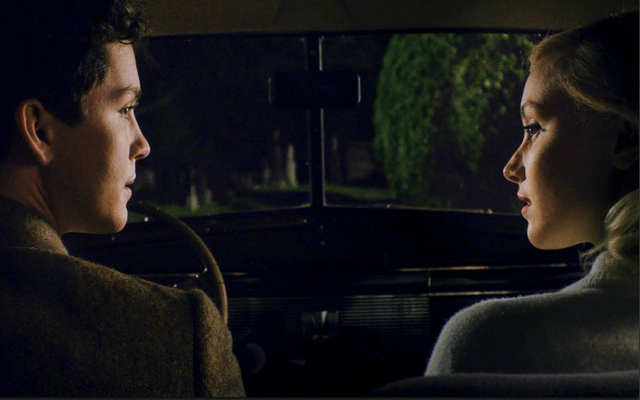
A studious young man—his roommate says, “He’s a scholar who doesn’t have time for frivolities like the theatre.”—he immerses himself in his classes to the exclusion of almost everything else. The only break in his concentration comes in the form of Olivia Hutton (Sarah Gaddon), a beautiful classmate whose charms, both physically and intellectually, distract him from his work.
On their first and only date something happens (NO SPOILERS HERE) that plunge Marcus into previously uncharted personal territory. Eventually his intensity toward his schooling and Olivia draws the attention of Dean Caudwell (Tracy Letts), which threatens his place within the school and provides the film with its best scene.
Like other adaptations of Roth’s work “Indignation” is filled with richly drawn characters. Where it falls down is in the storytelling. Roth’s novel is a personal piece of work loosely based on his own 1950s college experience. It’s a look at life’s decisions and their consequences, intellectual purity and sexual discovery, all themes touched on in the film but without the benefit of Roth’s investigative, haunting prose.
What does shine through are the characters. In a break-out role Lerman holds the center of the movie, doing formidable work in scenes opposite Gaddon and Letts. His scenes with Gaddon brim with sexual attraction touched with longing and sadness but it is with Letts that Lerman does his best work. A mid-movie tour-de-force sees the two showdown in the moralistic Dean’s office, arguing everything from baseball to Bertrand Russell. The verbally jousting is the film’s high point; a lovely bit of acting that could stand on its own as a short film.
“Indignation” is about truth and consequences, unspoken love and inexperience, but mostly its about great acting from a fine cast.
Hollywood is full of hyphenates, the kind of people who introduce themselves as a model-actor-writer-waiter-personal-trainer-dog-walker.
Lately there is one Tinsel Town citizen, however, who has actually earned every word in his hyphenated title.
Tracy Letts is an actor-writer-producer-Pulitzer-Prize-winner who is going to have to get longer business cards if he gets any more successful. You may not recognize the name unless you pay attention to the end credits of Homeland (he plays Senator Andrew Lockhart on the popular show) or if you know who won the 2013 Tony Award for Best Actor in a Play for Who’s Afraid of Virginia Woolf?.
He’s a multi-talent with a shelf of awards, some heavyweight acting credits and a new movie screenplay on his resume.
His latest project, the script for August: Osage County, puts words into the mouths of some of the biggest stars in Hollywood. The film brings together the Weston sisters, Barbara (Julia Roberts), Karen (Juliette Lewis) and Ivy (Julianne Nicholson) with their pill-popping mommy-dearest Violet (Meryl Streep).
As a writer Letts says inspiration came from Tennessee Williams, William Faulkner and Jim Thompson, which might explain the dark vein that runs through his work.
How twisted are his plays? “Everybody in Tracy’s stories gets naked or dead,” says his mom, author Billie Letts.
Tracy jokingly says that his mother is “a liar” for saying that, pointing out that “not all of the people in my plays wind up naked or dead.”
Still there is no denying that his screenplay for Killer Joe, the 2011 Matthew McConaughey thriller, is written with what Roger Ebert called, “merciless black humor.” The story of a corrupt cop and a bad insurance claim earned critical praise even if the Women Film Critics Circle cited the film for its presentation of what they called “the worst female and male images” of the year.
According to Entertainment Weekly his script for Bug, starring Ashley Judd and Michael Shannon as a lonely woman and unhinged war veteran trapped in a bug infested Oklahoma motel room, contains an “enjoyably icky heart.”
Tracy Letts seems willing to take on any challenge to add to his hyphenate status. There’s just one thing you can’t ask him to do. “I don’t act in the stuff that I write,” he says. “I have no interest in doing that.”