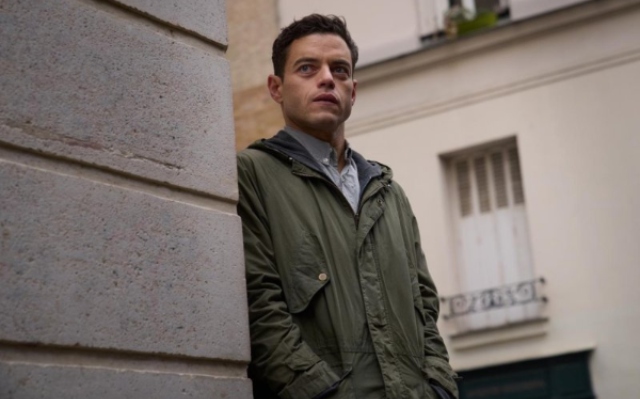
SYNOPSIS: In “The Amateur,” a new thriller now playing in theatres, Rami Malek plays a CIA cryptographer whose life is touched by tragedy when his wife is killed in a terror attack. When the agency refuses to investigate he takes matters into his own hands. Despite being “just a nerdy guy who works on computers,” he vows to use his unique set of skills to get vengeance. “I want to face my wife’s killers,” he says, “look them in the eyes, and balance the scales.”
CAST: Rami Malek, Rachel Brosnahan, Caitríona Balfe, Jon Bernthal, Michael Stuhlbarg, Holt McCallany, Julianne Nicholson, Adrian Martinez, Danny Sapani and Laurence Fishburne. Directed by James Hawes.
REVIEW: “The Amateur,” based on the 1981 novel of the same name by Robert Littell, is a workmanlike thriller, with loads of style but few actual thrills.
The story of vengeance, set into motion after CIA cryptographer Charles Heller’s (Rami Malek) wife is murdered in a terror attack, aspires to be a layered look at grief, anger, the integrity of institutional organizations and the ethics of revenge, is instead a slackly paced movie that is all surface and no depth.
It begins with promise. There’s a cast headlined by Oscar, Tony and Emmy winners, a premise that reflects government conspiracy theories and worldwide unrest, and who doesn’t love a revenge drama? But as the story unfolds it becomes a jumble of ideas that are never pulled together in a tight enough package to become truly engaging.
Malek is in virtually every scene and acquits himself well as the smartest-guy-in-the-room-with-a-grudge, but there’s never any real heat around the character. We are told over and over how brilliant he is, so while he plays a life-and-death game of “Survivor” with the baddies, it’s almost a certainty that he will Outwit, Outplay and Outlast everyone. The predictable nature of his near misses and close scrapes becomes less interesting with every minute of the film’s runtime.
And don’t get me started on the underuse of Rachel Brosnahan, who is barely given any screen time, and when she is, is relegated to playing an idealized version of Charles’ wife. Laurence Fishburne fares better but is still a stock character. He plays a no-nonsense tough guy, ripe with gravitas. It feels like the original script called for a “Laurence Fishburn type” and then they were lucky enough to get Laurence Fishburn. It’s a shame they don’t give him more to do.
As a thriller “The Amateur” rarely raises the pulse rate, but it is as a vehicle for its supporting actors that it really disappoints.
The only thing worse than someone who says, “I had the craziest dream last night,” and then tells you all about it is… well, hardly anything. There are few things worse than suffering through a disjointed story that barely makes sense to the teller and absolutely no sense to you.
But, just imagine if everyone, family, friends, strangers, told you about their dreams, because you were in them. Every single one of them. That’s the nightmarish idea behind “Dream Scenario,” a new “Twilight Zonesque” Nicolas Cage social satire, now playing in theatres.
Cage plays humdrum evolutionary biology professor Paul Matthews. He’s an unexceptional, almost invisible man, mocked by his students and colleagues at work and a sad sack at home with possessive wife Janet (Julianne Nicholson) and two teen daughters.
His unremarkable life is made noteworthy when inexplicably, he begins to appear in the dreams of millions of people.
He’s viral all over the world, except, tellingly, in the nighttime visions of his wife. Why not? “Because you get the real deal,” he says to her. “It wouldn’t be fair to get both.”
“Why me?” he asks. “I don’t know. I’m special I guess.”
Trouble is, he doesn’t do anything special in the dreams. He mostly just appears in the background, watching unresponsively as strange things happen to the dreamer. “He occupies the space like an awkward guest at a party,” says one dreamer.
As his fame grows, it brings with it some unexpected repercussions for the unassuming Paul. “You know,” says Sidney (Marc Coppola), “fame can come with some less desirable side effects. You should be prepared for that.” At first, he almost enjoys the intense glare of the spotlight, but when his presence in the dreams goes from passive to active, and he becomes as repugnant to the public as he was once popular.
“Dream Scenario” does feature some surreal dream sequences, but it’s not really about dreams. It’s about life as a modern, viral celebrity, on display in the unblinking eye of the public, social media and cancel culture.
Cage plays Paul as a man who claims to love his anonymity, but fights a former colleague for credit when she alludes to one of his thirty-year-old theories in an academic paper, and, when fame comes, he’ll pose with anyone who wants a selfie. He’s tired of being invisible, but wants fame on his own terms. But, as the movie ably points out, fame is a three-headed hydra, untamable and uncontrollable.
It’s a perfect role for Cage’s sensibility. As Paul’s life switches from dreamlike to nightmarish, Cage embraces the tragicomic elements of the role—a man who can’t live up to expectations in real life or dream life—and pulls off a great trick by making a forgettable man memorable.
“Dream Scenario” is a clever, timely film that details everything from mid-life crisis and cancel culture to viral fame and social media marketing in a bizarre, funny and thought-provoking way.
Marilyn Monroe is one of the most documented movie stars of all time. Her time on earth inspired hundreds of thousands of posthumous column inches, hundreds of books and a slew of biopics and documentaries, the first, narrated by Rock Hudson, coming out less than a year after her 1962 death. There is a Broadway musical and even videos games bearing her likeness.
It begs the question, What is left to learn about this Hollywood icon in 2022?
If a new movie, “Blonde,” with Ana de Armas as the “Some Like It Hot” star, and now playing in theatres before it moves to Netflix, is any indication, not much.
The film begins its 166-minute journey with Norma Jeane Mortenson’s (Lily Fisher) unstable single mother Gladys (Julianne Nicholson) gifting her child with a surprise, a battered photograph of a prosperous looking man in a fedora. That’s your father, the little girl is told. He is a very important man.
Thus begins, according to director Andrew Dominik, a Freudian lifelong search for a father figure, that would see her cycle through famous husbands like Joe DiMaggio (Bobby Cannavale) and Arthur Miller (Adrien Brody), both of whom she calls daddy in an annoying baby-doll voice.
In Hollywood, now known as Marilyn Monroe, she makes a splash working as a model before being sucked into the studio system in a flurry of casting couches, emotional auditions and the creation of her bombshell image, a look that sold movie tickets but didn’t resonate with Norma Jeane. “She is pretty I guess,” she says, “but it isn’t me.” At one point, she yells, “Marilyn is not here,” during a contentious call with her studio boss.
As her life spirals downward, accelerated by alcohol and pills, depression caused by everyone’s inability to look past the blonde dye job to see who she really is and career dissatisfaction, her life and career begin to fall apart. “She is not a well girl,” her make-up artist (Toby Huss) says. “If she could be, she would be.”
“Blonde” is an art house biography. Fragmented and often impressionistic, it attempts to take you, not just inside Marilyn’s life, but also her psyche and body. Dominik’s camera does offer never-before-seen views of Monroe, from the considerable nudity to literally travelling inside her womb.
But to what effect? The insights into Monroe’s life and career, that she was, essentially, two sides of the same coin, Norma Jean on one, Marilyn on the other, aren’t original, even if their daring presentation is. The film’s advertising tagline, “Watched by all, seen by none,” sums up most of the film’s message in a much more powerful, and mercifully succinct, way.
Dominik does create memorable moments, a nightmarish red carpet walk at the “Some Like It Hot” premier, for instance, visually conjures up the horror Marilyn must have felt as a reluctant superstar constantly in demand by people who wanted to use her. Less successful is footage of a missile launch to emulate the goings-on during a sex scene—most definitely not love scene—between Marilyn and JFK (Caspar Phillipson).
Dominik, who adapted the script from the fictionalized and controversial Joyce Carol Oates novel “Blonde,” does craft some interesting dialogue to bring Marilyn’s state-of-mind in focus—”Marilyn doesn’t have any well-being” she says, “she has a career.”—but he also includes some absolute clunkers, like the unintentionally hilarious, “I like to watch myself in the mirror. I like to watch myself on the toilet,” uttered by Edward G. Robinson Jr. (Evan Williams). That is “Mommy Dearest” level writing.
As Marilyn, de Armas is fearless, and does inhabit Monroe’s vulnerability and intellect, and looks enough like her to complete the illusion. My only quibble is that sometimes de Armas sounds like Marilyn and sometimes sounds like Marilyn doing an impression of de Armas.
I’m sure “Blonde” won’t be the last Marilyn Monroe biopic, but it will be the last one I devote three hours to watching. Not because it is definitive, but because I think that everything that needs to be said about the later movie star has already been said.
“I, Tonya” explores the seedy underbelly of a sport you didn’t think had a seedy underbelly. A darkly humorous look at the defining moment of figure skater Tonya Harding’s career, it’s a tale of death threats, broken blades and attempted hobbling.
Margot Robbie is Harding, an elite athlete who sums up her career with, “I was loved for a minute. Then I was hated. Then I was a punch line.” As a young child all she wanted to do was skate. A rink rat from age four, she began winning figure skating awards at a time when her friends were still learning cursive. Her embittered mother LaVona Golden (Allison Janney), the kind of person who stubs out her cigarette out in her mashed potatoes, is a punishing presence, pushing her relentlessly to be the best. “You’re not here to make friends,” she screeches when young Tonya pauses to say hello to a fellow skater. “That girl is your enemy.”
With the help of trainer Diane Rawlinson (Julianne Nicholson) Harding rises through the ranks, developing an aggressive and athletic style that sees her out skate most of her competitors to become the first skater to complete a triple axel combination with the double toe loop. Trouble is, her homemade costumes, Trashy Tonya nickname and hair trigger temper are not accepted by the skating establishment. “You’re not the image we want to portray,” she’s told. “You’re representing our country and we want a wholesome American family.”
To even the playing field husband Jeff Gillooly (Sebastian Stan) hatches a plan to unnerve Tonya’s biggest threat on the ice—Nancy Kerrigan (Caitlin Carver). What starts off as psychological warfare against a competitor snowballs into “The Incident,” a scandalous affair vaults Harding’s name into the headlines. On January 6, 1994, just six weeks before the Lillehammer Olympics, unbeknownst to Harding, a thug, hired by Gillooly’s friend and co-conspirator Shawn Eckardt (Paul Walter Hauser), broke Kerrigan’s knee as she walked through a corridor at Cobo Arena immediately after a practice session. “The Incident” made front page news and eventually saw Harding ousted from the sport she loved.
Director Craig Gillespie keeps the tone light and lively but presents Harding in a light never before seen. Framing her as an abused woman, first by her mother, then Gillooly and finally, devastatingly, by the press and the public—“You’re all my abusers,” she says directly to camera.—creates sympathy for a woman who has been widely vilified and mocked.
Robbie dons blue nail polish, perms her hair, chants her “It wasn’t my fault” mantra and hits a career high as the self-described redneck skater who had a shot at the big time. Bold and brassy, it’s a fourth wall breaking performance that could have slid into caricature but doesn’t. It’s a warts and all portrayal that doesn’t try and pull on your heart-strings or pander to easy theatrics. In Robbie’s hands Harding is still rough around the edges—“Nancy gets hit one time,” she complains, “and it’s life altering event.”—but “I, Tonya” looks beyond the Trashy Tonya image so often portrayed in the press to transform the punch line into a person.
In a movie full of showy roles Janney shines brightly. As the chain-smoking LaVona she’s a foulmouthed force of nature that belittles her daughter at every turn. “She skates better when she’s enraged,” she hacks. When its own style occasionally bogs the movie down Janney shows up like a bad penny to keep things interesting.
“I, Tonya” is “based on irony free, often contradictory interviews” with the main players in Harding’s life. As a result it’s messy, but this is a messy story about a woman who paid a heavy price for daring to be herself. Not conforming cost her everything but you get a sense, by the end of the film, it’s a price she was willing to pay.
“Novitiate,” the new drama from director Margaret Betts, is a story of love, piety, obedience and sacrifice that is as tightly wound as one of Reverend Mother’s (Melissa Leo) Rosaries.
Cathleen (played as a youngster by Eliza Stella Mason) is a just seven years old when she falls in love for the first time. Taken to church for the first time by her non-religious mother Nora (Julianne Nicholson) the little girl becomes attracted to the solemnity of the service. It’s the polar opposite of her home life where Mom and Dad (Chris Zylka) are constantly at one another’s throats. When she’s offered a chance to attend Catholic school for free Cathleen jumps at the chance despite Nora’s misgivings.
At the convent school Cathleen (played by Margaret Qualley from age seventeen on) finds the life she was always unable to enjoy at home. Under the watchful eye of Reverend Mother the teenager decides to give herself over to the church, become a nun and devote herself to the worship and servitude of God.
“That’s the craziest thing I have ever heard,” comes Nora’s stunned reaction.
“I was called,” says Cathleen. “I want to become a nun and there is nothing you can do to make me change my mind.”
Her training—from postulant to the novitiate—coincides with the introduction of Vatican II, a reaction to changing cultural practises after World War II that signalled widespread changes in the church. With change afoot Cathleen determines what it means to embark on a life as a servant of God, as Reverend Mother grapples with what the changes mean to her faith.
“Novitiate” is a detailed, sombre look at the nature of faith that sometimes feels like two movies in one. Cathleen’s narrative leads the story and is the most compelling part of the film but her story of love and sacrifice is diluted by Reverend Mother’s reaction to the reformist and more-liberal-than-she’d-like Vatican II dictums. The characters are bookends but even with the two hour run time there isn’t quite enough story to dive deep into their lives and make us care about both.
Better stated are Cathleen’s quandaries. She wrangles but rarely waivers with her faith, presenting a complex look at the personal toll that comes with the gruelling novitiate process. Qualley and her supporting cast of “sisters”— Liana Liberato, Eline Powell, Morgan Saylor, Maddie Hasson and Ashley Bell—are a mosaic of characters placed together to show the various reasons the young women chose to become nuns.
Leo humanizes the severe Reverend Mother, turning her from stern mistress to a person caught in the tide of change and unable to swim.
Betts, who also wrote “Novitiate’s” script, brings nuance and thoughtfulness to most characters but as a whole the meditative mood of the movie’s two storylines never coalesce.
In Black Mass, Dakota Johnson has a high profile role as the steely-but-sweet girlfriend to notorious gangster James “Whitey” Bulger but for much of her life she was simply known as a child of Hollywood, the daughter of Melanie Griffith and Don Johnson.
Despite an acting career that stretches back to 1999, the 25-year-old became a sensation just last year when she landed the lead role in one of the most anticipated films of the decade.
She beat out half of young Hollywood to play Anastasia Steele in the fastest selling R-rated title ever, Fifty Shades of Grey. She bared all, physically and emotionally; and became famous enough to have designers create clothes for her and an avalanche of interesting scripts to tumble her way. She’ll soon be seen in a Fifty Shades sequel and a remake of the legendary Italian horror film Suspiria.
This week she stars opposite her 21 Jump Street co-star Johnny Depp — they appeared in the 2012 film — as Lindsey Cyr, mother of Bulger’s son and the only person in South Boston who would stand up to the infamous killer.
Cyr is still alive but Johnson didn’t think it was a good idea to meet with her.
“It would have been if my goal had been to be extremely accurate but my goal was to bring out a different side of Jimmy. We talked about meeting her but we decided that it would have added a bunch of components. You wouldn’t see them. You wouldn’t see the stories she was telling because it wasn’t part of our story.”
Instead she studied footage of the former diner waitress and lawyer’s assistant.
“I did as much research as was available to me,” she says, “but the majority of the footage I found on her was pretty recent and it was her looking back on her time with Jimmy Bulger.
“Obviously the time that we see them together (in the film) is when she is quite young. A lot of that came from working it out with (director) Scott Cooper and Johnny.”
In her most intense scene she stares down and out-manoeuvres the controlling gangster after personal tragedy strikes the couple.
“There was a very heavy atmosphere on set but because Johnny was really not himself, he was a completely different person and because I’m not a mother and have never experienced anything as profoundly devastating as losing a child, I think we both completely slipped away from ourselves. That allowed us to create the scene the way it was.”
On acting: Edgerton portrays former FBI agent as a ‘bad dude’
Joel Edgerton didn’t meet the inspiration for his character in Black Mass, former FBI agent John Connolly.
“He’s alive and with us, albeit in federal prison and a little hard to reach,” said the Australian actor. The real-life Connolly was convicted of racketeering and obstruction of justice charges stemming from his relationship with gangster James “Whitey” Bulger.
“His version of events doesn’t line up with our version…. I felt like it was a little unfair to go and visit him in federal prison and say, ‘You stay in here while I’m over here making you look like a bad dude.’ It felt like it wasn’t a very genuine thing to do.”
Black Mass sees Johnny Depp playing Jimmy ‘Whitey’ Bulger, a crime lord-turned-FBI-informant who ruled South Boston and was also the inspiration for Jack Nicholson’s character in The Departed.
Bulger was a community minded cold-blooded killer. He loved his neighbourhood, kids, cats and choking people to death with his bare hands.
Depp says “a responsibility to history and truth to some degree” was very important to him going into the project.
“When you’re playing someone who exists or existed,” he says, “there’s a tremendous kind of amount of responsibility, at least for me, no matter whether they’re deemed good or bad or whatever. You have a responsibility to that person.”
The fifty-two year old actor’s performance is already earning early Oscar buzz for the chilling authenticity he brings to a man described in the film as “ripened psychopath.”
Director Scott Cooper says, “I don’t think people come to narrative features for the facts, or for truth. I think you go to documentaries for that. What you do come to narrative features for is psychological truth, emotion and deep humanity. I did not want to make a film strictly about criminals who happened to be humans. I wanted to make a film about humans who happened to be criminals.”
Like many underworld figures, Bulger created his own mythology based on his exploits, making it difficult for co-screenwriter Mark Mallouk and Cooper to discern what was true and what wasn’t.
“Jimmy Bulger had his version of the truth which was different from (accomplice) Stephen Flemmi’s,” said the director, “that was different from (henchman) Kevin Weeks and (hitman) John Martorano. I had to determine what was the story I was going to tell… and tell it as accurately as I could from a very emotional place.”
It’s a hard-edged tale to be sure, fuelled by Bulger’s violent and grim behaviour, but Depp found it best not to judge the character.
“I don’t think any of us wake up in the morning and say, ‘I’m so evil. I’m so horrible,’” Depp said. “I approached James Bulger as a human being, who’s multi-faceted and did have a side to him that was human and loving.”
Depp’s performance and the work of his co-stars Dakota Johnson and Joel Edgerton among others, ensure that Black Mass is a complex study of human behaviour, but hopefully, according to Mallouk, not a glamorous one.
“None of wanted anyone walking out of the theatre to go, ‘I want to be Whitey Bulger,’” said Mallouk. “You feel that way after Scarface or Goodfellas or after The Godfather, and I love those movies, but there is a responsibility to not do that here. It feels more like Donnie Brasco. We did not want to create more fuel for the Whitey Bulger myth.”
Cooper says his responsibility as a filmmaker and storyteller was with “the victim’s families because Jimmy Bulger and the men we chronicle in this film left a deep emotional scar on the city of Boston that is still very fresh and widely felt.
“I care what they think about the film and I hope I didn’t trivialize these events.”
In real life Bulger, now eighty-six years old and serving two life terms plus five years at a penitentiary in Florida, was convicted of racketeering, money laundering, extortion, weapons charges and was found to have been involved in 11 murders.
“You talk about six degrees of Kevin Bacon,” says Cooper. “In South Boston or Boston in general it’s two degrees of Whitey Bulger. Everybody had a story and everybody knew him.”
“Southie kids went from playing cops and robbers in the playground to doing it for real on the streets,” says Kevin Weeks (Jesse Plemons), “and like on the playground sometimes it was hard to tell who was who.”
It’s not that hard, really. Not in “Black Mass” anyway. The story of Jimmy ‘Whitey” Bulger (Johnny Depp), the crime lord-turned-FBI-informant who ruled South Boston and was the inspiration for Jack Nicholson’s character in “The Departed,” is populated by bad men who do terrible things.
Bulger himself was a community minded cold-blooded killer. He loved his neighbourhood, kids, cats and choking people to death with his bare hands. He was, in the words of FBI agent Charles McGuire (Kevin Bacon) a “ripened psychopath.”
“It’s not what you do,” Bulger says, “it’s when and where you do it. If no one sees it didn’t happen.”
“Black Mass” is a gangster thriller in the same vein as ”Goodfellas.” It follows a familiar pattern, the rise, fall and eventual ratting out of a crime boss, but provides more than enough underworld intrigue to keep things interesting. Depp is all coiled menace, a dark-eyed malevolent force capable of helping an old neighbourhood woman with her groceries one moment and killing an old friend the next. He’s unpredictable in the most predictable of ways, but Depp makes sure that Bulger isn’t just an echo of Michael Corleone or Tony Montana by giving him some tender moments with his family, son, mother and brother. It’s terrific work and a welcome change from his recent, extended Caribbean trip.
This is very much Depp’s movie but it is populated by an array of interesting and well-performed characters.
Joel Edgerton is John Connolly, a Southie kid who grew up to become the FBI agent who convinced Bulger to become an informant. Edgerton is always interesting, often in supporting roles. Here in a large, showy part he is all swagger and Brut cologne.
As the assorted bad guys and crooked FBI agents Jesse Plemons, Rory Cochrane, Peter Sarsgaard bring the scuzz, but while this is a very male movie, there are three solid performances from the female cast. As Connolly’s wife Julianne Nicholson brings the right amount of scepticism about being airlifted into a world she doesn’t understand and Juno Temple is heartbreaking as a street waif who makes the mistake of trusting Whitey. Dakota Johnson, as Bulger’s common law wife Lindsey Cyr, stands out, riding the line between steeliness and sweetness in her scenes with Depp.
The gangster saga may be the great American movie genre. From Howard Hawks and William A. Wellman to Martin Scorsese and Francis Ford Coppola, bullets and bangers have been a staple on the big screen. “Black Mass” is another piece of that puzzle, but unlike “Scarface” or “The Godfather” it doesn’t glamourize gang life—this is the underworld’s more down-and-dirty side—but neither does it break much new ground. Perhaps given the extensive Hollywood history of on-screen thuggery there aren’t many new ways to present the rise-and-fall story but director Scott Cooper, Depp and cast at least keep it compelling.
Richard hosted the press conference for the movie Black Mass held during the 2015 Toronto International Film Festival on Monday September 14 with Dakota Johnson, Johnny Depp, Joel Edgerton, Peter Sarsgaard, Kevin Bacon, Julianne Nicholson, Jesse Plemons, Rory Cochrane, as well as director Scott Cooper.
 SYNOPSIS: In “The Amateur,” a new thriller now playing in theatres, Rami Malek plays a CIA cryptographer whose life is touched by tragedy when his wife is killed in a terror attack. When the agency refuses to investigate he takes matters into his own hands. Despite being “just a nerdy guy who works on computers,” he vows to use his unique set of skills to get vengeance. “I want to face my wife’s killers,” he says, “look them in the eyes, and balance the scales.”