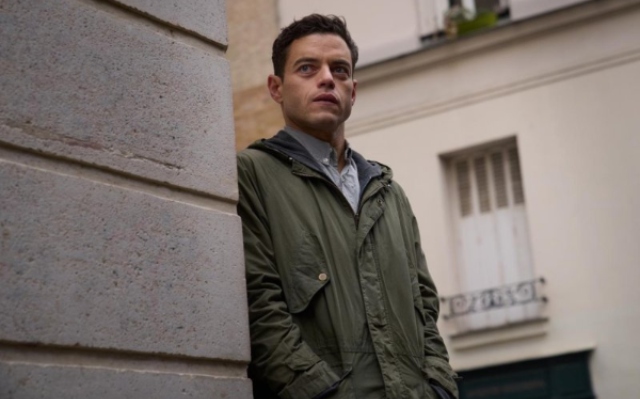
SYNOPSIS: In “The Amateur,” a new thriller now playing in theatres, Rami Malek plays a CIA cryptographer whose life is touched by tragedy when his wife is killed in a terror attack. When the agency refuses to investigate he takes matters into his own hands. Despite being “just a nerdy guy who works on computers,” he vows to use his unique set of skills to get vengeance. “I want to face my wife’s killers,” he says, “look them in the eyes, and balance the scales.”
CAST: Rami Malek, Rachel Brosnahan, Caitríona Balfe, Jon Bernthal, Michael Stuhlbarg, Holt McCallany, Julianne Nicholson, Adrian Martinez, Danny Sapani and Laurence Fishburne. Directed by James Hawes.
REVIEW: “The Amateur,” based on the 1981 novel of the same name by Robert Littell, is a workmanlike thriller, with loads of style but few actual thrills.
The story of vengeance, set into motion after CIA cryptographer Charles Heller’s (Rami Malek) wife is murdered in a terror attack, aspires to be a layered look at grief, anger, the integrity of institutional organizations and the ethics of revenge, is instead a slackly paced movie that is all surface and no depth.
It begins with promise. There’s a cast headlined by Oscar, Tony and Emmy winners, a premise that reflects government conspiracy theories and worldwide unrest, and who doesn’t love a revenge drama? But as the story unfolds it becomes a jumble of ideas that are never pulled together in a tight enough package to become truly engaging.
Malek is in virtually every scene and acquits himself well as the smartest-guy-in-the-room-with-a-grudge, but there’s never any real heat around the character. We are told over and over how brilliant he is, so while he plays a life-and-death game of “Survivor” with the baddies, it’s almost a certainty that he will Outwit, Outplay and Outlast everyone. The predictable nature of his near misses and close scrapes becomes less interesting with every minute of the film’s runtime.
And don’t get me started on the underuse of Rachel Brosnahan, who is barely given any screen time, and when she is, is relegated to playing an idealized version of Charles’ wife. Laurence Fishburne fares better but is still a stock character. He plays a no-nonsense tough guy, ripe with gravitas. It feels like the original script called for a “Laurence Fishburn type” and then they were lucky enough to get Laurence Fishburn. It’s a shame they don’t give him more to do.
As a thriller “The Amateur” rarely raises the pulse rate, but it is as a vehicle for its supporting actors that it really disappoints.
SYNOPSIS: “Megalopolis,” a new fable from legendary director Francis Ford Coppola, now playing in theatres, is a mix of Ancient Roman politics, sci fi, and even a little bit of mime.
Visionary artist Cesar (Adam Driver) has plans to build a utopian city to inspire hope within the rotting framework of New Rome. “When we leap into the unknown,” he says, “we prove that we are free.” He’s up against the corrupt Mayor Franklyn Cicero (Giancarlo Esposito), agent of chaos Clodio Pulcher (Shia LaBeouf) and the threat of partisan warfare.
CAST: Adam Driver, Giancarlo Esposito, Nathalie Emmanuel, Aubrey Plaza, Shia LaBeouf, Jon Voight, Laurence Fishburne, Talia Shire, Jason Schwartzman, Kathryn Hunter, Grace VanderWaal, Chloe Fineman, James Remar, D. B. Sweeney, and Dustin Hoffman. Directed by Francis Ford Coppola.
REVIEW: As idiosyncratic a movie as we’re likely to see this year, “Megalopolis,” the forty-years-in-the-making passion project from Francis Ford Coppola, is equal parts hammy and hopeful, dense and dazzling. It’s the work of a filmmaker with nothing left to prove, and brims with imagination, ambition and, unfortunately, self-indulgence.
Coppola, who says he rewrote the script for “Megalopolis” at least 300 times, empties out the idea drawer, producing a script that overflows with his thoughts on legacy, survival and hope for the future. Using lessons learned from the intrigue of Roman history, he throws in a dollop of sci- fi—Cesar Catalina (Driver) can stop time with a flourish of his hands—to tell a story of utopian values pitted against city hall.
It’s a mix of Ayn Rand and Marcus Aurelius, and not unfamiliar ground for the director. He has essayed the effects of power, political paranoia and the bloom of love in previous films like “The Godfather,” “The Conversation” and “One from the Heart.” The difference is, those movies, while often epic in scope, didn’t take a kitchen sink approach to the storytelling.
“Metropolis” is overstuffed to the point of bursting. The grand vision of warring billionaires and politicians is rendered almost incomprehensible by scenes that never lift off or, worse, feel randomly inserted into the narrative.
Coppola sets his story against a city in a fall of the Roman Empire decline, which should bring along with it very high stakes, but there is never a sense of danger or tension.
Instead, head-scratching line readings, spontaneous Shakespearean monologuing, and unintentionally funny, heightened performances distract from the actual story. “Megalopolis” is operatic in its ambition, experimental in its execution and rather baffling in its intentions.
Perhaps the film’s most telling line is a quote from Roman emperor Marcus Aurelius: “The object of life is not to be on the side of the majority.”
And so it goes with “Metropolis.” Despite the presence of big-name talent like Adam Driver and Aubrey Plaza, this is a deliberating non-commercial film. Coppola’s vision is experimental, difficult to penetrate, impossible to pigeonhole, and occasionally thrilling, but mostly a slog.
SYNOPSIS: “Transformers One” is the origin story of the two Transformers titans, Optimus Prime and Megatron, and how they altered the fate of Cybertron forever.
CAST: Chris Hemsworth, Brian Tyree Henry, Scarlett Johansson, Keegan-Michael Key, Steve Buscemi, Laurence Fishburne, Jon Hamm. Directed by Josh Cooley.
REVIEW: “Transformers One” is the story of an ideological split that drives a wedge between two lifelong friends. Nope, it’s not the story of you and your college pal who has decided to vote for Trump, it’s the animated origin story of the leaders of the Autobots and the Decepticons, the twins towers of the “Transformers” series.
When we first meet them, Orion Pax (Chris Hemsworth) and D-16 (Brian Tyree Henry) are
Cybertronian workers who can’t shapeshift into cars, guns or anything else. They are designed for work, nothing more. Under the rule of Sentinel Prime (Jon Hamm), who they view as a kind and benevolent leader, the pair work in the mines harvesting valuable commodities.
Before they become frenemies they have a great vibe, and the film is a fast-paced blast, filled with humor and heart. It’s a buddy movie, complete with good natured ribbing between the two, some slapstick shenanigans and a bit of playful competition before D-16 allows feelings of betrayal to colour his view of the world.
As their relationship sours, the film becomes darker, but that transformation brings with it an emotional element that while inevitable, also feels bittersweet.
Hemsworth, alongside Keegan-Michael Key as B-127 (ie: Bumblebee) and Scarlett Johansson as Elita-1, deliver solid voicework, but Henry is the MVP. On his way to becoming antagonist Megatron, D-16 has the biggest character arc, and Henry gives this bucket of bolts real personality and effectively conveys the sense of disillusionment that was the catalyst for his trip to the dark side.
The animation is slick and imaginative, although the battle scenes are often so frenetic it’s hard to discern who is fighting who. Still, the visuals sparkle, especially the inventive sci fi landscapes in the background of the above ground scenes.
“Transformers One” is a standalone movie, one that offers up copious Easter Eggs for longtime fans, and a top-notch, entertaining entryway for new fans.
“Why don’t you just die?” screams one of the hundreds of people looking to kill the titular character in “John Wick: Chapter 4,” the wild new Keanu Reeves assassin movie now playing in theatres.
Why doesn’t he just die? Because he’s John Wick, a mix of Anton Chigurgh, Wile E. Coyote and the Energizer Bunny, that’s why.
If you’re a fan of the movies, you already know Wick can take a lickin’ and keep on tickin’. You don’t need the backstory to enjoy the new film, but it might help. Here’s a quick John Wick Wiki to get you up to speed.
The John Wick Universe is a place where an association of twelve crime lords, called the High Table, govern the underworld’s most powerful criminal organizations. They control the Continental, a hotel chain with exclusive branches sprinkled across the globe that serve as homebases for assassins. It is a place run by a strict set of rules, like never do “business” on the premises, by managers like Wick’s friend Winston Scott (Ian McShane) who runs the New York outlet.
Legendary hitman Wick ran afoul of the High Table, and was declared excommunicado. He is persona non grata and they want him dead. Trouble is, he’s hard to kill.
Also, he really loves dogs as much he loves killing people. There. You’re caught up.
At the beginning of the new film, High Table elder and all-round psychopath, Marquis de Gramont (Bill Skarsgård), displeased with Winston’s continuing connection to Wick, decommissions the Continental New York. “He is the face of your failure,” he sneers.
With one of his last allies rendered powerless, Wick must get to the Marquis before the Marquis can get to him.
Cue an amount of mayhem rarely seen this side of Russian car wreck videos on YouTube.
At 2 hours and 49 minutes “John Wick: Chapter 4” is by far the longest film in the franchise. Heck, it’s even longer than “Pulp Fiction,” “A Clockwork Orange” and “Raging Bull,” but director Chad Stahelski maintains interest, staging at least one major action sequence, more like a well-choreographed ballet for the blood thirsty, each hour. People get gone in spectacular ways, Wick defies the laws of physics and medical science to get his revenge and some of the world’s most beautiful locations become the backdrop to Wick style mayhem.
A scene staged in the roundabout circling Arc de Triomphe de l’Étoile is an eyepopper, one of the best big screen action scenes in recent years not directed by George Miller. A shoot out on the 200 steps of Paris’s Sacré-Cœur has an anarchic cartoon vibe that would make the Tasmanian Devil envious. Tom Cruise may be famous for his signature run, but after this, I think, Reeves will be remembered for falling down stairs. It’s a wild, extended ticking-clock sequence that uses slapstick humor to alleviate the tension as Wick violently makes his way to a date with destiny.
Adding to the action sweepstakes are Hong Kong martial arts superstar Donnie Yen as the blind assassin Caine, and legendary Japanese actor and martial artist Hiroyuki Sanada, last seen on screen with Reeves in 2013’s “47 Ronin,” who plays the manager of the Osaka Continental Hotel and an old friend of Wick. Yen is effortlessly cool, with an elegant and humorous fighting style that threatens to steal the show from Wick’s blunt force. Sanada has fighting skills and brings gravitas to the character, a man who values loyalty above all. The personality each bring to their scenes adds much to the effectiveness of the action.
Director Stahelski stages several all-timer action scenes with grace and inventiveness, always remembering to keep the frenetic battles clean and easy to follow.
Of course, the Wick movies are all about the central character, a man whose path to inner peace is littered with the bodies of the people he’s killed. Like a character straight out of a Sergio Leone film, he is a man of few words, and few motivations. In part, that is what makes the character and the movies so enjoyable. He may be the most lethal man on the planet, but, in each movie, his violent tendencies are in service of one objective. There is no muddled middle ground for Wick, no waffling, and that clarity of purpose keeps the movies from becoming cluttered, even at an epic 169-minute run time.
If “John Wick: Chapter 4” is the last film starring Keanu Reeves in the series—it is set-up for spin-offs within the Wickverse—then it goes out with a bang.
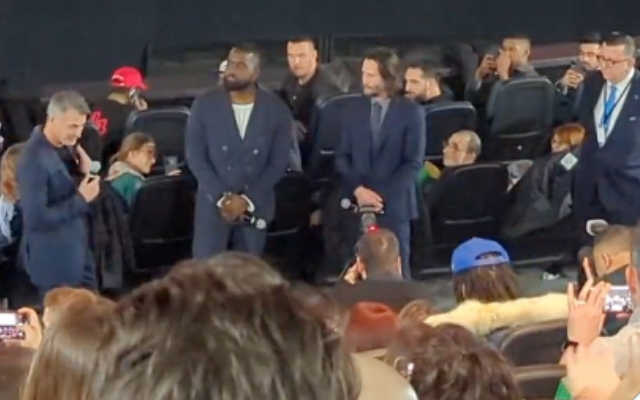
I introed the Canadian premier of “John Wick: Chapter 4” with stars Keanu Reeves and Shamier Anderson and director Chad Stahelski. Instead of the planned Q&A, they did a tribute to Lance Reddick, a co-star in all four Wick movies, who passed away earlier in the day.
In recent years we’ve seen Liam Neeson morph from dramatic actor to action star. He’s battled everything from human traffickers and Mexican cartels to hijackers and murderous drug dealers. His latest, “The Ice Road” sees him up against his most daunting adversary yet—a long stretch of frozen ocean.
Neeson is Mike, a grizzled big rig driver who cares for his Iraq war veteran brother Gurty (Marcus Thomas). Gurty is a master mechanic but his PTSD has made it difficult for the brothers to stay employment. When a diamond mine in Northern Canada collapses, they accept a job offer from Goldenrod (Laurence Fishburne) to be part of a convoy delivering lifesaving equipment to the remote mine location.
The brothers team with Goldenrod and Tantoo (Amber Midthunder), a fearless young woman whose brother is trapped in the mine, to navigate three 65,000 pound vehicles over “ice roads,” frozen lakes, rivers and oceans to deliver life-saving equipment.
There’s more but I can’t describe the plot’s main thrust without a major spoiler. Suffice to say, there is a villain so dastardly all that’s missing is a giant moustache to twirl.
The drama in “The Ice Road” quickly melts away like ice before a fire, leaving behind a residue of clichés, long, drawn out action and fight scenes and dialogue borrowed from a hundred other, better action movies.
Director Jonathan Hensleigh, writer of the screenplays for “Jumanji,” “Armageddon” and “Die Hard with a Vengeance,” struggles to bring the popcorn thrills of his best-known work to this movie.
Even the death of one of the major players (NO SPOILERS HERE) is so abrupt and undramatic, it’s as if the actor had a doctor’s appointment and had to leave the set suddenly.
It’s too bad because there’s lots to work with. Start with Man-against-nature. Move along to a pantomime villain and throw in some of Neeson’s trademarked grimaces and growls and you could have an enjoyable b-movie but the hackneyed relationships and threadbare special effects sink the whole thing.
“The Ice Road” is a long (why did this have to be 103 minutes long?) winding road to nowhere; all build up and no pay off.
Based on Maria Semple’s 2012 bestseller “Where’d You Go, Bernadette,” is a mystery-comedy that explores motherhood and mental illness.
Cate Blanchett plays the title character, an agoraphobic architect, once heralded as a genius, now a hermit who hasn’t designed a building in decades. Described as one of architecture’s “true enigmas,” she hates travelling, complains that people are rude and yammer too much, can’t sleep—“Anxiety causes insomnia,” she claims, “and insomnia causes anxiety.”—rarely leaves the house and has poured all her prescription drugs into one jar. “The colours and shapes are amazing together,” she says.
The other moms in the area, next door neighbor Audrey (Kristen Wiig) and “all her flying monkeys,” don’t like her and Bernadette makes no effort to build bridges with them. “I’m not good when exposed to people.”
The only bright spots in her life are husband Elgin (Billy Crudup), 15-year-old daughter Bee (Emma Nelson) and her virtual, on-line assistant. A series of unrelated but catastrophic events, including a mini-mud slide, an identity theft ring and an intervention, prompt Bernadette to disappear without a trace, leaving Bee and Elgin to figure out where she went.
“Where’d You Go, Bernadette” is more story driven than director Richard Linklater’s recent, more slice-of-life films. In movies like “Everybody Wants Some!!” he excelled in crafting interesting situations for his characters to inhabit. Here the details aren’t so much focussed on the location or building atmosphere, but in creating a layered and compelling central character.
Blanchett applies a light touch here, playing up the funny moments, but still digging in when it comes time to deal with the “formality of life.” It’s a lovely performance in a film that rambles somewhat, but ultimately finds touching moments in the story of a woman who had to get lost to find herself.
Cast your mind back to 2014. John Wick, the retired super assassin played by Keanu Reeves, was attempting to move on after the death of his wife. Keeping him company was a puppy, sent by his wife just before she died in the hopes that the dog’s love will help ease his pain. But then came the bad men who broke into his house to steal his super nifty 1970 Mustang. Things go sideways and the thieves do the unspeakable.
They kill the dog.
Big mistake. The doggy’s daddy is a killing machine. How wicked is John Wick? “Is he the boogeyman?” asks one former associate. “He was the one we sent to kill the boogeyman.”
Thus, was set into motion the series of bloody, open-up-a-can-of-whoop-ass events that lead us to “John Wick: Chapter 3 – Parabellum.”
Following “Chapter 2” which saw Wick ostracized from the exclusive world of killers-for-hire after breaking some very Old Testament style rules laid down by Winston (Ian McShane), operator of the mysterious assassin association the High Table. Now Wick has a $14 million price tag on his head and an army of international bounty-hunters on his tail.
You don’t go to “John Wick” movies for nuanced character development. You go for the kick butt-ery. “Chapter 3” delivers on the promise of action with scenes that show Wick dispatching a man using nothing but a book, stabbing somebody in the eye – that one is gruesome – and, of course shooting everyone in sight. There is so much and gunplay it’s as if they had to use up all of “Chapter 3’s” bullet budget or they wouldn’t get it again for the inevitable sequel.
These action scenes are carefully choreographed and the absence of music in the early fights emphasizes the brutality and the absurdity of the violence. But while we expect uber-violence from this franchise, we also expect consistently inventive battle scenes. There’s some of that—the action scenes involving horses and motorcycles are wild and woolly—but a long shoot-out in Casablanca is just that – a long shoot-out in Casablanca that feels plucked from a video game.
As the series moves further away from the original “dead puppy“ revenge plot of the original it is losing some of the simplicity that made the first two movies so enjoyable. The world of the High Table comes with rules of plenty but in the context of these action films less could be more. We don’t need complicated world building. This isn’t a Marvel movie, it’s a fists of fury action flick that threatens to get bogged down by details.
Having said that, “Chapter Three – Parabellum” (a Latin phrase meaning ‘prepare for war’) is still a hoot and features some of the coolest fight scenes in movies right now despite its excesses.
“Do you guys put the word quantum in front of everything?”
That’s the question Paul Rudd, playing Scott Lang / Ant-Man, asks in the new Marvel movie “Ant-Man and The Wasp.” Having seen the film I wonder why he didn’t speak up earlier, like when the screenwriters were scribbling about quantum physics, quantum realm, quantum void, quantum this and quantum that. These movies are supposed to be about a smart alecy guy who can shrink himself down to the size of an ant to solve crimes, not the Heisenberg principle.
The movie begins as Lang has just three days left on his house arrest following the events of “Captain America: Civil War.” Trapped in his apartment he has a strange dream. He sees Janet van Dyne (Michelle Pfeiffer), wife of scientist Hank Pym (Michael Douglas), mother of Lilly van Dyne a.k.a. Wasp (Evangeline Lilly), trapped in the quantum wormhole she disappeared into three decades before. Meanwhile Hank and Lilly are perfecting a method to rescue their loved one from the quantum hike she now calls home. Trouble is, they can’t do it alone. They need any information that may be trapped in Rudd’s head and money from a grubby bad guy. Time is of the essence as Ghost (Hannah John-Kamen), a spectral presence who can walk through walls, also seeks out Janet’s quantum power to heal her cellular disorder.
From the kitschy sounding title to the size-shifting characters to the scientific mumbo jumbo that takes up much of the screen time, “Ant-Man and The Wasp” is a throwback to drive-in movies of the 1950s. It’s been updated with better special effects and more authentic sounding science jargon, but make no mistake, for better and for worse, this has just as much in common with flickers like “Attack of the 50 Foot Woman” and “Them!” as it does with the Avengers. Like the 50s b-movies that were undoubtedly an influence, this is a loud-n-proud genre film but like many of the Avengers films that are part of the Ant-Man family, it is marred by excess. Too many characters, too many story shards—a rescue mission, two sets of baddies chasing down the quantum technology, a romantic subplot, a family film angle—too much exposition to much quantum theory.
There is a funny scene about an hour into the movie where Michael Peña, playing Lang’s former cellmate and current business partner, recaps the story so far. It takes two minutes, is laugh-out-loud funny and completely negates the need for much of the exposition—people in this movie love to ask things like, “What have you done?”—that comes before it. Move that to the beginning of the film and they could have saved pages of dialogue and juiced up the film’s fun factor by at least fifty percent.
“Ant-Man and The Wasp” does plough some new ground—it is the first time a female superhero’s name is in the title of an MCU film—but feels scattershot in its execution.
 SYNOPSIS: In “The Amateur,” a new thriller now playing in theatres, Rami Malek plays a CIA cryptographer whose life is touched by tragedy when his wife is killed in a terror attack. When the agency refuses to investigate he takes matters into his own hands. Despite being “just a nerdy guy who works on computers,” he vows to use his unique set of skills to get vengeance. “I want to face my wife’s killers,” he says, “look them in the eyes, and balance the scales.”