“Minamata” is a mix-and-match of a few different things. The story of celebrated “Life” photojournalist W. Eugene Smith as he documented the effects of toxic mercury poisoning in Japan is part, biopic and part exposé of corporate malfeasance with just a hint of “Fear and Loathing in Las Vegas” thrown in for color.
The story begins in 1971 in New York. Smith (Johnny Depp) is at the tail end of a legendary career. His reclusive and erratic behavior has eroded his relationship with “Life” editor Robert Hayes (Bill Nighy) and the years as a World War II photographer haunt his memory.
Aileen (Minami), a translator for Fuji film advertisement, suggests he go to Japan to witness and document the effects of mercury pollution in the city of Minamata. For a decade and a half, the locals have suffered a neurological disease caused by mercury poisoning, the result of toxic waste dumped into Minamata Bay by the Chisso chemical plant. Aileen wants the eyes of the world to focus on the problem.
The gruff Smith is initially reluctant, but his growing fondness for Aileen, an assignment from “Life” and his own sense of journalistic integrity change his mind. The resulting trip and story transforms both Smith and the perception of the situation in Minamata.
The long delayed “Minamata”—it premiered at the Berlin International Film Festival in February 2020—is an uneven film anchored by a rock-solid performance by Johnny Depp. He humanizes the curt Smith, milking out a redemption arc for the character as he atones for past transgressions by applying his craft to make the world a better place for the people of Minamata. His torment is made clear in a speech about the old belief that a photograph steals the soul of its subject. “What gets left out of the fine print,” he says, “is that it can also take a piece of the photographer’s soul.”
It is mature work, without a trace of Capt. Jack. A flash of Hunter S. Thompson peaks through in Smith’s abuse of methamphetamine, alcohol and general disregard for the niceties of being respectful to one’s editor, but overall, Depp digs deep and brings a rough-hewn mix of charm and compassion.
Depp shines in a movie that travels a well-worn path. Stories of activism vs. corporate malfeasance tend to follow a similar trajectory, and “Minamata” is no different. It hits familiar beats of corporate callousness but offers something new in the stunning recreations of Smith’s photos, specifically “Tomoko in her Bath,” the most famous picture from the portfolio.
“Minamata” takes liberties with historical timelines, but this isn’t a documentary, it is a dramatic recreation of Smith’s call to arms, and as such, delivers a compelling, if familiar, story.
A portrait either in self-destruction or the indomitable spirit of someone whose demeanour suggests a hangover come to life, “Crock of Gold: A Few Rounds with Shane MacGowan,” now on iTunes, is a vivid look at the life of the man best known as the lead singer of The Pogues. “He just doesn’t enjoy life without a drink.”
Most music bios focus on follow a standard rags-to-riches format but director Julien Temple applies his trademark visual and narrative density to MacGowan’s story, creating a movie that is as much a cultural history as it is a biopic.
Temple spends half the movie detailing MacGowan’s youth, from his birth on Christmas Day, 1957, to his early childhood in County Tipperary, Ireland. Illustrated with stock footage of rural life and re-enactments, it paints a rosy picture of a hard scrabble life, where hard work and even harder drinking are the norm. Life on the farm, with a Guinness in his hand at the age of six, gave MacGowan a deeply rooted sense of Irish pride, a sentiment that fuelled his greatest successes.
Less romantic is the move to England as a youngster. Poverty, drinking, drugs, anti-Irish racism and punk rock led to MacGowan’s first taste of fame, a blow to the head at a 1976 Clash concert that earned him notoriety as the jug-eared face of London punk.
Cut to 1982. Several failed bands and thousands of pints later, he formed The Pogues and married the spirit of punk with traditional Irish music. Feisty and furious songs about Irish nationalism, history, and experiences made MacGowan and the band wildly successful, but a tune the singer calls “Our ‘Bohemian Rhapsody,’” was their undoing. The release of “Fairytale of New York” set them on a never-ending tour with only a handful of days off in the coming year, leading to MacGowan’s descent into a walking, talking cautionary tale after a psychotic break while performing in New Zealand.
The story continues, covering his post-Pogues time with bands like The Popes, but it is the portrait of MacGowan as a poet who grabs songs out of the ether—“That’s why they’re called airs,” he explains—and a nationalist whose Irish identity energized his work that lingers. “I always felt guilty that I didn’t lay down my life for Ireland,” he says before adding, that at least “I participated in the revolution as a musician.”
Ultimately, culture and politics aside, “Crock of Gold: A Few Rounds with Shane MacGowan” is a story of a man with a seemingly unquenchable thirst for drink and drugs. Recent footage shows the ravages of a life lived hard as he mumbles his way through recent interviews with the kind of befuddled intensity that can only be found at the bottom of a bottle. His angels, a way with words and melody, robbed from him, he bemoans his inability to write new songs even as he washes down those words with a swig of wine or whiskey. It’s hard to believe him when he slurs, “I have no self-destructive impulses whatsoever,” but it completes the portrait of a complicated artist whose best work stemmed from his worst behaviour.
If you already know what a ‘magizoologist’ is you’re likely a fan of J.K. Rowling’s wizarding world. If not, you’ve got some catching up to do before buying ticket to the second instalment of the Harry Potter spin-off “Fantastic Beasts: The Crimes Of Grindelwald.”
When we last saw magizoologist Newt Scamander (Eddie Redmayne) he temporarily put aside his study of magical creatures to travel to New York City and help MACUSA (Magical Congress of the United States of America) bring the powerful Dark wizard Gellert Grindelwald (Johnny Depp) to justice.
The story picks up as Grindelwald escapes. Like all good villains he craves world dominance, but only on his own terms. He believes in wizarding superiority and sets in motion a plan to lead a new Wizarding Order of pure-blood wizards who will rule over all non-magical beings.
Enter Albus Dumbledore (Jude Law), professor of Transfiguration at Hogwarts School of Witchcraft and Wizardry and an influential member of the British Ministry of Magic. To stop Grindelwald’s diabolical plot Dumbledore contacts Scamander, a confidante and former student.
The film based on the second original screenplay from J.K. Rowling is more fantastical than magical. There are all manner of creatures and wizard’s tricks that could only have sprung from her fertile imagination but there is very little actual cinema magic. Sure Potter fans will love seeing Hogwarts and a glimpse of Quidditch again but that is nostalgia, and Alison Sudol’s Judy Holliday impression is as winning as it was the first time out but overall “The Crimes Of Grindelwald” feels like a placeholder for the films yet to come.
Non-Potter-heads will likely be confused by the barrage of names, the myriad of subplots and a deadly scene about the family tree of Credence Barebone (Ezra Miller) that gives the word convoluted a whole new meaning. Part of the joy of the Rowling’s story weaving in the Potter series was its depth and complexity. Here it feels as though she’s being paid not by the word but by the character.
When director David Yates isn’t bathing the screen with blue digital flames and the like there are things to admire. The set and costume design are spectacular, appropriate for both the 1920s setting and the otherworldly characters. Also interesting are the messages, both timeless—the search for identity—and timely—unity, fear mongering and freedom through force—provide subtext that is more interesting than the actual story.
Ultimately “Fantastic Beasts: The Crimes Of Grindelwald,” despite its grand face, feels thin, over written and under dramatic.
This weekend the Orient Express pulls into the station, bringing with it murder and mayhem. Murder on the Orient Express features an all-star cast including Johnny Depp, Dame Judi Dench and Daisy Ridley. Directed by and co-starring Kenneth Branagh as Belgian detective Hercule Poirot, the often-filmed mystery is based on the book of the same name by Agatha Christie first published in 1934.
The sensational story of a murder —13 strangers on the luxury train and an investigator’s race to solve the puzzle before the killer strikes again — is Christie’s best-known novel, but it is just one of 66 detective novels she penned in a career that spanned more than five decades.
“I think people have been pretty tough on her,” Branagh told The Guardian. “They’re suspicious of the volume of her output.”
It’s true that the author’s omnipresence on bookshelves, 20th century household-name status and massive popularity — over two billion copies of her books have been sold worldwide making her one of the bestselling authors ever — didn’t endear her to the literary elite, but Branagh sees her differently.
“Personally I admire the prolific nature of what she does … her ability to grab the audience’s attention is really striking,” he said. “The surface of what she writes has led people to dismiss her as a second-rater. But I think she is far more than that.”
Christie’s public persona was that of a button-down grandmother with a macabre imagination, but she led a remarkable life.
In an essay for Radio Times, Branagh writes, “This was a woman full of surprises.” He goes on to describe how the author became the first British female surfer to hang ten in Hawaii. “It was 1922,” he writes. “She was fully upright, scantily clad, and 32 years old.”
In her own words Christie says she wore a “wonderful, skimpy emerald green wool bathing dress, which was the joy of my life, and in which I thought I looked remarkably well!”
Another episode from her storied life feels like it could have been ripped out of the pages of one of her books. The year was 1926. Christie was on the verge of a divorce from her first husband when she vanished, leaving behind only her abandoned car, an expired driver’s licence and some clothes.
Already considered a national treasure, her mysterious disappearance was front-page news. Some thought it was a publicity stunt, others wondered if she was trying to frame her husband for murder.
Sir Arthur Conan Doyle, creator of Sherlock Holmes, tried to solve the mystery with the help of a psychic. When Christie re-emerged 11 days later, after living under an assumed name in a small hotel, she offered no clues as to what had happened.
One popular theory suggests the Queen of Crime had fallen into a psychogenic trance. In the book The Finished Portrait, biographer Andrew Norman sites the adoption of a new personality and “failure to recognise herself in newspaper photographs” as signs that she was depressed and had fallen into a fugue state.
Christie never publicly commented on those missing days, not even in her official biography.
Now, 91 years later the mystery will likely never be solved. So much time has passed that not even Christie’s greatest creation, Murder On The Orient Express’s master detective Hercule Poirot, could get to the bottom of this mystery.
Agatha Christie’s story of murder and mayhem and a moustachioed detective comes to vivid life on the big screen with, as they used to say, more stars than there are in the heavens. Penélope Cruz, Willem Dafoe, Judi Dench, Johnny Depp, Josh Gad, Derek Jacobi, Leslie Odom Jr., Michelle Pfeiffer and Daisy Ridley play travellers on the luxurious train and all are suspected of doing a dastardly deed by Hercule Poirot, the legendary Belgium detective played by director and star Kenneth Branagh.
Set in 1934, a time when women wore afternoon dresses, men donned flat hats and the Orient Express was seen as the epitome of first-class steam-age travel. Poirot, looking for peace and quiet, some downtime between cases, joins the Orient Express in Istanbul, heading for Calais for a much-needed holiday. “Three days free of care, concern the crime,” says friend Bouc (Tom Bateman).
On board is a colourful collection of characters. There’s Russian Princess Dragomiroff (Judi Dench) and her obedient maid Hildegarde Schmidt (Olivia Colman); the racist German academic Gerhard Hardman (Willem Dafoe); “husband huntering” American widow Mrs. Hubbard (Michelle Pfeiffer); the troubled Countess Andrenyi (Lucy Boynton) and her ballet star husband, Russian dancer Count Andrenyi (Sergei Polunin); Spanish missionary Pilar Estravados (Penélope Cruz); British governess Mary Debenham (Daisy Ridley) and American art dealer Ratchett (Johnny Depp), his butler, Masterman (Derek Jacobi) and private secretary, Hector MacQueen (Josh Gad). “There’s nothing like a triangle of strangers pressed together on a train with no purpose but to go from one place to another.”
One of them is murdered and one is a murderer. Vacation or not, there is a crime to be solved and only one man for the job. “My name is Hercule Poirot,” says the elaborately moustachioed detective, “and I am probably the greatest detective in the world.” Thus the “Avenger of the Innocent” goes fishing for clues in a barrel of red herrings.
Lush production design and old school story telling gives this version of “Murder on the Orient Express” a Masterpiece Theatre vibe. It is a parade of great faces and attention to period details with a slight updating in the character’s ideas about race but while the train may be speeding along on tracks of steel, the story isn’t.
Branagh revels in the deduction phase of the tale, shining a spotlight on Poirot’s process. He’s a great character and Branagh is clearly having a good time playing him but his larger-than-life presence sucks much of the air out of the room, leaving the others gasping. Individually the sprawling cast aren’t given much to do, many reduced to little more than cameo appearances. The real mystery is why Branagh would assemble such a stellar cast and then not give them anything to do.
Even more frustrating are several of Branagh’s stylistic choices. Beautiful sets, and frequently, beautiful performers are obscured by odd cinematography. Pfeiffer’s big entrance is shot in an impressive tracking shot that spends more time showing the outside of the train than the actors. Later a crucial revelation is inexplicably shot from above, showing only the backs of the actor’s heads. The camera is almost constantly in motion and while it helps create a sense of forward movement it can be distracting. However, when it focuses on the period details it is a pleasure to gaze upon.
At its core “Murder on the Orient Express” does end with a morally interesting question but doesn’t spend enough time with its characters—save for the great detective who is clearly being set to be the focus of a franchise—for us to get fully invested in whodunit in question.
Much has changed in the six years since the Black Pearl’s last voyage. Of late Johnny Depp, the previously beloved star of the “Pirates of the Caribbean” flicks, has been tabloid fodder, his personal life a treasure trove of scandal. Will Deep’s martial and financial peccadillos harm the new movie’s bottom line, sinking the once mighty franchise in a one-way trip to Davy Jones’s Locker? Or will Captain Jack Sparrow once again frolic down the plank to titanic grosses? Those are the questions hanging heavy over “Dead Men Tell No Tales,” the fifth “Pirates of the Caribbean” movie.
“The dead have taken command of the sea. They’re searching for Sparrow!”
The new adventure sees a new villain, undead pirate hunter Capt. Salazar (Javier Bardem), unleash an army of ghost sailors from a mysterious nautical underworld called the Devil’s Triangle. His plan is to hunt down and kill every sea going pirate with one name at the top of his list, Captain Jack Sparrow. Seems Sparrow not only doomed Salazar to watery purgatory decades ago but also has a compass that can break the ghost sailor’s hex curse.
“Find Jack Sparrow for me and relay a message from Captain Salazar. Tell him, death will come straight for him. Will you say that to him, please?”
Sparrow (Depp), meanwhile, has lost his mojo. After a wild bank robbery that tore up half of the island of Saint Martin but yielded little in the way of doubloons, Jack loses his luck and his crew. Reduced to helming the Dying Gull, a small and barely seaworthy ship, he must now fight for his life. To survive he has to locate the Trident of Poseidon, a divine artefact that can break any curse at sea. Helping on his mission are Carina Smyth (Kaya Scodelario), an astronomer with a diary filled with cryptic Trident clues and directions and Royal Navy sailor Henry (Brenton Thwaites).
Also mixed up in the action are returning characters, blacksmith-turned-Captain of the Flying Dutchman Will Turner (Orlando Bloom), Elizabeth (Keira Knightley), Turner’s wife and Henry’s mother, one-legged pirate Captain Hector Barbossa (Geoffrey Rush) and Captain Jack’s First Mate Joshamee Gibbs (Kevin McNally).
New comers include witch Haifaa Meni (Golshifteh Farahani) and Paul McCartney as a jokey pirate behind bars, eagerly awaiting a beating.
“Pirates of the Caribbean: Dead Men Tell No Tales” is more of a linear adventure than the series’ last few instalments. It’s a tale of mysticism and slapstick, a story that freshens up the franchise, although it cannot be denied that the originality and ingenuity of the first movie has turned into a fine mist that colours this movie but has no where near the impact of the original.
Once again Depp slurs and sashays through the movie, getting the biggest laughs. Sparrow is still an interesting character, a debauched scallywag (apparently based on Keith Richards) who appeals to children and adults alike. The embattled actor hams it up, giving audiences what they expect from Sparrow but whether moviegoers still want to see him in his best-known role is hard to say.
Tonally Depp hits the right notes but the movie is all over the place. Kid friendly slapstick is abundant but there is also a fair amount of PG+ swashbuckling, action and swordplay. And don’t get me started on the nightmare inducing zombie sharks.
Parents of small children will want to keep that in mind, and the two-hour plus running time. Like so many tent pole movies “Dead Men Tell No Tales” suffers from more-is-more syndrome. The action is easier to follow than in the Gore Verbinski films but watery climax is too long and a coda, reuniting the characters for one last hurrah, is unnecessary and adds little to the film except for a few extra minutes.
“Pirates of the Caribbean: Dead Men Tell No Tales” is a crowd pleaser and by far the best of the bunch since the first one. It contains all the elements you expect from the “Pirates” franchise and even a few you don’t but takes on water in its final half hour.
Alice Through The Looking Glass, the six-years-in-the-making sequel to Tim Burton’s Alice in Wonderland, takes place in a world where chess pieces come to life and the Cheshire Cat’s grin is as toothy as ever. It’s a flight of fantasy, based on a story published by Lewis Carroll in 1871, but grounded by the very human character of Alice Kingsley.
Mia Wasikowska has played Alice since the 2010 film, signing on to the first movie when she was just 18 years old.
“There is always a little bit of trepidation especially when you’re dealing with a character who is so iconic and so beloved by so many people and so many generations,” she told me on the release of the first film.
“But there is also a certain amount of realism to it because you know you can’t please everyone and not everyone is going to be pleased so it is more just making the character your own and feeling comfortable in the decisions you make.”
Originally imagined by Carroll in 1865, the little girl who found a world of wonder down the rabbit hole has become one of literature and film’s more enduring and malleable characters.
She was the insane character of America McGee’s video game Alice and the martial arts instructor of a Syfy channel adaptation. In 2010 Wasikowska said she thinks the stories have lasted because people relate to the strange characters and situations.
“I don’t believe in normal,” she said. “Nobody is normal. Everyone is crazy in his or her own way. So although these are extreme characters I think that just makes them more identifiable.
People want to see these characters, understand these characters, love these characters, feel comfortable with these characters because they are like everybody in this world who are kind of crazy. Everyone has felt like an outsider at some time in their life so it is a very identifiable story.”
Alice first got the big screen treatment in 1903 in a 12-minute silent version starring Mabel Clark, who was also employed on the set as a “help-out girl,” making costumes and running errands.
In 1966 director Jonathan Miller cast Anne-Marie Mallik as the lead in Alice, a mad-as-a-hatter made-for-BBC movie. Miller called Mallik, who auditioned by reciting a poem, a “rather extraordinary, solemn child.”
Not everyone agreed. Peter Cook’s biographer described the teenager’s take on Alice as “sullen, pouting, pubescent with no sense of bewilderment.” Mallik later said she wasn’t impressed with her illustrious co-stars — John Gielgud as the Mock Turtle and Peter Sellers as the King of Hearts — because she had grown up surrounded by the very accomplished friends of her “much older” parents.
After production wrapped she “retired” from acting and afterward the BBC had trouble paying her a royalty because they couldn’t find her.
It’s hard to know what Alice Liddell, the young girl who inspired the character would have thought of any of the wild and wacky versions of the story, but we do know she enjoyed the 1933 Paramount version.
“I am delighted with the film and am now convinced that only through the medium of the talking picture art could this delicious fantasy be faithfully interpreted,” she told the New York Times. “Alice is a picture which represents a revolution in cinema history!”
“Alice Through The Looking Glass,” the six years in the making sequel to Tim Burton’s $1 billion grossing “Alice in Wonderland,” takes place in a world where butterflies speak and the Red Queen applies her lipstick in a heart-shaped motif, but what should be a flight of fancy is grounded by a dull story.
The topsy-turvy world of Underland is more or less intact since the last time Alice Kingsleigh (Mia Wasikowska) visited. Chess pieces still come to life, Tweedledee and Tweedledumb (Matt Lucas) continue to speak in rhyme and the Cheshire Cat’s (Stephen Fry) grin is as toothy as it ever was.
One thing is different, however. The Mad Hatter (Johnny Depp), Alice’s greatest friend and ally in the otherworld, is having some problems. Call him the Sad Hatter. “He’s just not the same anymore.” Thinking of his family’s demise courtesy of the fiery breath of the Jabberwocky has thrown him into a depression. To help the Mad Hatter out of his funk Alice steals a time travel device from Time (Sacha Baron Cohen) himself (“I am time,” he says, “the infinite, the immortal, the measurable… unless you have a clock.”) ignores warnings about changing the past and careens across the ocean of time to find out what happened to Hatter’s folks. “Do try not to break the past, present or future,” purrs the Cheshire Cat.
“Looking Glass” is an epic fantasy artfully directed by James Bobin but lacking the effortlessly odd feel of Tim Burton’s work on the first film. It’s a trippy story that transverses time and space and should invite the viewer to turn on, tune in and drop out but the true weirdness of the story, the unhinged voyages of imagination, are absent. Instead we’re thrown into a world that feels like we’ve seen it all before: familiar and not nearly whimsical enough. It’s a sea of CGI with a story cut adrift inside it.
It’s lovely to hear Alan Rickman’s voice, if only briefly, as Absolem the Caterpillar on screen again and Baron Cohen does his best to breath life into his character, but no one, not even the Mad Hatter—who should more rightly be called the Quirky Hatter—is interesting enough to merit the movie’s hour-and-forty minute running time. There is a high level of craft evident in the computer-generated images, the costumes and set decoration, everywhere, in fact, except the story that seems to value “time” puns over actual plot.
Perhaps in six years or so, if they decide to add another film to this franchise, they’ll take heed of a bit of “Looking Glass’s” theme about learning something from the past and give the next movie the excitement and story Lewis Carroll’s creation deserves.
As the calendar moves ahead to 2016 I’m taking a moment to think back to the great people I met, wrote about or chatted with on television in 2015. I shared Tim Bits with Liev Schreiber—he liked the chocolate, I preferred the glazed—inhaled Johnny Depp’s vape fumes, had a “Sock Battle Supreme” with Anthony Daniels—Mr. C-3PO—and was embarrassed to order a Chai Tea Latte while standing next to Chris Cooper at a coffee bar. On stages, in hotel rooms, on phones and even in the back of taxis, they spoke and I listened. Here’s some of the best stuff I heard this year:
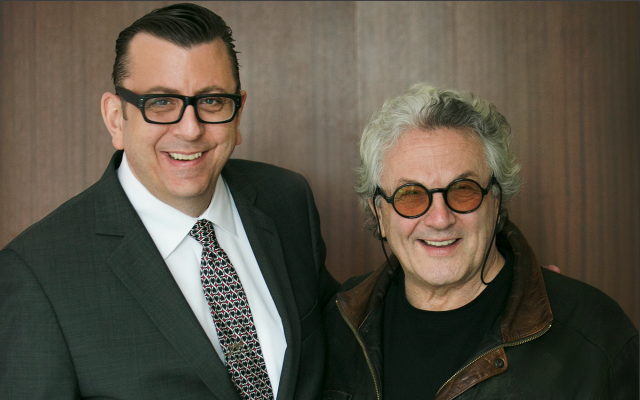
GEORGE MILLER: “I don’t think I’d be the filmmaker I am unless I had that medical education, in two very direct ways. Both of them have a lot of problem-solving in there. But the most important way is that as a doctor you are looking at people in extremis from many points of view. You look inside of people. You see people during birth and death and so on. Through microscopes — a lens. So you’re looking from many, many points of view. That’s exactly what you do in cin ema. Huge wide shots with massive crowds or you’re looking right down inside someone’s brain, someone’s head.”
AMY SCHUMER: “I never thought about being famous. That was never part of my thing, but once it was on the horizon as a possibility, it seemed like a real bummer. I could see there’s no upside. The upside is I sometimes get free appetizers and I can get a reservation at a restaurant. I only go to one place in New York, it’s a tea place, the Tea Cup, and they don’t take reservations but I can make a reservation there. I swear I don’t see another upside. It sucks.”
PHYLLIS SMITH: “I worked for JC Penny in the warehouse tagging the merchandise,” she remembers. “I used to stand there and tag thousands of fishing lures or bowling balls or roller shades, which were heavy as heck to lift around. The people were great to work with but the merchandise was a little challenging.
“I used to stand there, thinking about life, wondering what it is we all have in common because we’re not all given the same opportunity. Some people’s health is impaired when they’re born while others are charmed with intelligence or looks. I thought, ‘There has to be something that we all have. A commonality.’ I figured out that it’s the ability to love. We all, in some form or another, want to love and be loved. That was my big revelation. My lightbulb moment. Also, if you’re standing on a concrete floor, make sure you’re wearing comfortable shoes or you’ll pay for it later.”
CAROLL SPINNEY: Caroll is President Obama’s ninth cousin, but Big Bird isn’t political in the least. “Big Bird, I’m told by the owners of him, does not have political opinions. I thought of an idea that would get around that problem if someone (ever asked about it). ‘I don’t know who that is,’ he says in Big’s voice. ‘I thought we had a king.’ In most fairy tales, lands are run by kings or queens.”
DEBORAH ANN WOLL: A quick Internet search turns up many adjectives used to describe Daredevil star Deborah Ann Woll; gorgeous, talented and cute to name just a few.
The redheaded actress uses other terms to describe herself.
“There’s nerd, geek, all those words,” she says. “I am settling closer and closer to dork. I am a very proud dork.”
The former True Blood star — she played fierce teenage vampire Jessica Hamby for seven seasons on the hit show — embraces her inner dork — “I’m Dungeons and Dragons player, a Mystery Science Theatre buff. I like board games.”
She says the role playing games have benefits beyond entertainment value.
“Something like Dungeons and Dragons or a board game is a way for me to be social but it takes some of the responsibility off of me myself. If I don’t feel impressive as myself, I can feel impressive as Mistress Pyrona, the Genosi Sword Maiden. Like my acting, it gives me a little bit of support.”
JAKE GYLLENHAAL: “I think the people I admire as artists are the people who really listen to themselves even if it is to the detriment of what people might consider success. I’d rather be myself and do what I love than listen to someone else and follow that role and be unhappy.”
CHRISTOPHER PLUMMER: My favourite line from any interview? Christopher Plummer talking about the dog in “Remember”: “We had two dogs on set. One to do the stunts and the other just making money.”
BRYAN CRANSTON: “I don’t want to portray this idea that I’m just about the art. I’ve been poor and I’ve been rich and rich is better.” Also: Bryan Cranston told me he likes to go up to people wearing the Heisenberg t-shirts they wore on the show Breaking Bad and talk like Walter White… “Nice t-shirt,” and I whisper if to them and their eyes go wide and I put my finger to my lips, like ‘Don’t tell anyone… if you tell people, they won’t believe you.’
SAOIRSE RONAN: Saoirse is an Irish or Scottish name meaning freedom roughly pronounced SEER-shə. “I get very confused about my name all the time,” she said in a recent sit-down. “Sometimes I look at it when I’m writing it down for people and I go, ‘This is actually a ridiculous spelling of a name.’”
ADAM MCKAY: “We wanted to be the first Wall Street movie that took you behind the curtain, that really said, All these confusing terms you hear, all the ways the banks make you feel stupid or bored … it’s actually not that hard. If the guy who did Step Brothers can understand it you can too.”
RYAN COOGLAR: “Whenever I had a big test at school or a football game (my father would) say, ‘Take 10 minutes and watch this scene from Rocky. That’ll get you fired up. That’ll give you the juice to score five touchdowns. Or get an A on that test.’ I’d look over and think, ‘Are we watching this for me or for you?’”
ANTHONY DANIELS: Having one of the most recognizable voices in movie history can lead to some surreal moments. Just ask Anthony Daniels. He’s played C-3PO in all seven Star Wars films, including this weekend’s Star Wars: The Force Awakens and once rented a car with a very familiar voice on the GPS.
“I felt uncomfortable with me —very clearly — giving me instruction for something I didn’t know. I found it quite bizarre. I was driving thinking, ‘This is unnatural.’”
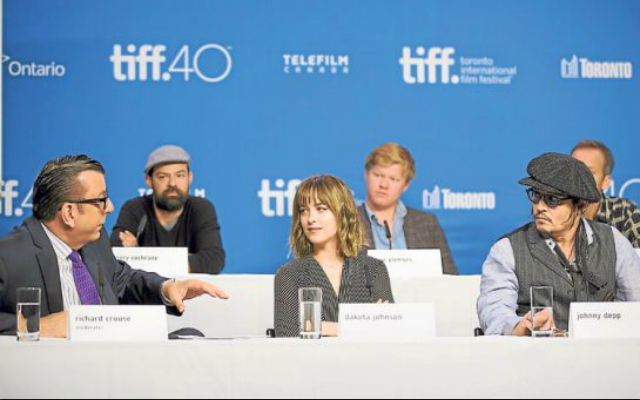
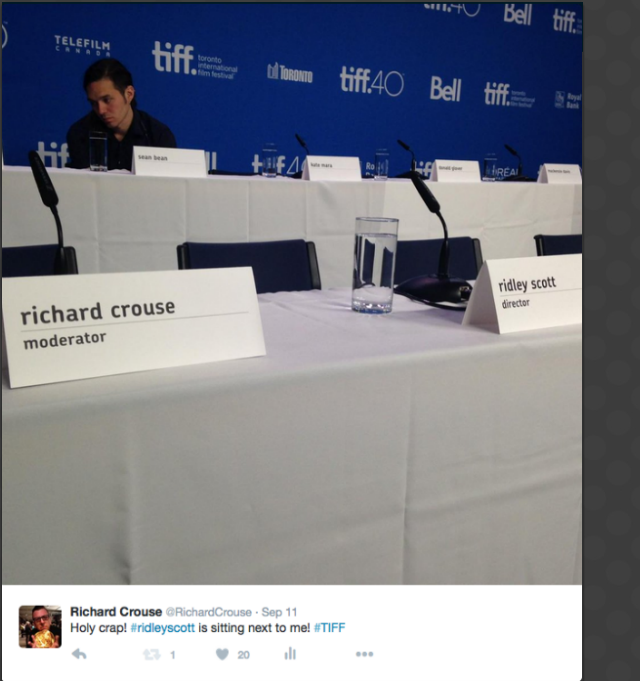
TIFF: The Toronto International Film Festival is only ten days but it looms large on my schedule every year. This year, in addition to watching dozens of movies and doing interviews for Metro, “Canada AM,” “NewsTalk 1010” and others, I hosted a bunch of press conferences, including, “The Martian” – with Ridley Scott, Matt Damon, Jessica Chastain, Demolition with Jake Gyllenhaal (#JakeQuake), Our Brand is Crisis with George Clooney and Sandra Bullock and Black Mass with Johnny Depp. They were some of the highlights of the fest for me… and unfortunately provided one of the low points. Read on… and once again Sean Bean, I’m REALLY sorry.
METRO: An insider’s look at TIFF: Behind the scenes with Richard Crouse
Ever wondered what it’s like to rub shoulders with celebs?
The backstage room at the TIFF Bell Lightbox’s press conference area is a beehive of activity.
“Is George here yet?”
“Is that Johnny vaping in the corner?”
It’s a place where no last names are necessary and the star wattage is blinding. Actors, directors, publicists and gofers mingle while air kisses, handshakes and Hollywood hugs are exchanged.
This year the Toronto International Film Festival is mounting 11 press conferences featuring everyone from Matt Damon and Sandra Bullock to George Clooney and Keith Richards.
I’m hosting four of them — Demolition, The Martian, Our Brand is Crisis and Black Mass — with, as MGM used to brag, “More stars than are in the heavens.”
Despite the buzzy nature of the events, backstage is a casually chaotic place where actors get caught up with one another before taking the stage.
Matt Damon made the rounds, glad-handing with his The Martian cast mates, many of whom he hadn’t met because he spent 90 per cent of his of screen time alone, stranded on Mars.
The business of the press conferences happens on stage. Moderating these things provides a fascinating glimpse into both sides of the publicity machine.
Ideally the press conferences are a reciprocal event: Reporters ask questions to actors and filmmakers they might not otherwise have access to, and in return the stars get publicity for their films. It’s a pretty simple but often unpredictable transaction.
Gone are the days of the legendary “journalist” who asked all her questions in rhyme, but for every sensible inquiry about the movie, there is inevitably another off-the-wall query that leaves panel lists either annoyed or scratching their heads.
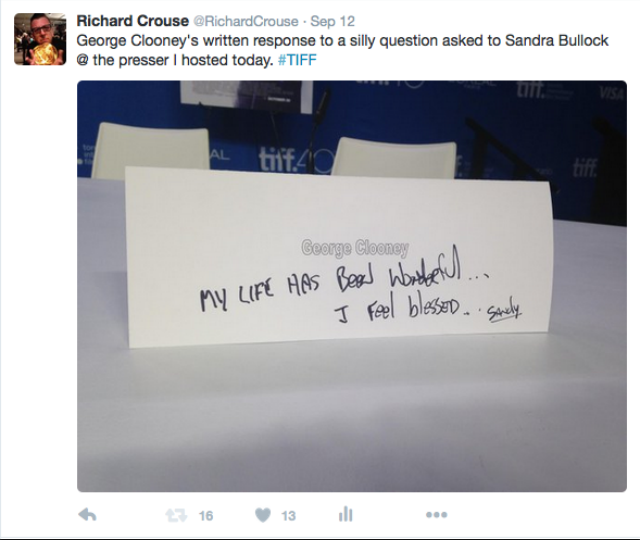
At the Our Brand is Crisis conference someone asked Bullock about her character’s grown-out roots. The Oscar winner replied as best she could and when she finished, Clooney chimed in, “Aren’t you glad you asked that question?”
Later she shut down a silly query regarding how she keeps her bum as toned as it is in the film. “It’s so sad that you just want to talk about the butt,” she said, before tersely adding that leg lifts are the secret to posterior pertness.
Not that the attendees are the only ones to pull a gaffe or two. During the Demolition conference, I asked Chris Cooper a long, rambling question about his character. He seemed genuinely perplexed, and you know what? I was, too. Sometimes you can overthink these things.
Later at The Martian presser, there were 13 people on the stage, everyone from Michael Pena to Damon, Scott, Chiwetel Ejiofor and Jessica Chastain, and in the shuffle I made the horrifying mistake of forgetting to ask the great Sean Bean a question and didn’t realize it until we were out of time.
Who doesn’t acknowledge Lord Eddard Stark?
Me, idiotically. Next year I promise to go to him first and frequently.