No one can play unlikable-with-a-hidden-heart-of-gold like Tom Hanks. Now in theatres, “A Man Called Otto,” is a sentimental Mean Old Man redemption movie that showcases the actor’s ability to transcend even the most predictable material.
When we first meet Otto Anderson (Hanks) he is the epitome of a grumpy old man. Recently retired, he spends his days making sure his neighbours in their suburban Pittsburgh, Pennsylvania cul de sac obey community rules. According to Otto, his neighbours are idiots who don’t recycle properly and never display their parking passes. “The whole neighbourhood is falling apart these days,” he grumbles.
The recent passing of his life-long love, wife Sonya (Rachel Keller), has made him bitter, angry at the world. “Nothing works,” he says at her grave site, “now that you’re gone.”
Lost and despondent, he makes several attempts to take his own life and join Sonya in the after world, but is interrupted by circumstance or the loud knocking on his front door by his new neighbours, a young, vivacious Mexican-American family, parents Marisol (Mariana Treviño) and Tommy (Manuel Garcia-Rulfo) and their adorable kids.
With new life on the street, Otto slowly lets his guard down, opening up to the possibility of living life without Sonya.
A mix of sadness and hope, of tears tempered by laughs, “A Man Called Otto’s” path is predictable, but elevated by its two central performances.
As Otto, Hanks is a man damaged by life. Hard knocks have dented him, tamping down his true nature. What is left is a hard shell, dinged by circumstance, but rather than go full-grump, Hanks allows his softer side to seep through. That’s the thing that makes Otto human and not a caricature, and Hanks’s well-established nice-guy reputation goes a long way to keeping us on Otto’s side.
The film’s beating heart, however, is Treviño as Marisol. As a counterbalance to Ottos’s curmudgeonly behaviour, she is empathy and kindness personified. She radiates warmth, and eventually melts Otto’s icy façade.
“A Man Called Otto,” a remake of the Swedish film “A Man Called Ove” from director Hannes Holm, is a tearjerking story of redemption that tries a bit too hard to strum the heartstrings, but, thanks to the performances, still manages to find resonate, emotional moments.
“Sicario,” Denis Villeneuve’s 2015 war on drugs movie, was a powerful look at a seemingly unwinnable battle and the toll it takes on its soldiers. Marked by tension and moral ambiguity, it wove complex quasi-morality and a sense of hopelessness into an edge of your seat story.
The new film, “Sicario: Day of the Soldado,” a sequel of sorts made without director Villeneuve or the ethical auras of Emily Blunt’s character, breathes similar air but is less nuanced. “Sicario” was an arthouse action film. The new one drops the art in favour of the action.
Josh Brolin and Benicio Del Toro return as CIA agent Matt Graver and assassin Alejandro Gillick. They are by-any-means-necessary black opps agents, tasked with creating chaos within the Mexican drug cartels after the president adds drug cartels to America’s list of terrorist organizations. Seems the drug lords have expanded from moving illegal substances across the border into the United States to importing humans.
Their plan is simple. Kidnap Isabela (Isabela Moner), a drug lord’s 16-year-old daughter, pin the blame on a rival, then sit back and watch the fireworks. “If you want to start a war,” says Graver, “kidnap a prince and the king will start it for you.”
Good plan, except it goes sideways when Isabela breaks free and hits the road. Gillick, who lost his family, including a young daughter, on the orders of Isabela’s drug lord father, rescues the youngster, stowing her in an out-of-the-way home where she becomes a pawn in a high stakes game.
Although the US-Mexico border plays a big role in “Sicario: Day of the Soldado” this isn’t a movie about a wall. Instead it’s a convoluted tale of corruption, fear, relationships, a young girl and the two men who change her life. For most of the running time it works well.
Brolin, the hardest working man at the box office this year, was born to play this amoral do-gooder. He’s a charming killer, a man who does what needs to be done, usually with a one liner and a gun. Like his other characters this summer, “Infinity War’s” Thanos and “Deadpool 2’s” Cable, he’s not above breaking the rules. Bingo. Few actors working right now could pull this off with the kind of steel jawed aplomb that oozes from his pores.
Ditto del Toro who brings an air of menace that positively drips off his perfectly sculpted cheekbones. He’s the boogeyman, a stone cold killer who lives on the edges of morality. This time around Gillick, however, has some softer edges, mostly due to his fondness for Isabela.
Herein lies the first bug-a-boo. When Gillick isn’t shooting people he’s displaying a warm and cuddly side looking after the well-being of the young girl. All of a sudden the guy who murdered kids in the last movie has a big heart. I guess it’s called character development but screenwriter Taylor Sheridan, who wrote the original, sets up an almost impossible situation involving a child. Big dollops of hopelessness and nihilism return from the first film but Isabela’s relationship with Gillick feels forced, like a plot point and not an organic narrative twist. The sense that director Stefano Sollima and Company are more interested in creating a franchise than staying true to the characters or making a statement about the mess at the US-Mexican border hangs heavy over the film, particularly in the final twenty minutes.
“Sicario: Day of the Soldado” is a wild ride until it stops making sense in the last reel. Cynicism and bleakness are still the name of the game but, strangely, Sollima and Sheridan take a u-turn near the end, pushing the limits of belief to create a platform for a sequel. It’s not a feel-good movie but it desperately tries to imitate one in its final moments.
Why did director Antoine Fuqua decide to remake the legendary 1960 western The Magnificent Seven? “I wanted to see Denzel Washington on a horse,” he jokes.
The story of seven men who come together to protect a town from a vicious robber baron looks back further than the 1960 film to the 1954 epic Japanese historical drama Seven Samurai. Often cited as one of the greatest films ever made, Akira Kurosawa’s Seven Samurai provided what Fuqua described as the DNA of his film, but he also noted, “Westerns change with the time we’re in, so we made our film based on the world we are living in.”
To that end he has assembled the most diverse cast for a western ever. In addition to top billed stars Washington, Chris Pratt, Ethan Hawke and Vincent D’Onofrio the seven magnificent leading actors include South Korean star Lee Byung-hun, the Mexican born Manuel Garcia-Rulfo and Martin Sensmeier, an American actor of Tlingit, Koyukon-Athabascan and Irish descent.
“You can’t do the same thing every era,” says Fuqua. “Westerns change all the time. If we were sticking to just one way of doing something then all westerns would be all white guys looking like John Wayne in a John Ford movie.”
“My idea was, if Denzel walks into a room, the room stops,” he says. “If Clint Eastwood walks into a room, the room stops. Is it because he’s a gunslinger or is it because of the colour of his skin? We’ll let the audience decide.”
When asked if The Magnificent Seven is proof that Hollywood is becoming more diverse the director says, “You have to give the studio credit when they do something like this. This becomes the new definition of what a western is.”
Chris Pratt, who plays gunslinger Josh Faraday says despite the film’s title The Magnificent Seven has more to do with another well known western.
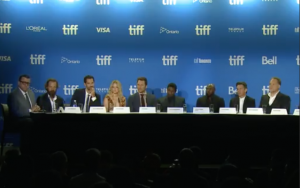
“I don’t know how many movies there are in the world,” he said at the TIFF opening night press conference. “What would you guess, several hundred thousand? Millions? Eventually you just run out of names. If I have a son and name him Chad, is he a remake of somebody else who was named Chad? No. We could have called this The Cowboys or something, but [The Magnificent Seven title] has reach,” he continued, “it gets people engaged. But [this movie] is probably more Wild Bunch than it is [1960’s] The Magnificent Seven. We use the title, we use the story. It’s a bunch of guys. There are seven of us. And we’re all [bleeping] magnificent. We’ve got that going for us, but let that movie be that movie. This is a different movie.”
Star Denzel Washington says he’s never seen the 1960 film. “I didn’t keep away from it,” he says. “I just didn’t know how it would help me. I had never seen it as a kid or whatever. People say, ‘You’re the so and so character,’ I don’t even know who that is. I think it allowed me to do whatever I wanted to do instead of trying to not do what someone else did.”
Why did he sign on? “Well, Antoine asked me. It’s as simple as that. Obviously, it’s a good story and a good script but most importantly it was Antoine.”
Director Antoine Fuqua’s remake of “The Magnificent Seven” literally starts with a bang.
A series of mine explosions echo through Rose Creek, signalling unrest in the tiny mining town. Bartholomew Bogue (Peter Sarsgaard) has taken over, terrorizing the town with hired goons. He’s a cruel man who guns down citizens and says to his henchmen, “Leave the bodies where they lie. Let them look at them for a few days.” Bad Bart wants the land but is only will to pay a pittance per parcel. “Those of you who signed the deeds will get your $20,” he sneers. “And those who don’t, God help you.”
The townsfolk are helpless. Bogue has killed a half dozen men and with the sheriff on his payroll will continue to do as he pleases. Fed up and recently widowed, Emma Cullen (Haley Bennett) turns to hired gun Sam Chisolm (Denzel Washington) for help. “You don’t need a bounty hunter,” he says, “you need an army.” Despite the massive odds against them Chisolm assembles a rag tag team of killers, gamblers and outlaws—Josh Farraday (Chris Pratt), Goodnight Robicheaux (Ethan Hawke), Jack Horne (Vincent D’Onofrio), Billy Rocks (Byung-hun Lee), Vasquez (Manuel Garcia-Rulfo), and Red Harvest (Martin Sensmeier)—to go up against the ruthless robber baron in what promises to be a better than OK gunfight at the corral.
“The Magnificent Seven” is a classic looking western with a modern pace. Fuqua chooses not to mess with the key oater elements. He papers the screen with acres of open land, seven tough men, one or two resilient women and a sea of cowboy hats. He is respectful to the form and doesn’t try to bring the genre into the twenty-first century with frenetic editing—I’m looking at you Timur “Ben-Hur” Bekmambetov—or contemporary language. It’s a western, with all that entails; good vs. evil with some moral ambiguity thrown in for good measure.
Also thrown in for good measure is a heap of star power. Washington is a cool character, quietly deadly. He says cool stuff—“Chisolm, should I know that name?” he’s asked. “You should know it from your obituary,” he replies.—and is the movie’s charismatic center. Chris Pratt’s easy charm gives Washington a run for his money, but this is really Denzel’s movie from top to bottom.
Hawke and D’Onofrio do interesting character work. As the shell-shocked Robicheaux Hawke is equal parts swagger and skittishness while D’Onofrio is practically unrecognizable as the squeaky-voiced Jack Horne.
The remaining member of the seven aren’t given much to do other than pull triggers and nod in agreement to Chisolm’s plans, but they are an interesting bunch nonetheless.
At a little over two hours “The Magnificent Seven” could be leaner and well, maybe not meaner—I would not be surprised if it had the highest body count in a western ever—but tighter. There is a mid-movie sag as the plans for the final shootout are being finalized but the ballet of bullets at the end is epic, if not a little excessive, putting a fitting cap on a story that is slight but entertaining for most of the running time.
Richard hosts the “Magnificent Seven” TIFF press conference with (from left to right) Richard, Peter Sarsgaard, Manuel Garcia-Rulfo, Haley Bennett, Chris Pratt, Denzel Washington, Antoine Fuqua, Ethan Hawke, Vincent D’Onofrio, Lee Byung-hun and Martin Sensmeier.