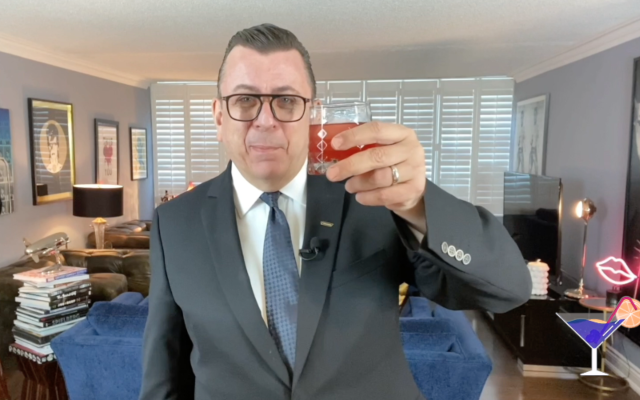
Fast reviews for busy lovers! Watch as I review three Valentine’s Day movies in less time than it takes to kiss your partner! Have a look as I race against Cupid to tell you about the obsessive “Wuthering Heights,” the supernatural love story “Eternity” and the scary romance of “Together.”
I join the CTV NewsChanel to talk about the reimagined “Wuthering Heights,” the time travelling farce “Nirvanna: The Band The Show The Movie” and the nostalgic b-movie “Cold Storage.”
SYNOPSIS: “Moor, moor, moor. How do you like it?” “Wuthering Heights,” a reimagined take on Emily Brontë’s grand gothic tale of bodice-ripping and obsessive love, stars Margot Robbie and Jacob Elordi as lovers with an unbreakable bond. “Love twisted by time. Desire that won’t die.”
CAST: Margot Robbie, Jacob Elordi, Hong Chau, Shazad Latif, Alison Oliver, Martin Clunes, Ewan Mitchell. Directed by Emerald Fennell.
REVIEW: More (or should that be “moor”) explicit than previous iterations of the Brontë classic, Emerald Fennell’s take on the story is a study in how obsessive love can lead to ruin.
Set in the late 1700s, Charlotte Mellington plays Catherine Earnshaw, the young, free-spirited daughter of Mr. Earnshaw (Martin Clunes), a booze-hound who brings home an illiterate, orphaned boy (“Adolescence” star Owen Cooper) from the city to the family’s decaying Yorkshire estate. She names him Heathcliff, after her dead brother, and they form a fast bond.
Cut to years later. Catherine and Heathcliff, now played by Margot Robbie and Jacob Elordi, are head over heels but Cathy desires the kind of social standing Heathcliff cannot provide.
Despite Heathcliff’s promise to “follow you like a dog to the end of the world,” she marries the refined gentleman Edgar Linton (Shazad Latif), a handsome rich man but without the intensity that defined her relationship with Heathcliff.
Rejected and devastated, Heathcliff leaves the only home and real love he has ever known, only to return five years later, wealthy and with revenge on this mind. “Why did you leave me?” she asks. “Why did you betray your own heart?” he replies.
Simply put, Emerald Fennell, the director of “Promising Young Woman” and “Saltburn,” has turned “Wuthering Heights” into something best described as a light “Fifty Shades of Bridgerton.”
Despite a reputation for pushing the envelope, Fennell seems restrained here, save for a brief scene of bizarre doggie-style degradation and the worst consent scene ever committed to film. Those moments are memorable for the kind of provocation and boundary-pushing we expect from the director. For much of the film’s runtime, however, she’s on a low simmer, stuck somewhere between the Brontë’s melancholic passion and the director’s usual decadent discomfort.
As the young Catherine and Heathcliffe, Charlotte Mellington and Owen Cooper provide a proper setup for the soul-deep connection to come. When the characters grow up Robbie and Elordi bring intensity but the heartfelt spark that lit the flame of passion years before is replaced by a romantic appetite that manifests itself in cruelty and muddled motivations.
At its most basic, Catherine and Heathcliffe straddle the thin line between love and hate, not an uncommon romantic position, but Fennell confusingly blurs the line into a gaping incoherent hole.
Robbie and Elordi look the part of impossibly beautiful star-crossed lovers, and they share chemistry, but their thirst for one another feels skin deep, even as it grows obsessive and destructive.
Like its stars, “Wuthering Heights” looks lovely—opulent interiors, moody moors—but the reimagination of Brontë’s novel feels lackluster, unable to truly grasp the passion or the tragedy inherent to the original story.
Those expecting “Barbie,” the new battle-of-the-sexes fantasy starring Margot Robbie as the titular doll, to be a two-hour advertisement for Mattel may be shocked to discover that it is actually an esoteric movie about what it means to be human. It’s Existential Crisis Barbie!
“Since the beginning of time,” intones narrator Helen Mirren, “since the first little girl ever existed, there have been dolls. But the dolls were always and forever baby dolls, until…” Barbie came along.
By design, the blonde plastic doll with arched feet and optimistic outlook, first introduced in 1959, could be and do anything. “Thanks to Barbie, all problems of inequity and feminism have been solved.”
At least that’s what “stereotypical” Barbie (Robbie) believes.
She lives in the fluorescent Barbieland, a feminine nirvana where “every day is the best day ever. So was yesterday, and so is tomorrow, and every day from now until forever.”
Barbies, like Robbie’s Barbie, and doctor Barbie (Hari Nef), Barbie with a Nobel Prize in physics (Emma Mackey), mermaid Barbie (Dua Lipa), Supreme Court Justice Barbie (Ana Cruz Kayne), president Barbie (Issa Rae), among many others, live in Dreamhouses, without a care in the world.
Along for the ride are Barbie’s platonic friends, the Kens (played by Kinglsey Ben-Adir, Scott Evans, Simu Liu, and Ncuti Gatwa). Barbie may have a great day every day, but lovesick Beach Ken (Ryan Gosling), only has a great day when Barbie looks at him.
It’s mostly all sunshine and dance parties in the candy-colored Barbieland, but lately Barbie is troubled. “Do you ever think about dying?” she wonders aloud.
Just as disturbing, after a fall, her arched feet, perfectly suited to the extra high heels she always wears, have gone flat. “Some things have happened that might be related,” she says. “Cold shower. Falling off my roof. And my heels are on the ground.”
Turns out, there is a rift in the time and space continuum between the doll and the real world. Barbieland’s elder, Weird Barbie (Kate McKinnon), advises Barbie that the only way to resolve her creeping ennui is to visit to the real world and find the little girl who is playing with her. The two are inexplicably intertwined. If the girl is sad, it could be rubbing off on Barbie.
“I’ll be back in no time with perfect feet,” she says, “and it will be like nothing happened.”
Transported to Venice Beach, the real world isn’t exactly what Barbie, and Ken who eagerly tagged along, expected. “No one rests until that Barbie is back in the box,” orders the Mattel CEO (Will Ferrell).
Unlike the doll that inspired the movie, “Barbie” has a big, beating heart. A study in what it means to be alive, to be a woman, feminism, patriarchy and toxic masculinity, it is a hilarious and humanist social satire that may win a world record for the use of the word “patriarchy” on film.
Director Greta Gerwig, who co-wrote the script along with Noah “The Squid and the Whale” Baumbach, takes a maximalist approach in creating Barbie’s thermonuclearly pink world. It’s a perky and playful take on her life, like a Barbie Dreamhome brought to magical life. It leans heavily into Mattel lore and is sure to stoke feelings of nostalgia for Barbie-heads. “I’m the Barbie you think of when someone says ‘Barbie,’” she says.
But as Barbie leaves behind the superficial life she knew before, her head fills with something unfamiliar; a flood of feelings. Her exposure to subjugation and objectification in a world opposite of the feminist utopia of Barbieland—“Basically everything men do in your world,” she says, “women do in mine.”—has a profound effect on her self-identification. She may still dress like “Hot Skatin’ Barbie” but her outlook has changed, she now craves meaning in her life, to understand who she really is.
Robbie brings breathes life into Barbie’s journey in a fully committed performance that is often as hilarious as it heartfelt. In a more comedic role, Gosling steals the picture as Ken, a soppy, dim-witted guy whose exploration of misogyny takes up much of the film’s last half.
“Barbie” is not your typical summer blockbuster, or your regular toy-based movie. It is both those things, of course, but it somehow finds a way to push back and be its own plastic and political thing. It has both style and substance, and while its story may get overactive and muddled in its last reel, Gerwig’s point of view on gender roles and the way that women are treated in society pulls few punches.
For better and for worse, there is nothing quite like a Wes Anderson film. The director’s unique production design is all over his new sci fi comedy “Asteroid City,” but with this film it is clear that whimsy has finally replaced storytelling on his to do list.
This is a twisty-turny one. Like a set of nesting dolls, it’s a film, within a play, within a show hosted by a Rod Sterling-esque talking head (Bryan Cranston), within a teleplay written by playwright Conrad Earp (Edward Norton).
The bulk of the “action” takes place in Asteroid City, a remote New Mexico desert town—population 87—where Steve Carell’s motel manager hosts a Junior Stargazer convention. Gifted kids and their parents from all over the state convene to showcase their incredible, and often outlandish, inventions.
It’s an interesting group that includes recently widowed war photographer Augie Steenbeck (Jason Schwartzman), father to “brainiac” Woodrow (Jake Ryan) and son-in-law to Stanley (Tom Hanks), movie star Midge Campbell (Scarlett Johansson) and the rough-n-tumble J.J. Kellogg (Liev Schreiber). Along for the ride are singing cowboy Montana (Rupert Friend), teacher June (Maya Hawke), Dr. Hickenlooper (Tilda Swinton) a scientist from the local observatory and the fast-talking Junior Stargazer awards judge, General Grif Gibson (Jeffrey Wright).
When the convention is interrupted by a visiting alien, the whole thing is locked down for a mandatory government quarantine.
Despite the quirky tone and Anderson’s trademarked stylistic choices, “Asteroid City” is a serious film, albeit one laced with a healthy dose of absurdism. A study in how people deal with grief, and the true nature of love, Anderson’s characters experience existential dilemmas, angst born of loss and dissatisfaction. Threats are posed by nuclear bombs and life from other planets unexpectedly dropping by to say hello and children wonder aloud what happens when we die. A shroud of melancholic anxiety hangs over the film, like a shroud, but Anderson’s staging of the film, the meta story within a story structure, obscures the movie’s deeper meanings under layers of style.
The cast, particularly Johansson and Hanks, bring focus to Anderson’s unfocussed story, and Carell, Cranston and briefly Goldblum are having fun, but it sometimes feels the surfeit of characters are there more to decorate the screen than to forward the story.
“Asteroid City” may delight long-time fans, but casual moviegoers or newcomers to the director’s oeuvre may find the film’s mannered obtuseness off kilter and off putting.
There is nothing modest about “Babylon,” the new three plus hour epic from “Whiplash” director Damian Chazelle, now playing in theatres. It is unapologetically epic in themes, in length and in sheer off-the-wall exuberance.
A multicharacter treatise on the movies and knowing when to leave the party, it is “Boogie Nights” by way of Fellini’s “Satyricon” with a dash of “Singin’ in the Rain” thrown in for good measure. Love it or hate it, and there are valid reasons for either response, it is audacious, chaotic, vulgar, and, like its leading lady, it always makes a scene.
The action begins in 1926 in Bel Air, then a dusty patch of dirt. Hollywood wannabe Manny Torres (Diego Calva) is an up-and-comer who’ll do almost anything to break into the film business. That includes the wrangling of full-sized elephant to be used as entertainment at a wild Hollywood party later that night. Pulled over by a cop who amusingly informs him, “You can’t drive an elephant without a permit,” the quick-thinking Manny talks his way out of a ticket and gets the job done.
Later, while working as security at the decadent bash, he meets Nellie LaRoy (Margot Robbie), a bombshell party girl with an attitude and a taste for cocaine and attention. “You don’t become a star,” she says. “You either are one, or you ain’t.”
She isn’t famous, but she is a star. To Manny she represents everything he aspires to be and it’s love at first sight. For Nellie it’s a chance to expose herself to the Hollywood elite and sure enough, her provocative wild child style catches the eye of a producer who hires her on the spot to replace an actress who overdosed at the party.
Meanwhile, as a live band, led by trumpeter Sidney Palmer (Jovan Adepo), blows the roof off the place, matinee idol Jack Conrad (Brad Pitt) splits with his third (Or maybe his fourth. Who’s counting anymore?) wife and is drowning his sorrows in champagne and cocktails.
As the music blares, the dancers dance, the drinkers drink, the touchers touch and the snorters snort. It’s a bacchanal, the kind of party that only could have existed before the invention of the cell phone camera and TMZ.
As the sun rises, the party breaks up. Nellie drives off, on her way to the studio to make her big screen debut, and Jack takes Manny under his wing, giving him a start in that business called show.
There is more. So much more, but “Babylon” is not a film that lends itself to a Coles Notes treatment. Put it this way, one of the stars fights a rattlesnake, surely the climax of a regular film, but in “Babylon,” there’s still two more hours of story to go.
Chazelle’s maximalist vision is gloriously off the hook. He fills the screen with overstuffed detail, creating an avalanche of images and ideas. It is, by times, unfocused and sloppy, and begins to “Babylon-and-on” near the end of the 3-hour and 15-minute runtime, but the sheer exuberance of it won me over.
A story of loving something that can’t love you back, whether it is the movies, a gig, drugs or a person, Chazelle weaves a complicated tale of the highest highs and lowest lows, of glitz, glamor and grime that examines the notion of stardom and what happens when times change.
Adversely affected by shifting tastes is former matinee idol Jack, played by current matinee idol Pitt. A king of early Hollywood, he’s a Douglas Fairbanks style action star who always gets the girl in the final reel. He believes in the power of the movies—“What I do means something,” he says earnestly.—to uplift people beginning to feel the sting of the Great Depression but as the sounds of Al Jolson’s voice begins to fill theatres, Jack is the last to realize his time at the top has passed.
Pitt finds a balance between comedy and tragedy in Jack’s character. When we first meet him, he’s a hedonistic Hollywood a-lister who embraces the town’s loose morality. Often drunk, frequently ridiculous, he’s never less than charming. As the good times evaporate and the industry he loves, and helped build, moves on without him, there is real pathos in his downfall.
“You thought the town needed you,” says gossip columnist Elinor St. John (Jean Smart). “It’s bigger than you.”
Robbie has a showier, if slightly less rich, character arc. Nellie is a rough and tumble Hollywood creature with a taste for cocaine and fame. Her rise and fall may be more predictable than Jack’s career collapse, but it is just as colorful. From all night coke binges to a vomit scene that brings to mind Mr. Creosote, she’s troubled and troubling, a person whose self-destructive motivations are only truly understood by herself. Robbie plays her as a brash and bold woman enabled by Hollywood, her youth and Manny’s unrequited love.
In a breakout performance Calva’s Manny begins his journey as an ambitious show business outlier. As he becomes an insider, Manny’s character becomes the avatar of the film’s theme of transformation.
Each of these main characters, including Adepo’s trumpet playing Sidney Palmer, are in flux. They are adrift in the winds of change, flailing about, at the mercy of public opinion and an ever-changing industry. Manny’s makeover is undoubtedly the biggest step up, mostly because he is the only character not living in the moment. “Everything is about to change,” he says after seeing “The Jazz Singer,” the first sound movie, and one of “Babylon’s” harbingers of transformation.
Pitt, Robbie, Calva, Adepo and a stacked list of supporting players, including Tobey Maguire, Olivia Wilde, Flea and “SNL’s” Chloe Fineman, among others, are given lots to do, but the real star is Chazelle. “Babylon” is big and sloppy, but Chazelle shoots for the moon in a way that few other recent films have dared.
“Amsterdam,” a quirky new film starring John David Washington, Margot Robbie and Christian Bale and now playing in theatres, is a convoluted story fueled by everything from fascism and birding to murder and music. If there ever was an example of a film that could have benefitted from the KISS rule, Keep It Simple Silly, this is it.
The madcap tale begins in 1933 New York City. WWI vet Dr. Burt Berendsen (Christian Bale), once a Park Avenue physician, he now runs a downtown clinic where he caters to the needs of soldiers who came back from the war broken and in pain.
When Berendsen and his best friend, fellow vet and lawyer Harold Woodsman (John David Washington), are hired by Liz Meekins (Taylor Swift), the daughter of their beloved commanding officer, to ascertain the cause of his death, they are drawn into a murder mystery involving secret organizations, ultra-rich industrialists and a crusty Marine played by Robert DeNiro.
In a flashback to the final days of WWI, we learn their backstory and meet Valerie (Margot Robbie), a nurse who treats their wounds, physically and mentally. As a trio, they swear allegiance to one another during an extended bohemian get-a-way in Amsterdam, a city that becomes a metaphor for freedom and friendship.
Reviewing “Amsterdam” stings. The production is first rate, from Academy Award nominated director David O. Russell, to the a-list cast to the ambitious script that attempts to link events of the past to today’s headlines. But, and this is what stings, the film is definitely less than the sum of its parts.
From the off-kilter tone, part screwball, part deadly serious, to the glacial pacing, which makes the already long two-hour-and-fifteen-minute running time seem much longer, and the script, which casts too wide a wide net in hope of catching something compelling, “Amsterdam” flails about, lost in its own ambition. This is the kind of story, it’s easy to imagine, the Coen Brothers could make look effortless, but Russell does not stick the landing.
He does, however, forward some lovely ideas about embracing kindness and the full experience of being alive, but even those are muddied by the inclusion of heavy-handed, and not particularly original, warnings about domestic terrorism and authoritarianism. Ideas get lost in a sea of exposition and narration, that not even these interesting actors can bring to life.
There may be an interesting story somewhere within “Amsterdam,” but it is hidden, lost in the movie’s epic ambitions.
I make the perfect cocktail to enjoy while watching Harley Quinn, Bloodsport and Peacemaker rampage through “The Suicide Squad.” Have a drink and a think about the movie with me!
The difference between the 2017 “Suicide Squad” film starring Will Smith and this weekend’s sequel, “The Suicide Squad,” goes far beyond adding the definite article to the title. I accused the first film of “trying to echo the very movies it should be an antidote to.” You know, the self-important, self-absorbed superhero blockbusters that forgot to unpack the fun along with the story. “The Suicide Squad,” now playing in theatres, has some social commentary but it doesn’t forget the fun. Or the violence, daddy issues or anthropomorphic weasel.
There’s a lot happening in “The Suicide Squad.”
At the beginning of the non-stop 132-minute rollercoaster ride, cold-blooded government official Amanda Waller (Viola Davis) offers a selection of the world’s worst criminals a deal. the Join Task Force X, a.k.a. the Suicide Squad, work for her and, and in exchange she’ll reduce their sentences at the notorious Belle Reve prison. Stray outside the job, however, and a chip inserted at the base of their skull will be detonated, ending the mission forever.
Signing on for the mission to invade the (fictional) South American republic of Corto Maltese and steal and destroy a piece of alien technology from evil scientist The Thinker (Peter Capaldi), are a motley crew of supervillains.
There’s assassin Bloodsport (Idris Elba), patriotic vigilante Peacemaker (John Cena) who will kill anything or anyone in the name of peace, the neurotic “experiment gone wrong” Polka-Dot Man (David Dastmalchian), the dumb-as-a-stump fish-human hybrid Prince Nanaue (Sylvester Stallone), the rodent loving thief Ratcatcher 2 (Daniela Melchior), the unhinged Captain Boomerang (Jai Courtney), crazed criminal and former psychiatrist Harley Quinn (Margot Robbie) and field leader Rick Flag (Joel Kinnaman).
Add to that TDK (Nathan Fillion), Weasel (Sean Gunn), Blackguard (Pete Davidson), Javelin (Flula Borg), Mongal (Mayling Ng) and Savant (Michael Rooker), and you have a dysfunctional “Brady Bunch” charged with saving the world, if a giant, telepathic alien starfish doesn’t get them first.
“The Suicide Squad” has many of the same features as a Marvel movie. The world is at stake, there’s an alien lifeform causing trouble, there’s villains and a team of outsiders with special skills who fight back. They may look the same on paper, and share blockbuster budgets, but DCEU’s “The Suicide Squad” is seedier; a sister from a different mister.
The kills are squishier and bloodier than anything seen in “The Avengers.” The sense of humour is more juvenile than “Thor: Ragnarok” and you’re not likely to find a cute rat with a backpack in “Black Widow.”
James Gunn has not forgotten his schlocky Troma Films roots. His resume includes a screenwriting credit for “Tromeo and Juliet,” and “The Suicide Squad” pays homage to “The Toxic Avenger.” That sensibility helps define the new Squad movie’s most memorable bits but Gunn also tempers the gross stuff with a certain kind of sweetness and some not-so-subtle social commentary.
When the characters aren’t in motion, kicking, shooting, punching, gouging or stabbing, they often engage in character work, explaining how and why life pushed them toward joining this unorthodox team. The stories are dysfunctional—being trapped in a box with live, hungry rats is the stuff of nightmares—but they create a bond between the Squad that is unexpected in a movie that, in the beginning anyway, values brutality more than empathy.
Built into the story of an invasion of another country are questions of US foreign policy and military integrity. Casting the likable John Cena as Peacemaker, a “hero” willing to do anything to protect his perceived ideology, is subversively brilliant. When one Squad member snarls, “Peacemaker… what a joke,” the line drips with meaning.
But don’t get the idea that “The Suicide Squad” has fallen prey to the foibles of the self-serious 2017 version. Gunn brings enough fun and absurd action to make the sonic overload of the second kick at the can equal parts silly and serious.
 Fast reviews for busy lovers! Watch as I review three Valentine’s Day movies in less time than it takes to kiss your partner! Have a look as I race against Cupid to tell you about the obsessive “Wuthering Heights,” the supernatural love story “Eternity” and the scary romance of “Together.”