Will James Bond (Daniel Craig) ever be happy? The dour superspy looks great in a tux, has saved the planet a dozen or more times and piloted invisible planes but despite his list of achievements, true happiness always seems to have eluded him.
In “No Time to Die,” however, it looks like Bond may have found a sweet spot in his life with his pretty love interest, Dr. Madeleine Swann (Léa Seydoux). But Craig’s fifth and final time as 007 isn’t all sunshine and roses as much as it is a requiem for a character who was shaped by trauma.
“No Time to Die,” now only playing in theatres, kicks off with a cold open unlike any other Bond beginning. Two decades ago, against a remote, icy Norwegian backdrop, the young daughter of a Spectre agent is orphaned when a masked murderer invades her home. “Your father killed my entire family,” he says between bullets. She survives, and twenty or so years later grows up to be Dr. Swann, psychotherapist and the only woman who can make James Bond smile.
On holiday in Materna, Italy, she encourages him to visit the grave of heartbreaker Vesper Lynd, and put her memory to rest. He does, and soon the idyll with his new girlfriend ends, literally blowing up in his face.
Convinced Swann has betrayed him, the superspy cuts her loose, vowing to never lay eyes on her again.
Cut to five years later. Bond is retired from MI6, but lured back into the game of international espionage when his friend and CIA field officer Felix Leiter (Jeffrey Wright) and associate Logan Ash (Billy Magnussen) ask him to help locate Valdo Obruche (David Dencik), a missing scientist working on a deadly DNA Nanobots weapon.
The job sees Bond square off with one of his greatest foes, Ernst Stavro Blofeld (Christoph Waltz) and revenge-thirsty terrorist Lyutsifer Safin (Rami Malek), a master in the art of asymmetric warfare.
“No Time to Die” shakes up the Bond formula while still offering most of what fans pay to see. There are exotic locations, some high-flying action and the odd 007 one-liner. They are embedded into the DNA of the franchise; character traits that have not been genetically edited out of the movie.
The womanizing, which was so much a part of the Bond folklore, is still there, but trimmed, and played for comic effect. In one instance Ana de Armas, whose appearance as CIA agent Paloma amounts to an extended cameo, charmingly closes the door on that aspect of the Bond legend. In a short but eventful scene, she almost steals the show, and leaves the audience wanting more.
What director Cary Joji Fukunaga, who co-wrote the script alongside Neal Purvis, Robert Wade, Phoebe Waller-Bridge and Scott Z. Burns, has done is add in a ponderous reevaluation of Craig’s years as Bond. Call backs abound to “Casino Royale,” “Quantum of Solace,” “Skyfall,” and “Spectre” and loose ends are tied into bows in in the film’s many Easter eggs. Much of that material is fan service as the fifteen-year Craig reign comes to a close. A shot of M’s (Judi Dench) portrait nods to Bond’s connection to her and Fukunaga reaches back to “Casino Royale” for a tribute to Felix “Brother from Langley” Leiter (Jeffrey Wright). It feels like a nice, respectful way to usher out one era and bring in the next, in whatever form that may take.
But “No Time to Die” is not simply a tip of the hat to the past. With an eye to the future, Fukunaga and Craig have fundamentally changed what a Bond movie is. As the only Bond actor to have an arc for his character, Craig didn’t simply put on Pierce Brosnan’s tux and carry on as so many of the previous actors have done. He took Bond to places he’s never been before, amping up the emotionality of the character as a person born out of trauma. He talks about having everything taken from him as a child, “before I was even in the fight.” For the first time in Bond history, 007 is feeling the ticking of the clock, and not the timer on a bomb he’s trying to diffuse, but the metaphorical hands of time tightening around him.
This approach effectively changes “No Time to Die’s” dynamic, from action film to soul-searching character drama. The 163-minute running time allows the characters to explore why and how they landed where they did in life, but it also sucks much of the urgency from the storytelling. Add to that Malek’s Safin, a clichéd villain who really should make a larger impact, and the drama necessary to shake that martini is lessened.
There is #NoTimeForSpoilers in this review but suffice to say, “No Time to Die” is a Bond film unlike any other. Craig leaves the franchise having made the biggest impact on the character since Sean Connery set the rules more than half a century ago. His finale is drawn out and may rely too heavily on pop psychologically but it’s an important film in the Bond canon. It may even be the most important and exciting since “Dr. No.” Why? Because, as an on-screen card promises, “James Bond will return,” but the movie gives us no hint as to what that re-invented future will entail and that, after almost sixty years of a steady diet of 007isms, is “No Time to Die’s” most exciting achievement.
“Chicago 10,” a documentary that echoes the events detailed in the recent Netflix drama “The Trial of the Chicago 7,” brings a sense of immediacy and even anarchy to an often-told story.
Director Brett Morgen uses mixed media, a amalgamate of archival footage and animation set to a soundtrack of edgy protest music, to tell the tale of one of the defining events of 1968. In an unsettled and unsettling year, a trial saw 60s counterculture icons Abbie Hoffman and Jerry Rubin of the Youth International Party, and assorted radicals David Dellinger, Tom Hayden, Rennie Davis, John Froines, and Lee Weiner charged with conspiracy and inciting to riot stemming from their actions at the anti-Vietnam War protests in Chicago, Illinois, during the 1968 Democratic National Convention. Black Panther Bobby Seale had his case severed from the others but earns considerable coverage here.
The story, based on transcripts and rediscovered audio recordings, is familiar but Morgen’s film is as much an experience as it is a straightforward documentary. His mix and match of styles brings with it an energy that captures the wild ‘n woolly climate of the times, from the hippies and the Yippies to the general atmosphere in Chicago. It’s trippy with a vibrant social awareness that side steps many of the cliches used in portraying the times.
“Chicago 10” is a digital release as part of the Impact Series.
Based on “Secrecy World: Inside the Panama Papers Investigation of Illicit Money Networks and the Global Elite” by Jake Bernstein “The Laundromat” chronicles the rot that festers on the corrupt body of our financial institutions.
Divided into chapters with names like “Secret Number One: The Meek Are Screwed,” “The Laundromat” is a funny, star-studded portmanteau of thematically linked stories involving tax loopholes, exploitation and financial malfeasance. “All these stories are about money,” says Ramón Fonseca (Antonio Banderas), “the secret lives of money.” Like “The Big Short” it takes the spoonful-of-sugar-to-help-the-medicine-go-down approach to telling a story so dripping with bile you have to laugh to stop from crying.
Meryl Streep is at the helm of this cinematic op-ed playing Ellen Martin, a steely woman whose husband’s death leads her by the nose into the world of fake insurance policies and a shady Panama City law firm run by slicksters Jürgen Mossack (Gary Oldman) and Fonseca. The flamboyant represent “drug lords, sex traffickers and destroyers of the planet” and also colorfully narrate the action. “Tax avoidance and tax evasion,” says Mossack. “The line between them is as thin as a jailhouse wall.” They’re more interested in the shell companies they control that help line the pockets of their very wealthy clients than the regular Joes affected by their actions. “Bad is such a big word for such a small word.”
As the story splinters into chapters, cameos from Jeffrey Wright (as a secretive insurance broker), Nonso Anozie (as a billionaire who tries to buy his way out of trouble) and David Schwimmer (as a business person screwed by his insurance company) pile up, revealing personal aspects of the dirty business of money laundering. The story wanders here and there but Streep stays on course, lending this ragged movie a strong emotional core.
“The Laundromat” features lively performances—I’m looking at you Oldman and Banderas—timely commentary about whistleblowers and fraud and a rousing fourth-wall-breaking ending and yet, feels like less than the sum of its parts. Director Steven Soderbergh provides some well-crafted big moments but the stories are too far flung and too brief to inspire any real interest in the characters. They come and go with little development (save for Martin), often representing ideas rather than fully formed characters.
Streep plays a double role, an ill-advised choice that feels like a stunt and doesn’t lend much to the telling of the tale, but wraps things up with a wake-up call, asking basic questions—Who is accountable? Where and how do you get justice?—that put a period on this story but should be a starting point for more discussion and thought.
“The Goldfinch” is a sprawling movie based on a Pulitzer Prize for Fiction winning novel by Donna Tartt. Like the book, the film, starring Ansel Elgort, spans years and is stuffed with colourful characters. Also, like the book, it could be described as Dickensian, given its study of social status, unrequited love and the topper, abused orphans. But the film, despite the ample plotting, is really about something simple, how the beauty of great art can give life meaning.
The action begins when Theo Decker (Oakes Fegley) is 13 years old. He and his mother are spending an afternoon at the Metropolitan Museum of Art in New York before an appointment with his school principal. They look at some of mom’s favorite paintings, Rembrandt’s “The Anatomy Lesson of Dr. Nicolaes Tulp” before becoming separated. From the next room Theo hears a panic, then an explosion. He survived the blast but his mother was killed and he has always felt responsible for her death.
Throughout his eventful life, from being almost-adopted by a wealthy Upper West Side family, and re-connecting with his errant father (Luke Wilson) to becoming fast friends with a sketchy neighbour (Finn Wolfhard as a teen, Aneurin Barnard as an adult) and carrying a torch for Pippa (Ashleigh Cummings) another explosion survivor, his constant companion is a “The Goldfinch,” a valuable painting by Dutch painter Carel Fabritius he took from the blast site. Moving from place to place, state to state, it was a carefully wrapped reminder of the worst day of his life.
“The Goldfinch” is respectful of its source material. The book is an epic exercise in storytelling, twisting and turning its way through Theo’s life, exploring all the dark nooks and crannies. Flashing forward and back the film also takes time in allowing us to form a connection with Theo and the guilt he wears like a badge. As an adult, played by Elgort, a veneer of charm hides his inner turmoil and heavy drug use. While it is interesting to see Theo navigate these choppy waters the heart of the film lies in young Theo.
Fegley, best known for his touching work in “Pete’s Dragon,” inspires pure empathy, playing the youngster as someone trying to take control of a life he has no control over. He’s a victim of circumstance as much as his mother is, but his curse is that he must go on, burdened by the past. Fegley reveals layers. In a standout performance, he’s simultaneously a kid and an old soul.
“The Goldfinch” swings for the fences but doesn’t quite hit a home run. The expansive story takes one or two strange turns too many and feels stretched in its final half-hour but is bolstered by tremendous performances courtesy of the ensemble, with Fegley, Kidman, Jeffrey Wright and Luke Wilson leading the pack.
Emilio Estevez became a Brat Pack star hanging around in a library in 1985’s “The Breakfast Club.” Years later he returns, this time as a grown up with grown up concerns. As writer-director-producer-star of “The Public” Estevez presents the socially aware story of what happens when people stand up for themselves and speak truth to power.
“The Public” sees Estevez play Stuart Goodson, head librarian and de facto social worker at the Cincinnati Public Library. Inside the library is an oasis of warmth for the city’s homeless community who use it as a drop in centre during the cold winter months. Outside, when the frigid weather claims one of the library regulars, the patrons, led by Jackson (Michael K. Williams), turn the building into an emergency homeless shelter. “There’s some situation at the central library,” says Detective Bill Ramstead (Alec Baldwin). “Probably somebody had a melt down over an overdue book.”
Behind the scenes the stand-off escalates as the sensationalist media, in the form of a TV news reporter played by Gabrielle Union, misrepresents the act of civil disobedience as a possible hostage situation or active shooter. A self-righteous mayoral candidate (Christian Slater) stokes the fire while library administrator Anderson (Jeffrey Wright) tries to keep the situation from boiling over. “Wat’s the downside to having them stay there for the evening,” he asks.
“The Public” takes a long hard look at pressing social concerns. Estevez based part of this story on a Chip Ward essay about public libraries as asylums for the homeless and drives home the point with all the subtlety of one of Cincinnati’s icy winters. Lack of shelter space for the homeless population coupled with governmental cutbacks to social programs are urgent needs brought to life here in a colorful if somewhat cliched way.
The idea that, as Anderson says, public libraries are the last bastion of democracy, truly a place for everyone and anyone, is an important one but delivered with a heavy hand. By the time Goodson reads a long excerpt from “The Grapes of Wrath” to a reporter the noble efforts of the screenplay give way to the stagier aspects of Estevez’s vision.
“The Public” features good performances from Slater, Baldwin, Estevez and Taylor Schilling as a flirtatious building manager but is weighted down by the burden of its good intentions.
“Game Night” is a new thriller comedy with Jason Bateman that is more comedy than actual thriller.
Bateman and Rachel McAdams are Max and Annie, two competitive people who meet at a trivia night, bond over obscure “Teletubbies” facts, fall in love and get married. They’re so into games they even play Just Dance at the wedding reception.
Cut to a couple of years later. They are comfortably tucked away in the suburbs and hosting weekly game nights with friends, the dimwitted Ryan (Billy Magnussen) and long time couple Kevin and Sarah (Lamorne Morris and Hamilton, Ontario-born Kylie Bunbury). They used to invite neighbours Debbie and Gary (Jesse Plemons), but since Debbie moved out they take great pains to ensure that Gary, a creepy cop, doesn’t find out about their get-togethers.
On a personal level they’re trying to have a baby, but it isn’t going well. Their doctor (Camille Chen) thinks stress is making it impossible for them to conceive. The source? Max’s brother Brooks (Kyle Chandler), a good looking, venture capitalist who loves to flaunt his wealth. “He’s like the Mark Wahlberg to Max’s Donnie,” says Ryan.
When Brooks rolls into town, driving Max’s dream car, a vintage Stingray, he throws a special game night at his new, rented mansion. With no Risk, Scrabble or Monopoly in sight, the regular gamers gather for a murder mystery party. The winner gets the Stingray. “This will be a game night to remember,” Brooks says.
When the murder mystery turns into a real kidnapping the game players are sucked into a world of intrigue as they have to solve the “game.“ Seems there’s more to Brooks than meets the eye. “I can’t believe your brother has been lying to us this whole time,” guffaws Ryan. “He’s even cooler than I thought.”
This isn’t a Hitchcock movie. There’s no real mystery in “Game Night,” just some twists and turns and engaging performances from a cast game to have fun. It’s more about spending time with the characters on their wild night out.
Much of the humour comes from the casual back-and-forth between Bateman and McAdams. They interact like an old married couple, not people in a bad situation. Bateman is a natural at this kind of deadpan comedy and McAdams, who generally features in dramas, keeps pace. Their chemistry is one of the reasons this slight comedy works as well as it does.
Magnussen, who plays a likable dim bulb, and Morris and Bunbury who work their way through a mystery of their own making aid the above-the-title stars. The biggest surprise and certainly the film’s oddest performance belongs to Plemons. Best known for his work on “Breaking Bad” and “Fargo,” he mixes deadpan delivery with a thousand-yard-stare that is as unnerving as it is funny.
“Game Night” isn’t slap your knee funny but it is an amiable enough comedy that makes up in charm what it lacks in procedural thrills.
What would happen if, 65 million years ago, the meteor that killed the dinosaurs missed the earth, leaving the behemoths alive to thrive? The new Pixar-child-in-peril movie “The Good Dinosaur” suggests the apatosauruses would have created a modern stone age world for themselves where they speak, work and live in huts but most of all try to make a mark on the world.
At the beginning of the movie Arlo (Raymond Ochoa) is the runt of the litter. His older brother and sister (Marcus Scribner and Maleah Padilla) are bigger, more accomplished and unlike his siblings the knobby-kneed Arlo is a bit of a fraidy-cat. When his father (Jeffrey Wright) (SPOILER ALERT!) is killed Arlo is left stranded far from home and must learn to survive. He’s alone except for a feral boy (Jack Bright) who starts off as a thorn in Arlo’s side but quickly becomes a trusted friend who helps the young dino overcome his fears and make his mark.
“The Good Dinosaur” takes place before the invention of the wheel, which perhaps explains why Pixar did not reinvent the wheel here story wise. It’s all about learning valuable lie lessons, dealing with loss and the power of friendship, all well-worn Disney themes.
What is different, and exciting, is the execution. Pixar paints a beautiful portrait of the prehistoric world, complete with interesting character design—imagine a cobra with legs—and stunning landscapes. It’s easily the most eye-catching of Pixar’s films, creating a whole world for Arlo and his family to exist in.
As predictable as the story may be, “The Good Dinosaur” does shake it up with several surreal sidebars. Much of the film takes the form of a road trip as the duo make their way back to Arlo’s home. Along the way they meet an anxious rhino who gathers a menagerie of animals to shield him from danger, the elements and even his “unrealistic goals,” and later eat rotting fruit that triggers what must be the most hallucinogenic episode ever in a kid’s film. These idylls are a nice distraction from the tried-and-true story but also allow the filmmakers to exercise another of the movie’s strengths. For much of the film Arlo and the boy are on screen alone, interacting in near silence and with a minimum of dialogue manage to portray complex emotions and thoughts.
“The Good Dinosaur” contains a few intense circle-of-life scenes that may be too much for youngsters but also milks as much emotion from its simple story as possible. In Pixar’s world dinosaurs can cry… and just might make you shed a tear as well.
“I like to think of myself as a good actor,” says David Oyelowo, “but Martin Luther King, I ain’t.”
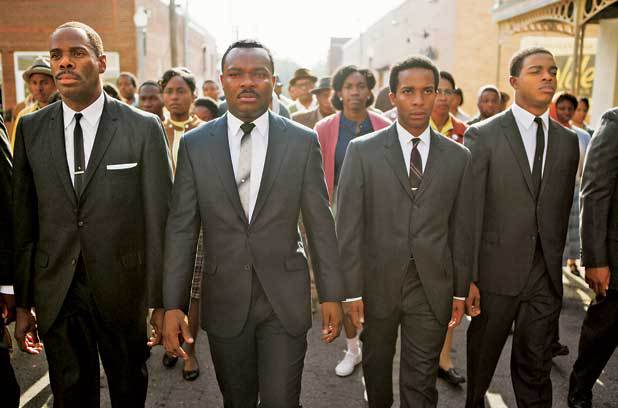
The 38-year-old British actor plays the venerated civil rights leader in Selma, a dramatic retelling of Dr. King’s 1965 Selma to Montgomery voting rights march.
It’s a stirring performance that has already earned him a Golden Globe nomination as Best Actor in a Drama. He admits he wasn’t a natural fit for the part— “I would never have cast me in this role, a British actor, having not done much work in Hollywood.”—but the film’s producer Oprah Winfrey (who also has a heart-wrenching cameo) said, “I can see King in you.”
The actor, best known for his work on the British TV show MI-5, told an audience at the AFI he always felt like he’d play King at some point. “Very soon after my wife and I moved to this country, I was told from above that I would play this role on the 24th of July, 2007. I couldn’t believe it, so I wrote it down.”
With the help of his higher power, Oprah, director Ava DuVernay, research and a weight gain of thirty pounds—eat lasagna late at night he says—Oyelowo found the character and won the blessing of Bernice King, Dr. King’s daughter. “It was huge for me to bridge that gap between the production and the family,” OIyelowo told The Daily Beast.
Martin Luther King III, son of Martin and Coretta Scott King, called Selma, “a very emotional experience,” and hopes that the film’s success will spur Hollywood interest in his father’s life, work and legacy.
Steven Spielberg is reportedly working on a biopic and a new German film called Schwarzkopf BRD features King in a study of racial politics in Berlin.
In more traditional films Dr. King has been portrayed by everyone from Paul Winfield, who earned an Emmy nomination for his performance in King, a three hour TV miniseries, to Jeffrey Wright in Boycott, to son Dexter King in The Rosa Parks Story.
King siblings, Dexter and Yolanda, collaborated with filmmakers Rob Smiley and Vincenzo Trippetti on the most unique retelling of their father’s life. Combining animation and historical footage, Our Friend, Martin is a time travel story about a student sent back in time to meet King at significant moments in his life. The hour long film is difficult to find but features wonderful vocal performances from Angela Bassett, LeVar Burton, Danny Glover, Oprah Winfrey, Whoopi Goldberg and Dexter King as his father at age 34.
I’m glad I saw the first “Hunger Games” movie because I’m not sure if I would have a clue as to what was going on if I didn’t have that background. I may have been taken in by the beautiful art direction, or Jennifer Lawrence’s intense performance, but I don’t think I would have been able to connect all the dots. Plot points become more obvious in the second hour, but for non-Hungerites it might be confusing.
If you haven’t seen the first movie, or read one of the 26 million copies of the book that are currently in print, here’s a glossary of terms to get you up to speed.
Katniss Everdeen: Sixteen year-old protagonist and citizen of District 12, a poor mining area in the dystopian nation of Panem.
Peeta Mellark: A baker’s son, who, according to Wikipedia has “extensive strength and cake decorating skills that contributed to the art of camouflage.”
Both are “tributes” chosen from the young people of District 12 and forced to participate in an annual Hunger Games, The Hunger Games, an annual televised event in which one teenaged boy and girl from each districts surrounding the Capitol are chosen by lottery to fight to the death until only one remains.
There’s more, but you’ll figure it out.
In the new film combatants and sweethearts Katniss (Jennifer Lawrence) and Peeta (Josh Hutcherson) have returned from the 74th Annual Hunger Games victorious to become the toast of the nation. While on a Victory Tour to Panem’s various downtrodden districts, revolution is in the air. They see Katniss as a symbol of freedom, which, of course, doesn’t sit well with President Snow (Donald Sutherland), the country’s autocratic leader. To quell the revolution he and his head gamesmaker (Philip Seymour Hoffman) devise the trickiest Hunger Games yet, the Quarter Quell that will pit former winners against one another in the battle to the death. If Snow gets his way Katniss will be killed and the revolution squashed.
“Hunger Games: Catching Fire” is a better movie than the first installment.
Set decorated and costumed (as played by Elizabeth Banks, District 12 minder Effie Trinket has the most elaborate futurist art deco costumes since “Metropolis”) to within an inch of its life, but has nonetheless has a gritty edge. It doesn’t feel like a budget big franchise movie and that’s a good thing,
Visually as well as thematically it has more edge than any of the recent Marvel movies. And it skirts around the thing that upset many people about the first movie—the idea of kids killing kids—by setting the action between former victors ranging in age from 20s to 70s.
It creates a world with it’s own rules, style and customs and does so convincingly. In part it’s comprised of things we’ve seen before in everything from the human sacrifices of Greek Mythology to reality television to stories of government corruption on the news, but author Suzanne Collins and director Francis “I Am legend” Lawrence tie it together to create something new.
In many ways it breaks the mold of what we expect from a young adult a blockbuster. The focus is on the characters and the underpinning of romance that snakes throughout the story. The action sequences are few and far between and it takes almost an hour before any of Katniss’s trademark bow-and-arrow dexterity comes into play. (Silly complaint: the number of arrows in her quiver changes from shot to shot! Just when you think she’s out, arrows magically appear.)
Sure there’s poison fog, angry animals and vicious victors but it’s about survival and relationships not the wholesale slaughter of the characters. It’s grim, shot in hues of grey with a perpetually overcast sky, which lends it a classic feel, more like 1970s sci fi than the brightly couloured eye catchers Hollywood makes these days.
“Hunger Games: Catching Fire” has a who’s who of a cast—Woody Harrelson, Lenny Kravitz, Jeffrey Wright, Stanley Tucci, Jena Malone, Brit heartthrob Sam Claflin and Amanda Plummer—who all perform well, lending some gravitas to the story, but it is carried by Lawrence whose vision for Katniss is as straight as an arrow.