In this mixed-up, shook-up world there are fewer and fewer things we can count on as absolutes. One of them is that there will be a new Woody Allen movie every year with a jaunty jazz soundtrack and credits written in the Windsor Light Condensed font. His new film, “Café Society,” the story of a frantic young romantic trying to find himself in 1930s Hollywood, is slice of comfort cinema with all of Allen’s trademarks intact.
Bobby Dorfman (Jesse Eisenberg) is a native New Yorker who jumped coasts to take up in Los Angeles. The slightly neurotic east coaster is not a natural fit in Tinsel Town, but his powerhouse uncle Phil (Steve Carell) helps out, giving him a job at his powerhouse talent agency and introducing him to a beautiful secretary named Vonnie (Kristen Stewart). By day he does odd jobs for Phil—“Menial errands are my specialty,” Bobby says, “but I don’t see a great future in it.”—while on the weekends he slowly falls for Vonnie. They share a disdain for industry talk and Hollywood’s catty innuendo and a love of cheap Mexican food but she doesn’t share his feelings. Unfortunately (for Bobby) Vonnie has a mostly absent boyfriend.
Enter romantic plot complications and Bobby hightails it back to New York where he goes into the nightclub business with his gangster brother Ben (Corey Stall). Finally successful, he marries and has a child with Veronica (Blake Lively), who he nicknames Vonnie, betraying the feelings he harbours for his west coast love. When Vonnie number one returns to New York for a visit the film offers up a line that sums the situation up, “Life is a comedy written by a sadistic comedy writer.”
A light-hearted tapestry, “Café Society” is embroidered with the odd punch line and hints of melancholy. It’s a comedy tinted with heartbreak, a look at true love and unsatisfactory options. It returns Allen to the fertile ground he ploughed with “Annie Hall” and “Manhattan” and while this film isn’t a classic on those terms, it’s an engaging look at life and love buoyed by great performances.
Eisenberg does the best Woody Allen impression we’ve seen on screen in some time, but there’s more to him than simply aping the master. His journey from nebbish to notable is believable and gives the movie its heart.
Co-star Stewart hands in what may be her first truly adult role. She plays Vonnie as level-headed in a sea of dreamers. When Bobby describes Joan Crawford as “larger-than-life” she replies, simply but compellingly, “I think I’d be happier life-sized.” It’s the line that sums up her character and Stewart makes the most of it and Vonnie.
“Café Society” is a welcome uptick after Allen’s last two films, “Magic in the Moonlight” and “Irrational Man.” For Woody’s fans it may feel familiar but in the most soothing of ways.
“The Big Short” is an infuriating movie. Not because it’s poorly made but because it is so well made. It takes years of banking bafflegab and distils it down to the essence in what may be the funniest, smartest and most maddening look at why America’s housing market crashed in 2008.
The films opens with a famous Mark Twain quote, “I’t ain’t what you don’t know that gets you into trouble. It’s what you know for sure that just ain’t so.” The quote is a bit of a Mobius strip but so is the story “The Big Short” is trying to tell.
Based on Michael Lewis‘ nonfiction best-seller of the same name, the film presents a cavalcade of facts and information formed into a story about how four investment-bankers—played by Christian Bale, Steve Carell, Finn Wittrock, John Magaro—saw the financial meltdown coming when no one else did. Taking on the arrogance of Wall Street’s old boy network, they bet against the American economy and, in the process, expose an unprecedented level of financial criminality.
“The Big Short” is a lighthearted look at a dire situation. Call it a dramedy. Director Adam McKay is best known for making movies like “Anchorman 2: The Legend Continues,” “The Other Guys,” “Step Brothers,” so he knows how to milk a laugh out of a scene. He also knows that the level of understanding the viewer needs to get why the housing bubble burst is above the level of most MBAs.
The movie explains that Wall Street likes to use confusing terms to make you think only they can understand what they do. “It’s like 2+2 = fish,” says one banker, expressing disbelief at the financial manipulations used by the big banks. To make the financial mumbo-jumbo sexy the McKay uses a variety of tricks, including cutting to Margot Robbie in a bubble bath explaining subprime loans in plain language. It’s a spoonful of sugar to help the expositional medicine go down. From the simple—one loan officer calls his clients “Ninjas, no income, no job.”—to the incredibly complex world of CDOs (collateralized debt obligations) “The Big Short” doesn’t shy away from tackling complex financial transactions but it never feels dry or forced. McKay is a showman, and layers the film with fourth-wall-breaking celebrity cameos and concise social commentary woven into the drama.
A great scene of Goldman Sachs executives laughing at Dr. Michael Burry’s (Christian Bale) $100 million investment is cut into a rap video celebrating excess. In one wordless scene McKay illustrates the arrogance of the bankers in the days before the rug was pulled out from underneath them.
Subtle it’s not, but the director’s use of pop culture images and music to set the scene goes a long way to establish a time, place and tone.
“The Big Short” features strong performances—Bale stretches in ways we haven’t seen from him before—but it is the film’s unflinching depiction of unbridled greed that will resonate.
Adam McKay is best known for directing broad comedies with Will Ferrell like Anchorman and Step Brothers. But his new film, The Big Short, is a different beast.
It’s the story of how four investment-bankers — played by Christian Bale, Steve Carell, Finn Wittrock and John Magaro — saw the devastating financial meltdown of 2007–10 coming when no one else did. It’s a lighthearted look at a dire situation. Call it a dramedy.
“When I read this book it did everything I wanted to see in a movie,” he says. “It was funny, it was tragic, and the characters were amazing. I think it was a case of running into one of the great books of the last 20 years that shows what is really going on in our modern world.”
McKay knows how to milk a laugh out of a scene but he also knows that the level of understanding the viewer needs to get why the housing bubble burst is above the level of most MBAs.
“It’s like 2 + 2 = fish,” says one banker, expressing disbelief at the financial manipulations used by the big banks. In the film he takes pains to explain how Wall Street likes to use confusing terms to make you think only they can understand what they do.
“We wanted to be the first Wall Street movie that took you behind the curtain, that really said, All these confusing terms you hear, all the ways the banks make you feel stupid or bored … it’s actually not that hard. If the guy who did Step Brothers can understand it you can too.
“We were trying to show that this thing that half of Wall Street doesn’t understand, these derivatives, mortgage backed securities, they’re actually pretty easy. They bundled a bunch of mortgages, they sold them, made a ton of money. Then they ran out of good mortgages so they put crappy mortgages in and coerced the ratings agencies to give them AAA. That’s it. That’s the whole story.”
McKay has an a-list cast but he didn’t want to make the movie all about the stars.
“It would have been very easy to just do this character story and just show these guys being affected by it but I wanted this thing to bridge a gap. I think there is too much stuff in our society where people just think, ‘Ahhh banking! It’s boring. Politics! Who cares?’ The truth is, this stuff is exciting, It’s the language of power. Once you get hooked on it, it gets addictive.”
The Big Short is a look at our recent past, but McKay warns this is not a historical drama or cautionary tale, rather it’s very much a going concern.
“All the effects of this collapse are still completely in play. All the same questions are still in play and they fixed a few things but they didn’t fix the main, weight bearing beam beams that caused this problem. So this is an active story right this second. That is one of the main reasons we made this movie, we want people to understand that. This isn’t over.”
Actress Phyllis Smith has had many jobs in and out of show business.
She was working as a casting associate when director Ken Kwapis fell in love with the way she read opposite the auditioning actors and cast her as Dunder Mifflin saleswoman Phyllis on The Office. She appeared on the hit show for nine years and just as that series wound down she got a call from Pixar.
Inside Out producer Jonas Rivera was flicking around the stations one night when he settled on Bad Teacher, a 2011 comedy co-starring Smith and Cameron Diaz. The raunchy film couldn’t be further afield of Pixar’s family friendly movies, but Rivera liked the sound of Smith’s voice. He knew she was the actor to play one of Inside Out’s main roles, the living embodiment of an emotion in an eleven-year-old girl’s head.
“He picked up the phone and called [director] Pete Docter and said, ‘I think I’ve found our Sadness,’” recalls Smith. “I guess it was the timidity in that scene and the timbre of my voice. That’s the nice thing about working for Pixar, when you get that call they pretty much already know what they want.”
Smith joins an all-star cast — Bill Hader, Lewis Black, Mindy Kaling and Amy Poehler as Fear, Anger, Disgust and Joy respectively — in a film that Variety called, “the greatest idea the toon studio [Pixar] has ever had.”
“Long after we’re gone people will still be watching,” Smith says. “Sort of like the Wizard of Oz.”
Smith, who is much more gregarious in person than her onscreen persona would suggest, is riding high today but it was a long circuitous route to television and film success.
“I started out as a professional dancer,” she says. “A show dancer. No stripping, but there were plumes, feathers, g-strings and all that. I was also in two ballet companies, a jazz company. That was my passion but I had an injury and knew logically it was time for me to make a switch in my career. I was getting older. So I just did what I had to do to pay my bills.”
She worked as a receptionist, an NFL cheerleader and manned the box office at a Los Angeles movie theatre. She dressed as Marilyn Monroe and played Steve Carell’s mother in a deleted scene from The 40-Year Old Virgin, but one job stands out for her.
“I worked for JC Penny in the warehouse tagging the merchandise,” she remembers. “I used to stand there and tag thousands of fishing lures or bowling balls or roller shades, which were heavy as heck to lift around. The people were great to work with but the merchandise was a little challenging.
“I used to stand there, thinking about life, wondering what it is we all have in common because we’re not all given the same opportunity. Some people’s health is impaired when they’re born while others are charmed with intelligence or looks. I thought, ‘There has to be something that we all have. A commonality.’ I figured out that it’s the ability to love. We all, in some form or another, want to love and be loved. That was my big revelation. My lightbulb moment. Also, if you’re standing on a concrete floor, make sure you’re wearing comfortable shoes or you’ll pay for it later.”
Bill Murray became a big screen superstar on the back of loose-limbed performances in comedies like Caddyshack, Stripes and Ghostbusters. By 1984, however, he was tiring of playing the clown and looking to do something with a bit more edge.
When director John Byrum gave him a copy of W. Somerset Maugham’s 1944 novel The Razor’s Edge, Murray responded the very next day. Calling the director at 4 am he said, “This is Larry, Larry Darrell,” dropping the name of the novel’s main character, an enigmatic man on a quest for spiritual fulfillment.
The resulting film bombed, with Roger Ebert suggesting Murray played “the hero as if fate is a comedian and he is the straight man.” Of course Murray has gone on to become a credible and in demand dramatic actor, but the story of a comedian’s rocky leap from farce to drama still rings true today.
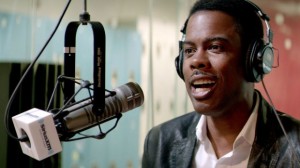
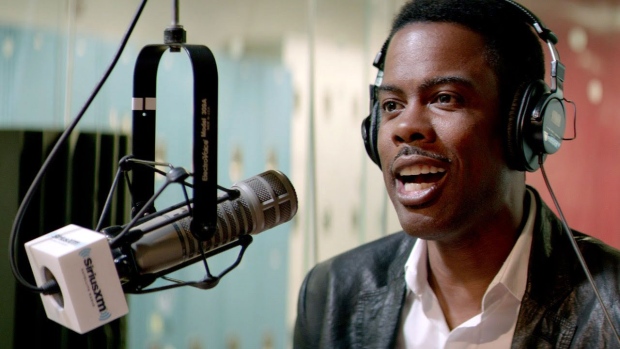
This weekend Chris Rock’s new comedy Top Five tells the story of Andre Allen, a fictional megastar trying to jump from silly comedies to Uprize, a serious drama about the slave revolt in Haiti.
Top Five is a new twist on an old story. Many comedians have tried to flick the switch from comedy to drama.
The late Robin Williams effortlessly hopped between genres. In 2002 alone he made three films, the lowbrow laffer Death to Smoochy, bookended by the psychodrama One Hour Photo and Christopher Nolan’s thriller Insomnia.
Will Ferrell, Steve Carell and Jonah Hill are best known for funny movies like Blades of Glory, The 40 Year-Old Virgin and Superbad, but each have stretched their dramatic muscles. Ferrell’s Stranger Than Fiction earned a good review from Roger Ebert who said Ferrell “has dramatic gifts to equal his comedic talent.” Carell’s new drama Foxcatcher looks poised to earn him notice at awards time and Jonah Hill is a two time Oscar nominee for heavyweights Moneyball and The Wolf of Wall Street.
Finally, think Jim Carrey and visions of talking butts and rubber-faced features come to mind but he made a serious run at being a serious actor. Perhaps he was pushed into more thoughtful work when his Batman Forever co-star Tommy Lee Jones told him, ‘I cannot sanction your buffoonery,” but whatever the case in movies like Man on the Moon, The Majestic and Eternal Sunshine of the Spotless Mind played it straight. “It’s going to be so hard to talk out of my ass after this,” he said when he won the Golden Globe for Best Actor award for The Truman Show, “but I’ll manage.”
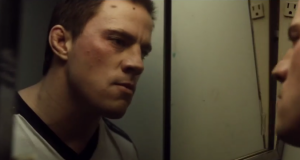
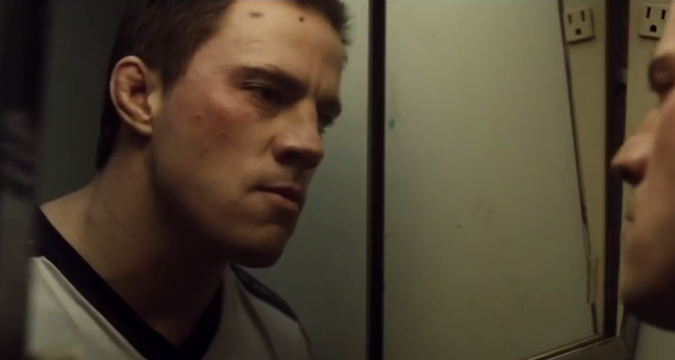
“I think I can comfortably say we were all very happy when the movie was over,” says Channing Tatum of making the crime drama Foxcatcher.
Based on a true story, the movie begins with former Olympian Mark Schultz, played by Tatum, training to regain the glory of his past achievements. When he accepts multi-millionaire John du Pont’s (Steve Carell) offer of sponsorship he begins a journey that will end in world championship glory and murder.
Director Bennett Miller wanted Foxcatcher to be the follow-up to his Oscar winning biopic Capote. When he first approached Tatum to play Schultz the muscle bound actor was best known as the eye candy in teen comedies like She’s the Man and dance movies like Step Up.
“I think the first time I read the script I just didn’t understand why you’d want to make the film,” he says. “There’s no resolve to any of this. No lesson learned. It’s way more complicated than that. It’s actually more close to life. It is a portrait of something that happened. I don’t think I was anywhere near to understanding the story or the character. I think I did a lot of growing in those seven years. I fell in love with this idea of attempting this.”
The actor threw himself into the role, studying wrestling, which he says is impossible to fake on screen—“It is just a melee but you get used to being inside that melee.”—and even destroying a hotel room in one powerful scene.
“I told them, ‘Whatever is in that room probably won’t come out not broken.’ That is all from Mark Schultz. He told me he would punish himself so badly after losing that he would make losing so much worse than any physical pain he was going through in the match so he would never want to lose again.”
He kept up that level of intensity for the whole shoot. “It just never stopped,” he said, not even when his wife, actress Jenna Dewan, came to visit.
“My wife was pregnant and she came to Pittsburgh during [the shoot],” he says. “She was supposed to stay a week but left after the second day. She was like, ‘Nope. It is not healthy for me to be here. You’re in a weird place. It’s OK but I’m just going to go now. Love you! Call me at least once a night before you go to bed and we’ll be fine.’”
If nothing g else “Foxcatcher,” a true-life crime drama from Bennett Miller, director of “Moneyball,” is an exercise in the transformative nature of an under bite. Jutting out his jaw changes Channing Tatum from movie star handsome to thick-necked gym rat Mark Schultz, one third of a story of murder and America’s wealthiest family.
Based on true events, the story begins with Schultz, a gold medal-winning wrestler at the 1984 Olympics, training with his brother David (Mark Ruffalo) to regain the glory of his past achievements. Out of the blue he is contacted by John du Pont (Steve Carell), multi-millionaire and sports enthusiast with a simple but grand offer. The patriotic du Pont asks Schultz to put together a team of wrestlers, who would train at a special facility at Foxcatcher Farms and establish America’s dominance at the upcoming Seoul Olympics. Schultz signs for $25,000 a year–“I just said the highest number in my head.”—beginning a journey that will end in world championship glory and murder.
Even though this is a true story that more or less follows the public record of events I’ve left the synopsis vague so as not to spoil the film’s climax. In doing so I also failed to mention the growing sense of alienation and the slow burn of psychological dysfunction. A pall hangs over the entire film, building toward the culmination of the action that is shocking not only in its randomness, but in its volume. Miller has made a quiet, restrained film, one that demands the viewer to lean forward to appreciate, so when three loud gunshots ring out they shatter the quiet in a jarringly effective depiction of violence.
But for as effective as that scene is, the build-up is demands patience. The leads are uniformly great—particularly Carell who, as a repressed man used to getting what he wants and winning, whether it is a world championship title or play wrestling at a party, hands in a career re-defining performance—but the studied precision of the direction bogs down the pacing. If Miller edited the VERY long pauses in the conversations between Mark and John he could have trimmed half-an-hour from the running time. Some will find the start-and-stop delivery adds to the film’s surreal feel, other will simply find it tedious.
“Foxcatcher” is buoyed by interesting, unexpected performances and an unnerving tone but adds little to the examination of the complex issues that lie at the center of the story. Unchecked privilege and moral decadence are on display but the underlying pathology of the piece remains a mystery.
Unsafe parenting. Reckless driving. A stoned teenager. No, it’s not the long awaited sequel to Larry Clark’s “Kids,” it’s the latest family fare from Disney.
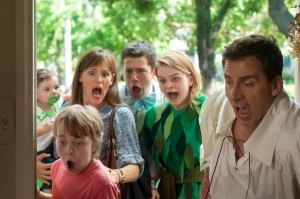
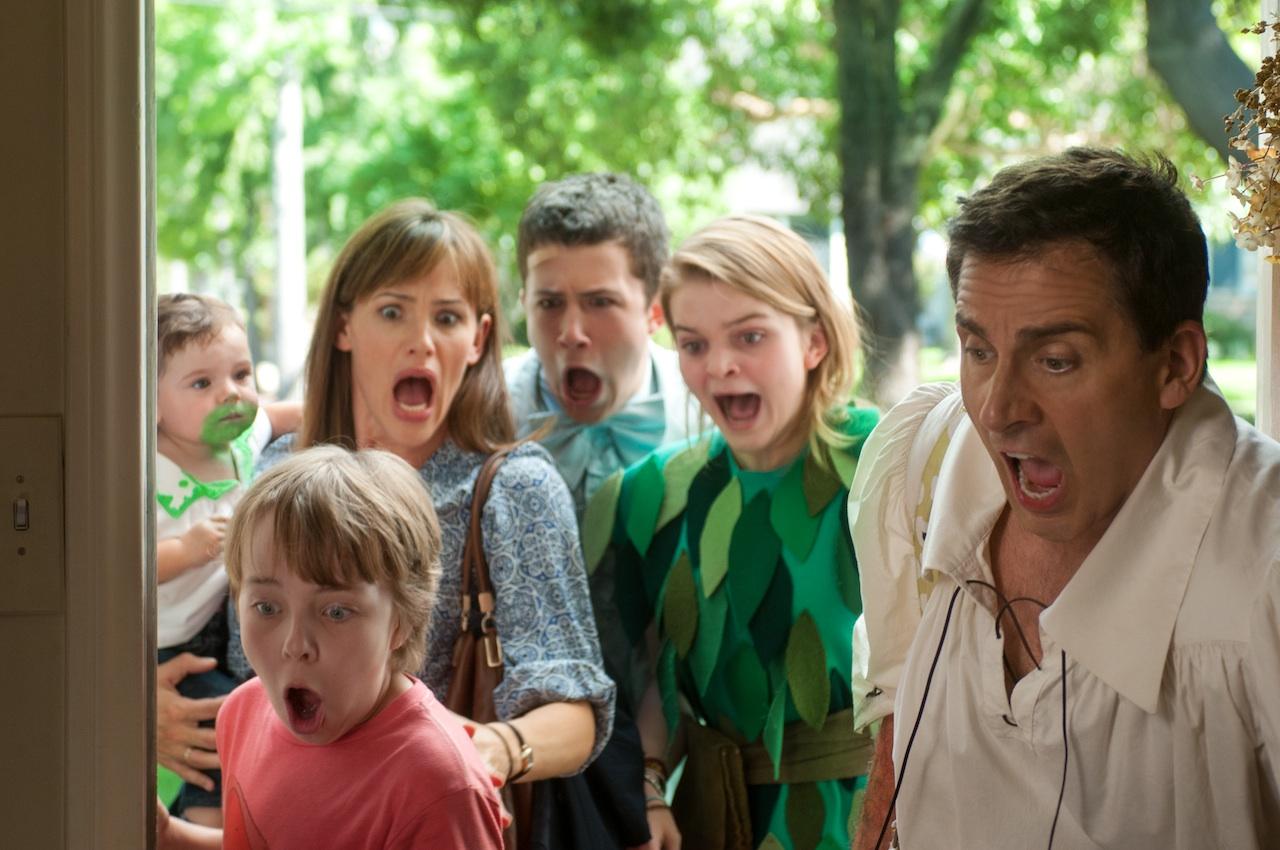
Alexander Cooper (Ed Oxenbould) is having a bad day. It’s the eve of his twelfth birthday and nothing is going right. He got gum stuck in his hair, he almost burns down the science lab at school and worst of all, no one is going to come to his birthday party because Phillip Parker, “a really cool kid with a hot tub and ADHD,” has scheduled a wild bash for the same night.
Things are going well for the rest of the family. Teen brother Anthony (Dylan Minnette) is taking the “hottest girl in school” to the prom and is about to get his driver’s license. Sister Emily (Kerris Dorsey) is about to star in a school production of “Peter Pan,” mom (Jennifer Garner) is due for a promotion and dad (Steve Carell) has a promising job interview.
Feeling down, Alexander makes a birthday wish. He wants everyone to know what it is like to have a “horrible, terrible, no good day.” Soon Emily gets a cold on the day of her performance, Anthony gets a zit and domestic chaos reigns.
The obvious joke to make about “Alexander and the Terrible, Horrible, No Good, Very Bad Day” would be to suggest that it should be retitled “Alexander and the Terrible, Horrible, No Good, Very Bad Movie.” But that would be disingenuous. It’s not terribly interesting, but it’s also not terrible, horrible, no good or very bad.
It’s gently paced family fare with a few genuine laughs and few surprises. Carell and Jennifer Garner are the most good-natured parents ever—when Emily vomits on dad after taking too much cough medicine he says, “Oh. I bet that felt good.”—and from that blossoms some funny situations and lines—“I’m going to need you to make an incredible effort on the potty tomorrow.”—but all are in service of the movie’s central theme that everybody has bad days.
Many of the situations don’t really feel organic. Instead they feel like set-ups to gags, outrageous filler—look Carell’s on fire!—to keep us interested until the inevitable happy ending.
Parents won’t find much to hold their attention in “Alexander and the Terrible, Horrible, No Good, Very Bad Day” but younger kids will likely get a kick out of the bad behavior on display. “Kids” it ain’t, although the Cooper children seem to get away with everything just short of murder.
It’s been ten years since we first met Ron Burgundy (Will Ferrell), a San Diego newscaster who claims he was put on earth to do two things, “have salon quality hair and read the news.” With his extreme news team—field reporter Brian Fantana (Paul Rudd), sportscaster Champ Kind (David Koechner) and bizarro weatherman Brick Tamland (Steve Carell)—he ruled the local airwaves.
This time around the stakes are much bigger. Relocated to New York City, Burgundy and company are set to change the face of news in a film that almost plays like a comedic version of “Network.” Almost… but not quite.
At the dawn of the 1980s Ron Burgundy’s best days seem to be behind him. His marriage implodes when his wife Veronica Corningstone (Christina Applegate) becomes the first female national news host. He hits the bottle, stops combing his perfect hair and it looks like his career is over until he’s recruited to join the anchor team at the newly formed Global News Network, the first 24-hour news channel.
He takes the job, but first insists on reuniting his old team, Blues Brothers style. With Champ, Brick and Brian on board they prepare to take New York by storm, but first they have to out do and out perform hot shot anchor Jack Lime (James Marsden).
Cobbling together a newscast made up of car chases, cat videos and Fox News style patriotism they inadvertently give birth to a new style of news.
As their ratings rise, so do questions of journalistic ethics. And that’s the first hour. Beyond that the movie is so demented I don’t want to give away any more plot points.
“Anchorman 2: The Legend Continues” brings with it a fair amount of goodwill. People love the original and the audience I saw the new one with laughed at almost everything that came out of Ferrell’s mouth.
For the first hour. Then the movie’s faults begin to show.
The opening sixty minutes feel like a worthy, although not quite as quotable, revisiting of the first movie. There’s nothing as memorable as, “I love scotch. Scotchy, scotch, scotch. Here it goes down, down into my belly…” but you’ll laugh, especially if you’re a fan of the original.
You’ll also laugh in the second hour, but it feels less like a film than a series of connected sketches. The plot veers around wildly, again delivering giggles, but in a rambling way that doesn’t feel like the first half. It tries hard to make a statement about early 1980s race relations and for a short while Ferrell channels his inner Howard Beale to comment on the erosion of the quality of news reporting.
Sounds more nuanced than it actually is. Despite the social commentary, this is still the kind of movie where Burgundy goes temporarily blind, hand feeds a baby shark and engages in hand-to-hand combat with rival news teams.
“Anchorman 2: The Legend Continues” is funny in an outrageous way. It’s a bit too long, (and don’t bother sitting through to the post credit scene unless you find the sight of Steve Carell eating cookies hilarious) but the buffoonery level is high in a season where serious drama seems to be the ticket.