Imagine a bar with an indoor lagoon. Now imagine that it rains, indoors every half hour. It’s not just a flight of fancy, it’s the Tonga Room, a classic restaurant and tiki bar in the Fairmont San Francisco hotel. Named after the South Pacific nation of Tonga, it is an eye-popping example of high-style Tiki that has been igniting the imaginations of customers for more than seventy five years.
Designed by Metro Goldwyn Mayer’s leading set director, it is the tropical paradise Anthony Bourdain called, “the greatest place in the history of the world.”
Learn about the invention of Tiki, the California Gold Rush and the Tonga Room HERE!
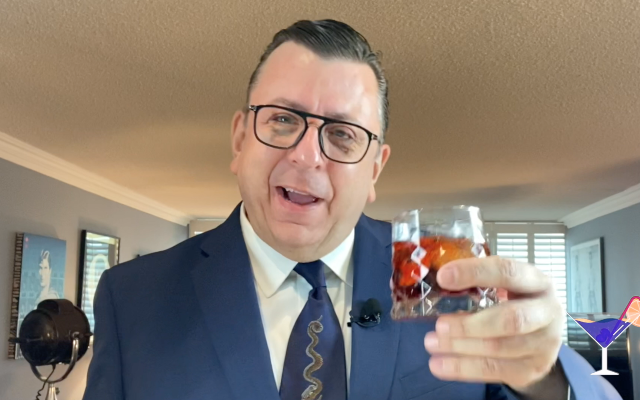
Richard makes a Negroni, the perfect cocktail to enjoy while watching the new documentary “Roadrunner: A Film About Anthony Bourdain.” Have Bourdain’s favourite drink and a think about “Roadrunner” with us!
In the opening moments of “Roadrunner: A Film About Anthony Bourdain,” a new documentary about the late television host and author, now playing in theatres, we hear the titular character’s voice state the obvious. “This does not have a happy ending,” he says.
For fans of Bourdain, the former heroin addict chef-turned-author-turned-television-star-turned-cultural-avatar, “Roadrunner” comes with high expectations.
The edgy but empathic Bourdain, who was 61 when he took his own life while shooting a television show in France, inspires strong feelings. A standard, hagiographic look at his life, rehashing the well-known details of his career, would be met with a collective yawn. Get too prickly and it might be seen as disrespectful to the memory of a man many still miss.
“Roadrunner” somehow straddles the line, providing a balanced overview of the scrappy chef’s personal and professional lives. Using outtakes from Bourdain’s shows “No Reservations,” “The Layover” and “Parts Unknown,” new interviews with friends and family and home footage, director Morgan “20 Feet from Stardom” Neville compiles a Russian nesting doll look of his subject.
What emerges is a deep dive into the life a complex man; a person who circled the globe dozens of times searching for meaning with every air mile point earned. “His whole personality was of a searcher,” says Alison Mosshart, the vocalist of The Kills and The Dead Weather. “He was always looking for something, and it was agony for him.”
Neville captures some of that agony, forcing the viewer to see familiar footage recontextualized by Bourdain’s co-workers and friends. With no shortage of material to choose from—Bourdain’s 250 days a year on the road were meticulously filmed and documented—Neville cherry picks moments that reveal the toll Bourdain’s schedule, celebrity and search for normalcy took.
Often the most revealing footage isn’t of the man speaking, but of the exhausted or melancholy look visible in his eyes as he performs for the camera. “Life was never going to measure up to how he pictured it,” says “Parts Unknown” segment producer Helen M. Cho. “He set himself up for disappointment.”
The circumstances of his death, of course, are investigated. His colleagues become tearful describing his last months as a lifelong addict who turned his addition to Italian actress and director Asia Argento. “Roadrunner” examines Bourdain’s final days but this isn’t a whodunnit or an exercise in pointing fingers. It’s a story about his life, not death.
“Roadrunner: A Film About Anthony Bourdain” provides an emotionally raw portrait of a gifted, charismatic man who travelled the world but never quite figured out where he needed to be. “You are not going to outrun or out smart pain,” comments artist David Choe, who provides the movie with a suitably Bourdain-esque ending.
Jeremiah Tower is the most famous celebrity chef you have never heard of.
Martha Stewart calls him “a father of the American cuisine.” Anthony Bourdain says he changed the world and Mario Batali calls him “the darling, the glamour puss, the sexy guy, the smart guy and the innovative chef that everybody wanted to know something about.”
The man himself, who pulled a D. B. Cooper style disappearing act at the height of his fame, after defining what an American restaurant could be says, “I have to stay away from human beings,” he says, “because somehow I am not one.”
A new documentary, “Jeremiah Tower: The Last Magnificent,” from director Lydia Tenaglia (and executive produced by Bourdain) aims to shed light on this enigma of man. “I’ve known Jeremiah for forty years,” says former Town and Country Magazine food and wine editor, James Villas, “and I am one of his oldest friends but I still don’t know Jeremiah.”
Born into wealth and privilege Tower had a troubled childhood with an alcoholic mother and a father he refers to as “a prick.”
“From early on food was my best pal, my companion,” he says. Trips to the world’s grandest hotels and voyages on ocean liners ignited a love of glamour—the Queen Mary, he says, “made me fall in love immediately with first class”—and restaurants. He read menus before he read books.
It was his mother’s elaborate garden parties that began his cooking career. His mother was usually drunk before the food was ready so he would help out, jumping into the kitchen to prepare the food.
At Harvard he studied architecture but spent much time seriously cooking for friends on a dorm hotplate. At school his friends encouraged him to get off his butt and join the 1960s youth revolution, but he was too busy cooking. It was there he created ideas about changing the culture through food. Cooking and the quest for a “utopian ideal of living” kept the darkness of his childhood from taking over.
After Harvard he was at loose ends. He had never worked and wasn’t interested in pursuing a career in architecture but had to get a job. He applied at Chez Panisse, a Berkeley, California resto Villas described as “a hippie, drug ridden explosion in a playpen.” “If I hadn’t been so broke I wouldn’t have paid attention,” he says.
As chef de cuisine he applied all he had learned eating around the world to the menu. Everything that had gone before in his life, the theatrics, the complexity, all of it, came into play and it became a sensation when he dropped the traditional French menu in favour of local California produce, dishes and wines. It was the match that started the fire of the new American cuisine revolution.
A fall out over credit with owner Alice Waters turned ugly. Refusing to become a footnote in the Chez Panisse story he left in a huff to create Stars, a San Francisco restaurant that would become a super nova and one of the top-grossing restaurants in the United States for years. Instead of going out to a movie after dinner, at Stars dinner was the entertainment. The success of the place made him a superstar, one of the first celebrity chefs.
In 1998 the place closed and he disappeared, leaving everyone behind.
Tower’s decades long exile ended in 2014 when out of the blue it was announced he would take over New York City’s legendary Tavern on the Green, a place Bourdain calls, “one of the biggest, most thankless operations going?” Why? Tower cites Proust, “Work while you still have the light,” he says. “I wanted to see if my light was still on.”
“Jeremiah Tower: The Last Magnificent” isn’t a food network special. There’s no cooking competitions or Top Five Moments in the Career of Jeremiah Tower. Instead we’re offered a methodical look at the man behind a foodie revolution. Like a chef who over perfumes everything with truffle oil, Tenaglia overuses recreations of Tower’s young life. The footage is stilted and overpowers the telling of the rebellious chef’s troubled childhood.
Archival footage from the well-documented Chez Panisse years onward is livelier, adding a badly needed you-are-there element to the film’s tale of food as an emotional crutch. But then, just as the film works up a head of steam Tenaglia skims over Tower’s decades out of the spotlight, picking up the story again when he lands in New York.
Still “Jeremiah Tower: The Last Magnificent” is a compelling watch thanks to its charismatic subject. In his mid-seventies Tower is as elegant as he is difficult. The film plays a little too heavily into the tortured chef cliché but since Tower had a hand in creating the cliché the movie gets a pass on that count. As the portrait of an enigma, it’s entertaining enough but despite the backstory, the recreations and the myriad of heavyweight talking heads, by the end credits Tower is still an enigma. Perhaps Bourdain sums it up best when he says, “there is a locked room inside Jeremiah, I haven’t been there, I don’t believe anyone has.”
George Clooney is a rare breed, a one-name film star. Mention “George” and everyone knows who you’re talking about.
He’s headlined a handful of films dating all the way back to when there was a Clinton in the White House that raked in north of $100 million. Since leaving the television show ER in 1999, he’s released two movies a year on average, including this weekend’s Money Monster, a thriller about the host of a financial advice show held hostage on live TV by an investor who lost everything.
Some of his films have been successful, others not, but it’s clear Clooney doesn’t aspire to be a blockbuster star. Perhaps it’s because George is, as Time called him, “the last movie star,” that he appears determined to smash what that kind of stardom means. By lending his name to offbeat movies he deconstructs the mechanism of superstardom.
George steers his career toward character driven pieces, often at the expense of giant box office numbers. And while the fabric of his fame may fray around the edges from time to time — he’s as susceptible to box office vagaries as anyone — he stays busy, winning Oscars, producing movies like August: Osage County and acting as pitchman for everyone from Fiat to Martini vermouth.
“I’m very aware of the fact that if not for a Thursday night time slot on ER, I wouldn’t have this career,” he once said, “so I’m going to push the limits as much as I can.”
From kid flicks to period dramas and political satire Clooney has done just that.
Loosely based on a Roald Dahl story, the stop-motion animated Fantastic Mr. Fox sees Clooney as a smooth-talking fox that returns to a life of crime after buying a tree house he can’t afford. Clooney brings charm, wit and warmth to an unpredictable character, smooth one minute, a wild animal the next.
Clooney also starred in The Good German, a tribute to 1940s cinema shot with technology from the golden age of Hollywood — the same lenses, the same atmospheric lighting, the same rat-a-tat-tat style of dialogue, the same everything. It’s a retro-looking film made with twenty-first century creative freedom. Clooney, as an American military journalist covering the Potsdam Conference in post-war Berlin, and co-star Cate Blanchett look like golden age movie stars but behave more like Brat Packers.
Strangest of all is The Men Who Stare at Goats, the best movie with the worst name on Clooney’s resume. He plays a psychic soldier in this screwball satire about the state of modern warfare. Its an absurdist film, filled with memorable images — Clooney staring down a goat, enlisted men doing the Watusi and a montage of Jeff Bridges embarking on a journey of enlightenment — where no joke is too broad or too barbed.
George is so artistically eclectic he even disowns one of his biggest hits. “I always apologize for Batman!” he says of the ludicrous Batman & Robin.
George Clooney looks like the kind of guy you could trust. Older, experienced, he seems trustworthy, brimming with advice you could take to the bank. I mean, if you’d buy Nespresso coffee because he told you to, why wouldn’t you take financial guidance as well? A new movie, “Money Monster,” uses that quality, Clooney’s charisma, as the cornerstone of a thriller about misplaced trust, mislaid money and attempted murder.
Clooney is Lee Gates, a loudmouth financial advisor who bellows about investing in stocks and saving for retirement on a live television show called “Money Monster.” Think “Mad Money with Jim Cramer” with just enough details changed to avoid lawsuits and you get the idea. Gates is a self-styled Wiz of Wall Street, a financial shock jock who starts each of his shows with a wild dance number.
Just as his Friday night broadcast is getting underway Kyle Budwell (Jack O’Connell), a jilted investor invades the studio and takes Gates, his crew, and producer Patty (Julia Roberts) hostage live on air. “Turn those cameras back on I’m going to shoot him in his head!” He trusted the TV oracle only to lose everything when a high-frequency trading company Gates endorsed called Ibis Clear Capital lost $800 million overnight, tanking the stock market. Kyle is convinced that Wall Street banks are stealing our money and our country and Gates is the emblem of the theft. “I may be the one with the gun,” he says, “but I’m not the criminal here.”
In real time over the next hour Gates learns the human cost of his actions as Kyle as the cameras broadcast every minute to a worldwide audience of millions.
Like the volatile stock market Gates chronicles on his fictional show, “Money Monster’s” story takes many unexpected twist and turns. Unexpected and, as the story unfolds, preposterous. Unable to decide whether it is an exposé of Wall Street’s dirty dealings—much of it breathes the same air as “The Big Short” minus the bubble baths and Anthony Bourdain—a humanist thriller or a comment on the remove we feel watching tragedy through a screen—“If Lee survives we got to get him on the show,” chirps one chat show host watching the action on a monitor—it blends all its ideas into a mushy concoction that is neither one thing or the other. Director Jodie Foster relies on clichés to move the story forward rather than trusting the ideas and rich vein of social commentary that could have been mined from the material. You can’t help but wonder what Sidney Lumet might have done with the same story.
Clooney does the best he can with a script that forces him to behave like a caricature. He’s believable as the cocky on-air host, less so when he has to transform that character into a vulnerable, real human being.
Roberts is trapped in a control room, barking orders through a headset for most of the film, bringing whatever charm there is to be had from a part that is essentially a conduit for information and she tries to unravel the film’s core “where did the money go?” mystery.
The third part of the triumvirate, O’Connell, plays confused/mad quite well, but again is saddled with a role that is dragged down with repetition.
Some of the supporting actors fare a little better, particularly Caitriona Balfe as the CCO who wants to do the right thing, if only she knew what the right thing was and Christopher Denham as a producer who will do anything to please Gates.
“This isn’t good Lee,” Patti says about the action unfolding in the studio. She could have been talking about “Money Monster,” a movie that feels like a missed opportunity to mix intimate life and death drama with an indictment of the wheelers and dealers who play hardball with our money.
“The Big Short” is an infuriating movie. Not because it’s poorly made but because it is so well made. It takes years of banking bafflegab and distils it down to the essence in what may be the funniest, smartest and most maddening look at why America’s housing market crashed in 2008.
The films opens with a famous Mark Twain quote, “I’t ain’t what you don’t know that gets you into trouble. It’s what you know for sure that just ain’t so.” The quote is a bit of a Mobius strip but so is the story “The Big Short” is trying to tell.
Based on Michael Lewis‘ nonfiction best-seller of the same name, the film presents a cavalcade of facts and information formed into a story about how four investment-bankers—played by Christian Bale, Steve Carell, Finn Wittrock, John Magaro—saw the financial meltdown coming when no one else did. Taking on the arrogance of Wall Street’s old boy network, they bet against the American economy and, in the process, expose an unprecedented level of financial criminality.
“The Big Short” is a lighthearted look at a dire situation. Call it a dramedy. Director Adam McKay is best known for making movies like “Anchorman 2: The Legend Continues,” “The Other Guys,” “Step Brothers,” so he knows how to milk a laugh out of a scene. He also knows that the level of understanding the viewer needs to get why the housing bubble burst is above the level of most MBAs.
The movie explains that Wall Street likes to use confusing terms to make you think only they can understand what they do. “It’s like 2+2 = fish,” says one banker, expressing disbelief at the financial manipulations used by the big banks. To make the financial mumbo-jumbo sexy the McKay uses a variety of tricks, including cutting to Margot Robbie in a bubble bath explaining subprime loans in plain language. It’s a spoonful of sugar to help the expositional medicine go down. From the simple—one loan officer calls his clients “Ninjas, no income, no job.”—to the incredibly complex world of CDOs (collateralized debt obligations) “The Big Short” doesn’t shy away from tackling complex financial transactions but it never feels dry or forced. McKay is a showman, and layers the film with fourth-wall-breaking celebrity cameos and concise social commentary woven into the drama.
A great scene of Goldman Sachs executives laughing at Dr. Michael Burry’s (Christian Bale) $100 million investment is cut into a rap video celebrating excess. In one wordless scene McKay illustrates the arrogance of the bankers in the days before the rug was pulled out from underneath them.
Subtle it’s not, but the director’s use of pop culture images and music to set the scene goes a long way to establish a time, place and tone.
“The Big Short” features strong performances—Bale stretches in ways we haven’t seen from him before—but it is the film’s unflinching depiction of unbridled greed that will resonate.
Adam McKay is best known for directing broad comedies with Will Ferrell like Anchorman and Step Brothers. But his new film, The Big Short, is a different beast.
It’s the story of how four investment-bankers — played by Christian Bale, Steve Carell, Finn Wittrock and John Magaro — saw the devastating financial meltdown of 2007–10 coming when no one else did. It’s a lighthearted look at a dire situation. Call it a dramedy.
“When I read this book it did everything I wanted to see in a movie,” he says. “It was funny, it was tragic, and the characters were amazing. I think it was a case of running into one of the great books of the last 20 years that shows what is really going on in our modern world.”
McKay knows how to milk a laugh out of a scene but he also knows that the level of understanding the viewer needs to get why the housing bubble burst is above the level of most MBAs.
“It’s like 2 + 2 = fish,” says one banker, expressing disbelief at the financial manipulations used by the big banks. In the film he takes pains to explain how Wall Street likes to use confusing terms to make you think only they can understand what they do.
“We wanted to be the first Wall Street movie that took you behind the curtain, that really said, All these confusing terms you hear, all the ways the banks make you feel stupid or bored … it’s actually not that hard. If the guy who did Step Brothers can understand it you can too.
“We were trying to show that this thing that half of Wall Street doesn’t understand, these derivatives, mortgage backed securities, they’re actually pretty easy. They bundled a bunch of mortgages, they sold them, made a ton of money. Then they ran out of good mortgages so they put crappy mortgages in and coerced the ratings agencies to give them AAA. That’s it. That’s the whole story.”
McKay has an a-list cast but he didn’t want to make the movie all about the stars.
“It would have been very easy to just do this character story and just show these guys being affected by it but I wanted this thing to bridge a gap. I think there is too much stuff in our society where people just think, ‘Ahhh banking! It’s boring. Politics! Who cares?’ The truth is, this stuff is exciting, It’s the language of power. Once you get hooked on it, it gets addictive.”
The Big Short is a look at our recent past, but McKay warns this is not a historical drama or cautionary tale, rather it’s very much a going concern.
“All the effects of this collapse are still completely in play. All the same questions are still in play and they fixed a few things but they didn’t fix the main, weight bearing beam beams that caused this problem. So this is an active story right this second. That is one of the main reasons we made this movie, we want people to understand that. This isn’t over.”
Chefs are the Food Network’s stock in trade. From Bobby Flay to Giada De Laurentiis, and Iron Chef to Top Chef, the delicious channel has created a cult of celebrity around the people who make our food.
A new film, Chef, takes a celebrity, actor Jon Favreau, and casts him as a restaurateur who has lost his way and desperately wants to reclaim his cooking cred.
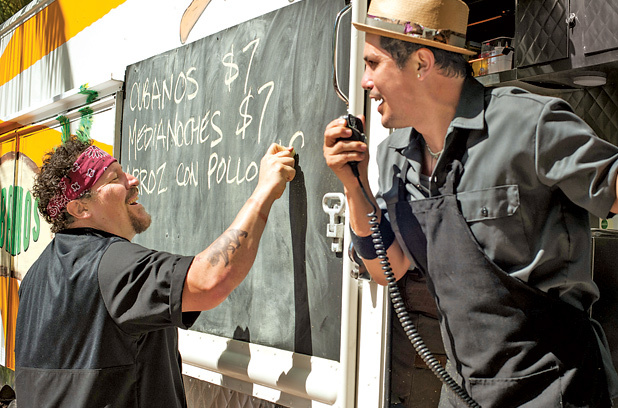
In the film, he plays Carl Casper, a Los Angeles chef who hightails it to his Miami hometown when his fancy restaurant gets a scathing review from an online food critic (Oliver Platt). There he buys El Jefe Cubanos, a food truck he plans on driving across the country with his son (Emjay Anthony).
High on food porn — there’s even a shrimp scampi seduction scene — and Cuban sandwich recipes, Chef is a movie that may whet audience appetites for other movies about the people that make our food.
In The Big Night, Stanley Tucci plays Secondo, owner of an Italian restaurant called Paradise. The place is slowly going broke but may get a boost from a visit by singer Louis Prima. If Prima shows up, the restaurant will have a big night and be saved from bankruptcy.
It’s not only one of the greatest food movies ever made (you’ll want to go for risotto afterward) but it also features what Rolling Stone’s Peter Travers called “an unforgettable acting duet” between Tucci and Tony Shalhoub, who plays his temperamental chef brother, “that is as richly authentic as the food.”
Ratatouille takes a different approach. An unusual cross between America’s Next Top Chef and Willard, the Pixar movie does something no other film has been able to (not that a lot have tried): It makes rats cute. Lovable, even.
The story of a cooking rat is chef and TV presenter Anthony Bourdain’s favourite food film. “They got the food, the reactions to food, and tiny details to food really right,” said The Taste host, “down to the barely noticeable pink burns on one of the character’s forearms. I really thought it captured a passionate love of food in a way that very few other films have.”
Real chefs are featured in the documentary Spinning Plates. Weaving together three stories from a trio of very different restaurateurs, the film shows the personal and professional side of the food biz as well as the connection to the community that’s so important for success.
It cuts through the Food Network’s simplistic food-family-and-feelings approach with a tagline that sums up its philosophy: “It’s not what you cook. It’s why.”
 Imagine a bar with an indoor lagoon. Now imagine that it rains, indoors every half hour. It’s not just a flight of fancy, it’s the Tonga Room, a classic restaurant and tiki bar in the Fairmont San Francisco hotel. Named after the South Pacific nation of Tonga, it is an eye-popping example of high-style Tiki that has been igniting the imaginations of customers for more than seventy five years.