On the Saturday February 3 edition of the Richard Crouse Show, we meet Kristen Vaurio, director of the new Paramount+ documentary June. The feature documentary shines an important spotlight on the history of country music and the mark the Carter and Cash families made on the genre before diving into the complex life of the legendary June Carter Cash. The five-time Grammy® Award-winning singer, comedian, musician, actor and author has opened for Elvis, appeared onscreen with Robert Duvall and Jane Seymour and co-wrote one of the most recognizable country songs of all time, “Ring of Fire.” Perhaps at times overshadowed by her iconic husband Johnny Cash, she now takes center stage.
Then, we meet Roger Mooking. As a celebrity chef, restaurateur, television host, author, and award-winning recording artist Roger has earned an international reputation as a multi-media artist and entertainer showcasing a globally inspired vision that reflects his rich family heritage, love for people and travel. He does lots of things… and has even won a special All-Star Chopped celebrity chef episode… today we talk about his career in food and music, and how he combined all of his interests in a new book called “Curious Sounds.”
Each week on the nationally syndicated Richard Crouse Show, Canada’s most recognized movie critic brings together some of the most interesting and opinionated people from the movies, television and music to put a fresh spin on news from the world of lifestyle and pop-culture. Tune into this show to hear in-depth interviews with actors and directors, to find out what’s going on behind the scenes of your favourite shows and movies and get a new take on current trends. Recent guests include Chris Pratt, Elvis Costello, Baz Luhrmann, Martin Freeman, David Cronenberg, Mayim Bialik, The Kids in the Hall and many more!
All iHeartRadio Canada stations are available across Canada via live stream on iHeartRadio.caand the iHeartRadio Canada app. iHeartRadio Canada stations are also connected through Alexa, Siri, and Google Home smart speakers.
“Sly,” a new, reverent Netflix documentary directed by Thom Zimny, is an authorized look at the life of Sylvester Stallone, through the lens of his two best known characters, resilient boxer Rocky Balboa and blunt-force object John Rambo.
The doc begins as Stallone announces he’s moving house, heading east to New York City from his longtime, opulent west coast home in search of a change of scenery and creative rebirth. As a lifetime of memories and memorabilia—the L.A. house has a truly shocking number of statues and figurines of Rocky and Rambo—is packed away, he reminisces about life, his movies and, in one of the film’s few surprises, his love of polo.
Direct and forthright, he turns on the charm to describe his hardscrabble beginnings in NYC’s Hell’s Kitchen with parents Frank and Jackie. He spends a great deal of time on his father, a complicated, abusive man who later in life became jealous of his son’s success, but, strangely, almost no time on his mother who was a celebrity in the 1980s.
That’s just one of many omissions. There’s no mention of his softcore movie “The Party at Kitty and Stud’s,” for instance, but “Sly” is not for completists. As Stallone hopscotches through his filmography, focusing on his three successful franchises, “Rocky,” “Rambo” and “The Expendables,” with little or no mention of the other 75 or so films that fill out his resume, it’s clear he has a more high-minded philosophical job to do.
The Oscar-nominated actor-writer-director-producer attempts to find common ground between his personal story of tenacity and his best-known characters. It’s hard to deny the connection between the underdog Rocky and early Sly, or John Rambo’s survival skill set and Stallone’s ability to stay relevant in Hollywood. It’s a bit of a stretch to see how “The Expendables” fits the mold, but this is Stallone’s world and we’re just visiting.
Better than the tangential links between art and artist is a scene featuring Stallone re-listening to a decades-old interview on a battered old cassette tape. “Rocky,” he says as a young man, “is a character study.” “No, it’s not,” his contemporary self says, “it’s a love story!” It’s a nice and rare moment of self-depreciation that compares and contrasts Stallone in different eras; the heady days of early fame and the more self-reflective present-day version.
More than anything, the remarkably intimate portrait of the larger-than-life Stallone is a study in star power. As he talks about his life. usually looking directly into the camera, the elusive it-factor that made and kept him a star is self-evident. “Sly” may not offer up a lot of new material, but does put a personal and entertaining spin on the familiar stories.
As extreme sports go, few entail the danger of free-diving. Often immersed hundreds of meters under the water, with no breathing apparatus, divers rely on mental and physical rigor to ensure success. One wrong move, a few seconds extra under the extraordinary pressure of the water, and all can be lost.
A new documentary, “The Deepest Breath,” now playing in theatres before moving to Netflix next week, is an up-close-and-personal look at the sport and the people who risk their lives to practice it.
Director Laura McGann assembles a study of the sport, vividly utilizing underwater photography and interviews with practitioners to provide context, and set the stage for the film’s main story, the story of Irish adventurer Stephen Keenan and Italian freediving champion Alessia Zecchini.
Determined to set a world’s record, Zecchini sets her sights on “the last quiet place on Earth,” the Blue Hole Arch, a claustrophobic 85-foot-long tunnel 184 feet below the Red Sea in Egypt. The treacherous tunnel has claimed at least 100 divers, so to aid in her dive, Keenan will act as her safety diver. His job is to track her underwater movements in case she gets lost or blacks out due to the lack of breath.
No spoilers here, but the dive does not go as planned.
With beautiful and often haunting underwater photography, director McGann gives “The Deepest Breath” a you-are-there feeling. The starkness of the dive footage effectively emphasizes the singularity of the sport; the self-reliance and mental preparation it takes to take the plunge.
The film is slightly less successful in the telling of its story. The first half of the doc is filled with choppy storytelling, archival interviews and digressions on behalf of its cast of characters. It makes for an uneven experience, but the immersive nature of the filmmaking in the ethereal underwater scenes calms any rough waters in the storytelling.
“The Deepest Breath” may not be completely satisfying account of why people risk their lives in this extreme sport, but it is a compelling visual record of those who do.
“The Return of Tanya Tucker: Featuring Brandi Carlile” is not a regular musical bio-doc. We get bits and pieces from Tucker’s legendary career, how she had her first hit with “Delta Dawn” when she was just thirteen-years-old, and her cocaine fueled relationship with country superstar Glen Campbell, but the focus here is the making of the 2019 album “While I’m Livin’.”
Produced by Shooter Jennings and country singer Brandi Carlile, it was Tucker’s first album in seventeen years, and earned a Grammy, her first ever.
Director Kathlyn Horan takes a fly-on-the-wall approach, a style that lends itself to revealing many organic and intimate moments of Tucker and her producers capturing the magic that is Tucker in full flight.
It also captures Carlile’s esteem for her elder. There’s palpable sense of second chances hanging over the proceedings as Carlile carefully and respectfully guides Tucker through the paces. The creative process reveals a deft and deep musical knowledge, and the importance of finding joy in the making of the art. Tucker’s career was marred by sexism and abuse, so this feels like a new beginning, a return to center stage, guided by Carlile’s steady hand.
It is a portrait of a legend who calls herself “just a country singer,” but with a voice that is imbued with the texture of a woman who has lived a life, and brings that experience to her art. At the heart, this is a love letter to Tucker, whose career has had as many ups as it has downs.
Come for the story, stay for the incredible music.
A new documentary, “The Automat,” directed by Lisa Hurwitz and now playing in theatres, is a evocative look back when you could get a square meal for a round quarter.
For more than fifty years Horn & Hardart automats fed more Americans than any other restaurant chain. For the price of a nickel you could get a cup of strong coffee, poured from a spout shaped like a dolphin. The rest of the menu was housed behind small doors with windows that displayed the wares, like baked beans, chicken pot pies, creamed spinach or Secretary of State Colin Powell’s favorite, the macaroni and cheese. Pop a coin in the slot, open the door and lunch or dinner is served.
“The Automat” uses talking heads, like Mel Brooks, Ruth Bader Ginsburg and Elliott Gould, and archival footage to create a nostalgic look at a by-gone institution but to also contextualize the contributions the quirky restaurants made to American society.
A precursor to fast food chains like Burger King or Arby’s, both of whom would later fall under the Horn & Hardart umbrella, the automats were a sensation. The first Horn & Hardart automat opened in 1902 in Philadelphia with a strict adherence to quality and egalitarianism. For the next 89 years—the last New York Horn & Hardart Automat closed in April 1991—everyone was welcome with no racial barrier, tables were shared by strangers and, at their heyday in the 1940s and 50s, they served upwards of 350,000 customers a day in New York alone.
Everyone interviewed raves about the food and the restaurants. Starbucks CEO Howard Schultz talks about how a visit to Horn & Hardart sparked his love of the hospitality business, and how it influences him today. Powell remembers family outings and the delicious pies that were a once-a-week treat.
As glowing as the interviews are, there is often a sense of nostalgic melancholy about the demise the automat—a victim of changing times—as an example of how the good ol’ days, represented by the elegant and welcoming restaurants, are truly behind us.
“It had some style and it was different,” says self-serve automat superfan Mel Brooks. “The marble, the brass, the polished floors, the chatter, the coffee. That was the Automat. It can’t work again because the logistics and economics of today won’t allow anything that simple, naive, elegant and beautiful to flourish again.”
“The Automat” is a quickly paced, interesting and affectionate populist documentary that brings to life how, for a time, happiness could be bought for the price of a cheap cup o’ joe.
Few voices captured the liberation of UK punk rock like Poly Styrene’s otherworldly wail. Born Marianne Elliott-Said, she may have chosen her unusual stage name as a “send up of being a pop star,” but her voice and message were the real deal. A new documentary, “Poly Styrene: I Am A Cliché,” now in theatres and on VOD, aims to remind the world of a ground breaking artist whose legacy can be heard in the riot grrrl and Afropunk movements and beyond.
Based on a book by Styrene’s daughter Celeste Bell, the film is an intimate look at the Anglo-Somali legend through the eyes of her child. “My mother was a punk rock icon,” Bell says. “People often ask me if she was a good mum. It’s hard to know what to say.”
The story begins in 1957 with the birth of Marianne, daughter of a Scottish-Irish legal secretary and a Somali-born dock worker. Her indoctrination to punk rock came via a 1976 Sex Pistols concert. The music was a revelation that led to the name change and formation of X-Ray Specs, the five-piece band whose sole album, “Germfree Adolescents,” is considered a genre classic.
Styrene became a regular target for the press who ridiculed the braces on her teeth, her weight and unconventional clothing choices. Her record company, much to her displeasure, slimmed down her album cover photo as they tried to position her as a sex symbol for a new generation.
“I wasn’t a sex symbol,” she said, “and if anybody tries to make me one, I’ll shave my head tomorrow.” And she did, at Johnny Rotten’s house during a party.
Her songs asked questions most other acts on the pop charts weren’t willing or equipped to ponder. “When you look in the mirror do you see yourself?” she sings in “Identity,” a slice of musical anarchy that was a rebuke to the images the media tries to foist upon people in the public eye.
Styrene’s rocky relationship with fame, her youth and a failed solo album led to a divorce from the music business as drugs, depression and a misdiagnosis of schizophrenia touched her private life.
Filling in the gaps between nicely chosen archival film clips are readings from Styrene’s personal diaries by Ethiopian-Irish actor Ruth Negga and Bell’s personal recollections.
“Poly Styrene: I Am A Cliché” is an intimate film. Unlike most music biographies that focus on the sex, drugs and rock ‘n roll aspects of the story, this movie also weaves in the social history of Britain, mental health and fame, while maintaining a personal touch courtesy of Celeste Bell.
Bell looks beyond the image, the media-imposed identity of her mother, to find the rebel, the radical and the real person who struggled to determine where she fit into the world. The documentary, directed by Bell and Paul Sng, is a rarity, a movie about punk rock that casts its eyes beyond the musical anarchy to portray the real people behind it.
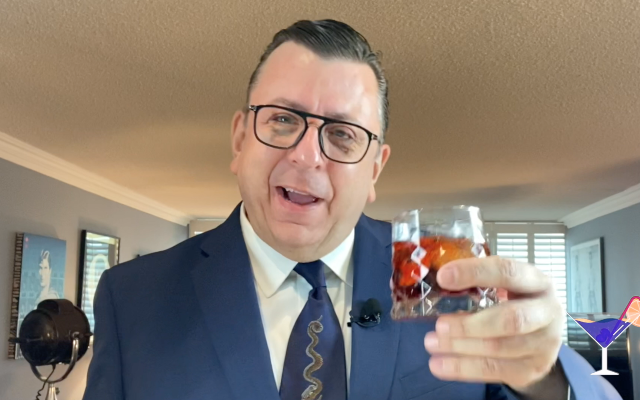
Richard makes a Negroni, the perfect cocktail to enjoy while watching the new documentary “Roadrunner: A Film About Anthony Bourdain.” Have Bourdain’s favourite drink and a think about “Roadrunner” with us!
In the opening moments of “Roadrunner: A Film About Anthony Bourdain,” a new documentary about the late television host and author, now playing in theatres, we hear the titular character’s voice state the obvious. “This does not have a happy ending,” he says.
For fans of Bourdain, the former heroin addict chef-turned-author-turned-television-star-turned-cultural-avatar, “Roadrunner” comes with high expectations.
The edgy but empathic Bourdain, who was 61 when he took his own life while shooting a television show in France, inspires strong feelings. A standard, hagiographic look at his life, rehashing the well-known details of his career, would be met with a collective yawn. Get too prickly and it might be seen as disrespectful to the memory of a man many still miss.
“Roadrunner” somehow straddles the line, providing a balanced overview of the scrappy chef’s personal and professional lives. Using outtakes from Bourdain’s shows “No Reservations,” “The Layover” and “Parts Unknown,” new interviews with friends and family and home footage, director Morgan “20 Feet from Stardom” Neville compiles a Russian nesting doll look of his subject.
What emerges is a deep dive into the life a complex man; a person who circled the globe dozens of times searching for meaning with every air mile point earned. “His whole personality was of a searcher,” says Alison Mosshart, the vocalist of The Kills and The Dead Weather. “He was always looking for something, and it was agony for him.”
Neville captures some of that agony, forcing the viewer to see familiar footage recontextualized by Bourdain’s co-workers and friends. With no shortage of material to choose from—Bourdain’s 250 days a year on the road were meticulously filmed and documented—Neville cherry picks moments that reveal the toll Bourdain’s schedule, celebrity and search for normalcy took.
Often the most revealing footage isn’t of the man speaking, but of the exhausted or melancholy look visible in his eyes as he performs for the camera. “Life was never going to measure up to how he pictured it,” says “Parts Unknown” segment producer Helen M. Cho. “He set himself up for disappointment.”
The circumstances of his death, of course, are investigated. His colleagues become tearful describing his last months as a lifelong addict who turned his addition to Italian actress and director Asia Argento. “Roadrunner” examines Bourdain’s final days but this isn’t a whodunnit or an exercise in pointing fingers. It’s a story about his life, not death.
“Roadrunner: A Film About Anthony Bourdain” provides an emotionally raw portrait of a gifted, charismatic man who travelled the world but never quite figured out where he needed to be. “You are not going to outrun or out smart pain,” comments artist David Choe, who provides the movie with a suitably Bourdain-esque ending.
Fifty-two years ago, during a hot, sticky New York summer, a music festival was filmed for posterity in front of a gigantic crowd. No, it’s not “Woodstock.”
That happened, but I’m talking about The Harlem Cultural Festival, a star-studded, six-week extravaganza featuring everyone from Stevie Wonder and the 5th Dimension to Mahalia Jackson and Nina Simone that drew tens of thousands of people to Mount Morris Park (now Marcus Garvey Park). The concerts were filmed, but when no taker could be found for the footage, it sat, unseen for fifty years in the basement of a producer named Hal Tulchin.
Now rescued and wrestled into a two-hour documentary by Ahmir “Questlove” Thompson of the Roots, it brims with excitement, pain, hope and, of course, dynamic performances and great music.
Part concert documentary, it’s a must see if only for Nina Simone’s performance of “Backlash Blues.” It is just one of the dozens of musical numbers, all expertly curated by Questlove, but here there is no sense of nostalgia, just the pure power of performance.
Mahalia Jackson and Mavis Staples bring another emotional highlight, duetting on Martin Luther king Jr.’s favorite gospel song “Take My Hand, Precious Lord.” The civil rights leader was assassinated the year before, and their singing brings out both the beauty and the ache inherent in the song and the circumstances.
Also deftly woven in are remembrances from people who were there, on stage and off. Marilyn McCoo wipes away a tear as she watches the footage of her band The Fifth Dimension. New York Times journalist Charlayne Hunter-Gault helps set the scene politically and culturally while
Rev. Jesse Jackson recalls the story behind the electric performance pf “Take My Hand, Precious Lord.”
Far from simply using the music and the festival as a framework for the film, Questlove mixes in, with the expert hand of a DJ who understands rhythm and syncopation, archival news footage and contemporary interviews. This approach provides much needed historical context and makes the effect of the music even more impactful.
The Harlem Cultural Festival took place at a time when music was changing—you hear the influences of Latin Jazz and soul and gospel, all brewing together to create something new—and as the world changed. “Summer of Soul” is the rare music documentary that balances the historical with the musical with such grace and power.