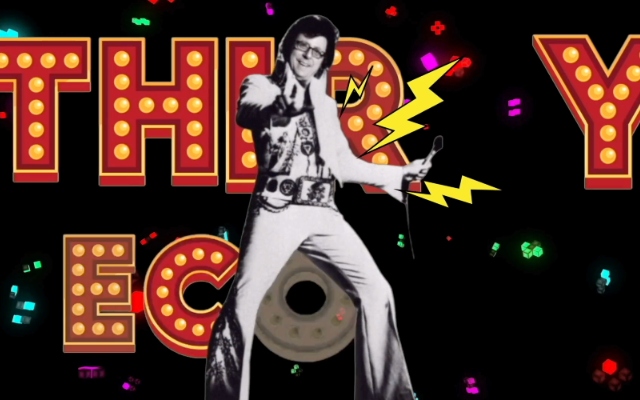
I join the CTV NewsChanel to talk about the return of the king in “EPiC: Elvis Presley in Concert,” the dark comedy “How to Make a Killing,” the heist film “Crime 1201” and the inspirational “I Can Only Imagine 2.”
Fast reviews for busy people! Watch as I review three movies in less time than it takes to sing “Hm, ooh, yeah-yeah, yeah” Have a look as I race against the clock to tell you about the return of the king in “EPiC: Elvis Presley in Concert,” the dark comedy “How to Make a Killing” and the horror movie “Diabolic.”
“Priscilla,” a new film from director Sophia Coppola and now playing in theatres, is a bird in a gilded cage story set against the backdrop of loneliness and rock ‘n roll superstardom.
The story begins in Germany, where 14-year-old Priscilla Beaulieu (Cailee Spaeny) lives with her mother Ann (Dagmara Domińczyk) and stepfather Paul (Ari Cohen), a United States Air Force officer stationed at Wiesbaden, West Germany.
Her life is changed forever when, while doing homework at a coffeeshop, she is approached by Terry West (Luke Humphrey), an officer stationed with 24-year-old Elvis Presley (Jacob Elordi in full-on “Uh huh huh” mode) in nearby Bad Nauheim.
“You like Elvis Presley?” he asks her.
“Of course,” she says. “Who doesn’t?”
Despite her parent’s reservations, Priscilla accepts West’s invitation to go to a party at Elvis’s home. She meets the King of Rock ‘n Roll, who, after inviting her to his bedroom, tells her he’s homesick and just wants to talk to talk to somebody “from home.”
Caught up in the fantasy of having Elvis all to herself, Priscilla falls hard.
The chaste romance continues, with some rules from set by Priscilla’s father, until Elvis is transferred back to the States. With no contact from the singer, Priscilla gets the GI Blues, and keeps up with his life through fan magazines that trumpet his love affairs with everyone from Nancy Sinatra to Ann-Margret. Her mother encourages her to forget about Elvis, to cast her eyes on the boys at school. “There must be some handsome ones,” she says.
When he finally calls, inviting her to come visit him in Memphis, Priscilla enters a world of fantasy, fame and manipulation.
“Promise me you’ll stay the way you are now,” he says to her. She nods demurely, but of course, people change, even when they’re in love.
Based on Priscilla’s 1985 memoir, the movie is told from her perspective. So, unlike Baz Luhrmann’s recent “Elvis,” there are no concert scenes, no screaming crowds. Instead, we see the flipside of fame, the family hours, the downtown as Priscilla is kept sequestered away at Graceland, a school girl living with an immature superstar, because, as Elvis tells her, “the Colonel thinks it’s better if the fans don’t know about you.” It is a world of wealth and luxury but, also one almost completely devoid of true freedom, happiness or contentment.
In Coppola’s episodic structure, Elvis is portrayed as an insecure, manipulative toady, easy to anger, emotionally abusive, a man used to getting what he wants, and calling the shots. He tells her how to dress, how to behave and demands she be available at all times. “It’s either me or a career,” he says when she muses about taking a job. “When I call you, I need you to be there.”
As Elvis’s career demands and drug habit escalates, so does Priscilla’s alienation and growing sense of independence.
In a breakout performance Spaeny, best known for playing a teenage single mother on the Emmy-winning “Mare of Easttown,” goes internal, creating a portrait of Priscilla that relies on what isn’t said as much as what is. It’s the perfect approach to display the loneliness and internal turbulence that characterized her time at Graceland.
The show me, don’t tell me aesthetic of the film isn’t limited to Spaeny’s work. Coppola stages a terrific tableau of Elvis, gun tucked into his belt, taking a photo with a nun, that captures the ridiculous, yet all-encompassing nature of the singer’s fame. More poignant is the image of the eager-to-please Priscilla, slathering on the heavy eye make-up and long lashes Elvis preferred just before going to the hospital to have a baby.
“Priscilla” is a gentle look at a turbulent time. It is occasionally a bit too on-the-nose in its music choices—for instance, “Crimson and Clover’s” “I don’t hardly know her/ but I think I could love her,” is a bit too obvious a soundtrack for their first kiss—but is otherwise a subtle and thoughtful musing on a doomed love affair.
“Elvis,” the new King of Rock ‘n Roll biopic from maximalist director Baz Luhrmann, begins with a sparkling, bedazzled Warner Bros logo and gets flashier and gaudier from there.
The movie is told from the point of view of Elvis’s (Austin Butler) manager Colonel Tom Parker (Tom Hanks under an inch or two of makeup), a huckster with a flair for spotting talent and a gift for manipulation.
Working on the carnival circuit taught Parker that a great act “gave the audience feelings they weren’t sure if they should enjoy,” a standard the early, hip-shaking Elvis met and exceeded.
Their partnership is one of the best known, and well documented success stories of the twentieth century. For twenty years, through the birth of rock ‘n roll of the late 1950s and the cheesy Hollywood years to the legendary 1968 Comeback Special and the Las Vegas rise and fall, Elvis and the Colonel shimmied and shook their way to the top of the charts and into the history books.
“Elvis” covers a lot of ground. From young Elvis (Chaydon Jay) discovering his love of music from the Black rhythm and blues artists and Mississippi church music he absorbed as a kid to his final white jumpsuit days in Vegas, Luhrmann shakes, rattles and rolls throughout in a blur of images and spectacular sound design.
It entertains the eye but feels akin to skipping a stone on a lake. If you hold the stone just right and throw it across the still water at the correct angle, it will skim along for what seems like forever without ever piercing the surface.
“Elvis” is a great looking movie. A pop art explosion that vividly essays the story’s various time frames and styles, it makes an impact visually and sonically. Unfortunately, Luhrmann is content to make your eyeballs dance, your gold TCB chains rattle and simply skim across the surface.
We do learn that Elvis was the sum of his country music and R’n’B experiences and influences, was fueled by the adoration of his audience and aware of the social change of the 1960s, but there is no excavation, no real exploration of what made the singer or his manager actually tick. It may seem fitting that a movie about a man who drove pink Cadillacs and wore phoenix embroidered jumpsuits and capes is over-the-top, but those images are so woven into the fabric of popular culture already that this feels clichéd, more like greatest hits album than a biography.
Butler is a charismatic performer, playing Elvis through several stages of his life, and despite the superficiality of the storytelling hands in a rounded performance that transcends impersonation of a man who spawned a generation (or two) of impersonators.
It’s rare to see Hanks play a character with no redeeming qualities. “I am the man who gave the world Elvis Presley,” he says, “and yet there are some who would make me out to be the villain of this story.” His take on Colonel Parker grates, with the theatrical Dutch accent and imperious, manipulative manner, he is certainly the villain of the piece. He’s a pantomime of the big, bad music manager, one who saw his client as a musical ATM machine and little more.
By the time the end credits roll “Elvis” emerges as an idealized look at the boy from Tupelo who became the King by paying tribute to the power of the music that made a legend.
Music documentaries often veer into hagiography, looking back with rose coloured glasses at their subject. There are heaps of high praise in “Gordon Lightfoot: If You Could Read My Mind,” a new career retrospective from co-directors Martha Kehoe and Joan Tosoni, but right from the outset it displays an honesty rare in authorized bios.
After a few bars of his chauvinistic ’60s hit “For Lovin’ Me” Lightfoot, watching vintage footage, demands it be shut off. “That’s a very offensive song for a guy to write who was married with a couple of kids,” he says before adding, “I guess I don’t like who I am.”
It’s a startling beginning to a movie that uses his music and a series of celebrity talking heads like Steve Earle, Sarah McLachlan, Geddy Lee, Anne Murray and Alec Baldwin, who helpfully adds, “This was a guy who sang poems,” to tell the story. Traditionally Lightfoot’s enigmatic approach to his biography has left many questions unanswered in the media. That doesn’t change much here, although he seems to have allowed open access to his home and is occasionally candid in the contemporary interviews. “I regret a lot of things,” he says near the end of the film. “I caused emotional trauma in people, particularly some women, the women I was closest to. I feel very, very badly about it.”
“If You Could Read My Mind” doesn’t skip over sensitive biographical points. His relationship with Cathy Evelyn Smith, a woman he loved who was later accused of killing John Belushi and the infidelities that marred his personal life are examined, although with a light touch that respects his privacy.
Supporting the storytelling are interestingly curated images. From rare clips of his early performances on the CBC and on the stages of Yonge Street taverns and Yorkville coffee houses and archival photos of the legendary, star-studded parties he threw at his Rosedale home, to old footage of his parents and behind-the-scenes images of his acting debut in Desperado—“You’ll never win an Oscar,” said co-star Bruce Dern, “but you’re fun to work with.”—the doc offers a comprehensive visual essay of Canadiana, Gordon Lightfoot style.
Ultimately the best documentary of Lightfoot’s storied life is his work, tunes like “Sundown” and “Rainy Day People” that suggest everything he has to say is in his songs. “Your personal experience and your emotional stress,” he says, “finds its way in by way of your unconscious mind over into the mind of reality and translates itself into your lyrics. And you don’t even know that is happening.”
Some people turn their noses up at cover bands. One critic I read called an early Elvis Presley impersonator “heretical.”
I see it differently. I never got to see Elvis shake his hips in person, but through the magic of tribute artists I feel almost like I have. I certainly know that I’ve seen hundreds of happy faces in audiences, enjoying the chance to see a de facto Presley in person and that’s what’s important. They say imitation is the sincerest form of flattery but for me Acts like AC/DCShe—an all female AC/DC cover band, or the ABBA mimics Björn Again or even MacSabbath, a Black Sabbath cover band in which all the members dress up as McDonald’s characters—are more than flattering their inspirations, they’re triggering happy, nostalgic memories and doing what live music is supposed to do, show people a good time.
A new documentary, “Almost Almost Famous,” has a look at The Class of ’59, a cover band featuring rockabilly musician Lance Lipinsky as Jerry Lee Lewis, R & B singer Bobby Brooks as Jackie Wilson and the “Elvis from Orlando”, Ted Torres. Set against the backdrop of the band on tour we learn about the dynamics of being on the road and discover why these artists chose the tribute act route rather than playing originals. For some it’s money, for some it’s for the love of being on stage and for one of them it’s a surprise tribute to a person they never met.
“Almost Almost Famous” doesn’t dig deep. We learn the backstories of the performers but only one of the characters, Bobby Brooks, has a history truly worthy of a feature (NO SPOILERS HERE) but director Barry Lank spends much time focussing on Lipinski, the terminally tired Jerry Lee Lewis impersonator.
He’s framed as the villain of the piece, a tribute artist who dismissively refers to his Class of ’59 gig as a day job. He’s always late, misses cues and is often less than inspired on stage. A talented singer and piano player, he has bigger things on his mind than aping sixty- year-old rock ‘n roll songs for an audience who stopped buying new music sometime around the time Elvis went into the army. Instead he wants to make neo-rockabilly for a younger crowd and it consumes his on and off stage moments. He’s a self-styled provocateur who wears an oversized Trump-Pence button on his lapel in interviews. Trouble is, he comes across as a one note, a brat, not a character you really want to spend time with.
Like the music it presents “Almost Almost Famous” doesn’t feel completely fresh but the peak behind the gold lame suits is interesting enough to keep tribute fans happy.
She shimmied and shook her way through the decades. When she wasn’t on stage, entertaining at some of the world’s most glamorous nightclubs, she filled her off hours with affairs with Elvis and JFK. She is burlesque icon Tempest Storm, the subject of a new eponymously titled documentary from director Nimisha Mukerji.
Storm, born Annie Banks in rural Georgia, always wanted to be famous. As a child she would go to the movies and imagine the actors were just behind the screen. Her career was launched after a move to Los Angeles around 1950. Waitressing paid the bills, barely, so when a customer suggested she might make more money as an exotic dancer she jumped at the chance, changed her name—rejecting her agent’s suggestion, the cheerier Sunny Day, with the curt explanation, “I don’t feel like a sunny day.”—and began a career that continues to this day.
Her life is the stuff of legends. Aside from her dalliances with rich and famous stars, “Tempest Storm” tells of her multiple marriages, childhood trauma, her search for her biological father and, of course, how she famously insured her breasts—her “moneymakers”—for one million dollars with Lloyd’s of London.
What sets the documentary apart from a run-of-the-mill celebrity tell-all is Mukerji’s sensitive handling of Storm’s personal troubles. A fraught relationship with her daughter Patti, who she gave up when the girl was just ten years old, becomes the film’s main theme. Storm wanted fame and fortune and for the most part got it, but at what price.
“Tempest Storm” is a portrait of a taboo-breaker, a woman who has always walked her own path. Her journey is entertaining but her message is profound.
Strange Magic, a new animated jukebox musical fantasy from George Lucas, follows in the footsteps of Peter Pan, Sleeping Beauty and Cinderella. All are musicals, all are for kids and all feature a villain geared to make young pulses race.
“I do think we underestimate how much darkness kids can deal with,” says Alan Cumming, who plays the film’s chief baddie, the Bog King,
Inspired by A Midsummer Night’s Dream, Strange Magic is set in a fairy world where you can never judge a book by its cover.
Cumming’s character, with his glowing eyes and a skeleton that is more exo than endo, certainly embodies the movie’s message that beauty is only skin deep.
“All these kinds of films are based on a tradition that goes way, way back to the Grimm Brothers,” says Cumming.
“In a way, the reason these stories are told is to teach kids some sort of moral lesson. You have to scare people but ultimately show that he has a nicer side to him.”
Lucas, who has a ‘story by’ and producer credit on the film says, “with the Bog King we did tone him down a bit because it is a delicate balance. We’ve shown it to a lot of kids and most of them aren’t affected by it at all. My daughter, who is only 18 months, saw the trailer with the Bog King in it on a screen, not on a TV and she wasn’t moved by it at all. But of course 18-month-olds aren’t afraid of anything yet.
“Kids are not as fragile as you think they are. All the stuff, that it warps their brains, I’m not sure about that,” he said.
“There is a certain reality to imitative violence, which is monkey see, monkey do, and that is dangerous, but at the same time a well brought up kid doesn’t fall into that.”
Lucas, who has been working on this project on and off for 15 years — “I liked to do it in between working on Star Wars and writing scripts and things”— says there are only three moments in the movie that are “bothersome.”
“It has been my experience with my kids that if you sense something coming up you just put your hand over their eyes and usually they’re faster at doing it than you are.”
Everyone knows the children of George Lucas, Han, Luke and Leia, will be closing out the year with the December release of “Star Wars: Episode VII – The Force Awakens.” What is perhaps less well known is that another Lucas fantasy kicks off 2015.
Lucas was inspired by “A Midsummer Night’s Dream” to create the story for “Strange Magic,” an animated jukebox musical set in a fairy world where you can never judge a book by its cover.
Evan Rachel Wood stars as the voice of Marianne, a tough Pat Benatar-type fairy with colourful wings, leather lungs and an attitude. She wasn’t always like that, once she was a gentle fairy princess engaged to the handsome Roland (Sam Palladio) but his unfaithfulness broke her belief in love and now she is alone.
Over in the Dark Forest the Bog King (Alan Cumming), a bad-tempered cockroach looking creatures whose skeleton is more exo than endo, has also lost faith in love. “Love destroys order,” he says, “and without order there is chaos.” To make sure love does not taint his kingdom he imprisons the Sugar Plum Fairy (Kristin Chenoweth), maker of love potions.
The fairy and dark forests collide when a bootleg batch of Sugar Plum’s potion leads to kidnapping and a showdown—and sing-off—between Marianne, the Bog King and their followers.
“Strange Magic’s” story is old fashioned. It’s “Beauty and the Beast” banged together with some Shakespearean farce and even a hint of “The Dark Crystal,” but there is nothing old fashioned about the presentation. The lush animation will blow the retinas off your eyeballs. The creature design owes a debt to Jim Henson and movies like “Labyrinth,” but they are marvelously realized with state of the art CGI and inventive voice work.
Director Gary Rydstrom fills the screen with memorable images, from Marianne splayed across a bed made of a rose bud to the wild kaleidoscope psychedelia of the film’s finale.
Your eyeballs will dance, and with a wall-to-wall musical score made of pop hits from the past fifty years, you might expect your feet to follow, but it’s here the movie doesn’t always deliver. It’s all well and good to transform “I Can’t Help Falling in Love With You” into a Broadway style belter but the abominable Muzak version of “Crazy Little Thing Called Love” would have been better left in the vault. The soundtrack plays like a K-Tel album of love songs—everyone from Elvis and Bob Marley to Heart and Lady Gaga are represented—has a Moulin Rouge-ish feel but isn’t quite as effective as Baz Luhrmann’s megamix.
“Strange Magic” takes some simple ideas—beauty is only skin deep and love conquers all—and sprinkles them with fairy dust to create a musical that plays like “Moulin Rouge” for kids.