Ryan Reynolds has carved out a unique and profitable niche for himself on screen. The current king of the non-IP action comedy, he recently scored big hits with “Red Notice” and “Free Guy,” original movies not based on a comic book or existing videogame premise. This week, add to that list “The Adam Project,” a sci fi adventure flick now streaming on Netflix co-starring Mark Ruffalo and Jennifer Garner.
Adam Reed (Walker Scobell), a precocious thirteen-year-old living with his mother Ellie (Garner), is still stinging from the death of his father a year earlier. “Son, you need to think about your future,” Ellie says, “because it’s coming. Sooner than you think.”
In fact, it may have already arrived.
One day Adam finds a wounded fighter pilot hiding in his family’s garage. Turns out the stranger isn’t a stranger after all. He’s Adam (Reynolds) from the future; the grown-up version with a bullet hole in his side and a mission. “You’re me,” says the awestruck youngster. “That’s classified,” says older Adam, “but yes, I once was.”
The time traveller jumped back to 2022 to save the world, using information created by his late scientist father Louis (Ruffalo). To do complete the mission, he’ll need to jump back in time further, this time with young Adam at his side. First though, there is a time travelling villain (Catherine Keener) and the question of how to come to grips with the past while saving the future.
Time travel movies rarely ever make perfect sense, and “The Adam Project” is no different. Time may be a flat circle, and destined to repeat itself, but the cinematic machinations of jumping from year to year, of changing the past from the future, often make my head hurt and take me out of the story.
“The Adam Project” sneaks by, not because of its grasp of the paradox of theoretical physics, but because if the chemistry between Reynolds and his young co-star Scobell.
Reynolds, reunites with his “Free Guy” director Shawn Levy, brings his trademarked charisma and way with a joke, while Scobell, making his acting debut, is a natural foil. He is funny, charming and holds his own against Reynolds, arguably one of the best scene stealers in movies today.
They click and because they do, the movie works. The sci fi aspects of the story, the Stormtrooper-looking soldiers from the future or the noisy CGI climax, don’t make as much of an impression as the film’s heart and soul, the relations ship between the Adams and their father as they heal the wounds caused by their dad’s death.
“The Adam Project” threatens to allow the special effect fireworks to overshadow its story, but contains just enough heartwarming material to earn comparisons to the 1980s Amblin movies that were clearly an inspiration.
Giving over the joystick to the young’uns for a day sounds like a every child’s dream but will the parents enjoy it at all? That’s the question asked by “Yes Day,” a new family comedy now on Netflix, that sees strict parents lighten up and give control to the kids.
Jennifer Garner is Allison, a former free spirit who found Carlos (Edgar Ramirez), her “partner in yes,” while travelling the world. “Yes,” she says, “was the theme of our relationship.” They said yes to bungee jumping, wild adventures and, ultimately, marriage. Burt when the kids came along no became the new yes. Saying no to misbehaving kids is “called parenting,” Allison says. Carlos is a softer touch. “I’m a bad guy all day at work… but when I come home, the kids actually smile when they see me.”
When daughter Katie (Jenna Ortega) writes a haiku for English class describing herself as a caged bird and her mother as a captor, and son Nando (Julian Lerner) makes a video about mom’s oppression—”It’s like 1984 in this house, Mother is always watching!”—they hit on the idea of a Yes day, twenty-four hours where they say yes to everything their kids want. The rules are simple, says yes to everything except murder and anything in the future.
Liberated form the word no and phones and laptops, Allison, Carlos and kids, including six-year-old Ellie (Everly Carganilla), embark on an adventure. Complete with an ice cream eating challenge, water balloons, angry birds (and not the video game kind) and a sopping wet carwash their day is every kid’s wildest fantasy.
But this movie isn’t just about kid chaos. Teachable moments abound and the family is brought together with a new sense of self-confidence and the understanding that sometimes it’s OK for parents to say no.
Based on the children’s book of the same name by Amy Krouse Rosenthal and Tom Lichtenheld, “Yes Day” is kind of a “Liar Liar” for kids. A silly, one joke premise, it’s about as engaging as Dolli Dimples, Chuck E. Cheese’s piano playing hippopotamus. That is to say, fun for a minute but as soon as you begin to question the entertainment value of the hippo, the game is up. Same with “Yes Day.” The action leading up to the inevitable moral is kept afloat by likable, peppy performances from Garner (who also produced) and Ramirez, but nonetheless feels contrived and too safe, even for a kid’s flick.
If nothing else the new animated film “Wonder Park” will teach kids how to use and possibly overuse the word “splendiferous.” Good lessons on self reliance and facing fears abound, but “splendiferous” appears so many times it’s as if the screenwriters earned a bonus every time a character utters it.
Precocious ten-year old June (Brianna Denski) spends most of her days hanging out in a world of imagination. Encouraged by her loving mother (Jennifer Garner), June is a mini P.T. Barnum, inventing a fantasy theme park, Wonderland, “the most splendiferous park ever,” using nothing but bendy-straws, stuffed animals like her monkey Peanut and her creativity.
When her mother falls ill and has to be hospitalized June puts away childish things, putting Peanut and all of Wonderland into boxes. Looking after her father she becomes obsessed with running the house. Concerned he cannot survive without her, she plays hooky from math camp, creating a diversion so she can get of the bus and cut through the woods to get home. On the way she discovers a discarded amusement park ride that transports her into the land of her imagination.
But things aren’t quite how she imagined them. Her beloved stuffed animal mascots are on the run from hoards of chimpanzombies determined to destroy the park. As the architect of the park her imagination will be put to the test as she searches for a way to restore harmony to her beloved Wonderland.
Even at just one hour and twenty-six minutes “Wonder Park” feels padded. Music montages and several frenetic action scenes stretch the story to feature length but there is much to like nonetheless. Good messages about the power of imagination to help work through life’s challenging moments and self-belief are sincere and powerful—“There is wonder in all of us!”—but it is the film’s willingness to expand beyond the eye-distracting action scenes into more personal territory that earns it a recommend.
The mother’s illness sub-plot is handled subtly and carefully but drives the entire story. “I got so scared of losing her,” June says, “that I lost myself.” It’s poignant and more heart-tugging than you might expect from a movie featuring a talking porcupine (John Oliver, doing some fun voice work).
“Wonder Park” is a movie that respects its audience. That understands children can handle complex ideas about real life and for that, it is splendiferous.
“Peppermint” begins with America’s sweetheart Jennifer Garner offering a guy, up close and personal. “You don’t remember me do you?” she asks before ventilating his body.
Five years previous she was a mom with a young daughter (Cailey Fleming) and husband (Jeff Hephner). Just days before Christmas on her daughter‘s birthday hubby makes a decision that puts him in the way of some very bad people. “Make an example out of him,” the bad guy (Juan Pablo Raba) says, “a loud one.“ A hail of bullets puts an end to her family life, and when police hit a dead end in the case—“We know everything but can’t prove anything.“—her switch is flipped from adoring soccer mom to avenging angel of death. On the fifth anniversary of the murder of her husband and daughter she returns to unleash holy hell against the cartel drug dealer who ordered the hit. “You don’t deserve justice,” she says to one of her victims, “but I do.”
“Peppermint” is not a sweet as the title might suggest. Garner got her start as an action hero on television’s “Alias” before straying into kinder and gentler roles. In “Peppermint” she finds her way back. She bloody knuckles her way through those who done her wrong with efficiency but the action scenes don’t feel quite frenetic enough.
Director Pierre Morel doesn’t infuse the film with the same forward momentum as other recent one-person crime waves are like “John Wick” or “Atomic Blonde.” Still, as mom revenge movies go, there is a fair amount of action and even a few laughs. And make no mistake, Garner, even while she is blowing away the baddies is in full-on mom mode. For instance, after she steals a car to chase down some bad guys the first thing she does is do up the seat belt. Safety first!
“Peppermint” isn’t quite a refrigerator movie. That’s where you think about the movie later, as you stand in front of the fridge looking for a snack, and your mind wanders back to the movie. As you reach for the leftovers it dawns on you that the film didn’t make any sense. That’s a refrigerator movie. “Peppermint” is different. You know it doesn’t make sense even as you watch it. I was willing to forgive some of its leaps of logic right up until the end. John Ortiz caps off the action with one of the silliest speeches in action movie history. And that bar is pretty high.
Julia Roberts is one of the biggest female movie stars of all time. With a career box office north of $2 billion she, and her megawatt smile, were the stuff of blockbusters throughout the 90s and early 2000s. She was everywhere, and then, somewhere around the time Jennifer Lawrence was celebrating her thirteenth birthday Roberts stepped away. Not completely, but she jumped off the Hollywood treadmill, doing what movie stars who have nothing left to prove do.
That is, whatever she wanted. She stayed out of view, voicing a couple of animated movies and popping up in the occasional film, some high profile—like the ensemble of Ocean’s Twelve—some not—like Fireflies in the Garden—but the days of solo Pretty Woman-esque success were, by her own choosing, behind her. By and large her choices became a bit more eclectic as she relied less on the famous smile and more on flexing her acting muscles. Since 2004’s Closer her filmography has been splintered between crowd pleasers like Eat Pray Love, dramas like August: Osage County and misfires like Secret in Their Eyes.
This weekend she’s back working with the director who helped make her famous starring in Mother’s Day, her fourth collaboration with filmmaker Garry Marshall. The pair make a movie roughly every ten years, from 1990’s Pretty Woman to Runaway Bride in 1999 to 2010’s Valentine’s Day to this year’s entry, and their combo usually delivers big box office.
In between her the commercial films she makes with Marshall, Roberts makes a movie a year and while they haven’t always connected with audiences many are worth a look.
Duplicity is a romantic comedy about espionage. Imagine if Rock Hudson and Doris Day starred in Mission Impossible. Instead you have Roberts as an experienced CIA officer looking for a change and Clive Owen as a charming MI6 agent. Both left the world of international intrigue for the infinitely more profitable task of corporate security. Together they launch an elaborate plan of corporate dirty tricks to steal a top-secret formula that will revolutionize the cosmetics industry. Roberts and Owen are witty and charming and Duplicity, with its entertaining performances and stylish look, is a bit of fun despite its convoluted story.
August: Osage County, an all-star remounting of Tracey Letts’s hit Broadway play, gives Roberts her juiciest role in years. As Barbara she’s a bit of an enigma. She’s a jumble of mixed, complicated emotions, capable of both great kindness and compassion but able only to express herself through tough love. When she explodes she lets loose a lifetime of rage stemming from her mother’s (played by Meryl Streep) mistreatment. When they go head-to-head it is the clash of the titans and an unforgettable scene.
Finally, there’s Larry Crowne, a boomer comedy aimed at audiences with memories long enough to remember when gas only cost 54 cents a litre, none of your neighbours had foreclosure signs on their front lawns and Tom Hanks and Roberts ruled the box office. It’s an uplifting comedy about middle age, brave enough to tackle modern problems like downsizing and foreclosure, but non-challenging enough to weave all the bad stuff into a pseudo romantic comedy. Hanks and Roberts cut through the material like hot knives through butter and Julia treats audiences to one of her trademarked laughing scenes.
Does Garry Marshall work for Hallmark or does he just love holidays? In the last few years he has turned his lens toward “Valentine’s Day” and “New Year’s Eve,” movies that bundle stars of dubious box office power in big, glittery packages to celebrate the holidays with all the joy and emotional resonance of a Budweiser Clydesdale commercial.
This weekend he casts his maudlin eye toward “Mother’s Day,” a look at mother’s and daughters featuring a Holiday Parade Womb Float.
Marshall continues with the scattershot story telling of his other holiday movies, presenting the story montage style. It’s as though he’s surfing the net, jumping from site to site, looking for something interesting to rest on. Three stories randomly dovetail together with contemporary motherhood as the glue that binds them.
Sandy (Jennifer Aniston) is a divorced mother of two whose kids like her ex’s much younger wife (Shay Mitchell). Sandy’s gym is run by widower Bradley (Jason Sudeikis), a guy with kids of his own who dreads Mother’s Day. Then there’s Kristin (Britt Robertson), a young woman searching for biological mom, Home Shopping Network star Miranda (Julia Roberts). The final flower in the Mother’s Day bouquet is Jesse (Kate Hudson), an overstressed mom who, along with her doctor husband Russell (Aasif Mandvi), is trying to deal with an unexpected visit from her squabbling, judgemental parents (Margo Martindale and Robert Pine).
There’s more—it’s a Gary Marshall All-Star-Holiday-Extravaganza so there’s always more—like Jesse’s gay sister Gabi (Sarah Chalke), Timothy Olyphant as Sandy’s former flame and a Jennifer Garner cameo—which I suppose is appropriate because the holidays are supposed to bring everyone together are they not?
“Mother’s Day” is filled to over flowing with faux heart warming moments, like a Lifetime movie on steroids. It hits all the emotional hot buttons—a dead wife who also happens to be a veteran, abandonment, first love, an awkward dad, kids growing up too fast—and tops off the whole thing with two, count ‘em two, dewy-eyed American sweethearts, Roberts and Aniston. To avoid troubling the audience with actual human emotions Marshall runs the whole thing through The Sitcomizer™ to ensure maximum blandness and erase the possibility that viewers will see something they haven’t already witnessed a hundred times before.
None of that would matter much if the movie was funny but real laughs are scarcer than last minute Mother’s Day brunch reservations. A likeable cast is wasted on a movie that panders to greeting card sentiment and slapstick.
The best part of “Mother’s Day” is that it puts Marshall one closer to running out of holidays to cinematically celebrate. What’s next? Hug Your Cat Day starring Courteney Cox and Luke Perry?
“Danny Collins” begins with a flashback to 1971. The title character is an up-and-coming folk singer promoting his first album. His Chime Magazine interviewer is clearly a fan, telling the young singer that soon he would he rich, famous and have more women than he’ll know what to do with.
Collins squirms in his seat.
“Why are you staring at me like that information scares you?”
“Because it does,” sputters Collins.
Cut to forty years later. Collins is a sell out, a Neil Diamond sound-a-like superstar who has become comfortable with the money, fame and women while developing a crippling cocaine habit. As a birthday gift his long time manager Frank (Christopher Plummer) gives him a letter from John Lennon, written in 1971 in response to the Chime Magazine interview. Collins never received the handwritten note, but its content regarding the Beatles’s thoughts on fame, fortune and not letting them affect your creativity, rock Collins.
“What would have happened if I got that letter when I was supposed to?” he wonders. “My life would have turned out different.”
Taking the letter to heart, he decides to change his life. The first stop on his recovery tour? New Jersey, to contact a son (Bobby Cannavale) he’s never met.
Appropriately enough, I guess, for a movie about music the story spends a great deal of time plucking at heartstrings. Sentimental and sappy, the only rock-and-roll things here are the John Lennon songs that wallpaper the soundtrack.
As edgy as Collins’s big hit “Baby Doll”—which comes complete with its own dance—the movie doesn’t ever feel authentic, but Pacino is Pacino and brings a certain charm to the main character. One of the film’s running jokes has Danny asking hotel manager Mary (Annette Bening) out for dinner, only to have her reject his offer. He won’t give up, however, and neither does Pacino. His Leonard Cohen-esque singing aside, he commits fully to the role and fills in some of the gaps with sheer strength of will.
Cannavale and Jennifer Garner, as the long-lost son and daughter-in-law and Plummer also bring considerable charm but make no mistake, this is Pacino’s peacock show. Like the character, the film is ridiculous but has a lot of heart and it’s hard to deny the underlying good-vibe on display.
Unsafe parenting. Reckless driving. A stoned teenager. No, it’s not the long awaited sequel to Larry Clark’s “Kids,” it’s the latest family fare from Disney.
Alexander Cooper (Ed Oxenbould) is having a bad day. It’s the eve of his twelfth birthday and nothing is going right. He got gum stuck in his hair, he almost burns down the science lab at school and worst of all, no one is going to come to his birthday party because Phillip Parker, “a really cool kid with a hot tub and ADHD,” has scheduled a wild bash for the same night.
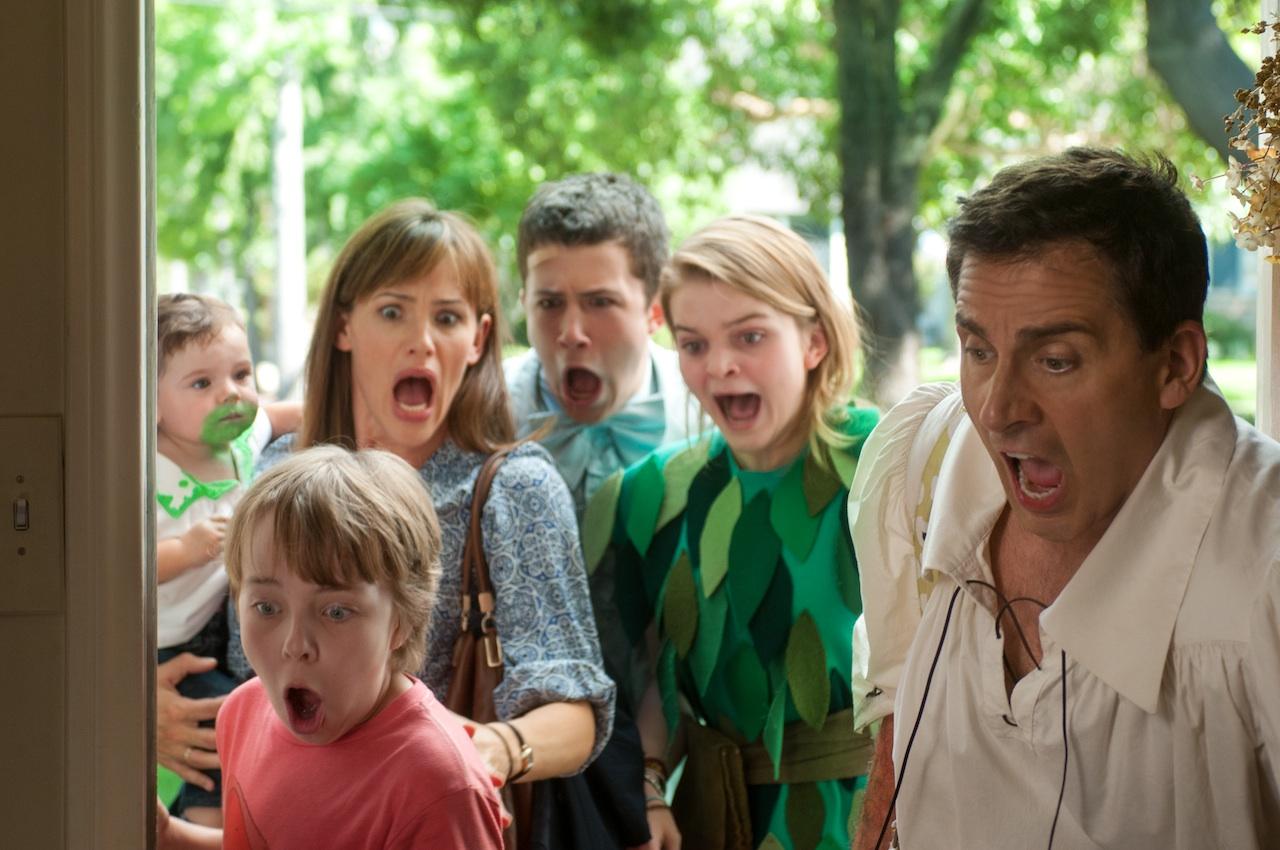
Things are going well for the rest of the family. Teen brother Anthony (Dylan Minnette) is taking the “hottest girl in school” to the prom and is about to get his driver’s license. Sister Emily (Kerris Dorsey) is about to star in a school production of “Peter Pan,” mom (Jennifer Garner) is due for a promotion and dad (Steve Carell) has a promising job interview.
Feeling down, Alexander makes a birthday wish. He wants everyone to know what it is like to have a “horrible, terrible, no good day.” Soon Emily gets a cold on the day of her performance, Anthony gets a zit and domestic chaos reigns.
The obvious joke to make about “Alexander and the Terrible, Horrible, No Good, Very Bad Day” would be to suggest that it should be retitled “Alexander and the Terrible, Horrible, No Good, Very Bad Movie.” But that would be disingenuous. It’s not terribly interesting, but it’s also not terrible, horrible, no good or very bad.
It’s gently paced family fare with a few genuine laughs and few surprises. Carell and Jennifer Garner are the most good-natured parents ever—when Emily vomits on dad after taking too much cough medicine he says, “Oh. I bet that felt good.”—and from that blossoms some funny situations and lines—“I’m going to need you to make an incredible effort on the potty tomorrow.”—but all are in service of the movie’s central theme that everybody has bad days.
Many of the situations don’t really feel organic. Instead they feel like set-ups to gags, outrageous filler—look Carell’s on fire!—to keep us interested until the inevitable happy ending.
Parents won’t find much to hold their attention in “Alexander and the Terrible, Horrible, No Good, Very Bad Day” but younger kids will likely get a kick out of the bad behavior on display. “Kids” it ain’t, although the Cooper children seem to get away with everything just short of murder.
“Men, Women & Children” is a sprawling ensemble drama that I suppose is meant to shed some light on the widening gap between analogue parents and their iphone toting kids, but comes off more as a high tech “Reefer Madness.” Someone needs to jiggle director Jason Reitman’s cord and reboot.
The movie, based on the Chad Kultgen novel, suggests that social media, video games and texting are the root of all modern evil. Anorexia, the shameless pursuit of Kim Kardashian style fame, teen pregnancy and even adultery, it seems to say, can be traced back to a key stroke or two.
It’s a remarkably clumsy observation from a director who has treated us to a searing look at downsizing in “Up in the Air” and a satiric look at lobbyists on “Thank You For Smoking.” Leading the charge against internet interaction is Patricia (Jennifer Garner), a mom who monitors her daughter’s every text and post and hands out pamphlets on the dangers of the selfie. She’s a hardcore crusader, the Mary Whitehouse of the anti-internet crowd. You expect her to yell, “Get off my URL,” at any moment. In any other Reitman movie she’d be played for laughs, the center for the satire, but here we’re supposed to take her seriously and that decision lies at the heart of what is very wrong with “Men, Women and Children.”
Instead of mining the rich vein of satire in the disconnect between kids and parents, Reitman pitches the tone in the area of an afterschool special. The listless direction and inability to answer any of the questions it raises, coupled with the tiresome cliché of texts and posts popping up all over the screen, overshadows some engaging work by the actors—particularly Judy Greer as a momanger to a teen wannabe, and Ansel Elgort and Kaitlyn Dever as a couple struggling to cope with their mothers.
Given the film’s attitude “Men, Women and Children” might have been better off with a title like “Old Folks Just Don’t Understand.”