The air of paranoia that hung over “All the President’s Men,” another movie centered on the investigative reporting of The Washington Post, is noticeably missing in “The Post.” Instead, the new Steven Spielberg film is a fist-pump-in-the-air look at the integrity and importance of a free press. It’s a little heavy-handed but these are heavy-handed times.
Meryl Streep plays Katharine Graham, the first female publisher of a major American newspaper. The socialite inherited The Washington Post following her husband Phil Graham’s death in 1963. “Kate throws a great party but she’s only here because her husband died,” harrumphs board member Arthur Parsons (Bradley Whitford). With the paper bordering on insolvency she has tough decisions to make.
Meanwhile hardnosed editor Ben Bradlee (Tom Hanks) is looking for a story that will help the paper break out of its local market and go national. “Are any of you tired of reading the news,” he asks his staff, “instead of reporting on it?”
When the New York Times breaks the story of a massive cover-up and is shut down by the Nixon White House, Bradlee sees an opportunity to scoop the Times and make a splash. Trouble is, the story involves several people close to Graham, most notably former Secretary of Defense Robert McNamara (Bruce Greenwood), who prolonged the Vietnam War despite knowing it was a no-win situation.
Graham must make the decision to publish or not. Running the so-called Pentagon Papers would expose years of government secrets, make an enemy of President Nixon and could scare off the investors she’s been courting. Not reporting could endanger young the Americans who were still being drafted and sent to fight an unwinnable war. “The only way to assert the right to publish is to publish,” argues Bradley.
No spoilers here, but the historical record shows that bombshell revelations were made and today The Washington Post is still a going concern.
“The Post” is a historical tale that feels as timely as any front-page story in today’s paper. A high-stakes look at journalism before the age of fake news, it reminds us of the importance of objective, investigative reporting in an era of secrecy, lies, and leaks. It’s a ‘if you don’t know your past, you don’t know your future” message movie that shines a light on a watershed but mostly forgotten slice of our past.
The Pentagon Papers were a significant turning point in our recent history. They were proof of a credibility gap between what politicians say and what they are doing. For Bradlee, publishing these documents sent a message that the White House had no influence on what stories made the front page and which don’t. “The press must serve the governed not the governors.”
Hanks and Streep, the two most trusted people in Hollywood, are solid as the two most trusted people in Washington.
As Graham, Streep is a woman who transcends the attitudes of her male advisors to do the right thing regardless of the repercussions. It’s a slow burn performance as she slowly sheds the weight of her socialite upbringing to embrace an outgoing and progressive point of view. As she grapples with publishing and possibly losing everything versus playing it safe, she becomes one of the film’s few characters with an arc.
Hanks plays Bradlee with bluster. As a noted collector of old school typewriters in real life, Hanks must have relished the chance to surround himself with the clickety-clack soundtrack of a newsroom in full tilt boogie. He is the movie’s reckless moral code, barking orders and making larger-than-life pronouncements on the importance of a free press. Hanks is at the Spencer Tracey stage of his career, an actor who brings with him an aura of decency and strength; the epitome of American exceptionalism made flesh. Despite the character being one-note Hanks breathes life into him, even if only as a spokesperson for the power of the first amendment.
“The Post” is propped up by good supporting performances, although fine actors like Sarah Paulson and Tracy Letts are stranded in roles that don’t give them much to do. Bob Odenkirk as Ben Bagdikian, one of the architects of the plan to publish the Pentagon Papers, fares better in one of the handful of roles expanded to full bloom.
The expected Spielberg touches are there as well. The Washington Post building shakes as the massive printing presses roar to life, a no-so-subtle metaphor of the upset the Pentagon Papers are about to cause in Washington.
Combined, all the elements add up to a movie that aims to make a statement while avoiding preaching to its audience. Spielberg, Hanks and Streep are entertainers first and foremost, and they do entertain here, but they also shine a light on a historical era whose reverberations are being felt today stronger than ever.
CHIPs: It’s a remake, a comedy and an action film and yet it doesn’t quite measure up to any of those descriptors. It’s a remake in the sense that writer-director-star Dax Shepard has lifted the title, character names and general situation from the classic TV show but they are simply pegs to hang his crude jokes on.
The Circle: While it is a pleasure to see Bill Paxton in his last big screen performance, “The Circle” often feels like an Exposition-A-Thon, a message in search of a story.
The Fate of the Furious: Preposterous is not a word most filmmakers would like to have applied to their work but in the case of the “Fast and Furious” franchise I think it is what they are going for. Somewhere along the way the down-‘n’-dirty car chase flicks veered from sublimely silly to simply silly. “The Fate of the Furious” is fast, furious but it’s not much fun. It’s an unholy mash-up of James Bond and the Marvel Universe, a movie bogged down by outrageous stunts and too many characters. Someone really should tell Vin Diesel and Company that more is not always more.
Fifty Shades Darker: Depending on your point of view “Fifty Shades of Grey” either made you want to gag or want to wear a gag. It’s a softcore look at hardcore BDSM (bondage, discipline, sadism and masochism) that spanked the competition on its opening weekend in 2015. Question is, will audiences still care about Grey’s proclivities and Ana’s misgivings or is it time to use our collective safeword? “Fifty Shades Darker” is a cold shower of a movie. “It’s all wrong,” Ana says at one point. “All of this is wrong.” Truer words have never been spoken.
The Mountain Between Us: Mountain survival movies usually end up with someone eating someone else to stay alive. “The Mountain Between Us” features the usual mountain survival tropes—there’s a plane crash, a showdown with a cougar and broken bones—but luckily for fans of stars Idris Elba and Kate Winslet cannibalism is not on the menu. Days pass and then weeks pass and soon they begin their trek to safety. “Where are we going?” she asks. “We’re alive,” he says. “That’s where were going.” There will be no spoilers here but I will say the crash and story of survival changes them in ways that couldn’t imagine… but ways the audience will see coming 100 miles away. It’s all a bit silly—three weeks in and unwashed they still are a fetching couple—but at least there’s no cannibalism and no, they don’t eat the dog.
The Mummy: As a horror film it’s a meh action film. As an action film it’s little more than a formulaic excuse to trot out some brand names in the kind of film Hollywood mistakenly thinks is a crowd pleaser.
The Shack: Bad things in life may be God’s will but I lay the blame for this bad movie directly on the shoulders of director Stuart Hazeldine who infuses this story with all the depth and insight of a “Davey and Goliath” cartoon.
The Snowman: We’ve seen this Nordic Noir before and better. Mix a curious lack of Oslo accents—the real mystery here is why these Norwegians speak as though they just graduated RADA—Val Kilmer in a Razzie worthy performance and you’re left with a movie that left me as cold as the snowman‘s grin.
Valerian and the City of a Thousand Planets: Movies like the high gloss crime thriller “La Femme Nikita,” the assassin mentor flick “Léon: The Professional” and outré sci fi opera “The Fifth Element” have come to define director Luc Besson’s outrageous style. Kinetic blasts of energy, his films are turbo charged fantasies that make eyeballs dance even if they don’t always engage the brain. His latest, “Valerian and the City of a Thousand Planets,” not only has one of the longest titles of the year but is also one of the most over-the-top, retina-frying movies of the year. Your eyes will beg for mercy.
Wonder Wheel: At the beginning of the film Mickey (Justin Timberlake) warns us that what we are about to see will be filtered through his playwright’s point of view. Keeping that promise, writer, director Woody Allen uses every amount of artifice at his disposal—including cinematographer Vittorio Storaro’s admittedly sumptuous photography—to create a film that is not only unreal but also unpleasant. “Oh God,” Ginny (Kate Winslet) cries out at one point. “Spare me the bad drama.” Amen to that.
THE UGLY
Song to Song: I think it’s time Terrence Malick and I called it quits. I used to look forward to his infrequent visits. Sure, sometimes he was a little obtuse and over stayed his welcome, but more often than not he was alluringly enigmatic. Then he started coming around more often and, well, maybe the old saying about familiarity breeding contempt is true. In “Song to Song” there’s a quick shot of a tattoo that sums up my feelings toward my relationship with Malick. Written in flowery script, the words “Empty Promises” fill the screen, reminding us of the promise of the director’s early work and amplifying the disappointment we feel today. This is the straw that broke the camel’s back, the Terrence Malick movie that put me off Terrence Malick movies. I’ll be nice though and say, it’s not him, it’s me.
EXTRA! EXTRRA! MOST COUNFOUNDING
mother!: Your interest in seeing “mother!,” the psychological thriller from “Black Swan” director Darren Aronofsky, may be judged on your keenness to watch American sweetheart Jenifer Lawrence flush a beating heart down a toilet. Aronofsky’s story of uninvited guests disrupting the serene lives of a poet and his wife refuses to cater to audience expectations. “mother!” is an uncomfortable watch, an off-kilter experience that revels in its own madness. As the weight of the weirdness and religious symbolism begins to feel crushing, you may wonder what the hell is going on. Are these people guilty of being the worst houseguests ever or is there something bigger, something biblical going on?
Aronofsky is generous with the biblical allusions—the house is a paradise, the stranger’s sons are clearly echoes of Cain and Abel, and there is a long sequence that can only be described as the Home-style Revelation—and builds toward a crescendo of wild action that has to be seen to be believed, but his characters are ciphers. Charismatic and appealing to a member, they feel like puppets in the director’s apocalyptic roadshow rather than characters we care about. Visually and thematically he doesn’t push button so much as he pokes the audience daring them to take the trip with him, it’s just too bad we didn’t have better company for the journey.
“mother!” is a deliberately opaque movie. Like looking into a self-reflective mirror you will take away whatever you put into it. The only thing sure about it is that it is most confounding studio movie of the year.
Baby Driver: Although it contains more music than most tuneful of movies “Baby Driver,” the new film from director Edgar Wright, isn’t a musical in the “West Side Story,” “Sound of Music” sense. Wallpapered with 35 rock ‘n roll songs on the soundtrack it’s a hard driving heist flick that can best be called an action musical.
The Big Sick: Even when “The Big Sick” is making jokes about terrorism and the “X-Files” it is all heart, a crowd-pleaser that still feels personal and intimate.
Call Me By Your Name: This is a movie of small details that speak to larger truths. Director Luca Guadagnino keeps the story simple relying on the minutiae to add depth and beauty to the story. The idyllic countryside, the quaint town, the music of the Psychedelic Furs and the languid pace of a long Italian summer combine to create the sensual backdrop against which the romance between the two blossoms. Guadagnino’s camera captures it all, avoiding the pitfalls of melodrama to present a story that is pure emotion. It feels real and raw, haunted by the ghosts of loves gone by.
Darkest Hour: This is a historical drama with all the trappings of “Masterpiece Theatre.” You can expect photography, costumes and period details are sumptuous. What you may not expect is the light-hearted tone of much of the goings on. While this isn’t “Carry On Churchill,” it has a lighter touch that might be expected. Gary Oldman, not an actor known for his comedic flourishes, embraces the sly humour. When Churchill becomes Prime Minister his wife, Clementine (Kristin Scott Thomas) makes an impassioned speech about the importance of the work he is about to take on. He raises a glass and, cutting through the emotion of the moment, says, “Here’s to not buggering it up!” It shows a side of Churchill not often revealed in wartime biopics.
The Disaster Artist: The key to pulling off “The Disaster Artist” is not recreating “The Room” beat for beat, although they do that, it’s actually about treating Wiseau as a person and not an object of fun. He’s an outrageous character and Franco commits to it 100%. From the marble-mouthed speech pattern that’s part Valley Girl and part Beaker from The Muppets to the wild clothes and stringy hair, he’s equal parts creepy and lovable but underneath his bravado are real human frailties. Depending on your point of view he’s either delusional or aspirational but in Franco’s hands he’s never also never less than memorable. It’s a broad, strange performance but it may also be one of the actor’s best.
Dunkirk: This is an intense movie but it is not an overly emotional one. The cumulative effect of the vivid images and sounds will stir the soul but despite great performances the movie doesn’t necessarily make you feel for one character or another. Instead its strength is in how it displays the overwhelming sense of scope of the Dunkirk mission. With 400,000 men on the ground with more in the air and at sea, the sheer scope of the operation overpowers individuality, turning the focus on the collective. Director Christopher Nolan’s sweeping camera takes it all in, epic and intimate moments alike.
The Florida Project: This is, hands down, one of the best films of the year. Low-budget and naturalistic, it packs more punch than any superhero. Director Sean Baker defies expectations. He’s made a film about kids for adults that finds joy in rocky places. What could have been a bleak experience or an earnest message movie is brought to vivid life by characters that feel real. It’s a story about poverty that neither celebrates or condemns its characters. Mooney’s exploits are entertaining and yet an air of jeopardy hangs heavy over every minute of the movie. Baker knows that Halley and Moonie’s well being hangs by a thread but he also understands they exist in the real world and never allows their story to fall into cliché.
Get Out: This is the weirdest and most original mainstream psychodrama to come along since “The Babadook.” The basic premise harkens back to the Sidney Poitier’s classic “Guess Who’s Coming to Dinner.” In that film parents, played by Spencer Tracy and Katharine Hepburn, have their attitudes challenged when their daughter introduces them to her African American fiancé. The uncomfortable situation of meeting in-laws for the first time is universal. It’s the added layers of paranoia and skewered white liberalism that propels the main character’s (Daniel Kaluuya) situation into full-fledged horror. In this setting he is the other, the stranger and as his anxiety grows the social commentary regarding attitudes about race in America grows sharper and more focussed.
Lady Bird: Greta Gerwig’s skilful handling of the story of Lady Bird’s busy senior year works not just because it’s unvarnished and honest in its look at becoming an adult but also, in a large degree, to Saoirse Ronan’s performance. I have long called her ‘Lil Meryl. She’s an actor of unusual depth, a young person (born in 1994) with an old soul. Lady Bird is almost crushed by the weight of uncertainty that greets her with every turn—will her parents divorce, will there be money for school, will Kyle be the boy of her dreams, will she ever make enough cash to repay her parents for her upbringing?—but Ronan keeps her nimble, sidestepping teen ennui with a complicated mix of snappy one liners, hard earned wisdom and a well of emotion. It’s tremendous, Academy Award worthy work.
The Post: Steven Spielberg film is a fist-pump-in-the-air look at the integrity and importance of a free press. It’s a little heavy-handed but these are heavy-handed times. Director Spielberg and stars Tom Hanks and Meryl Streep are entertainers first and foremost, and they do entertain here, but they also shine a light on a historical era whose reverberations are being felt today stronger than ever.
The Shape of Water: A dreamy slice of pure cinema. Director Guillermo del Toro uses the stark Cold War as a canvas to draw warm and vivid portraits of his characters. It’s a beautiful creature feature ripe with romance, thrills and, above all, empathy for everyone. This is the kind of movie that reminds us of why we fell in love with movies in the first place.
Three Billboards Outside Ebbing, Missouri: The story of a mother’s unconventional war with the world is simple enough, it’s the complexity of the characters that elevates the it to the level of great art.
Wonder Woman: Equal parts Amazon sword and sandal epic, mad scientist flick, war movie and rom com, it’s a crowd pleaser that places the popular character front and centre. As played by Gal Gadot, Diana is charismatic and kick ass, a superhero who is both truly super and heroic. Like Superman she is firmly on the side of good, not a tortured soul à la Batman. Naïve to the ways of the world, she runs headfirst into trouble. Whether she’s throwing a German tank across a battlefield, defying gravity to leap to the top of a bell tower, tolerating Trevor’s occasional mansplaining or deflecting bullets with her indestructible Bracelets of Submission, she proves in scene after scene to be both a formidable warrior and a genuine, profoundly empathic character.
One day someone may write about Emma Watson without mentioning the Harry Potter franchise, but today is not that day. Few child stars have faced the glare of the spotlight as acutely as the core Potter cast and the fame that came along with playing Harry, Ron and Hermione will likely follow them around for as long as Potterheads roam the earth.
It’s not like they are crying over spilt potion, however. On screen Daniel Radcliffe takes on demanding roles that give him the chance to distance himself from Harry and, apparently, show his bum at every opportunity. Rupert Grint has kept a lower profile, starring in a few independent films and playing an upper-crust criminal on the television adaptation of Snatch.
Of the three Emma Watson has maintained the highest professional profile. Whether addressing the United Nations or starring opposite a heartbroken furry beast or accepting British GQ’s Woman of the Year Award she has rarely been far from view.
This weekend she follows up her biggest post-Potter hit, starring as Belle in the live action remake of Beauty and the Beast, with the high-tech thriller The Circle. Appearing opposite Tom Hanks she plays a young woman hired at The Circle, America’s most influential and possibly dangerous tech company.
She says, “I pick movies, not roles,” and has amassed a carefully curated IMDB page—including everything from This is the End’s axe wielding version of herself to Noah’s adopted daughter—designed to challenge an audience used to seeing her as Hermione and showcase strong and independent characters.
A year after Harry Potter and the Deathly Hallows – Part 2 she surprised fans by playing a wise-beyond-her years free spirit in The Perks of Being a Wallflower. “If you had told me that the first movie I was going to do coming out of Harry Potter was an American high school movie,” she told the Hollywood Reporter, “I would have laughed at you.”
Based on a popular junior adult novel, it uses one of the building blocks of teen drama—the friendless teen trying to navigate high school in his freshman year—but layers in equal amounts of teen angst and exuberance before the final class bell rings. Watson is terrific, avoiding the square-peg-in-a-round-hole clichés that could have dogged her character.
Her next starring role silenced Hermione comparisons forever. The Bling Ring plays like a Law & Order episode of The Hills. Based on actual events, it centers on a group of narcissistic Los Angeles teenagers who track the comings and goings of their favourite celebs on the internet. While one-named millennial stars like Paris, and Lindsay are out on the town the Ring “go shopping,” breaking into their homes, helping themselves to jewels, designer clothes and loose cash.
Watson’s performance nails the vapidity that made the robberies possible. Dead eyed, with a bored infliction on every word she mispronounces, her take on Nicki shows there’s more to her than being a wizard’s sidekick.
“I am aware I have a long way to go,” she told Elle UK. “I am not sure I deserve all the respect I get yet, but I’m working on it.”
The twenty-seven-year-old may have a long way to go, but one thing is for sure, if she continues to choose daring and exciting roles, she’s not going anywhere.
There’s an old saying that says a little knowledge is a dangerous thing. “The Circle,” a new Emma Watson, Tom Hanks’ thriller updates the message for the cyber age. “Knowing is good, but knowing everything is better,” is the chilling message.
Based on the Dave Eggers bestseller of the same name, “The Circle” stars Emma Watson as Mae Holland, a young woman who lands a gig at The Circle, a social media company with the influence of Apple and Facebook combined. It’s high tech glamour with a human touch, the chaos of the web made elegant. When Mae’s father falls ill her health coverage is extended to include her extended family. “You are a valued member of the Circle,” says the Zuckerbergesque company head and co-founder Eamon Bailey (Tom Hanks). “We care about everybody you care about.”
As she moves up the ranks Bailey convinces her to take part in a radical test. “Mae,” he asks, “do you think you behave better or worse when you are being watched?” It is a grand social experiment that sees her observed on-line every minute of the day via a new, lightweight, wireless portable camera. On the surface it’s a utopian idea, a way to make people better—“When we are our best selves,” says Bailey, “there isn’t a problem we can’t solve.”—that soon has some unexpected consequences.
When her co-worker Ty (John Boyega) warns her that “all the information, everything broadcast, recorded and seen is stored there and they can use it however they want,” she realizes the possibilities of a surveillance culture.
“The Circle” is a snapshot not of today but of two years ago. It’s almost impossible to tell a dystopian or cautionary cyber tale when Russian hackers are throwing American elections and your laptop is already spying on you and likely has been for years. The film feels as current as it’s musical guest star Beck, a musician old enough to be Watson’s father.
It does raise questions about the usage of personal data for the gain of personal wealth, the role of technology in government—“The government needs us more than we need them,” snarls The Circle’s COO (Patton Oswalt)—and the nature and importance of privacy in the wild west of the internet but it doesn’t add much to the conversation. The messages are earnest, but Watson’s Mae is a passive player, a shallow character too gullible and easily influenced to maintain our interest. The solution to her moral quandary feels better suited to a Facebook post than the climax to a movie.
While it is a pleasure to see Bill Paxton in his last big screen performance, “The Circle” often feels like an Exposition-A-Thon, a message in search of a story.
This weekend professor of religious iconology and symbology Robert Langdon (Tom Hanks) returns to theatres in Inferno, the third movie in the Da Vinci Code franchise.
In 2006 the fictional Harvard prof made his big screen debut, uncovering the complicated personal life of Jesus Christ in The Da Vinci Code. Three years later he used his knowledge of symbology to unravel the mystery of a secret brotherhood called the Illuminati and thwart a terrorist act against the Vatican.
In between those two movies I received dozens of outraged emails, long tracts regarding Dan Brown’s books, the up-coming movie, The Illuminati and the veracity of the stories.
In response to the anxious folks who contacted me, concerned the film, which had not been released yet, would be a dangerous piece of anti-Catholic propaganda, I wrote a forward to my Angels and Demons review, pointing letter writers toward the Vatican newspaper L’Osservatore Romano. They described Angels and Demons as “harmless entertainment which hardly affects the genius and mystery of Christianity.” Their review noted it is filled with historical inaccuracies but went on to suggest that one could make a game of pointing out all of the film’s historical mistakes.
In other words, don’t take it seriously and you’ll have a good time. Despite the Vatican newspaper’s warm embrace, the film still ignited a firestorm of criticism from people upset about the story’s alleged anti-Catholic sentiments, “malicious myths” and churches being associated with scenes of murder.
Inferno sidesteps religious controversy with a tale of a deadly virus that threatens all of humanity, but cinema and religion have often made for uncomfortable pairings.
In 1999 the Catholic League denounced Dogma’s tale of two fallen angels (Ben Affleck and Matt Damon) trying to get back into heaven as “blasphemy.” More recently uproar erupted over Darren Aronofsky’s unorthodox take on the story of Noah. Jerry Johnson, president of the National Religious Broadcasters, loudly objected to the film’s “insertion of the extremist environmental agenda.”
Perhaps the most controversial religious film ever was The Devils, based on Aldous Huxley’s nonfiction book The Devils of Loudun. Years before Ken Russell made the movie, a filmmaker approached Huxley wanting to turn the story of a radical 17th century French Catholic priest accused of witchcraft and burned at the stake, into a film. Huxley said, ‘Don’t do it. Don’t make a movie out of this.’ He thought there was no way the story could be presented in an entertaining way without short-circuiting people’s minds. Turns out maybe he was right.
Forty-five years after its release Russell’s film is little seen but much talked about. Banned, censored and still unavailable in its complete form on Blu-Ray, the movie’s graphic church orgy offended many—and was cut to pieces and removed by censors—but it’s more than shock and titillation. It’s a film that makes a serious statement about the struggle between church and state but does so in an entertaining and provocative way.
Lots of movies contain violence or sex or religion, but Russell mixed all three together in one toxic cocktail. If released today The Devils may not inspire riots in the streets, as it did in 1971, but if presented in its complete form the following indignation would make the Angels and Demons protests seem tame.
A better title for “Inferno,” the latest big screen exploits of symbology professor Robert Langdon, might have been “The Da Vinci Code: This Time it’s Personal.” Not only must Langdon, once again in the form of Tom Hanks, confront an old love but he also must dig deep into his shattered memory to piece together the clues of his greatest mystery ever.
Or something like that.
The convoluted story begins with bioengineer and billionaire Bertrand Zobrist (Ben Foster) spewing his extreme theories on the planet’s problems. “Every ill on earth can be traced back to overpopulation,” he says. In the space of just twenty four hours Zobrist drops out of the picture, and Langdon is found disoriented and put under the care of Dr. Sienna Brooks (Felicity Jones). “What am I doing in Florence?” he asks. Suffering from retrograde amnesia and terrifying visions of a hellish nature, people with heads twisted back to front, seas of fire, pools of blood and serpents, he struggles to remember the events of the last forty-eight hours.
With the help of Brooks he goes on the run from a determined assassin (Ana Ularu) and the World Health Organization until he can gather the clues that will lead him to the Inferno Virus, a plague planted by Zobrist to cull the world’s population by half. “Humanity is the disease,” he cackles, “Inferno is the cure.”
Add in close calls, narrow escapes and clues hidden in Italian antiquities and you have “Inferno,” the thriller with no clue how to be thrilling. Instead it’s two hours of exposition, a lesson in Botticelli and Dante. Whatever thrills there were to be mined from David Koepp’s script are blunted by director Ron Howard’s habit of showing and telling clues and info over and over, not trusting the viewer to be able to follow along. With convoluted clues and lots of Italian names and places to keep track of “Inferno” repeats information ad nauseam.
This is the third time Hanks has played Langdon but in the fullness of time I don’t think we’ll look back on the symbologist as the actor’s most memorable character. He carries the movies, which have made hundreds of millions of dollars, but he’s less a character then he is an exposition machine, an explainer of obscure history, a purveyor of aha moments. Hanks is a charmer, but he’s done in trying to wade through the movie’s scripting mire.
Sharing the screen is Jones, soon to be seen in “Rogue One: A Star Wars Story.” As Dr. Brooks she is Langdon’s intellectual match and one of the dual engines that keeps the story plodding along, but spends most of the film nodding in agreement to Langdon’s sudden, remarkable realisations.
As the villain Foster’s few appearances—he’s peppered throughout usually appearing in video clips, is further proof that Hollywood doesn’t know what to do with this talented actor.
More fun is Irrfan Khan as the calm, cool and collected head of a mysterious group that manages risks for high profile clients. He’s deadly, duplicitous and James Bond villain suave.
The obvious joke here is that “Inferno” is clueless. But it’s not, it’s overstuffed with clues, just not thrills.
On January 15, 2009 Sully Sullenberger was an airplane captain with forty-two years experience piloting a plane on a routine run from New York’s LaGuardia Airport to a stopover at Charlotte Douglas International Airport. The next day he was a worldwide hero, an instant celebrity.
Shortly after take-off his plane was disabled by a flock of Canadian Geese who flew into the engines, knocking out the plane’s navigating system. In just under four minutes Sullenberger assessed the situation and, realizing there was no time to turn back, made the decision to land the craft on the Hudson River. The risky landing was successful and all 155 passengers and crew survived with only minor injuries.
To this day the now-retired pilot says when he flies “other passengers often tell me, ‘I feel so much safer now that you’re on the airplane with us.’ I’m not quite sure why they do, but I’m just glad they do.”
The Miracle on the Hudson, as the New York press dubbed it, is now the subject of Sully, a biopic from director Clint Eastwood and star Tom Hanks.
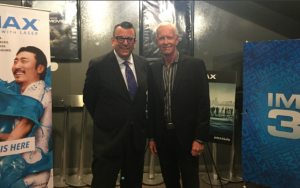
The pilot says, “Watching the film, especially in the IMAX format makes you feel like you’re on that flight with us,” but doesn’t bring back the anxiety of the day for him.
“Enough time has passed,” he says, “and I’ve had enough time to process this and make it a part of me and not something that just happened to me. I don’t have quite the same emotions I had during that day, that flight, but the very first time I saw this film with my family it was a very emotional experience for all of us. The second time I watched the film I was able to take it in as more of a usual movie going experience and see some of the things I wasn’t able to see the first time.”
As for having Oscar winner Hanks portraying him Sullenberger says, “We talked in some detail about the script and the obligation he felt to get it right because after the film was completed I would be going back to living my life and would have to live with however he portrayed me on screen.”
Now that the movie is finished he laughs, “It is a weird experience to see someone else onscreen portraying you and speaking words you actually spoke.”
Sullenberger’s story doesn’t end with the landing. In the years since he has been named one of Time magazine’s 100 Most Influential Heroes and Icons, written bestselling books and become a spokesman for St. Jude Children’s Research Hospital. It’s a whirlwind that changed his life forever.
“My family and I think of this story in two phases. There was the trauma of that flight itself and then the trauma of suddenly becoming a world recognized public figure. Once my name had been discovered by the press an onslaught, a tsunami of attention happened very quickly. Within a few months we had received 50,000 communications. Emails, letters, requests. The press was camped outside our house for ten days. It was just overwhelming. It very quickly required finding a new way of living this life as public figures. We had to become more complete versions of ourselves to be able to do that.”
“Life is easier in the air,” sighs First Officer Jeff Skiles (Aaron Eckhart). Easy? Not when the plane you are piloting is subject to a bird strike that disables two of the engines. That’s the story told in “Sully,” Clint Eastwood’s real-life account of ‘Sully’ Sullenberger’s miraculous landing of a disabled plane on New York’s Hudson River.
Tom Hanks plays the title character, a pilot with 42 years experience. “It’s been my life,” he says of aviation, “my whole life.” January 15, 2009 started off as a routine day for the seasoned pilot. As the captain of US Airways Flight 1549 he left New York’s LaGuardia Airport for a stopover at Charlotte Douglas International Airport when his plane was disabled by a flock of birds who flew into the engines, knocking out the plane’s navigating system. In just under four minutes Sully assessed the situation and, realizing there was no time to turn back, made the decision to land the craft on the Hudson River. “I’ve delivered one million passengers over 40 years,” he says later, “but will be charged on 208 seconds.” The risky landing was successful and all 155 passengers and crew survived with only minor injuries. “It’s been a while since New York had news this good,” says one airline official, “particularly with an airplane in it.”
The film dramatizes the landing but spends most of its time in the aftermath, the resultant onslaught of publicity and some very difficult questions from a National Transport Safety Board investigative panel.
“Sully” is a slight but entertaining movie. Because we know how it ends Eastwood’s attempts to create tension by and large don’t work. Its you-are-there recreation of the landing is exciting when it places the viewer in the plummeting metal tube—the mantra “Brace for impact” will forever be branded on your brain—melodramatic when it hits the water. It’s the centerpiece of an otherwise movie talky movie.
The ditching of the plane may get your pulse racing but it is the personal story that will stay with you. As Sully Hanks is dignity personified. Questions gnaw at him in the days leading up to the inquiry, causing sleepless nights and mild friction with his wife Lorraine (Laura Linney) but he remains steadfast. It’s old school heroism and it looks good on Hanks.
As a function of the story, but also, I suspect, as a preference of the filmmaker, technology is downplayed throughout. When the NTSB uses computer simulations to attack Sully, Skiles, who has most of the good lines in the film, says, “They’re playing Pac-Man while we’re the ones flying the plane.” The point being made is that computers lack the human touch but it does feel a bit like Grandpa complaining that the new fangled television remote is too complicated.
“Sully” is a well-constructed, occasionally exciting old-fashioned story of heroism in the face of modern cynicism.