Broad vocabulary, grammar and syntax are the domain of humans, but science tells us millions of species communicate by using body language and intuitive calls. Chimps can be taught to sign simple phrases and elephants have individual sounds to signify danger and emotions, but complex storytelling is left to us humans.
Unless you’re at the movies. This year, theatres have been overrun by hordes of anthropomorphic animals. From Zootopia and Nine Lives to The Secret Lives of Pets and The Jungle Book, animals have been talking up a storm.
This weekend The Wild Life becomes the latest animated film to tell a story from the point of view of wildlife. A riff on Daniel Defoe’s classic tale of survival, Robinson Crusoe, the film’s narrator is a bright red parrot named Mak (David Howard).
In this version, Crusoe crash lands on an island where animals rule and must work with the chatty Mak, a tapir named Rosie and Kiki the kingfisher to save their home from an invasion by some savage felines.
Disney has the grandest tradition of talking animals — Mickey Mouse to The Little Mermaid’s Sebastian the Crab and Jiminy Cricket to name just a few — but they are not the only ones putting words into our pet’s mouths.
Flushed Away comes from Aardman, the animation company behind Wallace and Gromit.
The story of an upper class pet mouse flushed down the loo by a bullying rat features great animation, an all-star British voice cast and something that all kids love — toilet humour. It swirls along at quite a clip, effortlessly mixing literate verbal and visual jokes — we glimpse a cockroach reading Kafka’s Metamorphosis — with potty humour that’ll appeal to the kids.
G-Force’s talking crime fighting guinea pigs come courtesy of über-producer Jerry Bruckheimer. The voice cast includes not one, but two Oscar winners, which may be an indication that the recession has finally taken root in Hollywood.
When the best gig Penelope Cruz can get involves saying lines like “Oh, I have to save his fur again?” you know times are tight for A-listers.
Pixar’s Ratatouille is an unusual cross between America’s Next Top Chef and Willard. Remy (voiced by Patton Oswalt) is a sophisticated rodent with a highly developed sense of smell and a wicked sense of humour.
While his rat brothers and sisters are happy to simply survive by scavenging through the garbage, Remy aspires to culinary greatness. Ratatouille does something no other film has been able to — not that a lot of have tried — it makes rats cute, lovable even.
On the live action front, Zookeeper, or as any Kevin James movie could be called, “Fat Guy Falling Down… A Lot,” plays like Dr. Doolittle if Dr. Doolittle was a romantic comedy for kids. Luckily the animals come to the rescue. Luckily the monkey from The Hangover 2 has some of the film’s best lines. Adam Sandler provides the monkey voice, but also listen for the beastly vocal work of Cher, Nick Nolte, Don Rickles and Sylvester Stallone.
“A Hologram for the King” is a crappy title. Doesn’t mean much. Sounds like it could be a sci-fi film or a high-tech Elvis Presley tribute. To really sum up the feel of the new Tom Hanks film I’d suggest calling it “How Tommy Got his Groove Back.”
Hanks plays Alan Clay, a put-up middle manager with a testy ex-wife and unhappy boss. He’s a boy wonder whose later years have not been so wonderful, an older man who finds himself beaten down by the corporate system he helped create. The opportunity to pitch an IT system for a new Saudi Arabian city offers up a way out of his financial, personal and career woes, but when he arrives in the Arab state he discovers there are no easy answers to his problems. He clashes with Saudi culture but ultimately find connections with people, including his reckless driver (Alexander Black) and compassionate doctor (Sarita Choudhury).
“A Hologram for the King” is an aimless, meandering movie that isn’t so much about being a fish out of water is as it is about one man getting his mojo back. When we first meet Alan he has lost direction. His ability to make complicated situations go smoothly has evaporated and he has a weird lump on his back that may or may not be cancer. He’s a sad sack with a permanent grin plastered on his face, the kind of loveable loser Hanks can play in his sleep. The actor has entered the Spencer Tracy phase of his career; he’s effortlessly likeable and doesn’t bump into the furniture.
Too bad he’s wasted in a tragicomic movie that can’t decide if it wants to make a statement about how American greed drove industry offshore or about Arab culture or about an aging yuppie facing emasculation and mortality. It’s all over the place and Hanks does his best to ground it but ultimately “A Hologram for the King” feels like two or more movies spliced together to form one whole.
In the Heart of the Sea features less of Chris Hemsworth than we’ve seen on screen before. He’s in virtually every scene, but for much of the film the usually bulked up Thor star is set adrift in a raft, starving and physically much less imposing than usual.
The movie is an old-fashioned whale of a tale. Literally.
Based on the true story said to have inspired Moby Dick, it’s about whalers battling not only repeated assaults from the one whale who fought back, but also malnourishment and dehydration.
At sea for three months in tiny whaleboats the men are pushed to the edge of sanity, taking drastic steps to survive.
To convincingly play a starving sailor Hemsworth trimmed 33 pounds off his already toned 6’2 3/4” frame.
“My crazy diet would make you pass out from exhaustion,” he said. At certain points he was eating just 500 or 600 calories — that’s less than a combo lunch meal at most fast-food places — in the form of a boiled egg, two crackers and a celery stick a day.
Hemsworth and his underfed cast mates passed away the time with conversations “about our favourite foods and what we would eat when we finished the film.”
The actor says losing that amount of weight isn’t something he’d like to do again, but adds, “by those final sequences when we were supposed to be exhausted and emotional. We were feeling that way off screen too, so it helped.”
Dramatic weight loss isn’t new — actors have been yo-yo dieting for roles for years — but doctors say rapid body mass reduction can lead to malnutrition, maladies like gallstones and worse. In other words, as Christian Bale who dumped 60 pounds for his role in The Machinist says, “It ain’t great for your health.”
Still, actors take on dramatic diets to aid in their dramatic work. Anne Hathaway dropped 25 pounds by food deprivation and exercise to make Les Miserables while Matthew McConaughey survived eating only Diet Coke, egg whites and a piece of chicken a day to play AIDS patient Ron Woodroof in Dallas Buyers Club. According to The Playlist he stopped dieting when “people stopped asking if he was all right and started suggesting he seek help.”
Just as common are actors who gain weight. Russell Crowe gained 63 pounds to play a CIA bigwig in Body of Lies, George Clooney gained 35 pounds for Syriana and Renee Zellweger gained 30 pounds for Bridget Jones’s Diary, lost it, only to regain it for the sequel.
Jared Leto who lost 40 pounds to play Rayon in Dallas Buyer’s Club, gained 67 pounds for the film Chapter 27 by drinking melted pints of chocolate Haagen Dazs ice cream mixed with olive oil and soy sauce “to get me bloated even more.”
Why do actors alter their bodies? Some call it dedication while cynics suggest it’s an easy Oscar. Physical transformations (plus acting talent) brought Robert DeNiro, Charlize Theron and McConaughey to the winner’s circle.
But some actors have sworn off manipulating their weight. Jim Carrey turned down a role in the Three Stooges biopic that would have required him to gain 40 to 50 pounds and Tom Hanks blames gaining and losing weight for roles with him developing Type 2 diabetes.
“I’ve talked to a number of actors who have gained weight for roles and — just out of the sheer physical toll on one’s knees and shoulders — no-one wants to do it again,” he told the BBC.
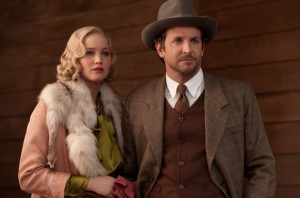
Bradley Cooper and Jennifer Lawrence first paired off in Silver Linings Playbook — he was a divorced substitute teacher, jailed for beating his wife’s boyfriend half to death; she was a troubled widow who needed his help to win a dance competition — and sparks flew.
Next they shared scenes, but no romance, in American Hustle. And, this weekend, they make it a trifecta with the release of Serena. Based on the novel by Ron Rash, Cooper and Lawrence play husband and wife lumber barons whose marriage becomes strained after she suffers a miscarriage. Despite having shared love scenes in movies, Cooper says they have kept the romance onscreen.
“I mean, first of all, I could be her father,” he says.
The re-teaming of Cooper and Lawrence in Serena proves that lightning does not always strike thrice.
The “it” couple had chemistry to burn in their previous pairings but fail to set off sparks here. As George and Serena they are ruthless and selfish, which should be the stuff of interesting characters, but the story throws so many hurdles their way that eventually it becomes one big, boring blur.
Some onscreen couples, however, have managed to keep the flame alive through several films.
After a 16-year separation, Tom Hanks and Meg Ryan — the pre-eminent cinema sweethearts of the 1990s — will reunite in the World War II drama Ithaca.
The three rom coms that made them superstars, Joe Versus the Volcano, Sleepless in Seattle and You’ve Got Mail, were fuelled by the platonic chemistry they share in real life.
“He makes me feel less alone,” says Ryan.
Kate Winslet and co-star Leonardo DiCaprio are so close in real life that her children refer to him as Uncle Leo. As Titanic’s star-crossed lovers Jack and Rose, they defined romantic tragedy for a whole generation before recoupling 11 years later in the feel-bad love story Revolutionary Road.
Despite what fans thought, their friendship never turned romantic off-screen. “He always saw me as one of the boys,” said Kate.
Despite falling in love over and over again in movies like The Wedding Singer, 50 First Dates and Blended, Drew Barrymore says she and Adam Sandler have exchanged nothing more than a “church kiss.”
“That’s probably why we’ve been able to stick together all these years,” she says, “because there never was that awkward moment.”
The lesson learned is that chemistry off-screen often leads to good results on the screen, but not always. Tony Curtis and Marilyn Monroe fogged up the lens in Some Like It Hot, but reportedly did not like one another.
There’s an old saying that goes, “You can choose your friends, but you can’t choose your family.” True enough, but as Hollywood has taught us, you can add neighbors to the “cannot choose” list.
This weekend in Neighbors Seth Rogen and Rose Byrne star as parents of a new baby whose quiet suburban life is uprooted when unruly frat boys led by Zac Efron and Dave Franco move in next door. “Make sure that if we’re too noisy, call me,” says Zac. “Don’t call the cops.”
When a house party spirals out of control the couple has to call the cops, thereby violating “the circle of trust” and triggering a Hatfield and McCoy’s style feud between the households.
Terrible neighbors are nothing new in Hollywood films.
In his final role John Belushi starred as earl Keese in the 1981 movie Neighbors. He plays a cranky man whose regimented residential life is turned upside down by toxic neighbors, played by his Blues Brothers cohort Dan Aykroyd and Cathy Moriarty. “We don’t want any bad blood,” says Aykroyd, “especially since we’ll be living next door to you for a long, long time.”
The situation spirals out of control, but what begins as domestic warfare between the tow households soon takes a turn when Earl realizes his new neighbors are way more fun than the button–down life he led before.
The dark comedy didn’t satisfy critics or fans of Blues Brothers era Belushi and Aykroyd, but Roger Ebert liked it, calling it, “an offbeat experiment in hallucinatory black humor,” and giving it four out of five stars
Roman Polanski’s study of nasty neighbors, Rosemary’s Baby was a much bigger hit. After moving into the beautifully gothic Bramford apartment building (exterior shots were taken at John Lennon’s old home, the Dakota Building on New York City’s Upper West Side) Rosemary Woodhouse (Mia Farrow) and husband Guy (John Cassavettes) soon discover that the folks next door Minnie and Roman Castevet (Ruth Gordon and Sidney Blackmer) have a satanic interest in their unborn child.
“Awful things happen in every apartment house,” says Rosemary.
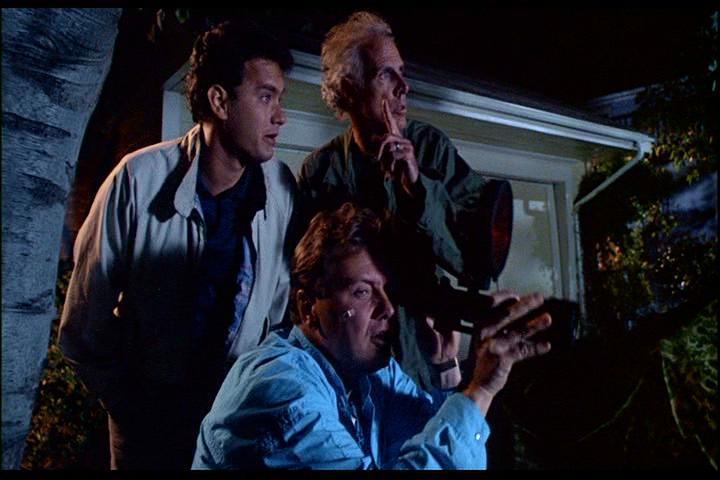
The ‘Burbs may have the ultimate nosy neighbors. The action in the 1989 Tom Hanks movie really begins when one of the locals finds as femur bone in the backyard. “Our neighbors are murdering people,” he says. “They’re chopping them up. They’re burying them in their backyard.”
Rumours of a suburban cannibalistic cult spread through town, putting everyone on edge.
“Green sky at morning,” say Ricky Butler (Corey Feldman), “neighbor take warning.”
TOP THIRTEEN HITS (click on the title to see trailer)
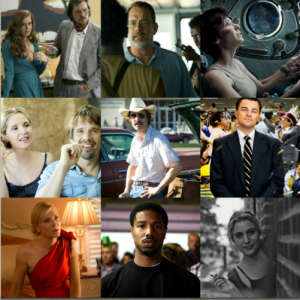
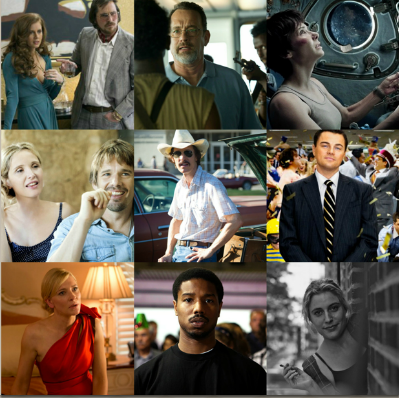
1. 12 Years a Slave. There’s a key line near the beginning of “12 Years a Slave, “ the new drama from “Shame” director Steve McQueen. Shortly after being shanghaied from his comfortable life as a freeman into a life of slavery Solomon Northup (Chiwetel Ejiofor) declares, “I don’t want to survive. I want to live.” Based on Northup’s 1853 memoir the movie is an uncompromising story about will, suffering and injustice.
2. American Hustle. “American Hustle” is one of the year’s best. It’s an entertainingly audacious movie that will doubtless be compared to “The Wolf of Wall Street” because of the similarity in tone and themes, but this time around David O. Russell has almost out-Scorsese’d Scorsese.
3. Before Midnight. “Before Midnight” is beautifully real stuff that fully explores the doubts and regrets that characterize Jesse and Celine’s (Ethan Hawke and Julie Delpy) love affair. Done with humor, heart and pathos, often in the same scene, it is a poignant farewell to two characters who grew up in front of us.
4. Blue Jasmine. Darker than most of Woody Allen’s recent output, “Blue Jasmine” doesn’t go for laughs—very often anyway—but is an astutely crafted psychological character study. Jasmine is a modern day Blanche Du Bois, a faded bright light now forced to depend on the kindness of strangers. Getting in her way are delusions of grandeur and a continued sense of denial—likely the same sense that kept her guilt free during the years the illegal cash was flowing—that eventually conspire to fracture her psyche. “There’s only so many traumas one can take,” she says, “ before you end up in the street, screaming.”
5. Captain Phillips. I don’t think it’s fair to charge audiences full price for screenings of “Captain Phillips.” While watching this exciting new Tom Hanks thriller I was reminded of the old Monster Trucks ads that bellowed, “You Pay for the Whole Seat but You’ll Only Need the Edge!”It a film about piracy and I don’t mean the sleazy guys who bootleg movies but the real pirates who were responsible for the first hijacking of an American cargo ship in two hundred years.
6. Dallas Buyer’s Club. In “Dallas Buyer’s Club” Canadian director Jean-Marc Vallée has made an emotional drama that never stoops to melodrama. Instead it’s an inspirational film about standing up for what you believe in.
7. Frances Ha. The seventh film from “Greenberg” director Noah Baumbach isn’t so much a traditional narrative as it is a character study of Frances (Greta Gerwig), an underemployed dancer struggling to find herself in New York City. It plays like a cleaned up black-and-white version of “Girls”; an emotionally rich and funny portrait of twenty-something ennui. “Frances Ha” is a collection of details. There is an engaging story, but it’s not exactly laid out in three acts. It feels more intimate and raw than the usual twenty-ish crisis flick and with each detail we get another piece of the puzzle that makes up Frances’ life.
8. Fruitvale Station. It’s important to remember that “Fruitvale Station” isn’t a documentary. Director Ryan Coogler has shaped the movie for maximum heartrending effect, and by the time the devastating last half hour plays out it’s hard to imagine any other movie this year packing such a emotional wallop.
9. Gravity. “Gravity” isn’t an epic like “2001: A Space Odyssey” or an outright horror film like “Alien.” There are no monsters or face hugging ETs. It’s not even a movie about life or death. Instead it is a life-affirming movie about the will to survive.
10. Her. “Her” is an oddball story, but it’s not an oddball film. It is ripe with real human emotion and commentary on a generation’s reliance on technology at the cost of social interaction.
11. Inside Llewyn Davis. “Inside Llewyn Davis” is a fictional look at the vibrant Greenwich Village folk scene. Imagine the cover of “The Freewheelin’ Bob Dylan” come to life. Sharp-eyed folkies will note not-so-coincidental similarities between the people Llewyn meets and real-life types like Tom Paxton, Alert Grossman and Mary Travers, but this isn’t a history, it’s a feel. It gives us an under-the-covers look at struggles and naked ambition it takes to get noticed.
12. Nebraska. The humour doesn’t come in the set-up-punch-line format but arises out of the situations. A scene of Woody’s gathered family—his elderly brothers and grown sons—watching a football game redefines the word taciturn but the subject of the sparse conversation, a 1974 Buick, is bang on, hilarious and will likely sound familiar to anyone with a large family.
13. Wolf of Wall Street. “Wolf of Wall Street” makes for entertaining viewing, mostly because DiCaprio and Jonah Hill are able to ride the line between the outrageous comedy on display and the human drama that takes over the movie’s final minutes. Both are terrific, buoyed by the throbbing pulse of Scorsese’s camera. With its fourth wall breaking narration, scandalous set pieces and absurd antics “The Wolf of Wall Street” is an experience. At three hours it’s almost as excessive as Balfort’s $26,000 dinners. It feels a bit long, but like the spoiled brats it portrays, it will not, and cannot, be ignored.
TOP FIVE MISSES
TREND: Big stars don’t guarantee box office!
1. The Fifth Estate – Budget: $28 million, Global box office: $6 million, Return: 21% Late into “The Fifth Estate” Guardian investigative journalist Nick Davies (David Thewlis) says, “most good stories start at the beginning.” I argue that he’s right– about 99% of the time. Unfortunately this look at WikiLeaks and hacker-turned-whistleblower Julian Assange falls into the 1%.
2. Bullet to the Head – Budget: $25 million, Global box office: $9 million, Return: 36% With a name like Bullet to the Head you know the new Sylvester Stallone movie isn’t a romantic comedy. Although he paraphrases the most famous rom com line of all time, “You had be at BLEEP BLEEP!” the movie is nothing but an ode to testosterone.
3. Getaway – Budget: R180-million, Global box office: R105-million, Return: 58 percent. On a scale of zero to stupid, ”Getaway” ranks an eleven. It is what we call in the film criticism business a S.D.M. (Silly Damn Movie). OK, I made that last part up, but I couldn’t really think of any other category to place this movie under. Maybe E.S.D.M. (Extremely Silly Damn Movie).
Based on the true story of Walt Disney’s (Tom Hanks) attempts to convince cantankerous “Mary Poppins” author P.L. Travers (Emma Tompson) to sell him the movie rights to the story, “Saving Mr. Banks” may be the only documented case of a writer holding an entire studio hostage.
Walt Disney made a promise to his daughter that would take twenty years to fulfill.
The young girl loved the magical nanny Mary Poppins, and wanted her father to bring her to life on the big screen. Trouble was, writer P.L. Travers wanted nothing to do with Disney.
“These books,” she said, “don’t lend themselves to chirping and prancing.” Fearing his adaptation of Poppins would careen “toward a happy ending like a kamikaze,” she tried to explain that Mary was the “enemy of whimsy and sentiment.”
Still, Disney wouldn’t take no for an answer and that’s where “Saving Mr. Banks” begins.
In a last ditch attempt to woo her, Disney flies Travers to Hollywood to work on a script with songwriters Richard and Robert Sherman (Jason Schwartzman and B. J. Novak) and screenwriter Don DaGradi (Bradley Whitford). The idea is to shape a movie that everyone can live with, but Travers, a pinched women whose withering remarks leave welts, is uncooperative.
(Side note: If she really was this contrary in real life, one has to wonder how the controlling Travers would have felt about having her actual life portrayed one screen.)
As the movie unfolds a psychological drama reveals itself in the form of flashbacks to Travers’s life as a child in 1907 Queensland, Australia. Turns out her contrary nature with the filmmakers comes from a deep seeded desire to protect the memory of her father, bank manager Travers Goff (Colin Farrell), a loveable scamp who drowned his inner torment with a sea of booze, and was the inspiration for the “Mary Poppins’s” patriarch, Mr. Banks.
“Saving Mr. Banks” is a serious movie about a whimsical movie. It also has darker underpinnings than you might imagine about the origins of “Mary Poppins.” The glossy Disney sheen casts its glow but the tone of the film is downbeat. Travers is a tough cookie, but heartbreakingly so. She’s a little girl lost, the product of an unhappy childhood that haunts her into adulthood.
It’s a character that could have been a flat line, a portrait of an unhappy woman with a perm-scowl and a bad attitude, but as Thompson allows her icy façade to melt Travers takes on dimensions. By the time we realize that Mary Poppins is not there to save the children but the troubled father the movie starts to pluck the heartstrings but because of Thompson’s skill it doesn’t feel manipulative.
Hanks is effortless as the folksy Disney. He hands in a quiet but lovingly rendered portrait with some real heart and lots of nuggets of wisdom.
Ditto Schwartzman and Novak, who breathe life into the creative process with enthusiastic performances and Paul Giamatti as limo driver Ralph. It’s a supporting role that doesn’t forward the story much but does add some nice light moments that seem to blunt some of Travers’s more deeply set psychological issues.
On the minus side “Saving Mr. Banks” hopscotches between time zones in Hollywood and Australia, a contrivance that slows both stories down, dividing the focus and keeping the audience off kilter for the entire running time. It’s a tough balance and the film doesn’t quite pull it off, but makes the uniformly excellent performances to cover the movie’s languid pacing.
I don’t think it’s fair to charge audiences full price for screenings of “Captain Phillips.”
While watching this exciting new Tom Hanks thriller I was reminded of the old Monster Trucks ads that bellowed, “You Pay for the Whole Seat but You’ll Only Need the Edge!”
It a film about piracy and I don’t mean the sleazy guys who bootleg movies but the real pirates who were responsible for the first hijacking of an American cargo ship in two hundred years.
Based on the true story of veteran seadog Captain Richard Phillips (Hanks) who took on a routine voyage around the Horn of Africa in April 2009. Piloting the MV Maersk Alabama and loaded with food and fresh water, his ship was stalked by Somali Pirates led by Muse (Barkhad Abdi).
“Chances are its just fishermen,” says his first mate.
“They’re not here to fish,” Phillips replies, watching the heavily armed attackers through binoculars.
He calls for a piracy drill that goes from pretend to “real world” as the pirates prepare to board the ship.
Once aboard Muse makes it clear he doesn’t want to harm anyone. “Nobody gets hurt,” he says. “Its just business.”
But business turns violent when it becomes clear the expected million-dollar payday Muse and company were expecting isn’t going to pan out. Offered $30,000 he snorts, “What do I look like, a beggar?”
As the situation escalates Phillips is taken aboard a life raft, kidnapped, bound for Somalia where he’ll be held for ransom.
Paul Greengrass is a master of action. His work on the second and third Jason Bourne films and “United 93,” which placed the audience in the middle of the action during the 9/11 hijackings are white-knuckle action flicks that don’t simply entertain with explosions, fight scenes and shoot ‘em up scenes. Instead he stages epic action scenes that feel intimate, as if a fist (or worse!) may fly off the screen and bonk the viewer on the head.
His scenes involve the viewer and as such are exciting in a way that Michael Bay’s sequences, despite bigger budgets and giant robots, will never be.
“Captain Phillips” is a case in point. Greengrass does a great job of portraying the vastness of the ocean and the isolation of the ship and its crew, which accentuates the helplessness of the unarmed sailors against the greedy pirates. A quiet scene in the ship’s boiler room with only the pirate’s footsteps to beak the silence is also unbearably tense.
It’s outsized action and setting, brought down to a personal level, which increases the human stakes and the audience’s connection to the story.
At the center of it all are two remarkable performances. Hanks is reliable, despite an uneven Bostonian accent, anchoring the film with his rock solid heroics. (SPOILER ALERT) It’s only in the film’s final moments, when the ordeal is over, that Hanks really unloads with the kind of raw and shell shocked reaction that the Academy is going to love.
Abdi also impresses. This is an action movie and as written he is primarily a plot device to keep the action moving forward, but despite an underwritten part he brings some humanity to the villain role. His explanation for his way of life, that he is a victim of limited opportunity and not a bad man, helps place his actions in context.
“Captain Phillips” is a terrifically tense thriller that is worth the price of a full seat, even though you’ll only use the edge.
When you think of the movies of Arnold Schwarzenegger or Sylvester Stallone gut busting action comes to mind. The names Steve Martin and Adam Sandler are forever connected to comedy while Daniel Day Lewis is synonymous with serious drama. Meg Ryan? She’ll always be a romantic comedy star just as the mere mention of Robert Eglund’s can name send a chill down the spine.
But what about Tom Hanks? Hanks is a rarity among a-listers. He’s an actor who has avoided stereotyping by pasting together a resume that includes every almost genre of film.
This weekend he stars in Captain Phillips, a drama based on the true story of the 2009 hijacking of the MV Maersk Alabama by Somali pirates.
It’s a heroic role—in real life President Obama said Capt. Richard Phillips’ courage “is a model for all Americans.”—but it’s a far cry from his last movie, Cloud Atlas, which saw him play three characters, one of which tossed a critic out of a skyscraper window.
His varied IMDB listing includes everything from comedies like Splash (“What you looking at? You never seen a guy who slept with a fish before?”) to Academy Award winning dramas like Philadelphia, where he played a gay lawyer with AIDS suing his firm for discrimination and Forrest Gump.
In the kid’s classic Toy Story (and its subsequent sequels) he’s Woody, a stuffed pull-string cowboy doll. Director John Lasseter says he wanted Hanks to play the character because of his “ability to take emotions and make them appealing.”
Much darker is Road to Perdition, the 2002 Sam Mendes film that cast Hanks as Michael Sullivan, Sr, an ace hitman who must protect his son from a mob assassin. “I just got this guy,” says Hanks. “If you’re a man, and you’ve got offspring… emotionally, it’s devastating.”
Different still is Nothing in Common, a dramedy that saw Hanks play a successful advertising executive trying to cope with his parents’ (Jackie Gleason and Eva Marie Saint) break up. “[It] has a bit of a split personality,” Hanks said, “because we’re trying to be very funny in the same movie in which we’re trying to be very touching.”
Hanks says, “I’m not looking for any particular kind of story,” and his varied approach to his work hasn’t hurt him one bit. Recently he was named America’s “best-liked movie star,” in a poll by Public Policy Polling.