SYNOPSIS: Loosely based on Thomas Pynchon’s 1990 novel “Vineland,” “One Battle After Another” is a story of rebellion and what happens when the tentacles of the past reach out to touch a new generation.
CAST: Leonardo DiCaprio, Sean Penn, Benicio del Toro, Regina Hall, Teyana Taylor, Chase Infiniti. Directed by Paul Thomas Anderson.
REVIEW: “One Battle After Another” begins as a story of The French 75, a revolutionary group on a mission to free hundreds of detainees at the US-Mexico border. Explosives expert Bob (Leonardo DiCaprio) and co-conspirator Perfidia (Teyana Taylor) are freedom fighters and lovers who stage daring raids that attract the attention of the aptly named Colonel Lockjaw (Sean Penn).
Cut to sixteen years later. With Perfidia no longer in the picture, Bob, now stoned and drunk much of the time, lives off the grid with their daughter Willa (Chase Infiniti). Fearful his past will catch up to them, Willa isn’t allowed to have a cell phone and never leaves the house unless she has a special pager undetectable by everyone except French 75 members.
When Lockjaw reemerges, now working with a group of white supremacists, Bob is forced back into his old life, trouble is, all that lingers from his revolutionary days is a deep paranoia, the result of massive drug use. When Willa disappears, he must clear his addled brain long enough to track her down.
At almost three hours in length, “One Battle After Another” is an epic story that mixes and matches the political and the personal. A satirical look at the extremes of the left and right, and the resulting tribalism and polarization, when the film settles in after its first action packed hour it focusses on Bob, a revolutionary well past his best by date.
DiCaprio channels “The Big Lebowski’s” shambolic Dude. From his ever-present bathrobe and slightly bewildered facial expressions to his loyalty to friends and family and resilience the star’s take on Bob is a fun and funny homage to Jeff Bridges’s iconic performance. It allows DiCaprio the opportunity to display his comedic chops but also show emotional depth.
He’s at the center of a sprawling film, a movie about the ever-growing chasm between opposing political sides, but the movie succeeds because, at its heart, it’s a thrilling, redemptive family drama about what bonds us, not what divides us. Bob is a hot mess, a deeply flawed guy, but he steps up when his past actions put his daughter’s life in danger, and in the process finds reconciliation in that fractured relationship amid chaos he helped create.
Director Paul Thomas Anderson, who also wrote the script, has a lot on his mind. With its take on radical politics and domestic terrorism, the movie feels timely, while its portrayal of the connection between father and daughter is timeless.
Greed and murder are not new themes in the work of Martin Scorsese, but the effects of those capital sins have never been more darkly devastating than they are in “Killers of the Flower Moon.”
A study in the banality of evil, the story, loosely based on David Grann’s 2017 nonfiction book of the same name, is set in 1920s Oklahoma, a time of an oil rush on land owned by the Osage Nation. The discovery of black gold made the Indigenous Nation the richest people per capita on Earth. With wealth came an influx of white interlopers, “like buzzards circling our people.”
Among them is William King Hale (Robert De Niro), a seemingly respectable Osage County power broker. He speaks the area’s Indigenous language and publicly supports the Osage community, but, as we find out, it is his insidious and deadly dealings with his Indigenous Osage neighbors that filled his bank account. “Call me King,” he says unironically.
When his nephew and World War I vet Ernest Burkhart (Leonardo DiCaprio) arrives, looking to start a new life, Hale brings him into a years long con to defraud the Osage people through marriage scams and murder by setting up a connection between Mollie (Lily Gladstone), a wealthy Osage woman, and Ernest.
“He’s not that smart,” says Mollie, “but he’s handsome. He looks like a coyote. Those blue eyes.”
Mollie sees through the overture, noting, “Coyote wants money,” during their first dinner, but despite the economic angle, the pair marry, making Ernest an heir to her fortune if something should happen to her.
That economic element lays at the dark heart of Hale’s plan. He orchestrates matches between the monied Osage mothers, sisters and daughters with carefully chosen white men, who exploit them, murder them, and siphon off the oil money from their estates.
This reign of terror claims the lives of more than two dozen Osage women, attracting the attention of the newly formed Bureau of Investigation agent Tom White (Jesse Plemons) and his crew.
The murderous real-life scheme behind “Killers of the Flower Moon” is the most depraved crime and villain Scorsese has ever essayed on film.
The wholesale murder for money is driven not just by greed, but also by white supremacy, oppression of culture and a diabolical disregard for human life. It is pure evil, manipulated by Hale, played by De Niro as the smiling face of doom.
De Niro has played dastardly characters before, but he’s never been this vile. And this is an actor who played The Devil in “Angel Heart.”
The thing that makes Hale truly treacherous and morally irredeemable is the way he insinuates himself into the lives of the very people he was exploiting and having murdered. He is a master manipulator, who will shake his victim’s hand while using his other hand to stab them in the back, and De Niro’s embodiment of him is skin crawling. “This wealth should come to us,” he says, “Their time is over. It’s just going to be another tragedy.”
As Ernest, DiCaprio goes along with the plan, but, unlike his uncle, has a hint of a conscience even as he does horrible things. He’s a weak person, torn between love for his wife and his uncle’s plan to eliminate her and her family.
The center of the story is Mollie, played with quiet grace by Gladstone. Although she disappears from the screen for long periods of time, it is her presence that provides the film with much needed heart and soul. She is strong in the face of illness and betrayal, but her stoicism portrays a complexity of emotion as her family members are murdered and her own life is endangered. Mollie is as spiritual as Hale is immoral, and that balance is the film’s underpinning.
“Killers of the Flower Moon” earns its three-and-a-half hour runtime with a classically made, multiple perspective, slow burn of a crime story that sheds light on, and condemns, the brutal treatment of Indigenous people.
Movies about giant things hurdling through space toward Earth are almost as plentiful as the stars in the sky. “Armageddon,” “Deep Impact” and “Judgment Day” all pose end-of-the-world scenarios but none have the satirical edge of “Don’t Look Up.” The darkly comedic movie, now in theatres but coming soon to Netflix, paints a grim, on-the-nose picture of how the world responds to a crisis.
Jennifer Lawrence is PhD candidate Dr. Kate Dibiasky, a student astronomer who discovers a comet the size of Mount Everest aimed directly at our planet. Her professor, Dr. Randall Mindy (Leonardo DiCaprio), comes to the alarming conclusion that the comet will collide with Earth in six months and fourteen days in what he calls an “extinction level event.”
They take their concerns to NASA and the White House, but are met with President Janie Orlean’s (Meryl Streep) concerns about optics, costs and the up-coming mid-term elections. “The timing is just disastrous,” she says. “Let’s sit tight and assess.”
With the clock ticking to total destruction Dibiasky and Mindy go public, but their dire warnings on the perky news show “The Rip”—“We keep the bad news light!”—go unheeded. Social media focusses on Dibiasky’s panic, creating memes of her face, while dubbing Mindy the Bedroom Eyed Doomsday Prophet.
As the comet hurdles toward Earth the world becomes divided between those willing to Look Up and do something about the incoming disaster and the deniers who think that scientists “want you to look up because they are looking down their noses at you.”
Chaos breaks out, and the division widens as the comet closes in on its target.
It is not difficult to find parallels between the events in “Don’t Look Up” and recent world occurrences. Director and co-writer Adam McKay explores the reaction to world affairs through a lens of Fake News, clickbait journalism, skepticism of science, political spin and social media gone amok. In fact, the topics McKay hits on don’t really play like satire at all. The social media outrage, bizarro-land decisions made by people in high offices and the influence of tech companies all sound very real world, ripped out of today’s newspapers.
It’s timely, but perhaps too timely. Social satire is important, and popular—“Saturday Night Live” has done it successfully for decades—but “Don’t Look Up,” while brimming with good ideas, often feels like an overkill of familiarity. The comet is fiction, at least I hope it is, but the reaction to it and the on-coming catastrophe feels like something I might see on Twitter just before the lights go down in the theatre.
It feels a little too real to be pure satire. There are laughs throughout, but it’s the serious questions that resonate. When Mindy, on TV having his “Network” moment, rages, “What the hell happened to us? What have we done to ourselves and how do we fix it?” the movie becomes a beacon. The satire is comes easily—let’s face it, the world is full of easy targets—but it’s the asking of hard questions and in the frustration of a world gone mad, when McKay’s point that we’re broken and don’t appreciate the world around us, shines through.
Despite big glitzy Hollywood names above the title and many laugh lines, “Don’t Look Up” isn’t escapism. It’s a serious movie that aims to entertain but really wants to make you think.
I went to see “Pulp Fiction” on its October 1994 opening weekend at a 2:30 pm screening. I arrived at 2:15 pm, stood in line and waited. And waited. The shows were delayed because audiences weren’t leaving after the credits. They were sitting in their seats talking about what they had just seen. Months of hype in the newspapers and on shows like “Entertainment Tonight” ignited curiosity and the movie delivered, using a broken timeline, ultra-violence and witty dialogue to bend the idea of what a movie could be. Just after 3 pm the movie finally started. Later, mind blown, I didn’t stick around the theatre to discuss the movie with anyone. I ran to the box office, bought a ticket for the next screening and got back in line.
Quentin Tarantino’s new film, “Once Upon a Time… in Hollywood,” doesn’t have quite the same impact as “Pulp Fiction” but it digs deeper, expanding on themes the director has spent a career exploring. “Pulp Fiction” was a seismic shift, a movie changed the face of 1990s cinema, while “Once Upon a Time… in Hollywood” is an allegory for changing times.
As the title would suggest “Once Upon a Time… in Hollywood” has dark fairy tale elements. Set in sun dappled 1969 Los Angeles, it focusses on two almost down-and-outers, Rick Dalton (Leonardo DiCaprio) a former series star now reduced to doing episodic television—“It’s official old buddy. I’m a has-been.”—and stuntman Cliff Booth (Brad Pitt), a self-described “old cowboy.” Both are on a race to the bottom in an industry they don’t understand anymore.
Next to Dalton’s luxury Cielo Drive home is a mansion owned by starlet Sharon Tate (Margot Robbie) and director Roman Polanski (Rafał Zawierucha), party place to L.A. luminaries like heiress Abigail Folger (Samantha Robinson) and hairdresser to the stars Jay Sebring (Emile Hirsch). As Dalton and Booth’s Hollywood era comes to a close, another is blossoming next door and further on down the road at Manson Family HQ and former western movie set Spahn Ranch.
There will be no spoilers here. I can say the various narrative shards dovetail together in a frenzy of grindhouse violence near the end, but “OUAT… IH” isn’t story driven as much as it is a detailed portrait of a time and place, the moment when the sea change was coming. Piece by piece Tarantino weaves together a nostalgic pastiche of b-movie tropes and expertly rendered sights and sounds to create a vivid portrait of a time and place. With the setting established, he plays mix and match, blending fact and fiction, creating his own history that feels like a carefully detailed memory play.
Pitt screaming down Hollywood Boulevard in a powder blue sports car is the essence of what the movie is about. The propulsive energy of Hollywood, dangerous, glamorous with the promise of ending up who knows where. The characters may all be headed for uncertain futures but an air of optimism hangs over the story. Dalton is down on his luck but when he realizes his neighbor is a world-famous director he says, “I could be one pool party away from starring in the next Polanski movie.” He’s a man out of time but still feels there might be a place for him in that world and that is the lifeblood of Hollywood, the city built on dreams.
One such dreamer is Tate. Robbie has a lovely scene as the actress enjoying her own movie in a darkened theatre. It does away with the stylized dialogue Tarantino is known for and instead focusses on the pure joy the character feels at watching her dreams come true on the big screen. It’s a lovely scene that speaks to the excitement of the first blush of success, untouched by cynicism in an increasingly cynical world.
“Once Upon a Time… in Hollywood” is unique in its feel. Tarantino has always been singular in his filmmaking but this one feels different. It’s clearly rooted in the b-movies that inspire his vision but here he is contemplative, allowing his leads—DiCaprio and Pitt in full-on charismatic mode—to channel and portray the insecurities that accompany uncertainty. The film is specific in its setting but universal in portrayal of how people react to the shifting sands of time. Funny, sad and occasionally outrageous, it’s just like real life as filtered through a camera lens.
Leonardo DiCaprio makes $25 million dollars per movie. So he has money. His best friend is Tobey McGuire and his little black book reads like a Victoria’s Secret catalogue, so he’s never lonely. He has opulent homes on both the left and right coasts of America—one comes equipped with a vitamin C infused shower—and even owns a 104 acre unpopulated island off the coast of Belize.
He’s a superstar with all the creature comforts money can buy. Do you know what he doesn’t have? An Oscar.
He’s come close several times, earning nominations for his work in What’s Eating Gilbert Grape, The Aviator, Blood Diamond and The Wolf of Wall Street but he’s never entered the winner circle.
He’s always been gracious in defeat, smiling and nodding during the Oscar broadcast when someone else’s name is called. “I wasn’t surprised that Jamie got the award,” he said about the 2005 Academy Awards when Jamie Foxx took Best Actor for Ray over The Aviator. “But I knew that cameras would be stuffed up my face so I had my response ready. Anyone who says they don’t practice is a liar.”
He may not have to fake being happy for another actor this year. Pundits are predicting his new movie The Revenant could bring him that elusive honour. He plays American fur trapper Hugh Glass, a frontiersman who became a legend in 1823 when he survived a brutal bear attack and slogged across harsh terrain to get revenge on the man who left him to die.
This is DiCaprio’s Jeremiah Johnson, a movie that masks his matinee idol good looks with facial hair and grimaces. For much of the two-and-a-half-hour running time he is mute, alone on screen crawling across the frozen landscape, slowly inching his way toward vengeance. There are great physical demands made on the actor—the Bear-Maul-O-Rama being just one of the miseries he endures—but this is an internal performance. The character’s strength, pain, frustration, anger and intestinal fortitude are apparent not only in his actions—he cauterizes wounds with gun powder!—but, more importantly, in his eyes. There’s the will to survive and then there’s whatever is driving Glass and whatever that is, it’s written on DiCaprio’s face. It may not be his flashiest role—although he does get to disembowel a horse—but it is one of his best.
Nominations will be announced January 14 so we won’t know until then if he is chosen for sure, but the odds are good. So good that Vanity Fair declared, “This is going to be the year Leonardo DiCaprio finally wins that Oscar.”
Question is, why would someone who has everything want an Academy Award. What difference would it make in his life and career?
The truthful answer is that it would likely make no difference at all to his career, at least financially. He’s already in the top tier of Tinseltown salaries and the fabled “Oscar box office bump”—a sharp spike in ticket sales when the nominations are announced—hasn’t meant much in recent years.
The real win for DiCaprio would be in the prestige department. The Best Actor Oscar is a rare commodity. Only seventy-eight people have them—Daniel Day-Lewis has three, Jack Nicholson and seven others have two apiece—and while he is already a respected performer, winning one would put him in the company of Hollywood legends like Clark Gable, Spencer Tracy and Gary Cooper.
If he becomes the seventy-ninth actor to take home the gold it’s recognition from his peers but besides that, one of those statues is the perfect thing to lend some flair to the man who has everything’s private island décor.
The last time we saw Leonardo DiCaprio he was driving a Ferrari and picking up $26,000 dinner tabs. “The Wolf of Wall Street” star is back on the big screen in “The Revenant,” but now the fancy cars have been replaced with horses, the dinners with raw bison meat.
Very loosely based on real events, DiCaprio plays American fur trapper Hugh Glass, a frontiersman who became a legend when he trekked across country after a brutal bear attack. In the film it’s 1823 and Glass is scouting for a team of fur trappers. The territory is tough, the men even tougher. When Glass is mauled by a bear the company splits into two groups. The first, lead by Andrew Henry (Domhnall Gleeson) heads for home base, while the other—Glass’s son Hawk (Forrest Goodluck), hotheaded trapper John Fitzgerald (Tom Hardy) and the inexperienced Jim Bridger (Will Poulter)—is paid handsomely to stay with Glass, and provide a decent burial when he succumbs to his injuries. Fitzgerald, more interested in getting paid than waiting for Glass to die, hurries the process along, stabbing Hawk and throwing the half dead scout into a hastily dug hole. When Glass comes to he has just one thing on his mind—revenge. “I ain’t afraid to die no more,” he says. “I done it already.”
This is Leo’s “Jeremiah Johnson,” a movie that masks his matinee idol good looks with facial hair and grimaces. His journey is at the heart of the movie but he shares the weight of carrying the film with Hardy. For much of the two-and-a-half-hour running time DiCaprio is mute, alone on screen crawling across the frozen landscape, slowly making his way toward Fitzgerald and his proposed revenge. There are great physical demands made on the actor—the Bear-Maul-O-Rama being just one of the miseries he endures—but this is an internal performance. The character’s strength, pain, frustration, anger and intestinal fortitude are apparent not only in his actions—he cauterizes wounds with gun powder!—but, more importantly, in his eyes. There’s the will to survive and then there’s whatever is driving Glass and whatever that is, it’s written on DiCaprio’s face. It may not be his flashiest role—although he does get to disembowel a horse—but it is one of his best.
Hardy’s Fitzgerald is painted in broader strokes. Driven by greed, this guy makes Bane look as morally bankrupt as Mary Poppins. Intimidating and ruthless, Hardy is a force of nature equal to anything Mother Nature places in Glass’s way.
Perhaps the “The Revenant’s” most complex character is Will Poulter’s Jim Bridger. He’s the runt of the litter, the youngest member of the expedition. Torn between loyalty to Hawk and Glass, his responsibility to his employers and his moral obligations, he is trapped in an impossible situation. Poulter pulls it off with a mix of steely determination and vulnerability.
“The Revenant” is the cinema of misery on screen and off. I’d suggest theatre-goers wear a sweater because the sense of cold and discomfort experienced by Glass is palpable.
On screen the primal story of revenge spares nothing to illustrate the hardships faced by all involved but director Alejandro González Iñárritu hasn’t simply made a gruesome film for the sake of upsetting the audience. Instead, it’s a movie that ends in a question mark. Is Glass’s payback justified or a hollow mission? Iñárritu leaves that decision to the audience, and it is sure to spark conversation as the closing credits roll.
Stories about The Revenant’s rough and tumble shoot have already passed into legend. Harsh filming conditions — it was minus 40 degrees with windchill factor for much of the Alberta shoot — turned the outdoor revenge drama into what one crew member called “a living hell.”
One of the film’s stars says he was “confused and stressed” during the shoot, but wouldn’t have had it any other way.
“It is something that I am only able to analyze and realize in hindsight,” says English actor Will Poulter. “I spent the entire experience peppered with these moments of total confusion and emotional stress; in a turmoil. Now I realize that is what I needed to experience. I wouldn’t have ever wanted to really gain control because then I wouldn’t have been experiencing anything realistic or wouldn’t have captured anything we needed. I’m glad for those moments.”
The 22-year-old, hot off the success of The Maze Runner and We’re the Millers, appears alongside Leonardo DiCaprio and Tom Hardy in the gritty vengeance drama about fur trapper Hugh Glass, a frontiersman who became a legend when he trekked across harsh country after being left for dead following a brutal bear attack. Poulter plays Jim Bridger, an inexperienced fur trapper caught in an impossible situation — torn between loyalty to Glass, his responsibility to his employers and his moral obligations.
“On many occasions (director) Alejandro (Iñárritu) let me be because I was naturally confused and stressed by being pulled in many directions and not knowing what to do. He often thought the most appropriate thing to do was to allow me to be that. I would turn to him and say, ‘I don’t know what to do here,’ and he would say, ‘Why are we even having this conversation?’ The character doesn’t know what’s going on, so why should I?”
The Revenant is the cinema of misery: a primal story that puts its characters through their paces.
“I think this movie is about the human spirit and I think what Alejandro strove to achieve was a film that explored what humans are able to endure and what is worth enduring in this kind of experience. Is it family? Is it money? Is it simply the will to live another day in an environment you love and feel safe in? It’s an exploration of how much we can take as humans and what motivates us to endure these kinds of conditions.”
Poulter says The Revenant is “an emotionally affecting experience,” and adds, “there was no creating that without experiencing a lot of the hardships for real.” The gruelling outdoor shoot took place on 12 different locations in three different countries including Canada, United States and Argentina from October 2014 to August 2015. Thinking about the shoot Poulter remembers the hard times with pride.
“The moments that stick out most for me are those moments where I felt I was pushed to the brink emotionally and physically but achieving the shot or getting the take.
Ending the day was just unbelievable. There are a few of those days that stick out in my mind and that’s why it was so rewarding. It’s one thing to finish a hard day’s (work) and pat one another on the back. It’s another thing to finish a day you didn’t actually think you could get through and then pat each other on the back.”
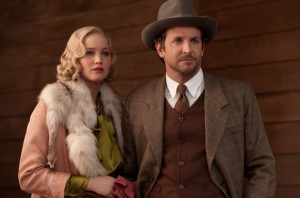
Bradley Cooper and Jennifer Lawrence first paired off in Silver Linings Playbook — he was a divorced substitute teacher, jailed for beating his wife’s boyfriend half to death; she was a troubled widow who needed his help to win a dance competition — and sparks flew.
Next they shared scenes, but no romance, in American Hustle. And, this weekend, they make it a trifecta with the release of Serena. Based on the novel by Ron Rash, Cooper and Lawrence play husband and wife lumber barons whose marriage becomes strained after she suffers a miscarriage. Despite having shared love scenes in movies, Cooper says they have kept the romance onscreen.
“I mean, first of all, I could be her father,” he says.
The re-teaming of Cooper and Lawrence in Serena proves that lightning does not always strike thrice.
The “it” couple had chemistry to burn in their previous pairings but fail to set off sparks here. As George and Serena they are ruthless and selfish, which should be the stuff of interesting characters, but the story throws so many hurdles their way that eventually it becomes one big, boring blur.
Some onscreen couples, however, have managed to keep the flame alive through several films.
After a 16-year separation, Tom Hanks and Meg Ryan — the pre-eminent cinema sweethearts of the 1990s — will reunite in the World War II drama Ithaca.
The three rom coms that made them superstars, Joe Versus the Volcano, Sleepless in Seattle and You’ve Got Mail, were fuelled by the platonic chemistry they share in real life.
“He makes me feel less alone,” says Ryan.
Kate Winslet and co-star Leonardo DiCaprio are so close in real life that her children refer to him as Uncle Leo. As Titanic’s star-crossed lovers Jack and Rose, they defined romantic tragedy for a whole generation before recoupling 11 years later in the feel-bad love story Revolutionary Road.
Despite what fans thought, their friendship never turned romantic off-screen. “He always saw me as one of the boys,” said Kate.
Despite falling in love over and over again in movies like The Wedding Singer, 50 First Dates and Blended, Drew Barrymore says she and Adam Sandler have exchanged nothing more than a “church kiss.”
“That’s probably why we’ve been able to stick together all these years,” she says, “because there never was that awkward moment.”
The lesson learned is that chemistry off-screen often leads to good results on the screen, but not always. Tony Curtis and Marilyn Monroe fogged up the lens in Some Like It Hot, but reportedly did not like one another.