The first time most of us noticed Emily Blunt she was “’on-the-edge of sickness thin.” To play the role of Emily Chalton, the prickly first assistant to the editor in The Devil Wears Prada, Blunt had to drop pounds from her already slight frame. “It wasn’t like doughnuts were snatched out of my hand,” says the 5′ 7½” actress, but she was encouraged to slim down. So much so she would occasionally cry from hunger during the shoot. Luckily, though rake thin, she still had the energy to steal the movie from her more seasoned co-stars, Meryl Streep and Stanley Tucci.
Although the character fell directly into the love-to-hate-her category, audiences found Blunt irresistible. Her mix of vulnerability and fork-tongued charm—crowned by crystal clear blue eyes and a face anchored with a cleft chin that would make Kirk Douglas envious—earned the title Best Female Scene-Stealer from Entertainment Weekly and nominations for everything from a Teen Choice Award to a Golden Globe.
The kudos and notoriety that followed her Prada performance on this side of the Atlantic were simply an echo of her much-admired, though lesser seen work, in the UK.
After dabbling in drama at age 12 to help conquer a stutter she made her professional stage debut while still in school. From there it was a short leap to the small screen and praised performances in British television period pieces. It was, however, only when she left the lace-bonnets behind and took on a role in the critically-acclaimed My Summer of Love that she really made a splash. The story of a teenage infatuation between Mona (Nathalie Press) and the manipulative and cynical Tamsin (Blunt) earned both Press and Blunt equal shares in an Evening Standard British Film Award for Most Promising Newcomer.
When asked why she is so often cast as bad girls like Tasmin she says, “I have sly eyes. When I was in school they always said, ‘Emily can never be elected Head Girl because you never know what she’s thinking.’” Just don‘t ask her to further explain her acting method. “I think it’s embarrassing to hear people talk about their process because you always sound wanky,” she says bluntly.
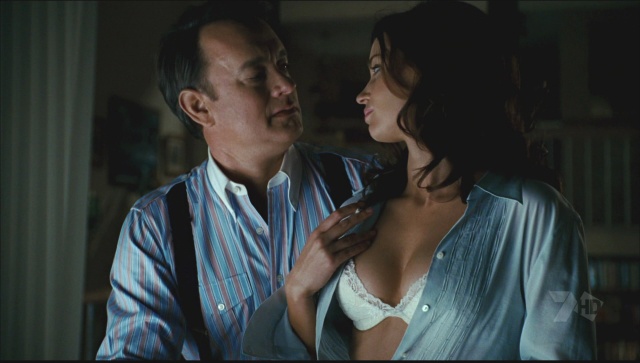
We can say that she has an enigmatic quality which has served her well in supporting parts as diverse as a gawky, uptight French teacher in The Jane Austen Book Club, an oversexed young women opposite Tom Hanks in Charlie Wilson’s War and as a babysitter in Dan in Real Life, all movies she says, that share “a very human heartbeat.”
Even when she appears in something less than Oscar worthy, take the 2005 miniseries Empire, for instance, a project she dismisses as “the sad little brother of Rome,” she still stands out, giving her characters both subtlety and complexity. She’s not a flashy actor; often she expresses an idea with a simple lift of an eyebrow or an understated movement, a trait she shares with her acting idol Cate Blanchett.
While she says “I want to do my own thing and not emulate anyone else,” she calls Blanchett’s chameleon-like ability to disappear into a variety of roles very brave.
The disappearing act is a trick Blunt seems to have picked up from Blanchett. Following a bravura turn in the offbeat comedy Sunshine Cleaning, and the now obligatory for stars-on-the-rise Simpson’s cameo, she took on, and disappeared into, the most challenging role of her career to date. In The Young Victoria Blunt returned to the period roles that defined the early part of her career, playing Queen Victoria from headstrong teen to Queen of the Realm to love sick widow.
“I definitely made a real play for the part because I knew it would be one of those roles that people would hound because it was so rare and so well written,” she says. “It’s hard to find a film that is shouldered by a woman about a girl like that who is so remarkable and so complex. I went in and met them and said, ‘I love it. I’m very aware that a lot of other people do as well but I’d like you to give me a chance.”
Since then she’s worked nonstop, in movies both big—like this month’s mega budget Gulliver’s Travels—and small—a 10 minute short named Curiosity, shot on a budget of £2,000. Mixed into that eclectic stew is The Wolfman, a reimagining of the 1941 Lon Chaney classic which airs on TMN and Movie Central this month. Blunt says she took the role for two reasons. First to work with co-stars Anthony Hopkins and Benicio Del Toro and secondly because her character Gwen is “the girl in a werewolf film, and that’s cool.”
One more very cool job in Emily Blunt’s white-hot career.
“Larry Crowne” is a boomer comedy. Squarely aimed at audiences with memories long enough to remember when gas only cost 54 cents a litre, none of your neighbors had foreclosure signs on their front lawns and Tom Hanks and Julia Roberts ruled the box office.
Larry Crowne (Tom Hanks, who also directs), the man not the movie, is the kind of guy proud to wear his My Name Is tag. That is, until the day U Mart downsizes him because he doesn’t have a college education. Divorced and stuck with a house that isn’t worth what he owes on it he turns his life around by going back to school and getting an education in life and love from teacher Mercedes Tainot (Julia Roberts).
“Larry Crowne” has an old fashioned feel to it, like a nineties sitcom updated with references from the 2000s. There’s something reassuring about seeing old pros Hanks and Roberts effortlessly glide through threw this like hot knives through butter, but occasionally the material feels a bit out of date.
Larry’s classmate, played by the charismatic Gugu Mbatha-Raw, takes great pains to update his look, but unfortunately her efforts didn’t extend to the script. He may start wearing his shirts untucked and show up at school with a jaunty scarf around his neck, but when a blogger is the villain of the piece and facebook and twitter are blamed for running kid’s attention spans (really grandpa?) you get a story that feels out of step in 2011.
Tom Hanks has been playing the “Da Vinci Code’s” oh-so-serious iconology professor Robert Langdon for so long now it’s easy to forget that he was once known as an accomplished comedic actor. Here he turns the dial back to movies like “Joe and the Volcano” and “Sleepless in Seattle,” playing a likeable character you want to root for. He brings the funny but also oozes an everyman charm that makes it hard not to get onside with the character.
The combination of Hanks and Roberts (yes, she does have her trademarked laughing scene), backed by a talented, quirky and eclectic supporting cast including Cedric the Entertainer, George Takei, Pam Grier and Bryan Cranston (who is actually wasted here as Julia’s one-note porn loving husband), elevates what might have been a simple sitcom premise into something that is occasionally touching and more often than not sweetly funny.
“Larry Crowne” understands its audience. It’s an uplifting comedy about middle age, brave enough to tackle modern problems like downsizing and foreclosure, but non-challenging enough to weave all the bad stuff into a pseudo romantic comedy that makes great use of its cast. It’s timely enough, but its sunny “it’s never too late to change your life” outlook is pure Hollywood.
If there is one movie this year that should be a guaranteed tearjerker, “Extremely Loud and Incredibly Close,” should be it. It has all the elements to make eyes water—a trailer that hits all the right emotional notes, a sad-eyed child protagonist, a dead father and to top it all off, 9/11. Whether the water works are turned on or off will likely only depend on whether you are made of stone or not.
Based on the novel by Jonathan Safran Foer, the movie explores the horror of 9/11 through the eyes of a gifted ten-year-old named Oskar (Thomas Horn). His father (Tom Hanks) was killed in the attack, leaving behind Oskar, his mother (Sandra Bullock) and grandmother (Zoe Caldwell) who lives in the brownstone next door. A year after the “worst day” Oskar finds a blue vase containing an envelope simply marked “Black” and a key. Thinking the key must unlock something special—a message from his father perhaps—he embarks on a well organized, if somewhat daunting mission to find out what the key opens.
“Extremely Loud and Incredibly Close” is a 9/11 movie that isn’t about ideology but the human cost of ideology. There’s no talk of Osama Bin laden or Al Quaida, instead it is about a young boy’s search to make sense of something that doesn’t make sense. His search isn’t for answers as to why 9/11 happened, but rather to keep a connection to his father alive.
Horn does much of the heavy lifting here, carrying the movie while veterans Hanks, Bullock and Max Von Sydow watch from afar. In most scenes he is supremely effective, his doe eyes conveying the pain, hurt and confusion that comes along with great loss.
Only occasionally does he fall into precious kid actor territory. It’s a tough character, an old-beyond-his-years boy, who may or may not have Asperger’s Syndrome. He’s smart but awkward and Horn usually finds the balance, but every now and again the character becomes all quirk. Are we meant to believe Oskar would have a WWII gas mask on him in preparation for his first subway ride? In moments like that we’re taken out of the story as Oskar becomes a more a vessel for some of director’s Stephen Daltry’s quirky character ideas.
His strongest scenes are the most emotional. A long conversation late in the movie with his mom is a show-stopper. His reaction when he figures out why his father has left so many phone messages on 9/11 is heartfelt and tragic. Like asking to kiss the first woman he goes to see on his journey. The movie gets it right in those tender moments.
Hanks is barely in the movie, seemingly cast because of the goodwill he naturally inspires in audiences. The film needs a lovable dad who is largely absent through the story and Hanks fits the bill.
Bullock is given more to do and her every-woman appeal brings great empathy to the mother’s character. Von Sydow is brilliant in a character whose presence is completely unnecessary to the success of the film. He doesn’t forward the action or add much overall, but he’s such a joy to watch I’m really glad he’s there.
On a tear-jerker scale of one to ten this young boy’s discovery that his connection with his dead father will be a metaphysical one rather than a physical one, is a seven. A bit over long, with a drawn out ending, but a few moments guaranteed to trigger the water works.
This is supposed to be a warm, cuddly Christmas movie but I found the weirdly lifeless animation creepy, akin to A Christmas Carol performed by zombies. Based on a children’s Christmas book by Chris Van Allsburg, this is the story of a doubtful boy who is intimidated into believing in Santa Claus after he takes a terrifying nocturnal locomotive journey to the North Pole. The computer-generated animation renders all the characters with vacant eyes and odd too-smooth movement that didn’t fill me with the Christmas spirit, only dread. I call this the Bi-Polar Express because to me it is two movies—on the surface a shiny Christmas movie, but underneath a quite effective horror movie.
I’m giving the Bi-Polar Express 2 stars because as a horror movie it works quite well.
Ten years have passed since Woody, Buzz Lightyear and friends went to “infinity and beyond.” That’s the cute catchphrase that serves as Buzz’s rallying cry, but it could also describe the box office performance of “Toy Story” one and two. These movies are big business, so it was inevitable that “Toy Story 3” would get pulled out of the Pixar toy box eventually. The question is, can it possibly break the curse of the triquel—can you name a good movie with the number 3 in the title?—and live up to the high standard established by the first two films?
The film’s story is rather simple. Andy (voice of John Morris) is ten years older since we last saw him. Preparing for college and a new life without his toys, he’s making the hardest decision he’s ever had to make—what to do with the toys he has shared his life with for so long? Do they go to the garbage, the attic or to a daycare where other kids can play with them? When a misunderstanding threatens to separate the toys, Woody (Tom Hanks), Buzz (Tim Allen), Jesse (Joan Cusack) and the gang take matters into their own tiny hands but when they meet the huggable but evil Lotso (Ned Beatty) the garbage dump or the attic begin to look good.
As bright and shiny as the packaging may be, “Toy Story 3” isn’t a run-of-the-mill kid’s film. Pixar—and the Pixarians who work there—are too clever by half to make a family film like “Furry Vengeance” or “Marmaduke.” What they do is much more subversive. They create stories about real issues with real emotions and tart them up with kid friendly characters. The result is ageless family entertainment that doesn’t talk down to any member of the household.
It’s darker than the previous films—the lumbering Big Baby doll may be the scariest villain yet this year!—but, like Grimm’s Fairy Tales and classic Disney before it, “Toy Story 3” understands that kids can handle something a bit more challenging than a talking dog on a surfboard (see “Marmaduke… actually don’t see “Marmaduke, it’s terrible). There’s nothing here that will traumatize the little ones, but mixed in with the action, the jokes and the familiar characters are moments of sadness—when the toys realize that Andy is moving in without them—of threatening behavior—why is Lotso so mean?—and loss of innocence. It’s sophisticated storytelling in a genre that too often doesn’t treat its audience with enough respect.
The voice work is uniformly strong, with all the regulars returning—Hanks, Allen, Cusack along with John Ratzenburger and Don Rickles—and some welcome new additions. Timothy Dalton’s rich baritone gives the theatrically ambitious plush hedgehog Mr. Pricklepants some of the film’s best moments and Michael Keaton’s Ken is very funny. One of the great pleasures of Pixar’s films is their unconventional voice casting. Who would have expected “Deliverance’s” Ned Beatty to turn up in a kid’s flick? Not me, but here he does some beautiful work, seemingly channeling a Tennessee Williams character as the nasty Lotso, the teddy bear who smells like strawberries.
Technically “Toy Story 3” is top notch. The 3D enhances the story, adding some depth to the action scenes, but doesn’t get in the way of the storytelling. Pixar has also been careful to update the look of the film to state of the art technology, while retaining the look of the first two films. But more impressive than the technology, however, is how Pixar is able to weave a story out of pixels and terabytes about toys and other inanimate objects and make us care about them for the ninety minutes we’re in the theatre. That’s the real magic of “Toy Story 3.”
The DaVinci Code is finally in the theatres after months of anticipation and hype. No movie in recent memory has generated the kind of controversy and column inches as this one has, but like Public Enemy used to say, “Don’t believe the hype.” The Ron Howard adaptation doesn’t live up to expectations. Howard has crafted a handsome 2 ½ hour movie that is faithful to the book—for better or worse.
The coded symbols and secret messages are here, all of which are crucial to the understanding of the convoluted story, but unfortunately the slavish adherence to those story conventions slows the whole thing down to a crawl, draining most of the excitement out of this provocative material.
Howard and screenwriter Akiva Goldsman edit the story, removing some of author Dan Brown’s superfluous story tentacles, but still get bogged down.
For what is essentially a chase movie it is awfully talky. The story is a multi-faceted juggernaut with Howard balancing a police procedural with a scavenger-hunt and religious intrigue. Add in a few mad monks, an eccentric English Lord and a deadly butler and you should have the basis for a ripping good tale, the 45 million or so readers of the book thought so, but the filmmakers are more interested in getting from one place to another in the story to worry too much about the characters. The actors appear to be there to support the story instead of being an organic part of the story. They all have heaps of dialogue but little in the way of actual characters. The result is a clumsy screenplay that doesn’t move along as quickly as the book.
Of the international cast, featuring French superstars Jean Reno and Audrey Tautou and Brits Paul Bettany and Ian McKellen only the latter seems to be enjoying himself. As the crusty Leigh Teabing, a Holy Grail obsessive, McKellen seems to have grasped the pulp fiction roots of this piece and actually calibrates his performance away from the terribly serious tone of the rest of the film.
Anchoring the cast is a morose Tom Hanks as Harvard Professor of Religious Symbiology turned murder suspect Robert Langdon. Hanks doesn’t do much with the character other than act as Mr. Exposition. He is the guide to the mystery of the DaVinci Code and as such has to deliver a great deal of information about symbols and the movie’s revisionist view of the life of Jesus Christ. These long speeches aren’t particularly cinematic and Hanks’ flat delivery of the material makes them even less so. Even when the pace of the film is more upbeat, the script lets him down. In a rare moment of passion he must deliver one of the least thrilling lines in the history of thrillers. “I have to get to a library—fast!” Hitchcock or any other good thriller director would have ditched that line at the first read through.
The movie does soft peddle some of the book’s more controversial claims. “We’ve been dragged into a world of people who think this stuff is real,” says the cinematic Langdon who is more of a Doubting Thomas than his literary counterpart. The filmmakers have added a sequence that stresses the influence of Jesus Christ in the modern world but these concessions to political correctness actually undermine the story, stripping it of some of its drama. Whether the history presented in the book and film is hokum or not, we need the characters to believe in it to make their search compelling. If they don’t believe, then why should the viewer care?
The DaVinci Code is a drama without much drama, a thriller with few thrills whose biggest sin is a failure to entertain.
While sitting atop the Castel Saint Angelo in Rome waiting to interview Angels & Demons star Ewan McGregor, I had a panoramic view of the city and the beautiful chaos that makes life in the Eternal City tick.
The traffic is crazy and there are people everywhere. It’s an intense place, even more so, I imagined, if you were shooting a big budget Hollywood picture that takes place in some of the city’s busiest spots.
“The funny thing is I didn’t shoot any of it in Rome,” McGregor said when asked. “I shot in this place called Caserta. There’s a palace in Caserta that I thought it sounded really romantic, so I arranged for my wife to come over and spend a weekend with me, but it’s a dump, a horrible place. I’m sorry but it’s just a suburb of Naples that’s exploded around this old palace. It’s really nasty. Not a good place.
“Apart from that I did most of my stuff in L.A. because my character is mainly inside the Vatican and of course, the Vatican didn’t want us to shoot inside their buildings so they built the Sistine Chapel on the Sony soundstages in L.A. They also built the exterior of St. Peter’s Square, this huge, huge set, in the parking lot of Hollywood Park Racetrack in south L.A. That was cool. I saw it from an airplane. I was landing at LAX and I looked down and thought, ‘God, that’s a big set… look at that.’ Then I realized it was ours.”
Despite never having stepped foot in an actual church during the shoot, McGregor convincingly pulls off the roll of Camerlengo Patrick McKenna, a priest who acts as the pope’s right hand man in the film adaptation of Dan Brown’s novel.
“We had a priest from New Jersey who came over and was our religious advisor for any of the technical things,” McGregor said, “the ceremonies and the ritual stuff. But he also gave us a kind of idea of what would be going on behind the scenes during those ceremonies and humanized it for us.
“It looks so precise from the congregation’s point of view but in actual fact behind the table there is a guy with matches trying to light the incense. He put that into it for me which was great.”
The training paid off, he says, at least superficially.
“I didn’t get to understand the meaning of all the ceremonies; why everything is in a certain order, but I did learn enough to look like I knew what I was doing, hopefully.”
Ron Howard, the flame-haired actor turned director of The Da Vinci Code, wasn’t surprised by the success of his adaptation of the best selling Dan Brown suspense novel.
“The idea at the centre of The Da Vinci Code was so provocative and such a hot button issue it really lived at the centre of popular culture for almost two years,” he said this week in Rome before the premiere of Angels & Demons, the follow-up to the record-breaking Da Vinci Code.
“Angels & Demons is a popular novel,” the director says, although he acknowledges that it isn’t as notorious as the other book. “What I’m finding, however, is if you like The Da Vinci Code you’re going to really like Angels & Demons. I feel like it could be a thrilling and exciting experience for audiences in of itself; separating itself from The Da Vinci Code movie or the novel.”
The new film, starring Tom Hanks in a reprise of his Da Vinci role as symbologist Robert Langdon, sees the Harvard professor work to solve a murder, unravel the mystery of an ancient secret brotherhood called the Illuminati and prevent a terrorist act against the Vatican.
The mix of intrigue and religious may sound familiar to Da Vinci Code fans but Howard maintains Angels & Demons is a different beast. “If I felt like it was a cookie cutter situation and I was being asked to repeat myself then it wouldn’t interest me,” he said, “but I just didn’t want to miss this next Robert Langdon adventure.
“I like the uniqueness of these Dan Brown stories. Sure they use the murder mystery genre, but in a way that is so fresh that these films stand on their own as something brand new.”
Something that certainly is new in Angels & Demons is the setting. Shot on location in Rome, the movie is a love letter to the Eternal City.
“For scheduling reasons we had to shoot in June,” Howard says.
“Everyone in Italy kept saying that we couldn’t have chosen a worse month but I’m very glad in a way it was so hectic and intense because it energized everything.”
• Angels & Demons opens across Canada next Friday.
Words like audacious and ambitious will be used to describe the sprawling three hour saga from co-directors Lana and Andy Wachowski and Tom Tykwer. Based on a novel by British author David Mitchell, it’s a non-linear epic that connects six characters—make that souls—throughout different times in history. It is audacious and ambitious, and all those other “a” words, but I’d add another word to the mix—baffling.
Careening through history like a time machine with a broken steering wheel, the movie jumps from the Pacific Islands circa 1849 to 1973 San Francisco, to Cambridge and London in the 1930s and present day to Neo Seoul in 2144 to a time known as 106 years after the Big Fall.
The structure seems random at first, but as the running time ticks on connections begin to assert themselves and through lines emerge. Each story has a distinct look and feel—Neo Seoul is futuristic, present day London is pitched almost like Benny Hill meets One Flew Over the Cuckoo’s Nest—but share a common cast. Each actor plays many characters—to stop your mind from wandering you may find yourself playing a Where’s Waldo game, trying to identify the actors in their various guises.
Genders are bent and ethnicity skewed to make the point that each of these people are connected, their souls passed form one time frame to another. It’s as if we’re watching a history (and future) of civilization seen through a handful of people. “Our lives are not our own,” the film tells us, “we are bound to each other from womb to tomb.” In other words these characters are replaying their lives throughout eternity, raising questions of fate versus destiny.
It’s heady stuff, much of it, but while there are loads of ideas on display, only one is hammered home. The idea that we are all connected, while spiritually satisfying, is the most simplistic of the movie’s concepts. We get it in the first hour, it’s reinforced in the second and by the end of the third act you want to scream, “I know! I know! We’re all connected!”
It’s heavy handed concept wise, but there is much to enjoy here. The performances are strong. They have to be to battle with the nonlinear structure that sees these stories seemingly randomly cut and pasted together as the trio of directors slowly connect the story’s dots.
It’s a pleasure to see actors like Tom Hanks, Jim Broadbent and Hugo Weaving push their boundaries. Hanks takes on multiple characters with fake teeth, fake hair and in one case, even a really fake accent.
The action scenes, however, are a let down. Surprisingly for directors who redefined movie action in their “Matrix” trilogy, the anticipated Wachowskis touch is missing in the bigger set pieces.
“Cloud Atlas” is a sincere attempt to bring a difficult novel to the screen, and even though the filmmakers include a scene where a critic is thrown off a balcony to his death, literally exploding in a gory gusher, I have to admire it’s scope, if not it’s execution.
 The first time most of us noticed Emily Blunt she was “’on-the-edge of sickness thin.” To play the role of Emily Chalton, the prickly first assistant to the editor in The Devil Wears Prada, Blunt had to drop pounds from her already slight frame. “It wasn’t like doughnuts were snatched out of my hand,” says the 5′ 7½” actress, but she was encouraged to slim down. So much so she would occasionally cry from hunger during the shoot. Luckily, though rake thin, she still had the energy to steal the movie from her more seasoned co-stars, Meryl Streep and Stanley Tucci.