Fast reviews for busy people! Watch as I review three movies in less time than it takes to wind your watch. Have a look as I race against the clock to tell you about the feel-good “I Play Rocky,” the wild “Victorian Psycho” and the crime thriller “How to Rob a Bank.”
See the movie everyone is talking about at The Playhouse (177 Sherman Ave. North in Hamilton) on Saturday November 14 at 3 pm! I’ll be there for a Q&A and book signing! More details HERE!
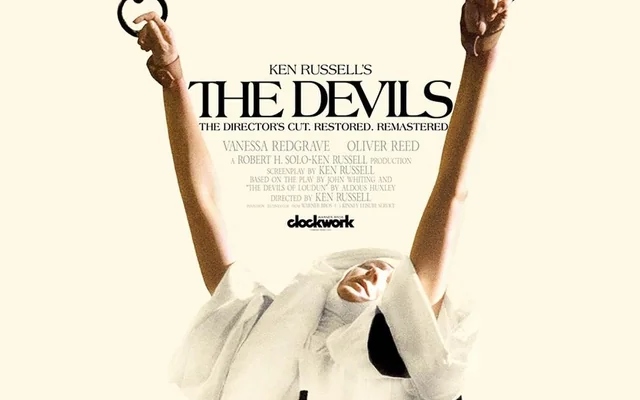
I literally wrote the book (check it out here) about this controversial 1971 Ken Russell film. Banned and censored in its initial release, the story of 17th-century priest accused of witchcraft by a sexually repressed nun has hasn’t been seen in its original form for decades.
Until now.
The new 4k restoration, which debuted in Cannes this year, is breathtaking. Provocative, it’s a thing of terrible beauty that demands a reaction. It’s a testament to Russell’s vision that 55 years after it was originally released in theatres, it will likely be the most transgressive movie of the year.
Read all about it in the New York Times article “In 1971, This Film Was a Scandal. In 2026, It’s a Respected Period Piece” by Ben Kenigsberg HERE!
SYNOPSIS: In “How to Rob a Bank,” a new heist film starring Nicholas Hoult and Zoë Kravitz, and now playing in theatres, a crew of social media-savvy bank robbers are hunted by a veteran FBI agent and a software engineer. “You know what’s more powerful than money?” asks Ryan (Nicholas Hoult). “An audience.”
CAST: Nicholas Hoult, Zoë Kravitz, Anna Sawai, Rhenzy Feliz, Pete Davidson, John C. Reilly. Directed by David Leitch.
REVIEW: A play on Robin Hood for the Instagram age, “How to Rob a Bank” sees a crew of influencer bank robbers called the Wolf Pack (Nicholas Hoult, Anna Sawai, Rhenzy Feliz and Pete Davidson) post their heists on-line to expose the exploitation of banks on regular citizens. “Welcome to our channel, How to Rob a Bank,” says Ryan (Nicholas Hoult), “where we teach our followers how to steal from the banks that steal from them.”
As their notoriety grows, they attract the attention of FBI veteran Agent West (John C. Reilly) and computer hacker Reagan (Zoë Kravitz). “You know,” he says, “I’ve been doing this for 30 years, and I’ve never come across a group of people as ballsy as this. Why are they posting it on social media? That’s 15 banks now. They must have a pretty big pile of money. Why are they taking these risks?”
As the FBI closes in, the thieves, driven by a sense of social responsibility, plan one last heist, their biggest one yet. “The city has a police force of hundreds,” says Ryan (Nicholas Hoult). “We’re an online community of thousands.”
A revenge fueled riff on “rob from the rich and give to the poor” for Tik Tokers, “How to Rob a Bank” is a slickly made but overstuffed heist flick with plenty of ideas but no nuance.
Director David Leitch, working from a script by Mark Bianculli, rides the line between dumb fun and social commentary.
Leitch stages several pulse racing car chases and there’s an action filled finale, but for a heist film, there’s not all that much actual robbery. We’re shown the crew at work, but the film gets weighed down with flashy music video inspired screeds about the death of the American Dream.
Wolf Pack leader Ryan (Nicholas Hoult) talks about the how-tos of bank robbing, systemic inequality, predatory lending and other revolutionary hot button topics, but his take at societal woes has a “I did my own research” vibe that undercuts its effectiveness. It’s a cavalcade of bold statements, percentages and graphics that feels like a quick scroll through the darker corners of the internet on the big screen. No subtlety, no depth, just scattershot collections of images and graphics.
As captured by Leitch ‘s camera, the emphasis on action and social comment prevent any degree of character building, save for the basics. Several characters get backstory while others are place holders without much to do.
As odd couple investigators Reilly and Kravitz have good chemistry, and it’s fun to see him as the rumpled but sharp-as-a-tack FBI agent, but after Kravitz (NO SPOILERS HERE) does her thing, her character is forgotten about, relegated to the background.
“How to Rob a Bank’s” championing of civil disobedience is either timely or irresponsible depending on your outlook. The issues it raises about affordability are timely and real, but the glamorization of violence in the wake of the attack and breach of the U.S. Capitol on January 6, 2021 and the 2024 shooting of Brian Thompson, the CEO of the health insurer UnitedHealthcare in New York City, place the film’s philosophy in a harsher light.
SYNOPSIS: In “I Play Rocky” Sylvester Stallone won’t take no for an answer. “I’m not giving this up. Not for a million bucks. Not for 10.”
CAST: Anthony Ippolito, AnnaSophia Robb, Toby Kebbell, P. J. Byrne, Stephan James, Jay Duplass, Robert Morgan, Tracy Letts, Matt Dillon. Directed by Peter Farrelly.
REVIEW: “I Play Rocky” is not a reinvention of Sylvester Stallone’s original story or the movie “Rocky,” it’s simply a crowd-pleasing reminder of a true underdog phenomenon.
The story begins in 1970s New York City with Mike Stallone (Anthony Ippolito) eking out a living with odd jobs while unsuccessfully auditioning for film roles. At his movie theatre usher gig he meets Sasha Czack (AnnaSophia Robb), who quickly becomes his girlfriend and biggest booster. She also encourages him to be himself and use his real name. “There are a lot of Mikes in the world,” she says. “There’s only one Sylvester. Sylvester Stallone.”
To be closer to the action, the new couple moves to Los Angeles. On a night off from his valet job, Stallone watches a heavyweight championship match between Muhammad Ali and part-time liquor salesman Chuck Wepner. Watching the underdog Wepner take a beating but never giving up inspired Stallone to write his own script. “Write a script.” Says Sasha, “and give yourself the best part.”
Working day and night he bangs out the script for what would become “Rocky” in just three and a half days. When producers Irwin Winkler (P. J. Byrne) and Robert Chartoff (Toby Kebbell) got hold of it they thought it would be a perfect film for Clint Eastwood or Charles Bronson. But despite a Brinks Truck of studio money backed up to Stallone’s apartment, he refused to sell the script unless he was cast in the lead. “I won’t sell it for $1 million,” he says. “Not $10 million. I play Rocky”
His persistence pays off, and the rest is Hollywood history.
An inspirational film about an inspirational movie, “I Play Rocky” is an audience friendly (i.e. formulaic) underdog tale that captures the spirit of the 1976 original film, even when it leans into sentimentality and exposition.
As Stallone, Anthony Ippolito does great work, handing in a performance that doesn’t feel like an imitation. Stallone is a pop culture staple, so we expect the marble-mouthed voice and muscles bursting out of his white tank top, and Ippolito nails that. More importantly, however, he captures the character’s ambition and underdog tenacity.
Ippolito is supported by a good ensemble, particularly Tracey Letts as an increasing frustrated studio executive.
“I Play Rocky’s” underdog story is so potent, that even though we know how it ends it still packs an emotional (but, it must be said, not intellectual) punch.
SYNOPSIS: In “Victorian Psycho,” a new thriller starring Maika Monroe and now playing in theatres, a wealthy family’s staff begin to disappear one by one after the arrival of an eccentric new governess. “I feel this darkness inside me,” says Winifred Notty (Maika Monroe). “Like a caged animal.”
CAST: Maika Monroe, Thomasin McKenzie, Jason Isaacs, Ruth Wilson, Jacobi Jupe, Evie Templeton. Directed by Zachary Wigon.
REVIEW: A blend of 19th-century gothic horror, dark social commentary and bonkers Penny Dreadful carnage, “Victorian Psycho” isn’t sure whether it wants to make you laugh or scream.
Based on Virginia Feito’s novel, “Victorian Psycho” begins when the wealthy Pounds family (Ruth Wilson and Jason Isaacs) hire governess Winifred Notty (pronounced “naughty”) to tend to their children, the obnoxious Andrew (Jacobi Jupe) and rebellious Drusilla (Evie Templeton), and teach them table manners, French, morals and pianoforte.
The year is 1858, the setting is a remote gothic manor known as Ensor House on the Yorkshire Moors and the governess has a problem.
“Most fear the darkness,” says the governess Winifred Notty (Maika Monroe), “but I feel tenderly towards mine.”
When the house staff begin to go missing, the Pounds wonder what is going on in their stately home. “What is the most important thing in life?” asks the maniacal Winifred. “Knowing good from evil.”
A horror satire of social hierarchies and exploitation, “Victorian Psycho” examines the class divisions of both upstairs and downstairs of the grand home. Everyone here, save for the sweet-natured scullery maid Ms. Lamb, played by Thomasin McKenzie, has a place in the rigid social network where cruelty is the norm.
Shaking things up is equal opportunity serial killer Notty, played to horrifyingly humorous effect by Monroe. It’s a wonderfully twitchy performance, unpredictable and unhinged, that finds a way to weave comedy into the film’s slasher elements.
She’s a blast and nicely supported by arch performances from Isaacs and Wilson, but they’re all trapped in a movie that doesn’t fully commit to its subversive ideas. Director Zachary Wigon, working from a script by Feito, sets up plenty of social satire—one playful scene has Mr. Pounds describing his decadent aristocratic ancestors—and the Pounds family’s casual cruelty points toward power imbalance and the behavior of the 1%, but the movie is more interested in Notty’s blood-soaked villainy than the inequality that pushes her to extremes.
A title like “Victorian Psycho” suggests what the viewer is in store for even before seeing a single frame of film. It delivers on the title’s gruesome promise, just without the depth that could have made it really memorable.
SYNOPSIS: In “Ebenezer” Johnny Depp stars as Mr. Bah Humbug, a wealthy and misanthropic businessman who hates Christmas in this new big screen remake of the classic Charles Dickens novella “A Christmas Carol.” “I wish to be left alone.”
CAST: Johnny Depp as Ebenezer Scrooge, alongside Rupert Grint, Andrea Riseborough, Sam Claflin, Daisy Ridley, Tramell Tillman, Ian McKellen. Directed by Ti West.
REVIEW: There’s a meta moment in “Ebenezer.” Johnny Depp, playing a man transformed after a surveying of his life, says, “I’m not the man I was.” It’s hard not to imagine those words also have meaning for the actor, who makes his return to big budget films after several years of controversy.
He comes back to theatres in “Ebenezer,” a familiar, darkly gothic tale set in early Victorian London. It’s Christmas Eve, a time of celebration for everyone, except miserly businessman Ebenezer Scrooge (Depp) who waves away any hint of Xmas cheer with a brisk, “Humbug!”
If he had his way he says he would boil anyone who wishes him a Merry Christmas in their own pudding and bury them with a stick of holly through their heart.
As the rest of London prepares for the big day, Scrooge is haunted, first by the ghost of his late business partner Jacob Marley (Ian McKellen), now a tortured soul draped in heavy chains forged by the sins he committed in life.
“I failed to honor the time I was gifted,” he says.
Marley tell his old friend that he will be visited by three spirits, the Ghosts of Christmas Past (Andrea Riseborough), Christmas Present (Tramell Tillman) and Christmas Yet to Come (Robert Strange), who will offer him a chance at redemption. “Listen to them,” he says. “Learn from your mistakes. Change, Ebenezer.”
Reliving moments of the past that saw him hardened to those around him, experiencing the melancholy moments of present day and seeing the bleak future that awaits him if he doesn’t see the light, Scrooge must search to see if the flame of humanity still flickers in his heart.
One of the most adapted stories in film and television history, “A Christmas Carol” has served as the source material for hundreds of versions, from the 1901 short “Scrooge; or, Marley’s Ghost” and 1992s “Muppet Christmas Carol” to Bill Murray’s “Scrooged” and the 1951 Alastair Sim classic.
So, is “Ebenezer” different than all the other versions? The advertising tagline thinks so. “If you think you know his story, think again,” it reads and it does feel distinctive from most takes of the Christmas tale.
Structurally, the screenplay by Nathaniel Halpern wanders from Dickens. Dickens originally planned “A Christmas Carol” as a ghost story and a study of inequality in Victorian life but Halpern flips the script. He gives Marley more backstory and develops Scrooge’s childhood trauma as a source of his hardheartedness, but it’s in his treatment of Dickens’s social justice themes that the screenplay makes its biggest moves.
In Halpern’s version Scrooge’s distrust of the poor is attributed to shady charity workers who line their own pockets with donations meant for the underprivileged. It fundamentally changes the core of Dickens’s story of systemic neglect of society’s less fortunate.
Director Ti West, however, is faithful to Dickens’s ghost story. Best known for making horror films like the “X” trilogy and “The House of the Devil,” he amps up the gloomy, atmospheric horror with jump scares, some unsettling moments and creepy imagery in the three ghost sequences. It’s more eerie than actually scary, but the ghosts are effectively portrayed.
Despite Halpern’s changes, “Ebenezer” is a serviceable, if a little dull, adaptation but it serves more as a vehicle for Depp to essay another in his long list of oddball characters rather than a radical reimagination.
Depp delivers a performance, buried under an inch of prosthetic makeup, that sits on the shelf alongside his work in “Sweeney Todd,” “Pirates of the Caribbean,” “Dark Shadows” and “Sweeney Todd.” It’s eccentric, emotional and comedic, a showcase for Depp’s unique touch.
His take on Scrooge veers toward sentimentality as he is exposed to lost loves and missed opportunities at creating relationships that could have given him the kind of joy he only otherwise found in collecting money from “those too poor and too blind to settle their debts.”
As the movie winds toward the end credits, it’s impossible to watch Depp’s performance without seeing a parallel to the actor’s major studio comeback and Scrooge’s search for redemption. The success of the film may well depend on whether the Ghost of Tinsel Town Past visits audiences this weekend.
Even with Depp’s off kilter lead performance, “Ebenezer” is a tad dull in its midsection, but even a ho hum version of this story supplies emotional moments. The Christmas setting, the suggestion that no matter who we are, or what we’ve done, it’s never too late to let our humanity shine, make this a time-honored story despite this middling presentation.
On the Saturday November 7, 2026 edition of The Richard Crouse Show we meet Kristen Joiner. She is a writer, activist, and producer. After two decades in nonprofit and human-rights work, she was asked to co-author the memoir of disability rights leader Judy Heumann—a collaboration that became Being Heumann: An Unrepentant Memoir of a Disability Rights Activist, and later the YA book Rolling Warrior.
Judy was blunt from the first meeting: Kristen had spent a career in social change and still had not understood disability as a civil rights issue. That tension—between a nondisabled writer and one of the movement’s central figures—shaped both the book and what followed. Kristen is now an executive producer on the feature film Being Heumann, directed by Oscar winner Siân Heder and starring Ruth Madeley as Judy and now playing in theatres.
Then, Noam Tomaschoff an actor and writer who turned a family secret into an award-winning musical. He is the writer and star of Our Little Secret: A True New Musical. After a DNA test revealed he wasn’t an only child, he and composer Ryan Peters and producer Russell Citron turned the story into a musical that began at Toronto Fringe, won over Edinburgh, packed Montreal’s Segal Centre, and now comes to the CAA Theatre in Toronto until November 22.
Each week on the nationally syndicated Richard Crouse Show, Canada’s most recognized movie critic brings together some of the most interesting and opinionated people from the movies, television and music to put a fresh spin on news from the world of lifestyle and pop-culture. Tune into this show to hear in-depth interviews with actors and directors, to find out what’s going on behind the scenes of your favourite shows and movies and get a new take on current trends. Recent guests include Chris Pratt, Elvis Costello, Baz Luhrmann, Martin Freeman, David Cronenberg, Mayim Bialik, The Kids in the Hall and many more!
All iHeartRadio Canada stations are available across Canada via live stream on iHeartRadio.caand the iHeartRadio Canada app. iHeartRadio Canada stations are also connected through Alexa, Siri, and Google Home smart speakers.
The Entertainment Is Broken podcast is back… and Brittlestar has joined as a co-host!
Brittlestar, Richard Crouse and Sarah Hanlon unpack Love Is Blind’s relationship drama, Nathan Fielder’s appeal and Canada’s Eurovision plans. Plus, a fake game show with a serious message—and a debate about whether audiences want authenticity or just great entertainment.
I sit with NewsTalk 1010 host Deb Hutton to talk about Nathan Fielder look-a-likes, getting the ball (or sphere) rolling with Rush, some honors for Paul Anka and David Foster and I review the John Malkovich and Sam Rockwell film “Wild Horse Nine.”