VICTORIAN PSYCHO: 3 STARS. “bonkers Penny Dreadful carnage.”
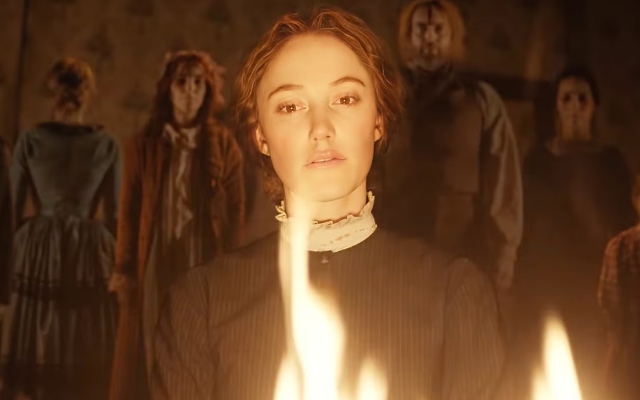
SYNOPSIS: In “Victorian Psycho,” a new thriller starring Maika Monroe and now playing in theatres, a wealthy family’s staff begin to disappear one by one after the arrival of an eccentric new governess. “I feel this darkness inside me,” says Winifred Notty (Maika Monroe). “Like a caged animal.”
CAST: Maika Monroe, Thomasin McKenzie, Jason Isaacs, Ruth Wilson, Jacobi Jupe, Evie Templeton. Directed by Zachary Wigon.
REVIEW: A blend of 19th-century gothic horror, dark social commentary and bonkers Penny Dreadful carnage, “Victorian Psycho” isn’t sure whether it wants to make you laugh or scream.
Based on Virginia Feito’s novel, “Victorian Psycho” begins when the wealthy Pounds family (Ruth Wilson and Jason Isaacs) hire governess Winifred Notty (pronounced “naughty”) to tend to their children, the obnoxious Andrew (Jacobi Jupe) and rebellious Drusilla (Evie Templeton), and teach them table manners, French, morals and pianoforte.
The year is 1858, the setting is a remote gothic manor known as Ensor House on the Yorkshire Moors and the governess has a problem.
“Most fear the darkness,” says the governess Winifred Notty (Maika Monroe), “but I feel tenderly towards mine.”
When the house staff begin to go missing, the Pounds wonder what is going on in their stately home. “What is the most important thing in life?” asks the maniacal Winifred. “Knowing good from evil.”
A horror satire of social hierarchies and exploitation, “Victorian Psycho” examines the class divisions of both upstairs and downstairs of the grand home. Everyone here, save for the sweet-natured scullery maid Ms. Lamb, played by Thomasin McKenzie, has a place in the rigid social network where cruelty is the norm.
Shaking things up is equal opportunity serial killer Notty, played to horrifyingly humorous effect by Monroe. It’s a wonderfully twitchy performance, unpredictable and unhinged, that finds a way to weave comedy into the film’s slasher elements.
She’s a blast and nicely supported by arch performances from Isaacs and Wilson, but they’re all trapped in a movie that doesn’t fully commit to its subversive ideas. Director Zachary Wigon, working from a script by Feito, sets up plenty of social satire—one playful scene has Mr. Pounds describing his decadent aristocratic ancestors—and the Pounds family’s casual cruelty points toward power imbalance and the behavior of the 1%, but the movie is more interested in Notty’s blood-soaked villainy than the inequality that pushes her to extremes.
A title like “Victorian Psycho” suggests what the viewer is in store for even before seeing a single frame of film. It delivers on the title’s gruesome promise, just without the depth that could have made it really memorable.