Writing a review for “Mission Impossible – Fallout” gave my thesaurus a workout. The film, the sixth instalment in the Tom Cruise franchise, is jammed to the gills with next-level stunts that require an expanded vocabulary to describe. Words like ‘extreme’ or ‘exciting’ or even ‘epic’ (and those are only the ‘e’ words) don’t come close to describing the behemothic action sequences contained within.
Cruise returns as the seemingly invincible action man and IMF (Impossible Mission Force) agent Ethan Hunt. Hunt and his crew, tech wiz Benji (Simon Pegg) and agent Luther (Ving Rhames), are charged with finding and capturing anarchist Solomon Lane (Sean Harris), a baddie who was the leader of the Syndicate during the last film, “Rogue Nation.” “Whatever you heard about Lane,” explains Hunt, “if it makes your skin crawl it’s probably true.” Lane is working with the mysterious and murderous John Lark, a man with some extreme ideas about squashing the world order.
As Lark and Lane collect the necessary plutonium to fulfil their plan the CIA begins to have doubts about Hunt’s loyalty. Add to that the return of former MI6 agent Ilsa Faust (Rebecca Ferguson), and some newbies, CIA assassin August Walker (Henry Cavill) and black market arms dealer and lady of mystery White Widow (Vanessa Kirby) and you have lots of characters to fill the space between the stunts. Complicating matters is the fallout from some of Hunt’s previous, well-intentioned missions.
There are a lot of very good-looking people in “Mission Impossible – Fallout.” Handsome fellas and femme fatale‘s, they are all woven into a stylish story of international intrigue and plutonium. Like the others “MI” movies it’s packed with exotic locations—only James Bond has more air travel points than Ethan Hunt—doublespeak and double crosses but the narrative doesn’t matter that much, it’s all in service of the Bunyanesque action.
Choreographed to an inch of Hunts life—Cruise really puts himself out there for this one—the realism of the stunts gives the movie a sense of danger and the Green Screen Department the day off. Monumental, vertigo inducing single sequences take place on land, wheels, water and air. Only the screeching of tires score one eye-peeling chase scene between a motorcycle and a car. Visually it is so visceral director Christopher McQuarrie wisely avoided cluttering the scene with frenetic music. It doesn’t need it.
Of course those looking for a finely crafted John le Carré style story of espionage in “Mission Impossible – Fallout” will be bitterly disappointed. While it does contain huggerymuggery it frequently falls just this side of making sense. That’s not to say it isn’t entertaining. Even when Hunt isn’t in action the movie is in perpetual motion, but Frederick Forsyth this ain’t. Instead it is an elephantine (although no actual elephants appear) action epic that breaks the blockbuster norm of cutting away to an action sequence every ten minutes or so. It’s made up of three Brobdingnagian set pieces stitched together by words that mostly make sense.
CHIPs: It’s a remake, a comedy and an action film and yet it doesn’t quite measure up to any of those descriptors. It’s a remake in the sense that writer-director-star Dax Shepard has lifted the title, character names and general situation from the classic TV show but they are simply pegs to hang his crude jokes on.
The Circle: While it is a pleasure to see Bill Paxton in his last big screen performance, “The Circle” often feels like an Exposition-A-Thon, a message in search of a story.
The Fate of the Furious: Preposterous is not a word most filmmakers would like to have applied to their work but in the case of the “Fast and Furious” franchise I think it is what they are going for. Somewhere along the way the down-‘n’-dirty car chase flicks veered from sublimely silly to simply silly. “The Fate of the Furious” is fast, furious but it’s not much fun. It’s an unholy mash-up of James Bond and the Marvel Universe, a movie bogged down by outrageous stunts and too many characters. Someone really should tell Vin Diesel and Company that more is not always more.
Fifty Shades Darker: Depending on your point of view “Fifty Shades of Grey” either made you want to gag or want to wear a gag. It’s a softcore look at hardcore BDSM (bondage, discipline, sadism and masochism) that spanked the competition on its opening weekend in 2015. Question is, will audiences still care about Grey’s proclivities and Ana’s misgivings or is it time to use our collective safeword? “Fifty Shades Darker” is a cold shower of a movie. “It’s all wrong,” Ana says at one point. “All of this is wrong.” Truer words have never been spoken.
The Mountain Between Us: Mountain survival movies usually end up with someone eating someone else to stay alive. “The Mountain Between Us” features the usual mountain survival tropes—there’s a plane crash, a showdown with a cougar and broken bones—but luckily for fans of stars Idris Elba and Kate Winslet cannibalism is not on the menu. Days pass and then weeks pass and soon they begin their trek to safety. “Where are we going?” she asks. “We’re alive,” he says. “That’s where were going.” There will be no spoilers here but I will say the crash and story of survival changes them in ways that couldn’t imagine… but ways the audience will see coming 100 miles away. It’s all a bit silly—three weeks in and unwashed they still are a fetching couple—but at least there’s no cannibalism and no, they don’t eat the dog.
The Mummy: As a horror film it’s a meh action film. As an action film it’s little more than a formulaic excuse to trot out some brand names in the kind of film Hollywood mistakenly thinks is a crowd pleaser.
The Shack: Bad things in life may be God’s will but I lay the blame for this bad movie directly on the shoulders of director Stuart Hazeldine who infuses this story with all the depth and insight of a “Davey and Goliath” cartoon.
The Snowman: We’ve seen this Nordic Noir before and better. Mix a curious lack of Oslo accents—the real mystery here is why these Norwegians speak as though they just graduated RADA—Val Kilmer in a Razzie worthy performance and you’re left with a movie that left me as cold as the snowman‘s grin.
Valerian and the City of a Thousand Planets: Movies like the high gloss crime thriller “La Femme Nikita,” the assassin mentor flick “Léon: The Professional” and outré sci fi opera “The Fifth Element” have come to define director Luc Besson’s outrageous style. Kinetic blasts of energy, his films are turbo charged fantasies that make eyeballs dance even if they don’t always engage the brain. His latest, “Valerian and the City of a Thousand Planets,” not only has one of the longest titles of the year but is also one of the most over-the-top, retina-frying movies of the year. Your eyes will beg for mercy.
Wonder Wheel: At the beginning of the film Mickey (Justin Timberlake) warns us that what we are about to see will be filtered through his playwright’s point of view. Keeping that promise, writer, director Woody Allen uses every amount of artifice at his disposal—including cinematographer Vittorio Storaro’s admittedly sumptuous photography—to create a film that is not only unreal but also unpleasant. “Oh God,” Ginny (Kate Winslet) cries out at one point. “Spare me the bad drama.” Amen to that.
THE UGLY
Song to Song: I think it’s time Terrence Malick and I called it quits. I used to look forward to his infrequent visits. Sure, sometimes he was a little obtuse and over stayed his welcome, but more often than not he was alluringly enigmatic. Then he started coming around more often and, well, maybe the old saying about familiarity breeding contempt is true. In “Song to Song” there’s a quick shot of a tattoo that sums up my feelings toward my relationship with Malick. Written in flowery script, the words “Empty Promises” fill the screen, reminding us of the promise of the director’s early work and amplifying the disappointment we feel today. This is the straw that broke the camel’s back, the Terrence Malick movie that put me off Terrence Malick movies. I’ll be nice though and say, it’s not him, it’s me.
EXTRA! EXTRRA! MOST COUNFOUNDING
mother!: Your interest in seeing “mother!,” the psychological thriller from “Black Swan” director Darren Aronofsky, may be judged on your keenness to watch American sweetheart Jenifer Lawrence flush a beating heart down a toilet. Aronofsky’s story of uninvited guests disrupting the serene lives of a poet and his wife refuses to cater to audience expectations. “mother!” is an uncomfortable watch, an off-kilter experience that revels in its own madness. As the weight of the weirdness and religious symbolism begins to feel crushing, you may wonder what the hell is going on. Are these people guilty of being the worst houseguests ever or is there something bigger, something biblical going on?
Aronofsky is generous with the biblical allusions—the house is a paradise, the stranger’s sons are clearly echoes of Cain and Abel, and there is a long sequence that can only be described as the Home-style Revelation—and builds toward a crescendo of wild action that has to be seen to be believed, but his characters are ciphers. Charismatic and appealing to a member, they feel like puppets in the director’s apocalyptic roadshow rather than characters we care about. Visually and thematically he doesn’t push button so much as he pokes the audience daring them to take the trip with him, it’s just too bad we didn’t have better company for the journey.
“mother!” is a deliberately opaque movie. Like looking into a self-reflective mirror you will take away whatever you put into it. The only thing sure about it is that it is most confounding studio movie of the year.
The “war on drugs” is one of the longest battles in American history. In 1971 President Richard Nixon declared drug abuse “public enemy number one,” vowing combat against drug producers and dealers.
Forty years and many billions of dollars later the Global Commission on Drug Policy stated, “The global war on drugs has failed, with devastating consequences for individuals and societies around the world.”
Last year, writing in the New York Times, Mexican journalist José Luis Pardo Veiras echoed those sentiments. “Drugs continue to stream north to the United States, the great user, and firearms enter Mexico in return, where they kill thousands.”
The fight has been a failure for everyone except Hollywood, which has consistently mined the war on drugs for stories and colourful characters. This weekend Tom Cruise stars in the latest tale from the war on drugs, American Made, the real-life story of Barry Seal, adrenaline junkie and TWA pilot.
The story begins with Seal being hired by the CIA to take reconnaissance photos of Soviet-backed insurgents in South America. His life quickly spirals out of control as he becomes a courier between the CIA and Panamanian CIA informant General Manuel Noriega while also working as a cocaine smuggler for the Medellin Cartel.
Drug cartel stories are tailor made for the movies. Populated by bigger-than-life characters like the wealthiest criminal in history, the so-called “The King of Cocaine,” Pablo Escobar, the stories have it all: glamour, drama, moral ambiguity and the primal clash of good and evil. Here are three films with three very different approaches to the war on drugs.
One critic described Sicario as a “French Connection for the drug-fuelled Mexico-US border war.” Starring Emily Blunt, Benicio del Toro and Josh Brolin, it’s a drama about an idealistic FBI agent working with an elite task force to stem the flow of drugs between Mexico and the United States. It’s gritty and certainly not a feel-good movie about winning the war on drugs. Instead, it’s a powerful look at a seemingly unwinnable battle and the toll it takes on its soldiers.
Savages is an over-the-top Oliver Stone movie that sees Aaron Johnson and Taylor Kitsch as drug dealers and two thirds of a love triangle with a California cutie played by Blake Lively. Their product, a potent strain of legal medical-grade marijuana, earns the attention of a Mexican Baja drug Cartel boss (Salma Hayek) who’ll do anything to create a “joint” venture, including kidnapping and murder.
Savages, at its black-hearted best, is a preposterous popcorn movie that sees Stone leave behind the restraint of movies like W and World Trade Center and kick into full bore, unhinged Natural Born Killers mode. It’s a wild, down ’n dirty look into the business of drugs and revenge.
Smaller in scale is End of Watch. Jake Gyllenhaal and Michael Peña play patrol cops in Los Angeles’s tough South Central neighbourhood. A routine traffic stop turns into something bigger when they confiscate money and guns from a cartel member. “Be careful,” they’re warned by a senior officer, “You just tugged on the tail of a snake that’s going to turn around and bite you.”
These movies and others, like Code of the West and The House I Live In, prove the winners of the war on drugs are filmmakers.
The War on Drugs is one of the longest battles in American history. In 1971 President Richard Nixon declared drug abuse “public enemy number one, “ vowing combat against drug producers and dealers. Forty years and many billions of dollars later the Global Commission on Drug Policy stated, “The global war on drugs has failed, with devastating consequences for individuals and societies around the world.”
The only winners in the drug wars appear to be filmmakers who have mined a rich vein of stories from the decades long battle.
This weekend Tom Cruise stars in the latest tale from the War on Drugs, “American Made,” the real-life story of Barry Seal, adrenaline junkie and TWA pilot. The story begins in 1978 with Seal mentally on autopilot and looking for thrills. Caught smuggling cigars into the United States, the CIA senses his potential and hires him to take reconnaissance photos of Soviet-backed insurgents in South America.
“The work is covert,” says his recruiter, Agent Schafer (Domhnall Gleeson). “If anyone finds out about it, family, friends, your wife, that would be a problem.”
What begins as a safe and profitable adventure takes a dangerous turn when he becomes a courier between the CIA and Panamanian CIA informant General Manuel Noriega. Next he signs onto an even more dangerous assignment, running arms to the contras in Nicaragua in their battle against the communist Sandinistas.
“Is this legal?” he asks. ”It is if you do it for the good guys,” says his Agent Schafer (Domhnall Gleeson).
Seduced by the money and the excitement he also takes gigs as a cocaine smuggler for the Medellin Cartel. “I’m working for the CIA, the DEA and Pablo Escobar,” he boasts. He sees himself as “just gringo who always delivers,” but his convoluted work life and allegiances make him a person of interest not only to everyone from Pablo “The King of Cocaine” Escobar to the DEA, the FBI and even the White House.
Drug cartel stories are tailor made for the movies. Populated by bigger-than-life characters like the wealthiest criminals in history like the Medellin Cartel members, the stories have it all—glamour, drama, moral ambiguity and the primal clash of good and evil. “American Made” has all that, although played in a lower key than movies like “Blow” or “Cocaine Cowboys.” It has a lighter touch—it’s not too violent and, oddly for a drug dealer movie, has no scenes where anyone actually samples the goods—which keeps things moving along at quite a clip but sheds next to no light on its characters, its go-go 80s setting or the political mess that turned into the Iran-Contra affair.
Echoes of “Top Gun” hang heavy over Cruise as the cockpit king Seals. He’s all teeth and grins, a charmer who can talk his way through almost any situation. He has nerves of steel and high-flying greed, a combo that should give us a compelling anti-hero but instead Cruise plays him as a decent guy who “didn’t ask enough questions.” Didn’t ask enough questions about the personal toll his work running guns and drugs for a cartel. Didn’t ask enough questions about human trafficking. He didn’t ask questions because he was greedy. He liked the suitcases of cash and fancy cars his job provided. If the movie had allowed Cruise (or vice versa) to actually explore Barry’s dark side the film might have delivered more of a punch.
There’s more character work in any episode of “Breaking Bad” or “Narcos” than “American Made’s” entire 115 minute running time but Cruise’s movie does have a sense of humour about itself that makes for an amiable, if not memorable, watch.
No longer content to simply offer up an endless string of remakes, reboots and reimaginings Hollywood is now in the business of creating universes. Marvel and DC lead the pack, generating big box office with movies that mix-and-match their flagship characters in ongoing and connected stories. Now others are looking to get a piece of that action.
This weekend’s “The Mummy,” a self-described “action-adventure tentpole with horror elements,” is the foundation of Universal Pictures’ Dark Universe. The studio aims to create a cross-pollinated world were their brand name monsters, like Frankenstein and The Invisible Man, are mixed and matched to infinity or at least as long as audiences will pay to see them.
The Mummy reinvents the story of ancient malevolence, presenting a new, female title character and adding Russell Crowe as Henry Jekyll, a doctor with a serum that unleashes his inner demons.
The idea of pairing up monsters is nothing new. Abbott and Costello Meet Frankenstein saw The Wolf Man, Dracula and Frankenstein’s Monster cross paths with The Invisible Man and Freddy Krueger battled fellow horror icon Jason Voorhees in a Friday the 13th and Nightmare on Elm Street combo pack but another monster movie mash up beats everything that came before it.
The Monster Squad, a fun 1987 teenage horror comedy sees Count Dracula recruit a posse of monsters — Frankenstein, The Mummy, The Wolf Man and The Creature from the Black Lagoon — to retrieve and destroy an ancient amulet that holds the key to controlling the balance of good and evil in the world. Trouble is, he didn’t count on a band of fifth graders (and one chain-smoking eighth grade greaser) who call themselves the Monster Squad, driving a stake through his plans.
The boys are a geeky group who wear “Stephen King Rules” T-shirts and debating important topics like, ‘Who is the coolest monster?’ and ‘Does The Wolf Man have the biggest nards?’
The Monster Squad, despite the salty language (the boys swear, no doubt courtesy of screenwriter Shane Black who also wrote more adult fare like Lethal Weapon), the refreshing lack of political correctness, the violence and the presence of nightmare-inducing monsters this is, above all, a kid’s film. The youngsters are the heroes and battle the monsters in ways that only kids can. A garlic pizza proves to be Dracula’s undoing, and in one classic scene The Wolf Man is felled by a well-placed kick to “the nards.”
Director Fred Dekker says he set out to make an exciting teen adventure movie, but may have been a bit ahead of his time. In the post–Buffy the Vampire Slayer world we live in the mix of kids, humor and horror seems normal, but in 1987 it didn’t click with audiences.
“I like to think that Monster Squad, in its own small way, says something about what it is to be a kid and to be afraid in the world,” says Dekker, “and discovering the need for heroism.”
“It took several years before the combination of young people in jeopardy in genre-horror situations like Buffy and Goosebumps and Harry Potter really became acceptable. The audience wasn’t ready for it in the ’80s. Sure there was The Lost Boys and The Goonies, but specifically the kind of monster-slayer approach wouldn’t be popular for another ten or fifteen years. So I like to think that we were a little ahead of the curve.”
It is no longer enough for Hollywood to offer up a constant diet of remakes, reboots and reimaginings. These days the studios are franchise building, creating interconnected universes for their characters to live in. Joining Marvel, DC, Star Wars and X-Men is Universal Pictures’ Dark Universe, a new series aiming to bring classic monsters like Frankenstein and The Invisible Man back to big screen life.
The universe’s foundation is “The Mummy,” a self described “action-adventure tentpole with horror elements.” The plan is to revive the eighty-five-year-old “Mummy” franchise, insert another classic character, Dr. Henry Jekyll, thus creating a cross-pollinated world were brand name monsters are mixed and matched to infinity.
The title may signify a character unearthed from the annals of antiquity but the star of the show is ageless action man Tom Cruise. He is Nick Morton a mercenary who specializes in plundering conflict areas for priceless artefacts. Under attack in the Iraq, he uncovers his greatest find yet, the five-thousand-year-old resting place of Ahmanet (Sofia Boutella), an Egyptian princess in line to be queen. When her insatiable lust for power led her down a dark and dangerous path she was deposed, buried alive far from home in Mesopotamia now Iraq, in an ornate sarcophagus.
“That’s not a tomb,” says Egyptologist Jenny Halsey (Annabelle Wallis), of the unearthed find, “it’s a prison.” Awake and angry Ahmanet, a.k.a. the big screen’s first female Mummy, brings Nick under her spell as she tries to regain her lost power and, of course, enslave all of humanity.
It’s not hard to sense the cynicism in “The Mummy.” Bundling Cruise and legendary monsters in the movie with a few laughs, some typical blockbuster action and a CGI climax it wouldn’t be out of place in an Avengers movie, it feels like a carefully constructed exercise in marketing first and a movie second.
There is plenty of atmosphere—the screen is often so dark it’s hard to see exactly what is going on. I see why it is called the Dark Universe—and the odd spooky scene—Ahmanet’s stretching out the kinks after her 5000 year nap is suitably weird—but it never dials up the horror too high.
As a horror film it’s a meh action film. As an action film it’s little more than a formulaic excuse to trot out some brand names in the kind of film Hollywood mistakenly thinks is a crowd pleaser.
Cobie Smulders has been in action movies a plenty, but she’s rarely part of the action. That changes in Jack Reacher: Never Go Back.
Opposite Tom Cruise, Smulders plays Major Susan Turner, a decorated solider accused of espionage. To prove her innocence she teams with Jack Reacher in a battle for the truth.
“I was really excited about doing some action scenes,” says the Canadian born actress who played former director of the planetary intelligence service S.H.I.E.L.D. Maria Hill in various Avengers movies as well on television.
“I’d done some quote, unquote action movies before, through The Avengers and the Marvel Universe. I’d be part of some of their stuff but I missed out on most of the fun fight sequences. Jumping on this, I knew I would get to do more fighting, hands on, rather than standing next to the superheroes while they do all the fighting.”
She has more than her share of up-close-and-personal battle sequences, bare knuckling her way through the story at a breakneck pace, but were the scenes as fun to shoot as she thought they would?
“That’s a great question because sometimes they are not,” she laughs. “They are quite technical and they can drag on. When it is fast and intense, they’re really fun because it’s like an adrenaline rush. It’s like doing a choreographed dance with somebody. But when they drag on and it becomes about the minutia of like, ‘We have to do the insert of the picking up of the meat tenderizer and we have to do it from this angle and that angle,’ it takes the magic out of it.”
A magical experience or not, Smulders, who will next be seen in the action comedy Why We’re Killing Gunther opposite Arnold Schwarzenegger, says the scenes helped her performance.
“For me all the training and all the fighting helped me get into the character,” she says. “There were days when I would push past breaking points and think, I can’t take this anymore, and then I would go further. It got easier and easier. It was really painful at first but I always kept that in the back of my mind, what this woman would have had to go through, and what women and men in the military have to go through.
“I think anybody who decides to enlist in the military and do all the work it takes to become a major is somebody who is much stronger than I will ever be.
“She’s a woman we say has graduated Ranger School. When we started shooting the movie that hadn’t happened yet; no women had graduated from Ranger School. Then during the shoot the first two women graduated. If I am playing a woman who can endure that type of training, then this should be like a piece of cake, what I’m doing on set.”
Cruise and Smulders play a sort of Mr. & Mrs. Smith, a deadly duo who never allow romance to get in the way of their appetite for bodily destruction. Their relationship is a mix of Roadhouse style fighting and humorous rom com dialogue.
“To not have these characters get together romantically,” Smulders says, “was more interesting to watch than having a love scene in the middle of the movie.”
Who exactly is Jack Reacher? If you are a reader, he’s the protagonist of twenty books by British author Lee Child. If you’re a moviegoer, he’s a bone crunching former Major in the United States Army Military Police Corps who looks a lot like Tom Cruise. According to the new movie “Jack Reacher: Never Go Back,” he’s “the guy you didn’t count on.”
When we first see Reacher it’s four years after his exploits in his eponymous debut film. With the help of Major Susan Turner (Cobie Smulders) he has just broken up—and beaten up—a ring of smugglers. When he arrives in Washington to thank her, and possibly wine and dine her, he is shocked to discover she’s been court-martialled, accused of espionage. His efforts to get to the bottom of the case suggest she was arrested because she had a hard drive with sensitive info. “What did you expect,” he’s asked, “a picture of her in a Burka and having drinks with the Taliban?” After a daring prison break, he and Turner hit the road, trading quips and punching faces with a deadly ex-military hit man (Patrick Heusinger) hot on their trail. Their efforts to clear her name and uncover a far-reaching conspiracy are complicated by the presence of Samantha (Danika Yarosh), a fifteen year old who may or may not be Reacher’s daughter.
The addition of a kid changes the dynamic of the film. The first Reacher movie was a fun but violent ride, designed to keep fans of Cruise’s actionman persona happy until the next “Mission Impossible” instalment came along. It was an old fashioned movie, the kind of flick that Steven Seagal might have starred in circa 1992. It was a bare-bones action movie and predictable but Van Dammit, taken for what it was, it was also a bit of fun.
The movie rips along at a fast pace, bareknuckling its way through the story at a breakneck pace. Cruise and Smulders are sort of a Mr. & Mrs. Smith, a deadly duo who never allow romance to get in the way of their appetite for bodily destruction. Their relationship is a mix of “Roadhouse” style fighting and cutesy rom com dialogue.
It all adds up to an action movie for those who like a dose of sentimentality with their spinal injuries.
As the calendar moves ahead to 2016 I’m taking a moment to think back to the great people I met, wrote about or chatted with on television in 2015. I shared Tim Bits with Liev Schreiber—he liked the chocolate, I preferred the glazed—inhaled Johnny Depp’s vape fumes, had a “Sock Battle Supreme” with Anthony Daniels—Mr. C-3PO—and was embarrassed to order a Chai Tea Latte while standing next to Chris Cooper at a coffee bar. On stages, in hotel rooms, on phones and even in the back of taxis, they spoke and I listened. Here’s some of the best stuff I heard this year:
GEORGE MILLER: “I don’t think I’d be the filmmaker I am unless I had that medical education, in two very direct ways. Both of them have a lot of problem-solving in there. But the most important way is that as a doctor you are looking at people in extremis from many points of view. You look inside of people. You see people during birth and death and so on. Through microscopes — a lens. So you’re looking from many, many points of view. That’s exactly what you do in cin ema. Huge wide shots with massive crowds or you’re looking right down inside someone’s brain, someone’s head.”
AMY SCHUMER: “I never thought about being famous. That was never part of my thing, but once it was on the horizon as a possibility, it seemed like a real bummer. I could see there’s no upside. The upside is I sometimes get free appetizers and I can get a reservation at a restaurant. I only go to one place in New York, it’s a tea place, the Tea Cup, and they don’t take reservations but I can make a reservation there. I swear I don’t see another upside. It sucks.”
PHYLLIS SMITH: “I worked for JC Penny in the warehouse tagging the merchandise,” she remembers. “I used to stand there and tag thousands of fishing lures or bowling balls or roller shades, which were heavy as heck to lift around. The people were great to work with but the merchandise was a little challenging.
“I used to stand there, thinking about life, wondering what it is we all have in common because we’re not all given the same opportunity. Some people’s health is impaired when they’re born while others are charmed with intelligence or looks. I thought, ‘There has to be something that we all have. A commonality.’ I figured out that it’s the ability to love. We all, in some form or another, want to love and be loved. That was my big revelation. My lightbulb moment. Also, if you’re standing on a concrete floor, make sure you’re wearing comfortable shoes or you’ll pay for it later.”
CAROLL SPINNEY: Caroll is President Obama’s ninth cousin, but Big Bird isn’t political in the least. “Big Bird, I’m told by the owners of him, does not have political opinions. I thought of an idea that would get around that problem if someone (ever asked about it). ‘I don’t know who that is,’ he says in Big’s voice. ‘I thought we had a king.’ In most fairy tales, lands are run by kings or queens.”
DEBORAH ANN WOLL: A quick Internet search turns up many adjectives used to describe Daredevil star Deborah Ann Woll; gorgeous, talented and cute to name just a few.
The redheaded actress uses other terms to describe herself.
“There’s nerd, geek, all those words,” she says. “I am settling closer and closer to dork. I am a very proud dork.”
The former True Blood star — she played fierce teenage vampire Jessica Hamby for seven seasons on the hit show — embraces her inner dork — “I’m Dungeons and Dragons player, a Mystery Science Theatre buff. I like board games.”
She says the role playing games have benefits beyond entertainment value.
“Something like Dungeons and Dragons or a board game is a way for me to be social but it takes some of the responsibility off of me myself. If I don’t feel impressive as myself, I can feel impressive as Mistress Pyrona, the Genosi Sword Maiden. Like my acting, it gives me a little bit of support.”
JAKE GYLLENHAAL: “I think the people I admire as artists are the people who really listen to themselves even if it is to the detriment of what people might consider success. I’d rather be myself and do what I love than listen to someone else and follow that role and be unhappy.”
CHRISTOPHER PLUMMER: My favourite line from any interview? Christopher Plummer talking about the dog in “Remember”: “We had two dogs on set. One to do the stunts and the other just making money.”
BRYAN CRANSTON: “I don’t want to portray this idea that I’m just about the art. I’ve been poor and I’ve been rich and rich is better.” Also: Bryan Cranston told me he likes to go up to people wearing the Heisenberg t-shirts they wore on the show Breaking Bad and talk like Walter White… “Nice t-shirt,” and I whisper if to them and their eyes go wide and I put my finger to my lips, like ‘Don’t tell anyone… if you tell people, they won’t believe you.’
SAOIRSE RONAN: Saoirse is an Irish or Scottish name meaning freedom roughly pronounced SEER-shə. “I get very confused about my name all the time,” she said in a recent sit-down. “Sometimes I look at it when I’m writing it down for people and I go, ‘This is actually a ridiculous spelling of a name.’”
ADAM MCKAY: “We wanted to be the first Wall Street movie that took you behind the curtain, that really said, All these confusing terms you hear, all the ways the banks make you feel stupid or bored … it’s actually not that hard. If the guy who did Step Brothers can understand it you can too.”
RYAN COOGLAR: “Whenever I had a big test at school or a football game (my father would) say, ‘Take 10 minutes and watch this scene from Rocky. That’ll get you fired up. That’ll give you the juice to score five touchdowns. Or get an A on that test.’ I’d look over and think, ‘Are we watching this for me or for you?’”
ANTHONY DANIELS: Having one of the most recognizable voices in movie history can lead to some surreal moments. Just ask Anthony Daniels. He’s played C-3PO in all seven Star Wars films, including this weekend’s Star Wars: The Force Awakens and once rented a car with a very familiar voice on the GPS.
“I felt uncomfortable with me —very clearly — giving me instruction for something I didn’t know. I found it quite bizarre. I was driving thinking, ‘This is unnatural.’”
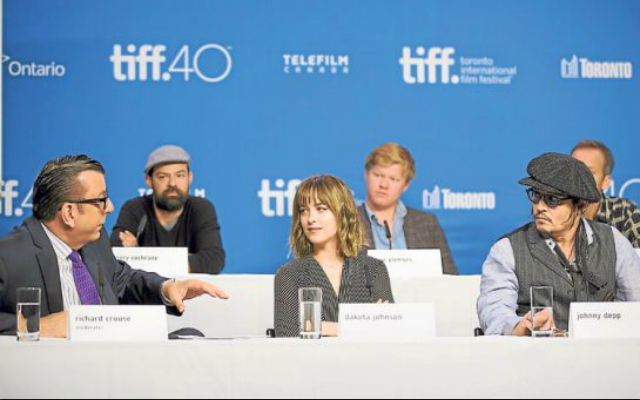
TIFF: The Toronto International Film Festival is only ten days but it looms large on my schedule every year. This year, in addition to watching dozens of movies and doing interviews for Metro, “Canada AM,” “NewsTalk 1010” and others, I hosted a bunch of press conferences, including, “The Martian” – with Ridley Scott, Matt Damon, Jessica Chastain, Demolition with Jake Gyllenhaal (#JakeQuake), Our Brand is Crisis with George Clooney and Sandra Bullock and Black Mass with Johnny Depp. They were some of the highlights of the fest for me… and unfortunately provided one of the low points. Read on… and once again Sean Bean, I’m REALLY sorry.
METRO: An insider’s look at TIFF: Behind the scenes with Richard Crouse
Ever wondered what it’s like to rub shoulders with celebs?
The backstage room at the TIFF Bell Lightbox’s press conference area is a beehive of activity.
“Is George here yet?”
“Is that Johnny vaping in the corner?”
It’s a place where no last names are necessary and the star wattage is blinding. Actors, directors, publicists and gofers mingle while air kisses, handshakes and Hollywood hugs are exchanged.
This year the Toronto International Film Festival is mounting 11 press conferences featuring everyone from Matt Damon and Sandra Bullock to George Clooney and Keith Richards.
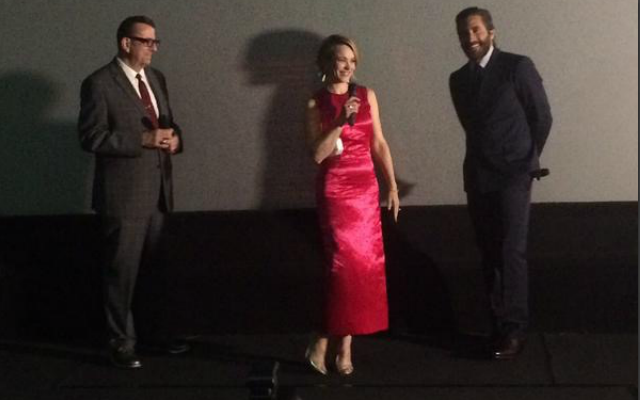
I’m hosting four of them — Demolition, The Martian, Our Brand is Crisis and Black Mass — with, as MGM used to brag, “More stars than are in the heavens.”
Despite the buzzy nature of the events, backstage is a casually chaotic place where actors get caught up with one another before taking the stage.
Matt Damon made the rounds, glad-handing with his The Martian cast mates, many of whom he hadn’t met because he spent 90 per cent of his of screen time alone, stranded on Mars.
The business of the press conferences happens on stage. Moderating these things provides a fascinating glimpse into both sides of the publicity machine.
Ideally the press conferences are a reciprocal event: Reporters ask questions to actors and filmmakers they might not otherwise have access to, and in return the stars get publicity for their films. It’s a pretty simple but often unpredictable transaction.
Gone are the days of the legendary “journalist” who asked all her questions in rhyme, but for every sensible inquiry about the movie, there is inevitably another off-the-wall query that leaves panel lists either annoyed or scratching their heads.
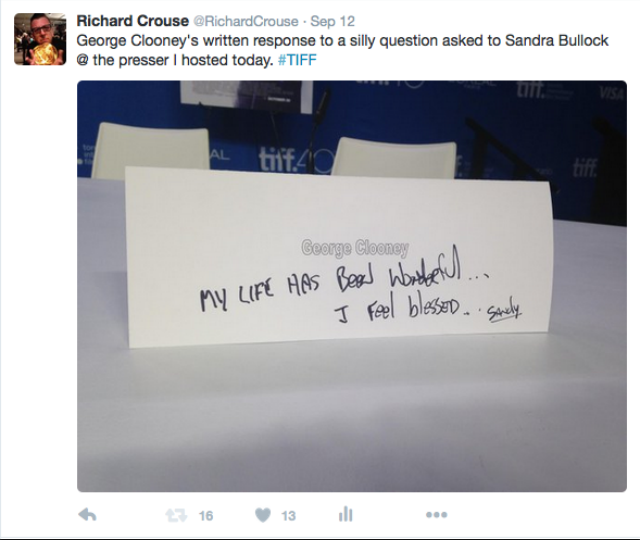
At the Our Brand is Crisis conference someone asked Bullock about her character’s grown-out roots. The Oscar winner replied as best she could and when she finished, Clooney chimed in, “Aren’t you glad you asked that question?”
Later she shut down a silly query regarding how she keeps her bum as toned as it is in the film. “It’s so sad that you just want to talk about the butt,” she said, before tersely adding that leg lifts are the secret to posterior pertness.
Not that the attendees are the only ones to pull a gaffe or two. During the Demolition conference, I asked Chris Cooper a long, rambling question about his character. He seemed genuinely perplexed, and you know what? I was, too. Sometimes you can overthink these things.
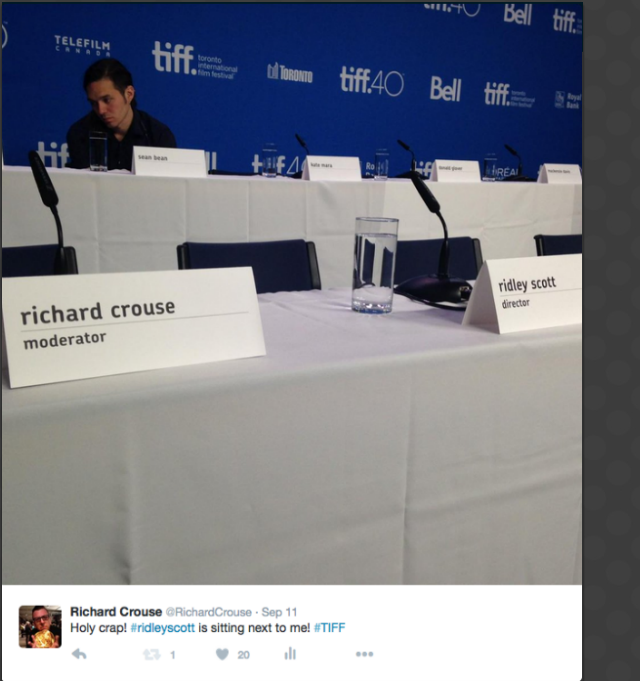
Later at The Martian presser, there were 13 people on the stage, everyone from Michael Pena to Damon, Scott, Chiwetel Ejiofor and Jessica Chastain, and in the shuffle I made the horrifying mistake of forgetting to ask the great Sean Bean a question and didn’t realize it until we were out of time.
Who doesn’t acknowledge Lord Eddard Stark?
Me, idiotically. Next year I promise to go to him first and frequently.