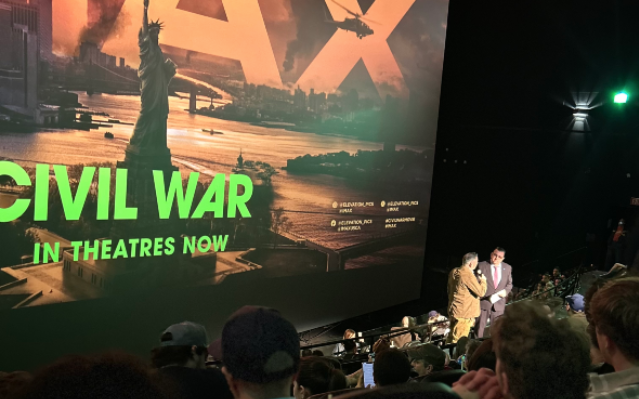
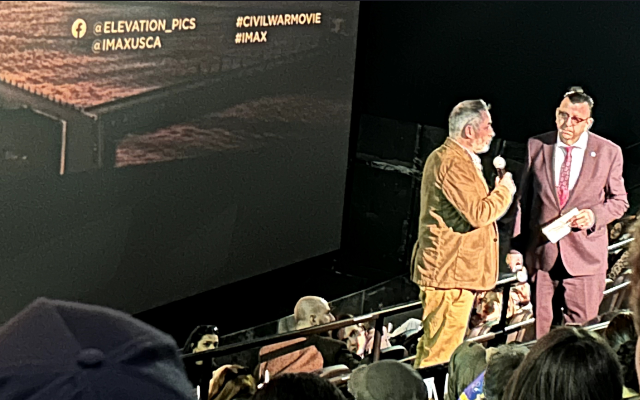
I hosted a special IMAX screening of “Civil War,” a new antiwar film. set in a dystopian future America, in which a team of military-embedded journalists race against time to reach Washington, D.C., before rebel factions descend upon the White House. AP calls it the “year’s most explosive movie,” while the Toronto Star calls it “the year’s most divisive movie.”
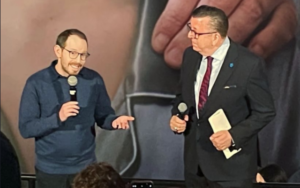
Director Alex garland joined me after the screening for a twenty minute Q&A where we discussed why he set the film in the United States, made the bold statement of blowing up the Lincoln Memorial and much more.
“Civil War,” a new, near-future vision of dystopia from director Alex Garland, now playing in theatres, is an emotional and intellectual experience that plays like a stark prediction of what could happen if division and hate are allowed to run unchecked.
At the film’s beginning the President of the United States (Nick Offerman) predicts victory for the American government over the separatist “Western Forces” led by Texas and California. In reality, the Second American Civil War is waning as the rebellious W.F. cut a path to Washington, while the “Florida Alliance” leaves a bloody mark on other parts of the country.
How bad is it? In the movie’s sole light moment, to Canadian audiences at least, it’s revealed that the Canadian dollar is more valuable, and more in demand than USD. That’s how bad the situation is.
In the midst of this, journalists capture the story on film and in words. Kirsten Dunst is Lee, a seasoned photojournalist, who with writer Joel (Wagner Moura) has an eye on getting the biggest scoop of the conflict, an interview with the President.
“Interviewing him is the only story left,” she says.
As Lee and Joel, along with veteran New York Times journalist Sammy (Stephen McKinley Henderson) and ambitious combat photographer Jesse (Cailee Spaeny), set off on the 857-mile journey from New York to D.C., the full impact of the war’s destruction, on property and people, becomes clear.
“Every time I survived a war zone, I thought I was sending a warning home, ‘Don’t do this,’” Lee says, “but here we are.”
There are no monsters or supernatural aspects in “Civil War,” but make no mistake, this is a horror film. The horrors of war are detailed in a visceral and chaotic way—the rat-a-tat-tat of gun battles is deafening, while the cinema verité style shots of carnage and bodies left abandoned to rot in the sun stick in the imagination—but it is the idea of a societal collapse that haunts. “No one is giving orders,” says a soldier. “Someone is trying to kill us, and we’re trying to kill them.”
Garland uses thrilling, in-your-face imagery that brings to mind everything from classic war films to the handheld coverage of the Capitol attack of January 6, 2021 to paint a portrait of a country in combat with itself.
The director, who also wrote the script, is decidedly non-partisan in his approach to the story, emphasizing the cruelty of the movement, and the actions of the extremist militias, not the politics. In this version of civil war, the population are divided by ideology. Friends turn on friends, state on state, and wearing an orange “Press” Kevlar vest won’t keep the journalists safe. “They shoot journalists on sight at the capitol,” says Sammy. The ravages of this war, set against ordinary backdrops, like an abandoned Christmas theme park, or a deserted highway, are unsettling in a profound, unnerving way.
The jarring visuals—an opening protest scene is a jaw-dropper—enhanced by a pulsating, anxiety inducing electronic soundtrack are almost overwhelming, but underscore the importance of the journalists who risk their lives to record history in real time. The occasionally shocking situations and images—the final shot is a doozy, provocative and bound to be controversial—are powerful reminders of the risks undertaken by reporters on the search for the truth.
That risk factor, at a time when journalism is under fire, is highlighted in “Civil War,” but takes a backseat to Garland’s bravura, pulse-racing filmmaking.
After 2021’s “Dune” was relegated to the small screen in the wake of pandemic related theatre closings, this weekend, the long awaited “Dune Part 2” brings the thunder, debuting on screens suitable for the story’s epic scale. The sci fi saga starring, well, almost everyone, in a sprawling cast headed by Timothée Chalamet, Zendaya and the giant sandworms who are literally and figuratively the film’s biggest stars, will play exclusively in theatres.
Wrestling novelist Frank Herbert’s expansive story of a psychedelic drug called Spice and reluctant messiah Paul Atreides, into a comprehensible movie has confounded filmmakers for decades. Most notably, David Lynch adapted the 1965 novel into a noble 1984 failure. The story is complex, with many characters and big, brainy concepts.
As a result, the spectacle of “Part 2,” on its own, isn’t for casual viewers. The last movie ended with Fremen warrior Chani (Zendaya) saying “This is only the beginning,” which means the new film isn’t a sequel, or a reboot. It’s a continuation, the second part of the story director Denis Villeneuve began in 2021, and to understand the story, you have to see the first film.
Equal parts action packed and philosophical, “Part Two” picks up where “Dune” left off. Set 8,000 years in the future, Atreides (Chalamet) son of an aristocratic family, and once heir to the planet of Arrakis, a desolate, almost inhabitable place, but rich in the lucrative, and psychedelic Spice, that is home to the Indigenous Fremen people.
Betrayed by Baron Vladimir Harkonnen (Stellan Skarsgård), the former steward of Arrakis, the family is all but wiped out, with Atreides and his mother, Lady Jessica (Rebecca Ferguson), left in the desert to die. If they are to survive it will be with the help of the Fremen—including Chani and Stilgar (Javier Bardem), leader of the Fremen tribe at Sietch Tabr—who call Atreides “The Chosen One” and believe he is a prophet with the power to bring peace to their world.
“Part 2” sees Atreides embedded with the Fremin in a mission of revenge against the House Harkonnen, the treacherous Baron, his sinister nephews, the brutish Beast Rabban (Dave Bautista) and Feyd-Rautha (Austin Butler), who Atreides holds responsible for the death of his father. Fighting gallantly alongside the Fremin, he’s mostly unconcerned with their belief that he is their messiah. His feelings for Chanti and his thirst for creating a conflict that will place him within striking distance of Emperor Shaddam IV (Christopher Walken), his daughter Princess Irulan (Florence Pugh), and Bene Gesserit Reverend Mother and the Emperor’s Truthsayer, Mohiam (Charlotte Rampling), are top of mind.
As the reckoning approaches, Atreides is plagued by terrible visions of the future.
There is so much more, but that is essentially the peg on which Villeneuve hangs his epic vision of Herbert’s tale. The director gives voice to the author’s study of vengeance, spirituality, fanaticism, liberation and conquest, articulating the story’s humanist nuances in the framework of a film that can only be described as a spectacle. It’s a bigger, wilder vision, an answer to the stately elegance of the first film.
The action sequences fill the screen. Villeneuve overwhelms the senses with grand images of desert warfare and Atreides sand surfing courtesy of giant “grandfather sand worms.” It’s blockbuster filmmaking writ large, exciting and laced with high stakes. Perfect for IMAX screens.
But the action sequences wouldn’t mean much if the film’s world building and characters didn’t set the stage. Arrakis is a sand swept hell, so immersive you’ll think you have sand in your underpants by the time the end credits roll. The vision of the planet is aided considerably by Greig Fraser’s gorgeous cinematography.
The devil, though, is in the details. On an arid planet, the Fremin syphon water from the bodies of their vanquished enemies to use in their cooling systems. Minutiae like this, and more, give the story depth, creating an exciting world for the characters to inhabit.
The stacked cast of a-listers deliver. Chalamet’s character comes of age on his hero’s journey, shedding any boyish traits Atreides may have had, to become a worm riding warrior and leader of armies.
Also making a mark is Butler as the eyebrow-challenged Feyd-Rautha (the part played by Sting in the Lynch’s adaptation). He maintains the rock star swagger of Elvis, his best-known role, but brings the danger as the sadistic nephew and heir.
It’s good stuff that showcases Villeneuve prowess, even if it feels rushed in its last act.
What Villeneuve isn’t good at, are endings. His first “Dune” film left audiences hanging, finishing up with no definitive ending. The end of “Dune Part 2” doesn’t dangle in quite the same way, but tensions are still unfolding as the end credits roll. Looks like we’ll have a “Part 3” coming in a couple years.
Despite the open-ended conclusion, however, “Dune Part 2,” with its stunning visuals, deep emotional core and good performances, suggests “Part 3” will be worth the wait.
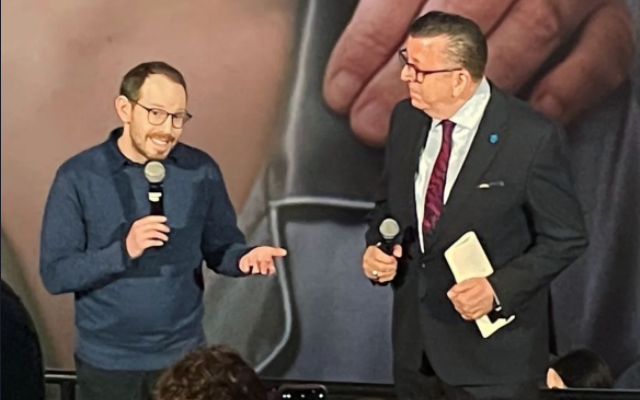
I hosted a live Q&A with director Ari Aster in front of a sold-out crowd at the Scotiabank Theatre in Toronto on Wednesday night. For a taste, check out my radio show on the iHeartRadio Network Saturday night at 8 pm t0 9 pm for a recorded interview with the director.
Magnificent and confounding in equal measure, “Beau is Afraid,” a new, three-hour epic from “Midsommar” director Ari Aster and now playing in theatres, is a nightmarish trek through a mishmash of mommy issues, anxiety and tragedy. Imagine a paranoid “Lord of the Rings” style quest reimagined by Luis Buñuel with a darkly comedic “After Hours” vibe and a hint of Thomas “You Can’t Go Home Again” Wolfe and you’ll be on the road to understanding Beau’s surreal journey.
Joaquin Phoenix plays the title character, a neurotic, over-medicated man whose father died at the moment of his son’s conception. The loss forever colored his life, leaving him lost in a sea of paranoia and uncertainty. “I am so sorry for what your daddy passed down to you,” says his overbearing mother Mona (Patti LaPone).
Beau’s already chaotic life is forever changed by a missed plane, a new prescription and a home invasion. Set off on an odyssey to return home for his mother’s funeral, circumstance continually keep him off track. First, he finds himself the reluctant patient of affable suburban caregivers Roger and Grace (Nathan Lane and Amy Ryan), their troubled daughter (Kylie Rogers) and a war vet with PTSD.
Then, a narrow escape finds him in the embrace of a travelling experimental theater troupe whose storytelling transports him into an animated folk tale of searching, struggle and solace.
Finally, bloodied and bruised, he arrives home to confront his past, face his fears and come to grips with the trauma that hangs over his life like a shroud.
“Beau is Afraid” is a complicated movie, laden with allegory and symbolism, that confronts the aftereffects of loss and grief. It’s familiar terrain for Aster, whose previous films, “Hereditary” and “Midsommar,” were also studies in intergenerational trauma.
But the new movie is anything but familiar.
It is a psychological dramedy that dives deep into how Beau’s trauma has molded every aspect of his life and lead to a breakdown, one we witness from his point-of-view, in real time. It’s a harrowing trip as Beau slowly loses his grip on reality, and his paranoia shapes the movie’s narrative.
Aster is uncompromising in his portrayal of Beau’s state of mind. His previous movies were more visually shocking, featuring images more aligned to traditional horror. “Beau is Afraid” has less overt horror. It’s more concerned with the psychological, the confusion, fear and anxiety that drives Beau. To convey this, Phoenix, in an internal performance, plays the character as a shell. The movie revolves around him and his state of mind, but he is a reactive character, one who responds to, rather than instigates, the action. It’s interesting, deeply felt work but the closed down, Chauncey Gardiner nature of the character makes him difficult to embrace.
Given the unsettled nature of the real world, audiences may understand, relate or sympathize with Beau’s all-encompassing fear, but the absurdism woven into Phoenix’s childlike performance, particularly in the film’s second half, wears thin.
“Beau is Afraid” is the weirdest film on Aster’s already proudly weird IMDB page. It may be the definition of a film that is not for everyone, but it cannot be faulted for its uncompromising vision. As a search for meaning in life, for closure from trauma, for freedom from fear, from relief from distended testicles (Yup! You read that right), it was never going to be a feel-good flick. So, instead, it swings for the fences, burrowing in on its grandiose emotional ideas even if it often feels like a three-hour panic attack.
Unpredictable, unexpected and ultimately, unexplainable, it’s challenging cinema that connects on a subconscious level.
“Bruised,” a new MMA drama directed by and starring Halle Berry, and now streaming on Netflix, punches through the usual sports cliches and training montages to tell a redemption story of a woman whose rage dominated her life.
Berry is Jackie Justice, a disgraced UFC mixed martial arts star who left the sport in disgrace when she vaulted out of the cage during a match. Four years later her hair trigger temper gets her fired from a job as a nanny and booze helps her cope with abusive boyfriend/manager Desi (Adan Canto). It was his push to take on bigger fights that sent her over the brink at the height of her fame, and now he wants her back in the ring, making money.
“I don’t want to fight,” she says, “I’m happy.” Trouble is, she doesn’t appear to be happy.
When she is spotted by fight league promoter Immaculate (Shamier Anderson), who promises to set her up with top flight trainer Buddhakan (Sheila Atim), her career looks to be back on track until the 6-year-old son (Danny Boyd, Jr.) she abandoned years ago suddenly comes back into her life.
“Bruised” is a slickly produced sports flick that takes us into a little explored world, women’s MMA. Berry doesn’t shy away from the brutal nature of the fight game, both in and out of the ring. It paints a vivid portrait of the physical and mental toll paid by Jackie as she seeks personal and professional redemption, but often veers into melodrama. Plots lines crisscross as we follow Jackie’s relationships with her mother (Adriane Lenox), her trainer, Desi and Manny. Each thread clutters the plot with storylines that are not only predictable, but also take away from the movie’s main thrust, how Jackie’s life has been shaped by trauma and rage.
When “Bruised” focusses on the fighting, it succeeds. It is interesting to see that world from a female point of view and about a woman older than might be expected in the punishing sport. Even Jackie’s trainer calls her “Betty White.”
But as Jackie’s road to redemption meanders through a laundry list of misery, the two-hour, 15-minute movie becomes weighed down by the sheer volume of story.
“Dune,” the latest cinematic take on the Frank Herbert 1965 classic, now playing in theatres, is part one of the planned two-part series. So be forewarned, the two-and-a-half-hour movie doesn’t wrap things up with a tidy bow. For some, the film’s last line, “This is only the beginning,” will be a promise of more interesting movies ahead, for others, who prefer tighter storytelling and a clear-cut finale, it may come off as a threat.
Director and co-writer Denis Villeneuve benefits from the parceled-out storytelling. Where David Lynch’s ill-fated 1984 version attempted to cover the complexity of the entire book, Villeneuve is given the time for world building, to explain the various and complex spiritual sci-fi elements that make up the story.
Here are the Cole’s Notes.
Set 8,000 years in the future, the story focusses on Paul Atreides (Timothée Chalamet), son of an aristocratic family and possibly, just maybe, a prophet. His father, Duke Leto Atreides (Oscar Isaac), has been bestowed stewardship of Arrakis, the desert planet also known as Dune. His mother, Lady Jessica (Rebecca Ferguson), is part of the Bene Gesserit, a social, religious, and political alliance who can magically control enemies by modulating their vocal tones.
Their new domain, Arrakis, is a desolate, almost inhabitable place that is home to the Fremen, a group of people who have lived on the planet for thousands of years. It is also the universe’s only source of mélange, also known as “spice.” It’s a drug with the power to extend human life, facilitate superhuman planes of thought and can even make faster-than-light travel possible. It is the most valuable commodity in the universe and those who control it, control everything.
When Baron Vladimir Harkonnen (Stellan Skarsgård doing his best impression of Marlon Brando in “Apocalypse Now”), the former steward of Arrakis, double crosses the Atreides clan, Paul and his mother are left in the desert to die. If they are to survive it will be with the help of the Fremen—including Chani (Zendaya) and Stilgar (Javier Bardem)—who call Paul “The Chosen One” and believe he has the power to bring peace to their world.
There’s more. Lots more, but that’s the non-spoilerific version.
Villeneuve lays out the information methodically, allowing the various story points and character motivations to seep into the fabric of the film and make an impact before moving on. There’s a lot to get through, but it doesn’t feel onerous like so many origin stories do.
Also effective are the large scale, and I mean large as in you need three or four eyes to take it all in, action scenes. The entire movie is big. So big it makes even the giant humans Jason Momoa and Dave Bautista, who play swordmaster Duncan Idaho and warrior Glossu Rabban respectively, look puny by comparison. As for the action, Villeneuve pulls out all the stops, staging world ending battles with elegance. Often major battle sequences can be muddled, a blur of colours and glints of metal, but Villeneuve delivers clear cut, tense sequences with a clarity that is unusual for modern action.
“Dune” is big and beautiful, with plentiful action and a really charismatic performance from Momoa. It is unquestionably well made, with thought provoking themes of exploitation of Indigenous peoples, environmentalism and colonialism.
So why didn’t I like it more than I did?
Partially because it’s an epic with no payoff. The cliffhanger nature of the story is frustrating after a two-and-a-half-hour wait. As good audience members we allow ourselves to be caught up in the world, humourless and bleak as it often is, to get to know the characters and then what? Wait for two years for the next movie? Apparently so, and the ending feels abrupt.
Nonetheless, “Dune” is formidable. It’s a grim, immersive movie that doesn’t shy away from the darkness that propels the story or the high-mindedness of the ideas contained within. Eventually, when we have a part two, it will feel like one piece, much like “The Lord of the Rings” franchise, but right now, despite its scope, it feels incomplete.
Reminders of real life were all around us at this year’s Toronto International Film Festival. From the digital screenings we watched at home to half empty, socially distanced screenings at venues like The Princess of Wales Theatre. But when my mind wanders back to September 2021, I won’t be thinking of having to show my proof of vaccination or the social distancing in theatres.
What will linger?
The images of Anya Taylor-Joy in “Last Night in Soho,” crooning an a cappella version of the Swingin’ Sixties anthem “Downtown,” and “Dune’s” Stellan Skarsgård doing his best impression of Marlon Brando in “Apocalypse Now,” come to mind immediately.
Those moments and others like them are the reason the movies exist. They transcend the vagaries of real life, transporting us away from a place where masks, vaccine passports are the reality.
And boy, did we need that this year.
Here a look back at some of the moments that made memories at this year’s TIFF:
“Night Raiders,” a drama from Cree-Métis filmmaker Danis Goulet, draws on the historical horrors of the Sixties Scoop and Residential Schools to create an unforgettable, dystopian scenario set in the new future. It effectively paints a somber portrait of totalitarian future, packed with foreboding and danger. The story is fictional but resonates with echoes of the ugly truths of colonization and forced assimilation. Goulet allows the viewer to make the comparisons between the real-life atrocities and the fictional elements of the story. There are no pages of exposition, just evocative images. Show me don’t tell me. The basis in truth of the underlying themes brings the story a weight often missing in the dystopian genre.
I asked Danis Goulet about having many of her characters in Night Raiders speak Cree: “It is everything to me,” she said. “My dad is a Cree language speaker. He grew up speaking Cree. He learned to speak English in school. His parents were Cree speakers. And coming down to my generation, I’m no longer a Cree speaker and there are entire universes, philosophies and poetry and beauty contained in the language. When we think of where our heritage lies, maybe some people think of museums. For me I think it is in the language. I think that richness doesn’t just offer Indigenous people something. I think if others looked closer at what the language tells us about the history of this land, they would be incredibly amazed. My dad has looked at references in the language that talk about the movement of the glaciers, so, foe me to have the Cree language on screen is everything. I’m in my own process. I go to Cree language camp to try and learn back the language and the language gives back in a way that is so healing and incredible. It is one of the greatest gifts in my life. So, the opportunity to put my dad’s first language on the screen, and the language of the Northern Communities where I come from, and my language that I lost, is the best. It’s incredible.”
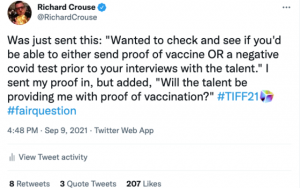
From Twitter: @RichardCrouse Was just sent this: “Wanted to check and see if you’d be able to either send proof of vaccine OR a negative covid test prior to your interviews with the talent.” I sent my proof in, but added, “Will the talent be providing me with proof of vaccination?” #TIFF21 #fairquestion 4:48 PM · Sep 9, 2021· 8 Retweets 3 Quote Tweets 206 Likes
There is no mention of COVID-19 in the Jake Gyllenhaal thriller “The Guilty.” But make no mistake, this is a pandemic movie, A remake of 2018 Danish film “Den skyldige,” it is essentially a one hander, shot on a just a handful of set with strict safety protocols in place. Gyllenhaal, as 911 operator Joe Baylor, may be socially distanced from his castmates, but his performance is anything but distant. Played out in real time, “The Guilty” builds tension as Baylor races against a ticking clock to bring the situation to a safe resolution for Emily. Director Antoine Fuqua amps up the sense of urgency, keeping his camera focused on Gyllenhaal’s feverish performance. The close-ups create a sense of claustrophobia, visually telegraphing Baylor’s feeling of helplessness and his crumbling mental state.
The sound of an audience laughing, applauding, crying, or whatever. Just being an audience. The big venues were socially distanced, and often looked empty to the eye, but when the lights went down and folks reacted to the opening speeches or the films, it didn’t matter. Roy Thomson Hall, with its 2600-person capacity, may have only had 1000 or so people in the seats, but for ninety minutes or two hours they formed a community, kindred souls brought together after a long break, and it was uplifting to hear their reactions.
“Flee” is a rarity, an animated documentary. A mix of personal and modern world history, it is a heartfelt look at the true, hidden story of the harrowing life journey of a gay refugee from Afghanistan. Except for a few minutes here and there of archival news footage, “Flee” uses animation to tell the story but this ain’t the “Looney Tunes.” Rasmussen used the animation to protect Amin’s identity, but like other serious-minded animated films like “Persepolis” and “Waltz with Bashir,” the impressionistic presentation enhances the telling of the tale. The styles of Rasmussen’s animation change to reflect and effectively bring the various stages of Amin’s journey to vivid life. It is suspenseful, heartbreaking and often poetic.
I asked “The Survivor” star Vicky Krieps about working opposite Ben Foster: “The first day I came [on set] I was very intimidated,” she said. “I wouldn’t say scared, but it felt like a wall to me. It began like this. There was no small talk. There was no, ‘How are you?’ He was already in character and it was very clear. I thought, ‘OK, I have to play his wife.’ And then, something really interesting happened. I like having a challenge and this felt like a challenge. So, I needed to find a way [to relate to him] because I knew I was going to be his wife. How do I do that? Imagine it as a wall, but then in the wall there are eyes. I used those eyes and I felt like I could open a window, and inside of those eyes was a horizon where I could go. I liked to say to Ben, ‘And then we would dance.’ Sometimes I wrote to him and said, ‘It was nice dancing today.’”
“Last Night in Soho,” from director Edgar Wright, is a love letter to London’s Swingin’ Sixties by way of Italian Giallo. Surreal and vibrant, and more than a little bit silly, its enjoyable for those with a taste for both Petula Clarke and murder. It begins with verve, painting a picture of a time and place that is irresistible. A mosaic of music, fashion and evocative set decoration, the first hour brings inventive world building and stunning imagery. Wright pulls out all the stops, making visual connections between his film and the movies of the era he’s portraying and even including sixties British icons Rigg, Tushingham and Stamp in the cast.
I asked “Dune” star Rebecca Ferguson why she said reading Frank Herbert’s novel was like doing a crossword puzzle: “Sometimes I wonder what comes out of my mouth,” she said. “My mother and many of my friends sit and do crosswords, but I have never been in that world. There is a way of thinking around it. It’s logical, mathematical. You need to be able to see rhythms. Whatever it is. Reading “Dune” was quite dense and I think for people who are immersed into the world of science fiction, they understand worlds and Catharism and this planet and that planet. It is just another picture, which, not to stupefy myself, I am intelligent enough to understand it, but there is a rhythm. I think it is me highlighting the fact that people who live and breathe science fiction, they get it at another level.”
“Dune,” the latest cinematic take on the Frank Herbert 1965 classic, now playing in theatres, is part one of the planned two-part series. “Dune” is big and beautiful, with plentiful action and a really charismatic performance from Jason Momoa as swordmaster Duncan Idaho. It is unquestionably well made, with thought provoking themes of exploitation of Indigenous peoples, environmentalism and colonialism.
On paper the teen angst of “Lady Bird”—teen heartbreak, mom issues and blossoming sexuality—sounds like something we’ve seen before. “Where’s Molly Ringwald?” you might ask. And yet, though this may be well-trod ground, writer-director Greta Gerwig’s semi-autobiographical look at her California upbringing hits the ground running. It feels fresh, simultaneously heartfelt and spirited.
(NOTE TO READER: This synopsis does not do the movie justice. Feel free to skip the next two paragraphs.)
Saoirse Ronan is Christine McPherson, a Catholic School teen who goes by the name Lady Bird. “Lady Bird. Is that your given name,” Father Leviatch (Stephen Henderson) asks. “It is,” she replies. “I gave it to myself.” She lives in Sacramento—“The Midwest of California.”—with mother Marion (Laurie Metcalf), unemployed father Larry (Tracy Letts) and two adopted siblings. She’s a theatre kid who, along with her best friend Julie (Beanie Feldstein), performs in plays, plan for their future college careers and develop crushes on cute classmates.
Lady Bird learns about life and love through dalliances with two boys; the sweet natured Danny (Lucas Hedges) and edgy rocker dude Kyle (Timothée Chalamet). The key relationship in her life, however, is her mother. The two are deeply connected yet cannot see eye-to-eye, especially when it comes to Lady Bird’s choice of university.
Gerwig’s skilful handling of the story of Lady Bird’s busy senior year works not just because it’s unvarnished and honest in its look at becoming an adult but also, in a large degree, to Ronan’s performance. I have long called her ‘Lil Meryl. She’s an actor of unusual depth, a young person (born in 1994) with an old soul. Lady Bird is almost crushed by the weight of uncertainty that greets her with every turn—will her parents divorce, will there be money for school, will Kyle be the boy of her dreams, will she ever make enough cash to repay her parents for her upbringing—but Ronan keeps her nimble, sidestepping teen ennui with a complicated mix of snappy one liners, hard earned wisdom and a well of emotion. It’s tremendous, Academy Award worthy work.
“Lady Bird” bangs familiar gongs but Gerwig and Ronan, with ample help from the supporting cast, help those notes resonate loudly and clearly. The material is tenderly observed on both sides of the camera, imbued with a refreshingly genuine point of view.
 I hosted a special IMAX screening of “Civil War,” a new antiwar film. set in a dystopian future America, in which a team of military-embedded journalists race against time to reach Washington, D.C., before rebel factions descend upon the White House. AP calls it the “year’s most explosive movie,” while the Toronto Star calls it “the year’s most divisive movie.”