“She’s Funny That Way,” Peter Bogdanovich’s first theatrical film in twenty-four years is a screwball comedy that plays like Woody Allen’s interpretation of “Breakfast at Tiffany’s.” It’s filled with Allen’s farcical mainstays like therapy sessions, young women, obsessed old men, show biz in jokes and even a character described as an ”existential cab driver.” Trouble is, Allen had nothing to do with the script. She may be funny that way, but she’s not funny this way.
Imogen Poots is Izzy Beatty, a Broadway star sitting down for a no-holds barred interview. She tells of reinventing herself, from “muse” to older men—ie: high priced call girl—to star by way of a chance meeting—ie: paid encounter—with married Broadway director Arnold Albertson (Owen Wilson). Arnold is prepping his next show, a new play called A Grecian Evening, by playwright (Will Forte) Joshua Fleet. The show is set to star Arnold’s wife Delta (Kathryn Hahn) and movie star Seth Gilbert (Rhys Ifans) as a couple who, in real life, had a fling years before while co-starring in London’s West End. Add to that cast of characters Fleet’s girlfriend, the edgy Dr. Jane (Jennifer Aniston), a psychologist who describes her patients as “crazy old loons,” then mix-and-match romantic allegiances and you have a celebration—but not celebratory story—of urban neurosis.
The idea of Bogdanovich returning to the big screen with a fleet-footed comedy is a welcome one. He’s tread similar ground before in films like “What’s Up, Doc” and “Noises Off” with interesting results which makes the flatness of “She’s Funny That Way” all the more puzzling.
What should be a soaring story of romantic intrigue and slamming doors is, instead, a mannered movie that feels like second rate Woody Allen. Of the sprawling cast only a handful are given anything to do. Why cast the hilarious Kathryn Hahn and not give her laugh lines? Why cast Cybill Shepherd and give her what can only be described as half-a-cameo? Those who eat up the majority of the screen time try hard to bring the material to life but Poots, normally an engaging performer, is hampered by a grating Noo Yawk accent that makes Fran Drescher sound refined and overwritten interview scenes which look and sound like acting school monologues.
Wilson fares better but Ifans, as a teen heartthrob, is poorly cast. He pulls off the degenerate Lothario schtick well enough but doesn’t pass muster as a superhero movie star.
What could have been a wistful “if you don’t let go of your past it will strangle your future” look at personal reinvention, or an Allenesque farce, or both, turns out to be neither. Despite a laugh or two it falls flat and works mostly as a cameo parade for faces like Richard Lewis, Joanna Lumley and Michael Shannon without ever working up a real head of steam.
At one point in “She’s Funny That Way” Arnold says, “We have a tornado coming up in the elevator and it is about to touch down.” Trouble is, it never touches down.
This weekend Reese Witherspoon and Sofía Vergara play a by-the-book cop and the widow of a drug boss in the comedy Hot Pursuit. The unlikely duo hit the road, teaming up to outrun crooked cops and a murderous cartel. “Right now we can’t trust anyone but each other,” says Reese as they crack wise and dodge bullets.
It’s a movie that follows in the long tradition of Hollywood buddy comedies.
There’s an argument to be made that Abbott and Costello or Laurel and Hardy originated buddy comedies long before Jack Lemmon and Tony Curtis donned dresses and camped it up in 1959’s Some Like It Hot. For my money, however, the Billy Wilder film about two musicians who witness the St. Valentine’s Day Massacre and flee the state disguised as women set the template for the modern buddy movie.
The basic formula is there — colliding personalities, gibes and comic conflict between the two actors — but more important than any of that is the chemistry between Lemmon and Curtis. Even though every buddy picture relies on tension between the leads, sparks also have to fly between them or the whole thing will fall flat.
Brett Ratner, director of Rush Hour 1, 2 and 3—which paired Chris Tucker and Jackie Chan to great effect—calls interesting chemistry between actors “an explosion in a bottle” and says it’s crucial to the success of any buddy pic.
Since Some Like It Hot, producers have paired up a laundry list of actors searching for the perfect mix. Lemmon and Walter Matthau were the journeymen of the genre, co-starring in six buddy pictures ranging from the sublime—The Odd Couple, which features the classic buddy picture one-liner, “I’m a neurotic nut, but you’re crazy.”— to the ridiculous — Grumpier Old Men.
The female buddy comedy is a more elusive beast. Recently Melissa McCarthy and Sandra Bullock teamed as a tough-talking street cop and uptight, lone wolf FBI agent to bring down a murderous drug dealer in The Heat and in the 1980s Bette Midler was the Queen of the form, pairing off with Shelley Long for Outrageous Fortune and with Lily Tomlin for Big Business in which both stars played dual roles, making it a buddy comedy times two. “Two’s company. Four’s a riot,” read the movie tagline.
There are others, dating back to 1937’s Stage Door, but there is no debating that Hollywood has been slow to feature female bonding as a subject of buddy movies. It’s wild there are two man-and-his-dog buddy movies—Turner and Hootch and K9—but so few featuring women. Despite the box office success of several female buddy comedies sequels have been as rare as hen’s teeth. For instance, Vulture.com points out that of the duelling buddy comedies released on April 25, 2008—Tina Fey and Amy Poehler’s Baby Mama and Harold & Kumar Escape from Guantanamo Bay—Fey and company grossed $60 million, while Harold and friends made $38 million and yet the guys laughed all the way to another sequel while Baby Mama remains a one off.
Hollywood is finally warming to the idea of female driven comedies, so perhaps this weekend Witherspoon and the highest paid woman on television can generate enough box office dough to warrant another team-up. In the movie biz money usually speaks louder than anything, including gender.
Unless the movie is called “Planet of the Apes” its faint praise to say the monkey is the best thing about a picture. Such is the case with “Night at the Museum: Secret of the Tomb,” the third outing in the popular Ben Stiller kid’s franchise. Crystal the Monkey as Dexter a Capuchin monkey, gets the most laughs and is the only member of the top-of-the-line cast who doesn’t feel like they’re only in it for the big holiday movie paycheque.
On the third visit to the New York Natural History Museum we discover the Tablet of Ahkmenrah, the magical Egyptian plaque that gives its life force to the museum’s statues, allowing them to come to life after the sun goes down, is losing its power. Soon the tablet will die and so will animated exhibits Theodore Roosevelt (Robin Williams in one of his last movies), miniature men Jedediah and Octavius (Owen Wilson and Steve Coogan), and a Neanderthal named Laa (Ben Stiller). To save them night guard Larry Daley (Ben Stiller again) travels to the British Museum to find the secret to restoring the artifact’s power.
“Night at the Museum: Secret of the Tomb” beats the original premise into submission, blowing up the idea of a secret nightlife at the museum into the best example this year of how franchise filmmaking can go horribly wrong. Like the dimming tablet that slows down the wax exhibits, this movie sucks the life out of once interesting characters, placing them in a plot that is essentially an excuse to showcase more characters (like Dan Stevens as Sir Lancelot and a surprising and rather charming cameo from a very big star) and bigger special effects than in parts one and two.
There’s plenty of kid friendly slapstick and computer generated effects but a short action scene inside M. C. Escher’s topsy turvy staircase painting shows more imagination than the rest of the movie’s big set pieces put together.
It all feels old hat and despite the nostalgic rush of seeing the late Mickey Rooney and Robin Williams on the big screen, it’s less exciting to see Sir Ben Kingsley as Ahkmenrah’s father delivering bad double entendres like, “I am a pharaoh. Kiss my staff.” Andrea Martin has a fun blink-and-you’ll-miss-it cameo and the above mentioned cameo will raise a laugh, but as I left the theatre I couldn’t help but think my feelings about the film were best summed up by a line Octavius speaks just after a monkey urinates on him. “We must never speak of what happened here.”
The second feature from “Mad Men” creator Matthew Weiner is an odd duck. A comedy about substance abuse and bi polar behavior, it’s not as funny as a movie starring Owen Wilson and Zach Galifianakis should be nor is it as insightful as Weiner likely intended.
Wilson is Steve Dallas, an Annapolis, Maryland weatherman who lives off a diet of marijuana, scotch and anonymous sex. “I eat life out of the big box,” he says, unconvincingly. His best friend is Ben Baker (Galifianakis), a childhood pal “who wasn’t that screwed together to begin with.” He’s bi polar, drug addicted and the heir of a large chunk of money and land from his late father. His plan to create a utopian society on his dad’s old farm doesn’t sit well with his controlling sister Terri (Amy Poehler) who tries to have him declared incompetent. Steve is in the middle of the action, coming between Ben and his sibling while trying to woo Ben’s twenty-five year old free spirited stepmother Angela (Laura Ramsey). Between the strife and family politics the characters look for the answer to one of life’s great questions: Is this it?
Audiences may find themselves asking the same thing, but for very different reasons. For all the movie’s commentary on the vagaries of life, like friendship—“It’s a lot rarer than love,” Says Steve, “because there’s nothing in it for anybody.”—mental illness and the freedom to be who we are, the story doesn’t add much to the conversation on any of those topics. Add to that some annoying characters and a disrespectful attitude toward the film’s women—they are either harridans or contradictory in their behavior—and you’re left with the feeling that if Weiner had turned this into a television series and given the characters time to live and breath he might have been able to develop this into something more interesting.
“Grand Hotel… always the same. People come, people go. Nothing ever happens.”
That famous line from the Greta Garbo film Grand Hotel is only half right. Hundreds of movies have used hotels as a backdrop for the action because people come, people go, but despite the quote’s assertion, there’s always something happening.
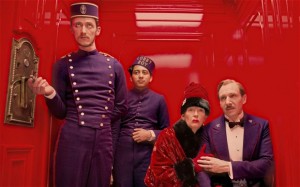
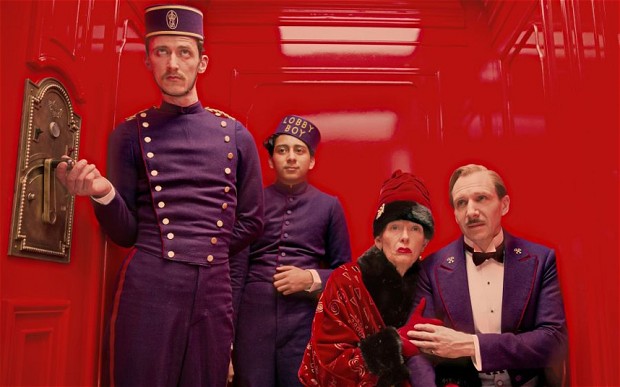
This weekend’s The Grand Budapest Hotel is a case in point. Starring Ralph Fiennes as a concierge at a European hotel between the world wars, it features an all-star cast, including Bill Murray, Owen Wilson, Harvey Keitel and Edward Norton. They are all part of the fabric of the hotel’s history, which includes assassins, murder, riches and a mysterious painting.
Hollywood has always recognized that the transient nature of hotels makes for great drama.
New York City’s Plaza Hotel has played host to many famous movie scenes. Everything from Barefoot in the Park to Funny Girl to The Great Gatsby has used the iconic hotel as a backdrop, but it is probably best known as a location for North by Northwest. In the Alfred Hitchcock film Roger O. Thornhill (Cary Grant) is mistaken for a government agent and kidnapped from the ornate lobby.
The opening shot of Goldfinger features a stunning aerial view of Miami’s Fontainebleau Hotel, which at the time was the most luxurious guesthouse on Miami Beach. Later in the film Bond Girl Jill Masterson (Shirley Eaton) dies of skin asphyxiation inside the hotel after henchman Oddjob (Harold Sakata) coats her whole body in gold paint.
In the 1920’s the Hotel del Coronado was a famous weekend getaway for Hollywood stars like Mae West, Charlie Chaplin, Clark Gable and Errol Flynn but the Victorian wooden beach resort found fame as the setting for several scenes in Some Like it Hot. Located on San Diego Bay across from San Diego, the beachfront location was the scene of one of the film’s most famous lines. When Jerry (Jack Lemmon) first spies Sugar Kane (Marilyn Monroe) sashaying through the sand he says, “Look how she moves! It’s like Jell-O on springs.”
Stephen King was inspired to write The Shining after staying at the 140-room Stanley Hotel in Colorado. “I think a lot of things happened right here in this particular hotel over the years,” says Dick Hallorann (Scatman Crothers) in the film version. “And not all of ’em was good.”
The Stanley has been used as a location for Dumb and Dumber and other films, but Stanley Kubrick chose not to showcase the place in his 1980 adaptation of the novel. Instead, much to King’s disappointment, he used Oregon’s Timberline Lodge as a stand-in for the film’s fictional Overlook Hotel.
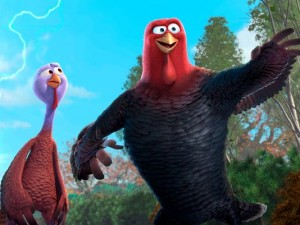
“Thanksgiving is a turkey’s worst nightmare.” So says Reggie (voice of Owen Wilson), an outcast turkey who has never been part of the flock.
This year, however, Reggie has much to be thankful for. On the eve of Thanksgiving he is pardoned by the president, and taken to Camp David where he leads a life of luxury, watching TV and ordering in pizzas.
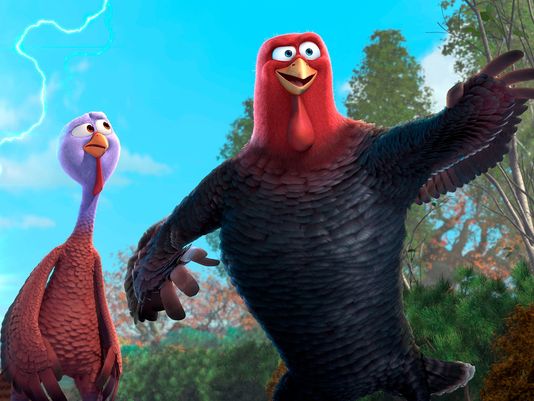
Reggie is in turkey heaven until a wild turkey named Jake (Woody Harrelson), the leader (and only member), of the Turkey Freedom Front, kidnaps him, babbling a wild story about the Great Turkey and a magic doorknob. Jake’s plan is to use a top secret egg shaped time machine to travel back to Plymouth Colony in 1621, just days before the first Thanksgiving, and take turkey off the menu.
PETA will likely approve of “Free Birds” pro-Tofurky message (and just in time for American Thanksgiving) but will the kids gobble up “Free Birds”?
They’ll probably enjoy the turkey characters and the cute little fuzzball chicks are guaranteed to make little voices go “Ahhhh,” but story wise “Free Birds” is as dry as Aunt Mable’s overdone turkey. There are good lessons about being part of the flock and learning about confidence, but the story feels drawn out to feature length.
The voice work is solid. Harrelson, Wilson and Amy Poehler do confident work, and George Takei amps it up as the voice of the time machine, but despite the headline voices, many of the jokes fall flat, plucked of the impact by long awkward “Family Guy” style pauses that don’t work as well for an audience full of kids as they do for adults.
Compared to many recent animated kid’s films—or even Angry Birds for that matter—“Free Birds” feels average, like a flightless bird trying to soar with the Pixars of the genre.
When British author H.G. Wells created the term “time machine” way back in 1895, he could never have imagined the lasting impact his ideas of fourth dimension travel would have on the career of Rachel McAdams.
His book, The Time Machine, has been filmed twice for the big screen, but the ideas of shifting ripples of time have also inspired three very different movies starring the London, Ont., born actress.
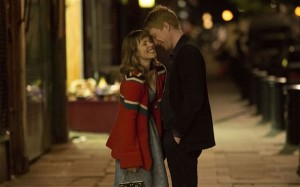
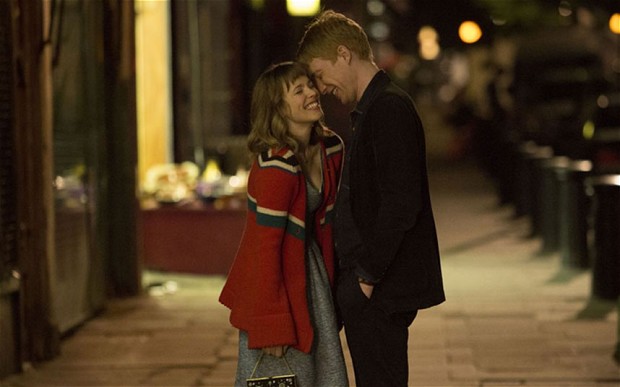
This weekend she co-stars with Domhnall Gleeson and Bill Nighy in About Time as the present day girlfriend of a 21-year-old who uses his ability to switch time zones to learn information to woo her.
“I know I have a little bit of time travel in my past but this is different,” McAdams says. “The element of time travel thrown in was unique and quirky and dealt with lightly.”
Previously the Mean Girls star appeared as Clare Abshire in The Time Traveler’s Wife, starring opposite Eric Bana playing a Chicago librarian with a genetic disorder known as Chrono-Displacement that causes him to involuntarily travel through time.
From the outset their relationship is a strange one. When they first meet she has known him since she was six years old, but because his syndrome flips him to random times in his life on an ever shifting timeline he is always meeting her for the first time. Confused? Not as confused as Clare, who tries to build a life with Henry even though his ailment keeps them apart.
Based on a best-selling novel, it’s a three-hankie story about love with no boundaries and how romance can transcend everything, even death.
In Woody Allen’s Midnight in Paris it’s Owen Wilson who jumps through time — finding himself transported back to 1920s Paris and hanging with F. Scott and Zelda Fitzgerald (Tom Hiddleston and Alison Pill), seeing Cole Porter sing at a party, drinking with Hemmingway — while McAdams stays put, bringing him back to reality, as his irritating present-day fiancée Inez.
But what about actual time travel? When she was asked by AOL if there was anything she would go back in time and change in real life, McAdams said, “I was a figure skater, so I would take back a lot of fashion choices on the ice. A lot of sequins. I would pull back on the sequins a little bit and maybe less blue eye shadow.”
“There are some gross traditions in American Thanksgiving,” says Jimmy Hayward, the Kingston, Ontario born, Los Angeles based director of the animated Thanksgiving comedy Free Birds. “Stuff I didn’t eat as a kid. Yams with marshmallows is an excellent example of that.”
Food choices aside, the director compares the American holiday to Christmas in Canada.
“Ultimately I think Canadian Thanksgiving is not that much different,” he says on the line from his Los Angeles home. “I think in Canada Christmas is for everybody of sorts of religions and creeds. It’s almost the same sort of holiday as Thanksgiving is here. It’s the holiday where everybody takes the most time off work and really make sure they travel where people belong. Everybody goes mad crazy shopping the day after. Boxing day is a lot like Black Friday is here, so I think ultimately it’s all about getting together with the people you love in both places. I think that’s the beauty of the holiday.”
In the movie Owen Wilson voices Reggie, a loner turkey kidnapped by Jake (Woody Harrelson) a zealot member of the Turkey Freedom Front, who takes him back in time to Plymouth Colony in 1621 just days before the first Thanksgiving to take turkey off the menu.
The plot sounds PETA approved but Hayward says, “the fact that a bunch of meat eaters are working with a vegan to make this movie illustrates that none of us have an agenda.”
“We were setting up to tell a funny and endearing story about these characters. The real message is, pay attention to the people that are helping you through life at the holidays. Stop and take a moment to appreciate that.
“Woody Harrelson is vegan and eats with a wooden fork. He’s very in touch with that part of himself and I totally respect that. He understood going into the movie that in no way were we trying to build a message into it. Woody thinks pizza is worse than turkey! He thinks pizza is one of the unhealthiest things ever. Owen pointed out to me that this movie could have been about two beans who travel back to Toyko to save themselves from tofu.”
Not since The Beverly Hillbillies’ Miss Jane has there been such a bird crazy character. “The Big Year,” a new comedy starring the tryptic of comics Steve Martin, Jack Black and Owen Wilson, is based on a true story of birders trying to break a world record.
“This is a true story,” the opening credit reads. “Only the facts have been changed.” Wilson is Bostick, the world’s best birder (they don’t like being called bird watchers). He is the king of The Big Year, an annual competition to see the greatest amount of birds in North America in a calendar year. There’s no prize other than bragging rights, but, jokes Brad Harris (Jack Black), “the bird seed endorsements are huge.” The film follows Bostick and the efforts of two newcomers to the Big Year, Stu (Martin), a wealthy CEO who is finally taking time to smell the roses and look at the birds, and Harris, an unhappy office grunt who loves anything that flies, as they vie for the top spot.
Whether or not audiences will migrate to “The Big Year” depends on their tolerance for a soundtrack stuffed like a Thanksgiving turkey with bird songs like a jazz version of “Blackbird,” and the trio of leading men.
Each plays to his strength. Black provides the slapstick, martin is the silver haired charmer and Wilson plays the edgy jerk he’s perfected in movies like “Drillbit Taylor.” The three different styles work well together even though nothing about it really feels fresh. Despite its subject it never really takes flight. There’s a more ripple of giggles throughout but the big laughs are fewer and further between. Surely some Blue Footed Booby jokes could have spiced things up just a bit.
Having said that, “The Big Year” is enjoyable enough, particularly if you like footage of our fine feathered friends. The final third tugs at the heart strings when it becomes more about the characters than their birding obsession. Not really memorable, but at least it’s not another installment of Martin’s dreadful Inspector Clouseau series.