In the latest Jason Bourne movie, Matt Damon will punch, kick and spy master his way to the top of the box office charts.
His previous Bourne films, Identity, Supremacy and Ultimatum, were all hits commercially and critically.
Damon says he owes a great deal to the fictional character.
After the early success of Good Will Hunting, Saving Private Ryan and The Talented Mr. Ripley made him a star, a string of flops cooled his box office appeal.
“Right before The Bourne Identity came out,” he said, “I hadn’t been offered a movie in a year.”
Then his career was Bourne again.
“It’s incalculable how much these movies have helped my career,” he told The Telegraph. “Suddenly it put me on a short list of people who could get movies made.”
In the spirit of “one for them, one for me” for every film like The Martian or the new Jason Bourne, Damon has attached himself to smaller, riskier projects.
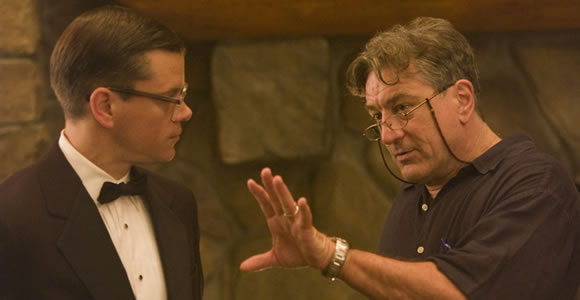
He lent his star power to The Good Shepherd, a low budget film directed by Robert De Niro. It’s a spy movie without the bells and whistles we’ve come to expect from our favorite undercover operatives.
There are no elaborate chase scenes a la James Bond or even the great scenery of the Bourne flicks.
In fact, the only thing The Good Sheperd shares with any of those movies is Damon, who plays Edward Wilson, one of the (fictional) founders of the CIA.
Despite mixed to good reviews — USA Today gave the film three out of four stars—and winning the Silver Bear of the prestigious Berlin International Film Festival, the movie barely earned back its production costs at the box office.
Ninety per cent of director Steven Soderbergh’s job on The Informant! was casting this mostly true tale of a highly paid executive-turned-whistleblower who helped uncover a price fixing policy that landed several executives (including himself) in jail.
It’s a tricky balancing act to find an actor who can keep the audience on-board through a tale of corporate malfeasance and personal greed, who can be likeable but is actually a liar and a thief, but Damon is the guy.
The Informant! skewed a tad too far into art house territory to be Soderbergh’s new Erin Brockovich-sized hit, but Damon’s presence kept the story of accounting, paperwork and avarice interesting. Reviews were kind but A Serious Man and The Twilight Saga: New Moon buried the film on its opening weekend.
Damon teamed with John Krasinski to produce and co-write Promised Land, a David and Goliath story that relied on the charm and likability of its cast to sell the idea that fracking is bad and the corporations who dupe cash-strapped farmers into leasing their land are evil.
It’s hard to make talk of water table pollution dramatic but Promised Land makes an attempt by giving much of the heavy lifting to Damon.
Done in by middling reviews and “sobering” box office receipts, this earnest and well-meaning movie might have been better served in documentary form.
With an Oscar on his shelf and more than 70 films on his resume Damon is philosophical about the kinds of films he chooses to make, big or small.
“If people go to those movies, then yes, that’s true, big-time success,” he says.
“Jason Bourne,” the first Matt Damon led film in the series in nine years, proves that actions speak louder than words. Damon speaks a mere twenty-five lines of dialogue as he kicks, punches and crash-boom-bangs his way through this spy thriller, letting the action do the talking.
Damon’s fourth go-round as amnesiac superspy Jason Bourne begins with him tormented by his violent past. Most of his memory is intact, but he’s eaten away by guilt for the terrible things he did as a government programmed killer. “I remember,” he says. “I remember everything.”
To get his ya-yas out he goes all Fight Club, bare-knuckling any and all contenders but he’s drawn back into the international spy game—the movie never met an exotic location it couldn’t use, whether it’s Berlin, Reykjavík, Athens, London or even Vegas—after his former-handler-turned-hacker Nicky Parsons (Julia Stiles) tells him of a collaboration between CIA director Robert Dewey (Tommy Lee Jones, whose face is one forehead wrinkle away from becoming a caricature of an old man) and Silicon Valley kingpin Aaron Kalloor (Riz Ahmed). They’re working on Edward Snowden’s worst nightmare, a new program called Ironhead, a system of full spectrum surveillance; watching everyone all the time.
Wanting Bourne out of the way Dewey uses every newfangled asset at his disposal—like state-of-the-art global surveillance—to find the agent before turning to the old ways and bringing in an assassin known as, appropriately enough, The Asset (Vincent Cassel) to take care of business. “I’m going to cut the head off this thing,” says Dewey.
Flitting about the edges of the intrigue is the CIA’s cyber ops head Heather Lee (Alicia Vikander), who helps Bourne in an effort to keep him away from The Asset’s deadly gaze. “Bringing him in is the smart move,” she says. “There’s no bringing in Bourne,” Dewey says. “He needs to be put down.”
Cue the carnage.
If nothing else “Jason Bourne” proves once and for all that you can’t keep a good man down. Shot, beaten, dropped from a tall building or whatever, he’s the Energizer Bunny of international spies. He just keeps on ticking. We expect that from Bourne and we also demand feral fighting scenes, crazy car crashes and action, action, action. Make no mistake, there’s plenty of Bourne battle and bloodshed and some of it is quite exciting but it doesn’t have the finesse of the earlier films. Director Paul Greengrass’s signature handheld you-are-here style is in place but doesn’t feel as fresh as it did in the other films. Often frenetic instead of pulse-racing, the action sequences are frequent but not as memorable as the magazine-in-the-toaster gag from “Bourne Supremacy” or “Bourne Ultimatum’s” hardcover book punch. Still, you might not make it quite to the edge of your seat, but the combo of action and intrigue will shift you out of a reclining position.
“Jason Bourne” has its moments. Damon brings a grizzled power to the role and Vikander is a welcome addition, even if her motives are sometimes are hard to understand. There are interesting messages about online personal rights versus public safety that would have been moot in 2002 when the series debuted, a labyrinthine plot occasionally weighed down with unnecessary exposition and an unhinged Vegas climax—Bourne must really hope that whatever happens in Vegas stays in Vegas—that would not be out of place in an Avengers movie. I just wish the ending felt less like an Avengers scene—with cars comically flying through the air—and more like a Bourne moment.
This isn’t Ridley Scott’s first trip to space but the director of “Alien” and “Prometheus” takes a different kind of journey in “The Martian.” Thrilling, funny and, above all, human, it’s a crowd-pleasing story about the power of the will to survive.
Matt Damon is Mark Watney, an astronaut left for dead during a mission to Mars. As the rest of the crew heads for Earth (Jessica Chastain, Kate Mara, Aksel Hennie, Michael Peña and Sebastian Stan) Watney comes to 140 million miles from home. A botanist by trade, to survive he knows he’ll have to “science the BLEEP out of this.” Rationing the food left behind and growing his own potatoes he’s able to feed himself, but the supplies won’t last forever.
When NASA receives a message from Mars, “Hi, I’m Mark Watney and I’m still alive… obviously,” teams of scientists and Mark’s old crew stage a daring rescue attempt.
The trick to casting a movie like “The Martian” lies in finding an actor able to hold the screen for extended periods of time by himself while being likeable enough to have an audience care whether or not he makes it back to Earth in one piece. Since Tom Hanks has aged out of playing roles like this, Damon, recently named as Hollywood’s Most Bankable Actor by Forbes, is that guy. His mix of humour, smarts and all-American problem solving keep you invested in Watney during the long stretches he putters around finding ways beat the insurmountable odds.
The rest of the film isn’t as engaging as Damon’s “Castaway” act. “The Martian” is composed of three components: Life on Mars, Ground Control and the Space Cowboys who hurtle through the universe to rescue their lost friend. Each are well cast—Jeff Daniels is perfect as the spearhead of the NASA rescue and Peña brings some wonky good humour—but the when the film leaves the Red Planet it leaves some of its heart behind. There is drama, conflict and even some humour in all segments, but the compelling stuff happens when the film is at its quietest, when Damon is alone MacGyvering his way out of a bad situation.
“The Martian” is a fun film, a space Western about the strength of the human spirit and the indomitable will. “Interstellar” tread similar thematic ground last year but did so without the humour, the cheesy 70’s soundtrack or, most importantly, Matt Damon.
Director Ridley Scott says his new film, The Martian, is much more realistic than his other, classic space dramas.
“The fantasy of space,” he said, “which is now also a reality, is a marvellous platform and a form of theatre. Honestly, almost anything goes. But, if anything goes whether you do a play, a book or a film, you’ve got to actually make your own rule book and stick within the confines of the rules you make. So, if I’m doing space fantasy like Alien or Prometheus, I’ve got to draw up the sidelines of the rule book and stick within them. It’s still a fantasy because it’s never going to happen. (The Martian) is a lot easier because, actually, you can lean very heavily on the science in the book. This was a much more realistic movie.”
That realism stems from source novel by Andy Weir, a self-professed science geek who worked to ensure that the story of Mark Watney, an astronaut who survives after being left for dead on Mars, felt genuine.
“The basic structure of the Mars program in the book is very similar to a plan called Mars Direct, though I made changes here and there,” he said, in a Q&A on the Penguin Random House website. “It’s the most likely way that we will have our first Mars mission in real life. All the facts about Mars are accurate, as well as the physics of space travel the story presents. I even calculated the various orbital paths involved in the story, which required me to write my own software to track constant-thrust trajectories.”
As research the actors met with representatives from NASA’s Jet Propulsion Laboratory and the European Space Agency.
“I got to go to the JPL in Pasadena and meet with all the robotics guys and see the Curiosity Rover and do virtual reality to be on Mars and see what that would be like,” said Jessica Chastain, who plays the commander of the Mars mission. “Then I went to Houston and met with Tracy Caldwell Dyson, who’s an astronaut and talked to her.”
The cast says filming the zero gravity and space walk scenes involved careful planning and wirework to make them look authentic. “It’s choreographed to within an inch of its life and we’re just along for the ride,” said Chastain. “It feels very much like a dance and there is choreography to it,” adds Kate Mara, “but, once you do it, you really do feel like a little kid.”
The former House of Cards star says Scott was enthusiastic about shooting those scenes. “Maybe he was just faking it really well (but he) seemed just as excited as we did when were doing the scenes floating through the air.”
Matt Damon, who demonstrated another technique to achieve the look of weightlessness on screen at The Martian TIFF press conference — standing on one leg while slowly waving his hands through the air — said that,“one of the things that is fun about making movies and (also) totally, totally ridiculous is that we are grownups doing this.”
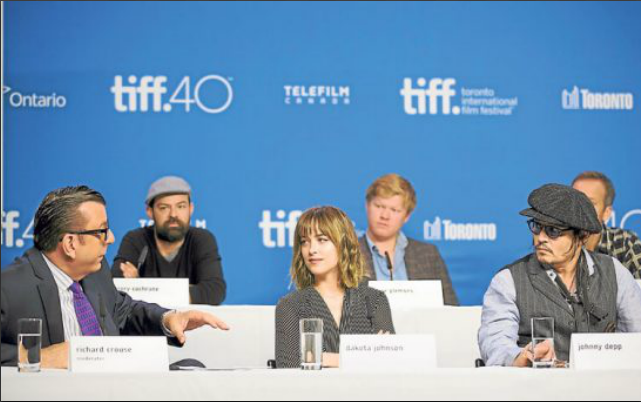
The backstage room at the TIFF Bell Lightbox’s press conference area is a beehive of activity.
“Is George here yet?”
“Is that Johnny vaping in the corner?”
It’s a place where no last names are necessary and the star wattage is blinding. Actors, directors, publicists and gofers mingle while air kisses, handshakes and Hollywood hugs are exchanged.
This year the Toronto International Film Festival is mounting 11 press conferences featuring everyone from Matt Damon and Sandra Bullock to George Clooney and Keith Richards.
I’m hosting four of them — Demolition, The Martian, Our Brand is Crisis and Black Mass — with, as MGM used to brag, “More stars than are in the heavens.”
Despite the buzzy nature of the events, backstage is a casually chaotic place where actors get caught up with one another before taking the stage.
Matt Damon made the rounds, glad-handing with his The Martian cast mates, many of whom he hadn’t met because he spent 90 per cent of his of screen time alone, stranded on Mars.
The business of the press conferences happens on stage. Moderating these things provides a fascinating glimpse into both sides of the publicity machine.
Ideally the press conferences are a reciprocal event: Reporters ask questions to actors and filmmakers they might not otherwise have access to, and in return the stars get publicity for their films. It’s a pretty simple but often unpredictable transaction.
Gone are the days of the legendary “journalist” who asked all her questions in rhyme, but for every sensible inquiry about the movie, there is inevitably another off-the-wall query that leaves panel lists either annoyed or scratching their heads.
At the Our Brand is Crisis conference someone asked Bullock about her character’s grown-out roots. The Oscar winner replied as best she could and when she finished, Clooney chimed in, “Aren’t you glad you asked that question?”
Later she shut down a silly query regarding how she keeps her bum as toned as it is in the film. “It’s so sad that you just want to talk about the butt,” she said, before tersely adding that leg lifts are the secret to posterior pertness.
Not that the attendees are the only ones to pull a gaffe or two. During the Demolition conference, I asked Chris Cooper a long, rambling question about his character. He seemed genuinely perplexed, and you know what? I was, too. Sometimes you can overthink these things.
Later at The Martian presser, there were 13 people on the stage, everyone from Michael Pena to Damon, Scott, Chiwetel Ejiofor and Jessica Chastain, and in the shuffle I made the horrifying mistake of forgetting to ask the great Sean Bean a question and didn’t realize it until we were out of time.
Who doesn’t acknowledge Lord Eddard Stark?
Me, idiotically. Next year I promise to go to him first and frequently.
Richard hosted the “The Martian” press conference at the 2015 Toronto International Film Festival at TIFF Bell Lightbox on September 11 with Kate Mara, Matt Damon, Jessica Chastain, Andy Weir, director Ridley Scott, Sean Bean,Donald Glover, Chiwetel Ejiofor and Drew Goddard.
I root for George Clooney. He has a lot going for him; he’s good looking, has a villa in Italy and is good friends with Sandra Bullock. That’s a lot for anyone, but that’s not why I root for him. I’m on his side because even though he’s a superstar he takes chances.
As an actor he put nipples on Batman, starred in a remake of an obscure Russian sci fi film, played a fox in a Wes Anderson movie and has played the lead in a movie about paranormal goats.
As a director he’s just as edgy. He’s stood behind the camera for a black and white look at Edward R. Murrow’s battle with Senator Joseph McCarthy, an old school football movie set in 1925 and an exposé of backroom politics.
He’s an a-lister who takes chances, and I applaud that which makes me sad to report I didn’t find as much to applaud in his most recent film as actor and director “The Monuments Men.”
Based on the book “The Monuments Men: Allied Heroes, Nazi Thieves and the Greatest Treasure Hunt in History” by Robert M. Edsel, the movie stars Clooney, Matt Damon, Bill Murray, John Goodman, Jean Dujardin, Bob Balaban and Hugh Bonneville as a motley crew of art historians, engineers and museum directors recruited to locate and rescue priceless art works stolen by the Nazis. When two members of their team are killed they are no longer observers but active participants in the war.
Helping in the mission to return the plundered cultural artifacts is Rose Valland (Cate Blanchett), a French art historian and member of the French Resistance who not only aids the Allied art platoon but also tries to work her Parisian charms on Damon’s character.
“The Monuments Men” is a wartime comedy. Think “Hogan’s Heroes” by way of Leonardo Da Vinci and you’ll get the idea. It has some mild laughs (the biggest laugh, for Canadians anyway, comes from the Parisians who blame Matt Damon’s terrible French on having spent too much time in Montreal) but also a great deal of reverence for the art and the work of the real-life Monuments Men. ”People can come back but if you destroy their achievements, their history,” says George L. Stout (Clooney), “they can’t come back from that. That’s why Monuments Men was created.”
The reverential tone is reinforced by old school pacing that focuses on the character and art over action and a rousing soundtrack that sounds air-lifted in from a classic wartime era movie. The cast is uniformly fine and Bill Murray shows, once again in a brief scene in a shower (NO SPOILERS HERE), how his understated style can move an audience.
No problems there, but co-writers Clooney and longtime collaborator Grant Heslov appear to have taken a dose of sentimentality pills before putting pen to paper. What might have been an edgy, exciting look at an underreported slice of World War II history is reduced to an elegantly directed but somewhat dull film.
“The Monuments Men” is an earnestly told story but the lack of any real energy or surprises undermines its effectiveness.
“Green Zone” starts with a bang. Or more rightly stated, a series of bangs. Set in Bagdad on the first night of the shock and awe campaign, the opening minutes are a harrowing portrait of what it must be like to be under massive fire. It’s a frenetic beginning, shot in a wild cinema verite style, which will leave many in the audience wishing someone would buy director Paul Greengrass a tripod.
Matt Damon, reuniting with Greengrass after two Jason Bourne thrillers, is Army Chief Warrant Officer Roy Miller. He’s a good soldier who allows creeping doubt about the existence of Weapons of Mass Destruction to force him to go rouge. Breaking ranks from the Pentagon he aligns himself with a CIA Middle East expert Army Chief Warrant Officer Roy Miller to try and ferret out the complicated truth. At odds with Miller is Clark Poundstone (Greg Kinnear), a freshly scrubbed Penatgon appointee who won’t let the soldier’s misgivings get in the way of his mission to bring democracy to Iraq.
Nobody shoots action like Greengrass. He breathed new life into the spy genre with the Bourne films, using handheld camera to put the viewer in the action. Shooting where most action directors fear to tread—in tight, claustrophobic spaces for example—he brings a breathless documentary feel to his films that has redefined how we watch action on screen. That’s mostly a good thing, but for all the excitement that his whiplash camera style creates it occasionally leaves me hungry for an image or two that doesn’t look as though the camera was attached to a yoyo. His gritty style works for the gritty material in “Green Zone” but despite the masterful editing I found Greengrass’s propulsive approach overshadowed the story.
The action scenes are tense, but when the action stops, (which, frankly, isn’t very often) even the dialogue scenes move with the velocity of a bullet shot from a gun. It’s pedal to metal all the way with little regard to the nuances of storytelling.
Inspired by—it takes too many liberties with the text to be called “based on”—Rajiv Chandrasekaran’s book “Imperial Life in the Emerald City” it is a straightforward story that dumbs down the story of Bush era Iraq policies to the level of a cut rate James Bond flick. The added political intrigue elevates things a tad but the addition of several characters right out of central casting makes one long for the days before every CIA operative character had a weary smile and a jaded heart.
Damon is comfortable mixing the game faced soldier with an earnest side and acquits himself well, particularly when in the actions scenes. By this time he and Greengrass must have a shorthand on set that allows them to blend character and action, and here it works.
The same can’t be said for Brendan Gleeson as CIA veteran Martin Brown. Gleeson, a fine actor, doesn’t have any action scenes, and seems to be an afterthought to the director who places such hoary old clichés as, “Don’t be so naive,” in his mouth. Ditto Amy Ryan as a Wall Street Journal writer. It seems if the characters aren’t shooting a gun or in constant motion than Greengrass doesn’t know exactly what to do with them.
There is no question that “Green Zone” is an adrenalized action film. Unfortunately it oversteps its reach when it tries to go highbrow with the political intrigue.
The Good Shepherd is a spy movie without the bells and whistles we’ve come to expect from our favorite undercover operatives. There are no elaborate chase scenes a la James Bond, no cool gadgets like Ethan Hunt’s presto-chango masks in the Mission Impossible movies, not even the great scenery of the Bourne Supremacy. In fact the only thing The Good German shares with any of those movies is star Matt Damon, who has traded his Bourne identity for that of Edward Wilson, one of the (fictional) founders of the CIA.
The Good Shepherd is a movie about secrets and duplicitous men who live in a shady underworld where nothing is as it seems. Director Robert De Niro, in his first stint behind the camera in over a decade, has delivered a long, thoughtful movie about the paper pushers who fought the cold war from behind desks.
Damon is a stone-faced bureaucrat who is involved at the very highest levels of espionage. De Niro dispenses with most of the spy movie conventions to tell a complex story of this man’s career and private life. From a life groomed for clandestine politics first as a member of the Scull and Bones Club at Yale to counter-intelligence in WW2 to the Bay of Pigs to the sexual politics of feeling trapped in an unhappy marriage while feeling guilty about carrying on affairs, The Good Shepherd covers it all.
It’s an ambitious story, but the movie over-reaches in its attempts to present a well-rounded portrait of this man’s life. The time frame leap frogs constantly and it isn’t always clear whether we’re in the past or present, but I found the espionage story interesting enough to keep me engaged in the confusing story.