In this mixed-up, shook-up world there are fewer and fewer things we can count on as absolutes. One of them is that there will be a new Woody Allen movie every year with a jaunty jazz soundtrack and credits written in the Windsor Light Condensed font. His new film, “Café Society,” the story of a frantic young romantic trying to find himself in 1930s Hollywood, is slice of comfort cinema with all of Allen’s trademarks intact.
Bobby Dorfman (Jesse Eisenberg) is a native New Yorker who jumped coasts to take up in Los Angeles. The slightly neurotic east coaster is not a natural fit in Tinsel Town, but his powerhouse uncle Phil (Steve Carell) helps out, giving him a job at his powerhouse talent agency and introducing him to a beautiful secretary named Vonnie (Kristen Stewart). By day he does odd jobs for Phil—“Menial errands are my specialty,” Bobby says, “but I don’t see a great future in it.”—while on the weekends he slowly falls for Vonnie. They share a disdain for industry talk and Hollywood’s catty innuendo and a love of cheap Mexican food but she doesn’t share his feelings. Unfortunately (for Bobby) Vonnie has a mostly absent boyfriend.
Enter romantic plot complications and Bobby hightails it back to New York where he goes into the nightclub business with his gangster brother Ben (Corey Stall). Finally successful, he marries and has a child with Veronica (Blake Lively), who he nicknames Vonnie, betraying the feelings he harbours for his west coast love. When Vonnie number one returns to New York for a visit the film offers up a line that sums the situation up, “Life is a comedy written by a sadistic comedy writer.”
A light-hearted tapestry, “Café Society” is embroidered with the odd punch line and hints of melancholy. It’s a comedy tinted with heartbreak, a look at true love and unsatisfactory options. It returns Allen to the fertile ground he ploughed with “Annie Hall” and “Manhattan” and while this film isn’t a classic on those terms, it’s an engaging look at life and love buoyed by great performances.
Eisenberg does the best Woody Allen impression we’ve seen on screen in some time, but there’s more to him than simply aping the master. His journey from nebbish to notable is believable and gives the movie its heart.
Co-star Stewart hands in what may be her first truly adult role. She plays Vonnie as level-headed in a sea of dreamers. When Bobby describes Joan Crawford as “larger-than-life” she replies, simply but compellingly, “I think I’d be happier life-sized.” It’s the line that sums up her character and Stewart makes the most of it and Vonnie.
“Café Society” is a welcome uptick after Allen’s last two films, “Magic in the Moonlight” and “Irrational Man.” For Woody’s fans it may feel familiar but in the most soothing of ways.
You’d be forgiven for thinking that “Equals,” the new film starring Kristen Stewart and Nicholas Hoult, was a zombie movie. Characters roam around aimlessly, mumble dialogue and stare at one another as though they’d like to take a bite out of one another.
But it’s not a zombie flick, it’s a high-concept sci-fi love against-all-odds story set in a utopian society where emotions don’t exist. IE, it’s 101 minutes of whispered words and blank stares.
“Equals” is takes place in a place where human emotions have been eradicated. It has resulted in a peaceful, if somewhat dull world. Like small town Ontario, everyone dresses the same and is unfailingly polite. The only disease they have been unable to remedy is S.O.S., a virus that eats away at their icy demeanours and restores their pleasure centers. In other words, it allows people to feel again. Illustrator Silas (Hoult) is infected with feelings, developing romantic thoughts for co-worker Nia (Stewart). She is also sick but undiagnosed. They begin an affair but when a cure is found their new-found feelings and romance are threatened.
Director Drake Doremus has set up an almost impossible situation for himself and his actors. Flat and unaffected, “Equals” is icy in the extreme. The only heat on display comes from several hand-holding sessions which, I suppose, are meant to melt the screen but honestly, there are Amish love stories with more sexual tension.
What could have been an exploration of the very core of what makes us human, a kind of star-crossed sci fi “Romeo and Juliet,” is instead a plodding look at two people experiencing late puberty.
It’s a shame, but perhaps not a surprise, that a movie that aims to sap the emotion out of most of its characters, is a bit of a slog.
In polite society no one would dare ask a stranger about his or her father’s violent death, but celebrity culture is not polite society.
Over the years I’ve heard interviewers ask questions ranging from the innocuous — “What are you wearing?” — to the silly — “How do you keep your bum in such great shape?” — but rarely have I heard anything as unnecessarily meddling as the query aimed at Charlize Theron during a press conference I hosted several years ago.
A reporter asked the actress about seeing her mother shoot her abusive, alcoholic father dead when she was a teenager. But instead of breaking down Theron said, “I’m not talking about that,” with an icy finality that made everyone freeze.
I admired her for not over sharing, not spilling the intimate details of her life à la the Kardashian Klan. She’s careful what she says to the press, avoids scandal and damage controls the ones that inevitably pop up in every celeb’s life. For instance, recently she said, short and sweetly, “We both decided to separate,” when accused of “ghosting” on her romance with Sean Penn.
She understands some things should only be spoken about when and where she chooses and not at the behest of an aggressive reporter looking to dredge up painful memories for the sake of “good television.” Theron is media savvy so I was surprised a few weeks ago when she caused a media hurly burly with comments about the burden of being beautiful.
Chatting up her new film The Huntsman: Winter’s War with British GQ she said, “How many roles are out there for the gorgeous, BLEEPINGing, gown-wearing eight-foot model? When meaty roles come through, I’ve been in the room and pretty people get turned away first.”
She is a beautiful woman, that is as clear as the perfectly positioned nose on her face, but is she intimating that being beautiful has harmed her career?
Turns out she wasn’t, or so she claims. Alleging a misquote, she later apologized, saying that playing “deconstructed characters” appeals because, “how many characters really are there out there for a woman wearing a gown? You have to play real people.
The mea culpa was unnecessary. She works in a business where beauty is a commodity.
The problem with her earlier statement is that publicly acknowledging one’s own looks carries with it a hint of arrogance, a suggestion that winning the genetic lottery somehow makes you superior, but she simply said something others already have.
Keira Knightley claims she almost lost the role in Pride and Prejudice because the director thought she was too pretty and Jessica Biel says being Esquire’s 2005 Sexiest Woman cost her work.
Theron may have missed out on a job or two because of her looks, but it’s also an element of what made her a star.
That and talent, and just as you wouldn’t apologize for skin colour or having red hair or being tall or short, she doesn’t need to say sorry for being beautiful.
Once upon a time there was a movie called “Snow White and the Huntsman.” Starring Hollywood princesses Kristen Stewart and Charlize Theron, it was a dark reimagining of the classic story that played like the love child of the Brothers Grimm and “The Hobbit” with two compelling characters, warrior Snow White and the villainous Ravenna.
Another film was inevitable, but how do you make a sequel when KStew busy making art films and Ravenna didn’t make it to the end credits? Easy, you rehire Theron, play mix and match “Frozen” and “Game of Thrones” and hope for the best.
“The Huntsman: Winter’s War“ begins its confusing journey as a prequel. Ravenna (Theron) is alive and well, a Grand Guiginol vision of a fairy tale Queen. Despite her best efforts sister Freya (Emily Blunt) refuses to embrace their evil birthright, choosing instead to start a family. When tragedy strikes the formerly good-natured princess finds her wicked power, morphing into the Winter Queen, whose icy glare can freeze kingdoms. The only things missing are Olaf and a show tune or two.
In her frigid northern empire she raises a child army of orphans called the Huntsmen (even though they’re not all boys or men). Elsa’s… er… Freya’s warriors are forbidden to love. They must let it go. “In my kingdom there is one rule do not love,” she says. “It is in a sin I will not forgive.” When Eric (Chris Hemsworth) and Sara (Jessica Chastain) fall hard for one another and plan to elope, Freya goes to extraordinary and cruel lengths to ensure they live happily never after.
Cut to seven years later. The movie is now into sequel territory. Snow White (who is glimpsed only briefly) has defeated Ravenna and now needs Eric to locate the Magic Mirror and ensure it is never used for evil. Cue the goblins, a few hi ho hi ho’s provided by Nick Frost, Rob Brydon, Sheridan Smith and Alexandra Roach and more CGI than you can throw an enchanted mirror at.
I’m not sure what to call “The Huntsman: Winter’s War.“ It’s not a sequel or a prequel and yet it is both. Officially I suppose we’re supposed to call it a “sprequel”; I call it bloated, confusing and worst of all, dull. You would think that any movie featuring Emily Blunt riding a polar bear would be great fun but you’d be wrong. From the half hour of narration that opens the story to the cavalcade of CGI and bad accents—Hemsworth and Chastain easily beat Kevin Costner for worst-ever cinematic British Isles burrs—to sloppy storytelling, this is a grim, not Brothers Grimm tale.
Bad accent aside Hemsworth brings some swagger to the role of Eric, Chastain tries to keep a straight face and sidekicks Frost, Brydon, Smith and Roach create a badly needed sense of fun to the proceedings. Blunt isn’t given much to do, aside from her rather stunning entrance in the polar bear but Theron actually disappoints. In the first film she’s a hoot, a bundle of bad intentions gathered up in one pretty package. Here she’s not the same figure of malicious amusement but oddly disconnected and not nearly as much fun.
Over long “The Huntsman: Winter’s War“ drones on for almost two hours until the narrator (Liam Neeson) reappears. As his dulcet tones close the movie with something to the effect of the story may be over “but fairy talks never end,” it doesn’t seem so much like an ending as it does a threat that they might make a sequel to this mess.
Where have all the movie stars gone? Once upon a time big names on even bigger marquees were as close to a guarantee of good box office as one gets in the movie biz, but no more.
This weekend The Divergent Series: Allegiant, the third part of the young adult series, hit theatres. Based on a series of successful books, it stars Shailene Woodley and Theo James in a teen epic about dystopia, guilt and artfully tossed pixie haircuts. In the new film the pair risk it all to go beyond the walls of their shattered city to discover the truth about their troubled world.
Woodley and James are appealing performers and despite having chiselled cheekbones, a Golden Globe nomination and a Teen Choice Award for Choice Movie: Liplock between them no one is going to see Allegiant because they’re in it. Why? Because they’re not movie stars, they’re brand ambassadors. The movie’s brand is bigger than they are and that’s the draw.
Young adult movies like Twilight made Robert Pattinson and Kristen Stewart famous and superhero films reignited Robert Downey Jr.’s career and turned Chris Hemsworth into a sex symbol, but none of these actors have scored recent hits outside of their best-known brands.
These days the marketing is more important than the movie star.
It’s almost a throwback to the very early days of cinema when actors weren’t given billing or publicized for the films they made. Fearing performers would demand larger paycheques if they became popular the studios gave them nicknames instead. Hamilton, Ontario born Florence Lawrence was known as the Biograph Girl, named after the studio that produced her films, but with the release of The Broken Oath in 1910 became the first entertainer to have her name appear in the credits of a film.
Floodgates opened, soon names like Mary Pickford (another Biograph Girl), Douglas Fairbanks and Charlie Chaplin festooned not only movie credits but posters as well, usually above the title. The studios seized the marketing value of their actors and for years the star system was a money-spinner.
These stars were so powerful they not only sold tickets by the fistful but also influenced contemporary trends. For instance, it’s rumoured that sales of men’s undershirts plummeted in 1934 when The King of Hollywood, Clark Gable, was seen without one in It Happened One Night. As the legend goes, sales took such a hit several underwear manufacturers tried, unsuccessfully, to sue Columbia Pictures for damages.
For decades stars ruled supreme at the box office, but the business has changed. I’m guessing the movie studios love it because no film brand ever asked for more money or a bigger trailer.
Certainly Tom Cruise can still sell a ticket or three, but only if his movie has the words Mission Impossible in the title and Matt Damon was brought back in to add star sparkle to the new Jason Bourne movie after a lackluster reboot with Jeremy Renner. Jennifer Lawrence is a movie star. Her latest film Joy, the empowering story of a woman and her mop, wasn’t a big hit but without her star power would likely never have been made at all.
It’s not just the movie business’s attitude toward fame that has changed, it’s also ours. Today a proliferation of YouTube superstars and social media has democratized fame and in a world and business where everyone is famous, no one truly is, not even the stars of a blockbuster like The Divergent Series: Allegiant.
“Hmmm… it needs a twist, something to make it fresh.”
“How about a young, stoned Jason Bourne?”
“Like Cheech and Chong and Robert Ludlum had a baby? Bingo!”
The movie is three days in the life of Mike and Phoebe (Jesse Eisenberg and Kristen Stewart). Young and in love, they live in small town Liman, West Virginia. When she isn’t working at a local bail bond joint and he’s not clerking at a rundown Cash ‘N’ Carry, they spend their days getting high and riffing on Mike’s idea for a comic book about an astronaut ape.
Meanwhile in Langley a midlevel CIA bureaucrat (Topher Grace) is looking to close the file on the abandoned Ultra Program, a government project that offered third strike drug offenders a chance to become part of an experimental program in return for their freedom. They were turned into highly skilled assassins. Trouble was, it didn’t work. The only success story was Mike, but when the pressure got to be too much for him, his memory was wiped and he was given a new identity.
Enter stoned Mike.
For five years he floated through life on a cloud of marijuana with no memory of his former life. When two killers show up in Liman to eliminate him his old instincts kick in and Mike turns from friendly stoner to lean mean killing machine. Still, he doesn’t revert completely. “I have a lot of anxiety about this,” he says as the body count mounts.
At the center of “American Ultra” are Eisenberg and Stewart, reteamed for the first time since 2009’s “Adventureland.” Both are fine actors—if you need convincing watch him in “The End of the Tour” or her in “The Clouds of Sils Maria”—and while neither are stretched as performers, they leave vanity at the door and have fun in the world director Nima Nourizadeh and screenwriter Max Landis give them to cavort in.
Strong supporting work from Connie Britton as Mike’s sympathetic CIA handler balances out the wackier performances by John Leguizamo as Mike’s mile-a-minute drug dealer and laughing killer Walton Goggins. The over-the-top turns fit the feel of the film, but Grace’s shrill sociopath is pitched a bit too high, even for a movie where someone is killed with a dustpan.
The violence in “American Ultra” often feels gratuitous—we’re told Mike singlehandedly kills seventeen people—but the look of stoned amazement that drifts over Eisenberg’s face each time he pulls off some feat of derring-do is worth the wanton bloodshed.
“The Clouds of Sils Maria” contains fine performances from its leads, Juliette Binoche, Kristen Stewart and Chloë Grace Moretz, some delicious irony, and some razor sharp commentary on the state of modern celebrity. What it’s missing is entertainment value.
French director Olivier Assayas has made an art house “Birdman,” with stunt casting but allows it to get weighed down by its ideas and melodrama.
Binoche is actress Maria Enders, an international star who got her start decades ago on stage playing the alluring Sigrid in “Maloja Snake,” a young woman who drove her boss Helena to suicide. When she is offered the role of the older woman in an all-star remounting of the play opposite Jo-Anne Ellis (Moretz), a scandal-prone Hollywood starlet, she retreats to the relative calm of Sils Maria, a rural town in the Alps, to rehearse with her assistant Val (Stewart) while contemplating aging, her past and her place in show business.
“The Clouds of Sils Maria” is as self absorbed as the people it portrays. The most interesting tangents, from a pop culture point of view, concern the character Val, who seems to be piercing the fourth wall by allowing Stewart to seemingly comment on her “Twilight” success and subsequent career. “I love her,” she says of Ellis, “she not completely antiseptic like the rest of Hollywood.” In fact, it’s more likely she’s referring to herself and her descent from Tween Queen to serious working actor.
“Clouds” is very much Binoche’s film—she’s in almost every scene and the action revolves around her—but thematically it’s not a stretch to see it as Stewart’s comment on her own career. “She’s brave enough to be herself,” Val says admiringly of Ellis, throwing down the gauntlet to critics who might questions her less than mainstream choices of late.
As interesting as that glimpse into Stewarts ID may be coupled with Maria’s fears of losing credibility, “The Clouds of Sils Maria’s” art vs. life premise takes pains to make the discovery of these points as obtuse as possible. Plot shards hang, interrupted by jarring scene transitions and needless narrative machinations. It’s the rare kind of movie that is undone by the very same cultural elitism it celebrates.
“Still Alice” has a Disease of the Week Movie plot but is elevated by a central performance from Julianne Moore. Her portrayal is deeply nuanced, self-aware but most of all, heartbreaking.
Moore plays the title character, a linguistics teacher at Columbia University in New York. She has a career, a loving husband (Alec Baldwin), three grown children Anna (Kate Bosworth), Lydia (Kristen Stewart) and Tom (Hunter Parrish) and early onset Alzheimer’s. She’s a woman who reveled in intellectual success, proud of her vocabulary and mental prowess but lately she can’t remember the small things. She blanks on people’s names and gets lost in familiar places.
Before she becomes incapable of looking after herself she records a message to her future self. In it she describes a contingency plan, a way to end the suffering that will be easy on her and the family.
Later in the film, when we finally see the video message, we are struck by the duality of Moore’s performance. The transformation from early onset to full blown Alzheimer’s has been subtle but constant. Placing her afflicted self side-by-side with her healthier being displays the depth, beauty and subtly of Moore’s work. It’s a showstopper of a sequence that cleverly displays Alice’s deterioration and Moore’s mastery of the character.
Also notable is Kristen Stewart who delivers a rough hewn but tender version of a daughter who is occasionally frustrated by her mother’s situation but slowly come s to form a deeper relationship with her than anyone else in the film. Her reading of a passage from “Angels in America” and the emotional heft that comes with it should mute the ”Twilight” jokes once and for all.
“Butterflies have short but beautiful lives,” Alice says, and while “Still Alice” doesn’t have the raw intensity of films like “Iris” and “Away From Her,” it is a showcase for a beautiful portrayal of a woman who has everything stripped away from her.
The release of The Hobbit: The Battle of the Five Armies brings Peter Jackson’s trilogy to a close, and marks the end of a life immersed in Middle Earth for the actors. For several of the cast it was a years-long journey, and like any trip it’s nice to pick up a souvenir as a keepsake.
According to director Peter Jackson the actor who played the exiled dwarf king Thorin stole “the most boring thing in the world to steal,” from the set of the penultimate film, The Desolation of Smaug, socks.
“I did steal every single pair of costume socks,” said Richard Armitage, “because we were given a brand new pair every day.”
As production on The Battle of the Five Armies wrapped Armitage was gifted with some more interesting props including the deadly goblin cleaver Orcrist, which he keeps in an umbrella stand, “cause I want to be able to pick it up.”
Martin Freeman, who plays head Hobbit Bilbo Baggins, says he doesn’t miss making the films—“I’m really proud to have done it,” he says, “and I’m really glad to have done it, but I rarely miss jobs.”—but kept his sword and prosthetic ears as mementos.
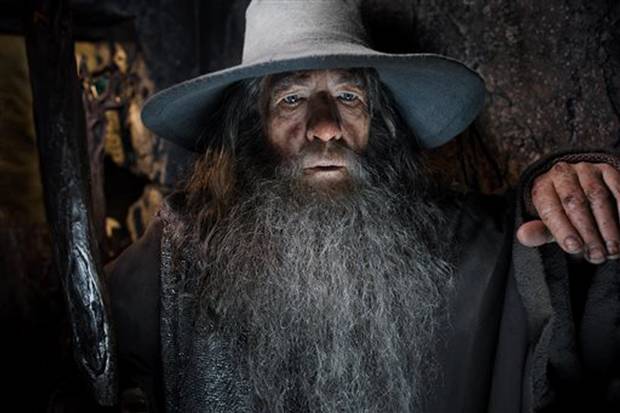
Unlike Freeman, Sir Ian McKellen does get sentimental when he reflects on making the movies because, “a lot of the audience seeing The Hobbit part three wouldn’t have been born when we started filming it.” After spending thirteen years playing wise wizard Gandalf the Grey he took two priceless props from the set, “Gandalf’s staff, which I keep with umbrellas and walking sticks, and Gandalf’s hat, which I keep in the basement.”
Many actors have pilfered props from their movies. Keira Knightley walked off with Elizabeth Bennet’s striped socks from Pride & Prejudice. Elijah Wood has the One Ring from Lord of the Rings and Daniel Radcliffe liberated two pairs of Harry Potter’s famous round glasses, even though there was a strict policy about taking props from the set.
‘The ones from the first film are absolutely tiny now,” he says, “but they are very sweet.”
Kristen Stewart kept the engagement ring Edward Cullen gave her at the end of Twilight: Eclipse and Zachary Quinto took the ears he wore as Spock in Star Trek: Into Darkness but the strangest cinematic souvenir may belong to Mark Wahlberg.
The Academy Award nominee kept the prosthetic penis he wore as Dirk Diggler in Boogie Nights. “I used to keep it in my desk drawer,” he said, “and I’d take it out and slap my friends in the face with it. I don’t keep many things from my movies, but that just seemed to have personal significance.”