In polite society no one would dare ask a stranger about his or her father’s violent death, but celebrity culture is not polite society.
Over the years I’ve heard interviewers ask questions ranging from the innocuous — “What are you wearing?” — to the silly — “How do you keep your bum in such great shape?” — but rarely have I heard anything as unnecessarily meddling as the query aimed at Charlize Theron during a press conference I hosted several years ago.
A reporter asked the actress about seeing her mother shoot her abusive, alcoholic father dead when she was a teenager. But instead of breaking down Theron said, “I’m not talking about that,” with an icy finality that made everyone freeze.
I admired her for not over sharing, not spilling the intimate details of her life à la the Kardashian Klan. She’s careful what she says to the press, avoids scandal and damage controls the ones that inevitably pop up in every celeb’s life. For instance, recently she said, short and sweetly, “We both decided to separate,” when accused of “ghosting” on her romance with Sean Penn.
She understands some things should only be spoken about when and where she chooses and not at the behest of an aggressive reporter looking to dredge up painful memories for the sake of “good television.” Theron is media savvy so I was surprised a few weeks ago when she caused a media hurly burly with comments about the burden of being beautiful.
Chatting up her new film The Huntsman: Winter’s War with British GQ she said, “How many roles are out there for the gorgeous, BLEEPINGing, gown-wearing eight-foot model? When meaty roles come through, I’ve been in the room and pretty people get turned away first.”
She is a beautiful woman, that is as clear as the perfectly positioned nose on her face, but is she intimating that being beautiful has harmed her career?
Turns out she wasn’t, or so she claims. Alleging a misquote, she later apologized, saying that playing “deconstructed characters” appeals because, “how many characters really are there out there for a woman wearing a gown? You have to play real people.
The mea culpa was unnecessary. She works in a business where beauty is a commodity.
The problem with her earlier statement is that publicly acknowledging one’s own looks carries with it a hint of arrogance, a suggestion that winning the genetic lottery somehow makes you superior, but she simply said something others already have.
Keira Knightley claims she almost lost the role in Pride and Prejudice because the director thought she was too pretty and Jessica Biel says being Esquire’s 2005 Sexiest Woman cost her work.
Theron may have missed out on a job or two because of her looks, but it’s also an element of what made her a star.
That and talent, and just as you wouldn’t apologize for skin colour or having red hair or being tall or short, she doesn’t need to say sorry for being beautiful.
Once upon a time there was a movie called “Snow White and the Huntsman.” Starring Hollywood princesses Kristen Stewart and Charlize Theron, it was a dark reimagining of the classic story that played like the love child of the Brothers Grimm and “The Hobbit” with two compelling characters, warrior Snow White and the villainous Ravenna.
Another film was inevitable, but how do you make a sequel when KStew busy making art films and Ravenna didn’t make it to the end credits? Easy, you rehire Theron, play mix and match “Frozen” and “Game of Thrones” and hope for the best.
“The Huntsman: Winter’s War“ begins its confusing journey as a prequel. Ravenna (Theron) is alive and well, a Grand Guiginol vision of a fairy tale Queen. Despite her best efforts sister Freya (Emily Blunt) refuses to embrace their evil birthright, choosing instead to start a family. When tragedy strikes the formerly good-natured princess finds her wicked power, morphing into the Winter Queen, whose icy glare can freeze kingdoms. The only things missing are Olaf and a show tune or two.
In her frigid northern empire she raises a child army of orphans called the Huntsmen (even though they’re not all boys or men). Elsa’s… er… Freya’s warriors are forbidden to love. They must let it go. “In my kingdom there is one rule do not love,” she says. “It is in a sin I will not forgive.” When Eric (Chris Hemsworth) and Sara (Jessica Chastain) fall hard for one another and plan to elope, Freya goes to extraordinary and cruel lengths to ensure they live happily never after.
Cut to seven years later. The movie is now into sequel territory. Snow White (who is glimpsed only briefly) has defeated Ravenna and now needs Eric to locate the Magic Mirror and ensure it is never used for evil. Cue the goblins, a few hi ho hi ho’s provided by Nick Frost, Rob Brydon, Sheridan Smith and Alexandra Roach and more CGI than you can throw an enchanted mirror at.
I’m not sure what to call “The Huntsman: Winter’s War.“ It’s not a sequel or a prequel and yet it is both. Officially I suppose we’re supposed to call it a “sprequel”; I call it bloated, confusing and worst of all, dull. You would think that any movie featuring Emily Blunt riding a polar bear would be great fun but you’d be wrong. From the half hour of narration that opens the story to the cavalcade of CGI and bad accents—Hemsworth and Chastain easily beat Kevin Costner for worst-ever cinematic British Isles burrs—to sloppy storytelling, this is a grim, not Brothers Grimm tale.
Bad accent aside Hemsworth brings some swagger to the role of Eric, Chastain tries to keep a straight face and sidekicks Frost, Brydon, Smith and Roach create a badly needed sense of fun to the proceedings. Blunt isn’t given much to do, aside from her rather stunning entrance in the polar bear but Theron actually disappoints. In the first film she’s a hoot, a bundle of bad intentions gathered up in one pretty package. Here she’s not the same figure of malicious amusement but oddly disconnected and not nearly as much fun.
Over long “The Huntsman: Winter’s War“ drones on for almost two hours until the narrator (Liam Neeson) reappears. As his dulcet tones close the movie with something to the effect of the story may be over “but fairy talks never end,” it doesn’t seem so much like an ending as it does a threat that they might make a sequel to this mess.
Fresh from a festival run—TIFF and the Cannes Film Festival where it competed for the Palme d’Or—comes Emily Blunt, Benicio del Toro and Josh Brolin in a drama about an idealistic FBI agent working with an elite task force to stem the flow of drugs between Mexico and the US. One critic in Cannes referred to it as a “French Connection for the drug-fuelled Mexico-US border war,” so expect tension, moral ambiguity and no happy endings.
After a grizzly discovery courtesy of the Mexican drug Cartels, by-the-book CIA kidnapping specialist Kate Macer (Blunt) volunteers to be part of a special task force led by freelancers Matt Graver (Josh Brolin) and the enigmatic Alejandro (Benicio del Toro). She thinks they’ll be trying to stem the flow of drugs from the US side of the border, but soon she learns that she’s working in a situation where the boundaries have been moved. On her first assignment a wild public shootout leaves a dozen people dead, but yet violence is so common that a showdown at the US -Mexican border is hardly news. “This will make the front page of every newspaper in America.” “No, it won’t even make the paper in El Paso.”
The plan is to disrupt the cartels. Despite prosecuting twice as many drug cases in one year as the previous two years combined, none of the arrests have made a difference. To truly get at the heart of the drug trade they have to break the rules, and, as Graver says, “shake the tree and create chaos.” That means bending the very principles that Macer holds dear.
“Sicario” (it means “hitman” in Spanish) begins with a tightly wound sequence and doesn’t go slack for the next ninety minutes. Director Denis Villeneuve has made a slow burn of a film, deliberately paced, that weaves complex quasi-morality with a sense of hopelessness into an edge of your seat story.
Leading the charge is Blunt. A multifarious mix of vulnerability, stone cold confidence and outrage, she’s the most interesting female action star since Imperator Furiosa.
Del Toro is a badass supreme as a man caught between doing the right thing completely the wrong way. Vicious and malicious, he doesn’t mind collecting a handsome paycheque while quenching his thirst for revenge against the cartel leaders.
The third part of the triangle is Graver, a jovial rule breaker who calls the shots. Brolin, the manliest man currently working on film, is an edgy presence joking and laughing his way through one dangerous situation after another.
The real stars here, however, are director Denis Villeneuve and cinematographer Roger Deakins. Villeneuve treats the story like an onion, peeling off layer after layer, taking his time to get to the core of the story. Deakins, an eleven time Oscar nominee, turns aerial shots of sprawling cities into metaphors for the magnitude of the problems facing the police. Later he transforms a standard night vision raid from videogame action to a wonder of texture and tension.
“Sicario” isn’t a feel good movie about winning the war on drugs. Instead it’s a powerful look at a seemingly unwinnable battle and the toll it takes on its soldiers.
Have you ever heard the saying, “Be careful what you wish for because you just might get it”? It’s a fitting maxim for the new Disneyfied version of Stephen Sondheim’s musical “Into the Woods.” Of course, it is one of the themes of the show, but on another level, for the people who have long hoped to see a screen adaptation of the legendary musical, it may not be a situation of wish fulfillment.
Fans of the stage show will notice a few liberties have been taken with the show’s book. The changes are slight—for instance, the prince does not sleep with the Baker’s Wife, although they do have an encounter—but purists may feel like their beanstalk has been shaken a bit too much.
Casual fans of big screen musical theatre, however, will find a handsomely mounted reworking of the popular show, filled with the stuff of fairy tales: beautiful princesses, handsome but dimwitted princes, witches and even a giant or two.
The story is broken into two halves, a sunnier and irreverent “Once Upon a Time” first half that introduces the Baker (James Corden) and his Wife (Emily Blunt), a couple unable to have children because of a Witch’s (Meryl Streep) curse. The old crone agrees to undo the spell if the pair supply her with four items, a cow as white as milk, a cape as red as blood; hair as yellow as corn and a slipper as pure as gold.
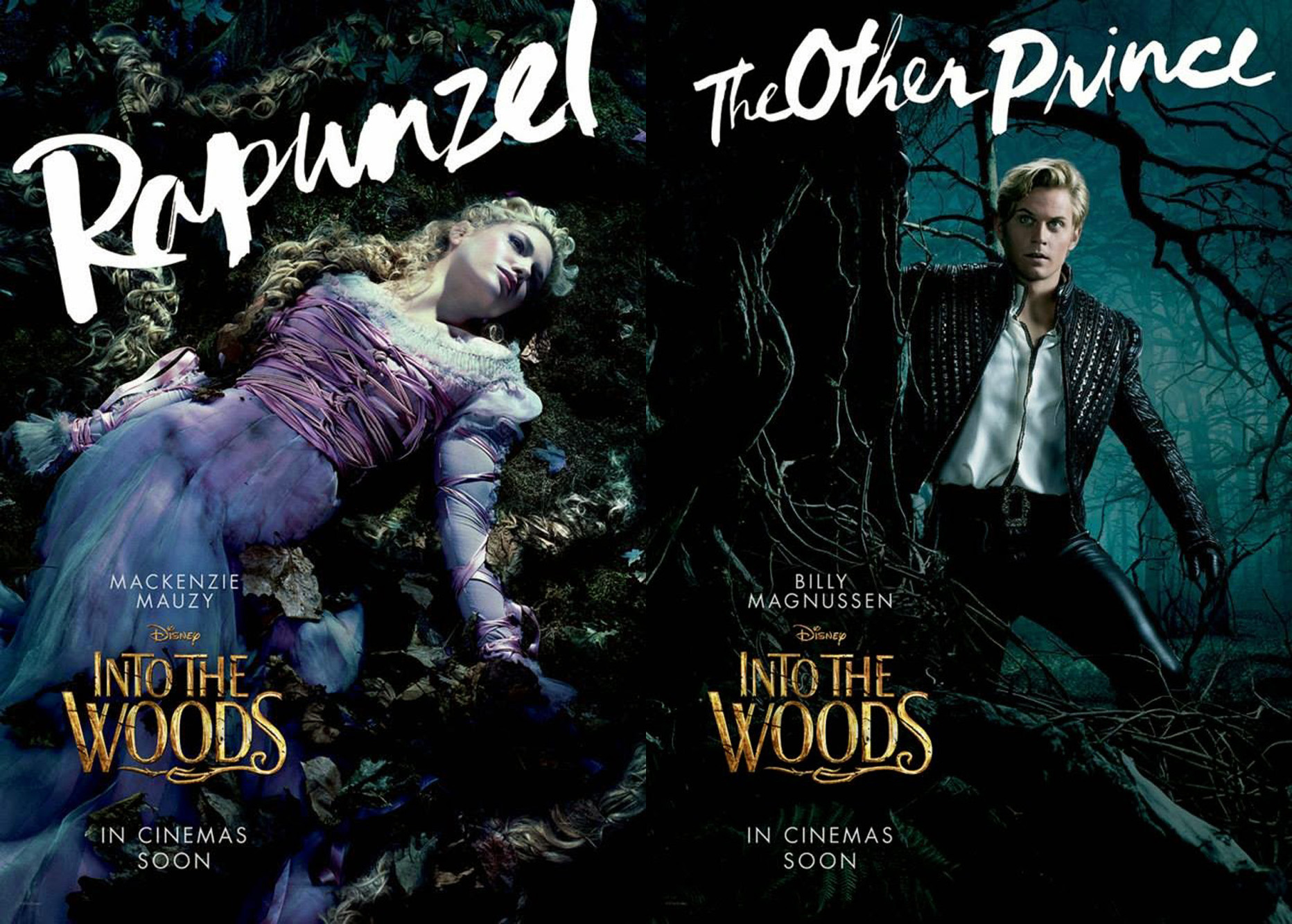
Their search takes them into the woods and in collision (and later in collusion) with Jack (Daniel Huttlestone), later of Beanstalk fame, Little Red Riding Hood (Lilla Crawford) after the Big Bad Wolf (Johnny Depp) has swallowed her whole, Rapunzel (Mackenzie Mauzy) and Cinderella (Anna Kendrick).
The second half, the darker side of the fairy tale world, begins where the happily ever after part usually sits. When a female giant comes to the woods looking for Jack, the boy who killed her husband, the story takes a turn, teaching a lesson about wish fulfillment and responsibility for our actions.
“Into the Woods” has more to do with the original Grimm Brother Fairy Tales—the ones where evil stepmothers sawed the toes off their daughters to fit into golden slippers—than anything Disney has ever attempted before. The stereotypes are all present and accounted for, but under the prince’s brocade jackets or the Witch’s wild mauve wig, are complex characters that veer from comedic to serious to poignant, often in the same scene.
The cast is comprised of actors who can sing, warbling to Sondheim’s rich score. Standouts include “Agony,” an amusing duet between the two princes (Billy Magnussen and Chris Pine) and the Witch’s swansong “Last Midnight.”
On the downside, it feels a bit overlong and the Big Bad Wolf scene could have been renamed the Huge Unctuous Wolf, given Depp’s oily interpretation of the character.
“Into the Woods” survives the script meddling through strong staging, good performances and sheer wish fulfillment to make end up at it’s own kind of happily ever after.
I learned a great deal during my interview with Mackenzie Mauzy and Billy Magnussen. The Manhattan based performers brought me up to speed on the rite of passage for all New York actors, Rapunzel’s hair and whether or not Meryl Streep likes men in blue tights.
The pair play Rapunzel and Rapunzel’s Prince in the big screen adaptation of the legendary Broadway musical Into the Woods. The two relative new comers—she’s best known as Abigail on Forever while he made a memorable appearance on Boardwalk Empire and will soon be seen in an upcoming Steven Spielberg spy thriller—help bring fairy tales to life as part of a large ensemble that includes Johnny Depp, Emily Blunt and Meryl Streep.
Which leads me to the first thing I learned during our chat.
“Meryl’s a beast,” says Magnussen. “She’s the one who got me the job. I was in a play and she saw it and recommended to me [director] Rob [Marshall] and [producer] Mark Platt. The play was Vonya and Sonia and Marsha and Spike and I dress up as a prince because we’re going to a costume party. It’s all about the blue tights.”
“Meryl likes the blue tights,” laughs Mauzy.
Next I discovered the wig Mauzy wears in the film put her at a follicular risk.
“They used my hair and braided it into the extensions,” she says. “It was thirty feet long so I wrapped it around my arm. I had a little fake one for rehearsal but I asked to actually wear [the real one] one day so I could figure out how to be mobile. It’s a tripping hazard! We joke about how I had a really strong left bicep for a couple months.”
Then Magnussen enlightened me on a rite of passage for New York actors, “Once you get on Law and Order,” he says, “you’re really an actor.” Both have done time in the L&O trenches. Mauzy played a child killer named Carly Di Gravia—“It’s weird I remember that name,” she says.—while Magnussen says, “It was one of my first jobs. They bleached my hair white and I was a Southern male prostitute. How do you tell your mom? Hey watch this!”
Finally, one I gleaned one last pearl of knowledge from Mauzy. Apparently it’s OK to call Stephen Sondheim, legendary Into the Woods composer and eight time Tony Award winner, Steve. “Everyone calls him Steve!” she laughs. “He likes to be called Steve! It is weird. Steve Sondheim.”
“Edge of Tomorrow” may sound like the title of a soap opera, but it’s actually the name of a new and unusual Tom Cruise alien invasion flick. In it Cruise battles nasty space bugs called Mimics but the story is more “Groundhog Day” than it is “War of the Worlds.”
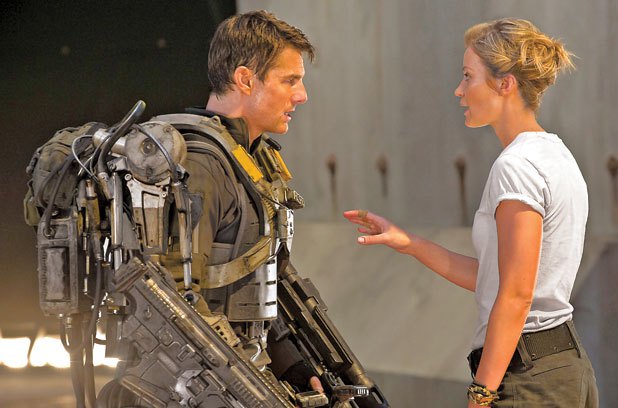
Set at the height of a worldwide battle between the human race and seemingly indestructible aliens called Mimics, Cruise plays William Cage, a marketing genius who lost his advertising firm when the world was thrown into chaos following the invasion. He now works for the army, selling war to the masses. He’s inspired millions of people to enlist by telling them the story of hero Rita (Emily Blunt), a legendary warrior with more Mimics notches on her belt than the rest of the army combined.
When he is pressed into active service on the eve of a massive offensive, he proves that while he may be an officer, he’s no gentleman. “I can’t stand the sight of blood,” he says trying to weasel out of the dangerous duty, “not so much as a paper cut.” His cowardly antics get him arrested and shipped to the front lines where, following a wild deployment scene that sees Cruise and Co plunged into Mimic territory, he is promptly killed.
That’s right. A Tom Cruise character in a Tom Cruise movie is killed in the first twenty minutes. But this is where things get interesting, and strange.
Instead of shuffling off this mortal coil, he actually wakes up and starts his journey all over again. Over and over he wakes to the unmelodious sound of a drill sergeant calling him “Maggot” but each time he has learned something more that helps him cope with the situation.
The only person who believes his strange story is Rita. Together they “reset the day” repeatedly and start anew with the info he’s learned. Eventually he’ll know enough to beat this unbeatable foe. Trouble is, he has to die every day…
Two thirds of “Edge of Tomorrow” is as Un-Cruiselike a movie as Tom has ever made. The “Groundhog Day” been-there, done-that section of the film is inventive, often played for laughs and presents Cruise in a way we’ve rarely ever seen him—as a coward. It’s a refreshing twist for him and gives him a chance to exercise his rarely used comedic chops. You know he’s going to turn heroic sooner or later, but it’s a blast to see him do something just outside his usual wheelhouse.
Just as important to the film is Blunt’s take on Rita. This is something different for her—she’s arguably best known for the comedy “The Devil Wears Prada”—and for action movies in general. Big budget blockbusters don’t usually make room for female characters unless they are sidekicks or girlfriends. Here Blunt avoids being objectified and is as strong, if not stronger than Cruise.
Director Doug Liman has figured out clever and entertaining ways to show the same thing over and over, keeping it exciting with interesting editing and changing perspectives. The first two reels are packed with energy and invention it’s only when the conventions that made the story enticing are put aside in the last reel that the movie becomes a standard Cruise action flick. A good Cruise action flick but still more standard than the promising first hour.
The tagline for Tom Cruise’s latest film is “Live. Die. Repeat.”
“How many times have we been here,” asks Rita (Emily Blunt). “For me, it’s been an eternity,” replies William (Cruise) as he relives the same day of an alien invasion over and over.
Edge of Tomorrow is a time-loop movie that can best be described as War of the Worlds meets Groundhog Day.
In Groundhog Day, Bill Murray says, “Every morning I wake up without a scratch on me, not a dent in the fender. I am an immortal.” His take on a drunk, suicide-prone weatherman who discovers the beauty of life by living the same day endlessly may be the granddaddy of all
Hollywood déjà vu stories, but many other movie characters have been caught in cinematic time circles.
The DVD cover for 2006’s Salvage asks the question, “What if every day you relived your own murder?” Originally called Gruesome for the festival circuit, the movie is as grim as Bill Murray’s film is life-affirming. Called a “digital video hell — spawn of Psycho, Eyes Without a Face and Groundhog Day,” by Variety, Salvage is the story of Claire (Lauren Currie Lewis), a convenience store worker who undergoes her murder over and over. Despite its extremely low budget — star Lewis doubled as the film’s make-up artist — Salvage was an official selection of the 2006 Sundance Festival.
The horror genre lends itself to time-bending tales. Camp Slaughter is a 2005 throwback to the slasher films of the 1980s. In this one, a group of modern teens stumble across Camp Hiawatha, a dangerous place where not-so-happy-campers are trapped in 1981 and forced to re-experience the night a maniacal murderer went on a killing spree. Labelled “Groundhog Day meets Friday the 13th (part 2,3,4,5,6,7,8… every one of them!),” by one critic, it’s gory good fun.
Not into gory? The Yuletide provides a less bloody backdrop for time-looping. The title Christmas Every Day is self-explanatory but 12 Dates of Christmas is better than the name suggests. Us Weekly called this Amy Smart romantic comedy about a woman stuck in an endless Christmas Eve, a sweet “nicely woven journey.”
Finally, the aptly named Repeaters is a Canadian film written by Arne Olsen, scribe of Power Rangers: The Movie. Repeaters is about a trio of recovering addicts who find themselves in “an impossible time labyrinth” after being electrocuted in a storm. Like most time-bending films, Repeaters is about learning from your mistakes. What sets it apart from some of the others are three unlikeable leads who use their situation to raise hell and break the law. It’s only when Kyle (Dustin Milligan) realizes they could be in big trouble if time suddenly unfreezes for them that familiar time-loop themes of redemption and self-reflection arise.
The first time most of us noticed Emily Blunt she was “’on-the-edge of sickness thin.” To play the role of Emily Chalton, the prickly first assistant to the editor in The Devil Wears Prada, Blunt had to drop pounds from her already slight frame. “It wasn’t like doughnuts were snatched out of my hand,” says the 5′ 7½” actress, but she was encouraged to slim down. So much so she would occasionally cry from hunger during the shoot. Luckily, though rake thin, she still had the energy to steal the movie from her more seasoned co-stars, Meryl Streep and Stanley Tucci.
Although the character fell directly into the love-to-hate-her category, audiences found Blunt irresistible. Her mix of vulnerability and fork-tongued charm—crowned by crystal clear blue eyes and a face anchored with a cleft chin that would make Kirk Douglas envious—earned the title Best Female Scene-Stealer from Entertainment Weekly and nominations for everything from a Teen Choice Award to a Golden Globe.
The kudos and notoriety that followed her Prada performance on this side of the Atlantic were simply an echo of her much-admired, though lesser seen work, in the UK.
After dabbling in drama at age 12 to help conquer a stutter she made her professional stage debut while still in school. From there it was a short leap to the small screen and praised performances in British television period pieces. It was, however, only when she left the lace-bonnets behind and took on a role in the critically-acclaimed My Summer of Love that she really made a splash. The story of a teenage infatuation between Mona (Nathalie Press) and the manipulative and cynical Tamsin (Blunt) earned both Press and Blunt equal shares in an Evening Standard British Film Award for Most Promising Newcomer.
When asked why she is so often cast as bad girls like Tasmin she says, “I have sly eyes. When I was in school they always said, ‘Emily can never be elected Head Girl because you never know what she’s thinking.’” Just don‘t ask her to further explain her acting method. “I think it’s embarrassing to hear people talk about their process because you always sound wanky,” she says bluntly.
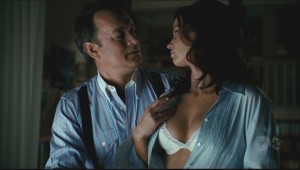
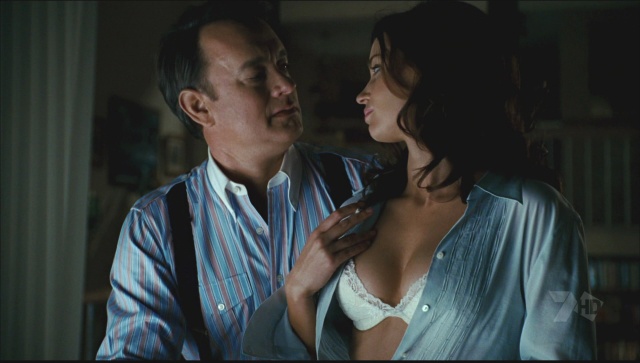
We can say that she has an enigmatic quality which has served her well in supporting parts as diverse as a gawky, uptight French teacher in The Jane Austen Book Club, an oversexed young women opposite Tom Hanks in Charlie Wilson’s War and as a babysitter in Dan in Real Life, all movies she says, that share “a very human heartbeat.”
Even when she appears in something less than Oscar worthy, take the 2005 miniseries Empire, for instance, a project she dismisses as “the sad little brother of Rome,” she still stands out, giving her characters both subtlety and complexity. She’s not a flashy actor; often she expresses an idea with a simple lift of an eyebrow or an understated movement, a trait she shares with her acting idol Cate Blanchett.
While she says “I want to do my own thing and not emulate anyone else,” she calls Blanchett’s chameleon-like ability to disappear into a variety of roles very brave.
The disappearing act is a trick Blunt seems to have picked up from Blanchett. Following a bravura turn in the offbeat comedy Sunshine Cleaning, and the now obligatory for stars-on-the-rise Simpson’s cameo, she took on, and disappeared into, the most challenging role of her career to date. In The Young Victoria Blunt returned to the period roles that defined the early part of her career, playing Queen Victoria from headstrong teen to Queen of the Realm to love sick widow.
“I definitely made a real play for the part because I knew it would be one of those roles that people would hound because it was so rare and so well written,” she says. “It’s hard to find a film that is shouldered by a woman about a girl like that who is so remarkable and so complex. I went in and met them and said, ‘I love it. I’m very aware that a lot of other people do as well but I’d like you to give me a chance.”
Since then she’s worked nonstop, in movies both big—like this month’s mega budget Gulliver’s Travels—and small—a 10 minute short named Curiosity, shot on a budget of £2,000. Mixed into that eclectic stew is The Wolfman, a reimagining of the 1941 Lon Chaney classic which airs on TMN and Movie Central this month. Blunt says she took the role for two reasons. First to work with co-stars Anthony Hopkins and Benicio Del Toro and secondly because her character Gwen is “the girl in a werewolf film, and that’s cool.”
One more very cool job in Emily Blunt’s white-hot career.
Somewhere etched on a stone tablet are the Rules of Rom Coms™. All romantic comedies, it seems, must have an unlikely couple meet, fall in love, hit an obstacle and then reconcile just before the credits roll. “Five-Year Engagement” is no different, but shakes up the formula with some dark comedy—no other romance would use frostbite as a plot point—an adult conversation done with Muppet voices and two leads with charm and charisma to burn.
Jason Segel is Tom, a San Francisco chef engaged to his girlfriend Violet (Emily Blunt). The quirky couple—they go to parties dressed as Princess Diana and Super Bunny—are a perfect match, but circumstance is getting in the way of the wedding plans. First Violet’s sister Suzie (Alison Brie) preempts her sister’s big day by getting pregnant and planning a shotgun wedding. Then psychology student Violet accepts a place in a two-year graduate program at the U. of Michigan, once again placing a speed bump in the way of their walk down the aisle.
Like many Judd Apatow-produced movies “Five-Year Engagement” begins plays out like a standard rom com but takes many twists and turns along the way.
Some darker touches help separate this from the run-of-the-mill romantic comedy. Having said that, they also weigh down the midsection of the movie. Luckily this isn’t Kristen Bell, or worse yet, Katherine Heigl and any other Standard Romantic Male Lead™, but Blunt and Segel. They are engine that keeps the movie moving forward. You care about what happens to them, and when the plot contrived obstacle comes between them, it doesn’t feel as standard as it does in most movies, and you really hope they’ll be able to work things out.
They are helped by a terrific supporting cast made up of Thursday night Must See TV sitcom regulars from shows like “The Office,” “Community” and “Parks and Recreation.” Community’s Alison Brie, is a scene-stealer. Watching her and Blunt have a grown-up conversation in Muppet voices is worth the long running time.
“Five-Year Engagement” could have used some trimming, but succeeds not because it follows Rules of Rom Coms™ but because it doesn’t.