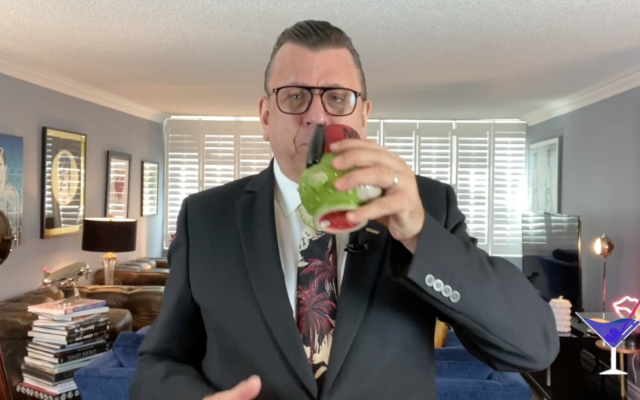
Richard makes a Painkiller, the perfect cocktail to enjoy while watching the new Emily Blunt, Dwayne Johnson action-adventure “Jungle Book.” It’s the Rock on the rocks! Have a drink and a think about “Jungle Cruise” with me!
“Jungle Cruise,” now playing in theatres and on Disney+ with premium access, is a new adventure story that reaches back into Hollywood history for inspiration. The Emily Blunt and Dwayne Johnson movie is based on the 65-year-old Disneyland riverboat cruise theme park ride, which, in turn, was inspired by the Humphrey Bogart and Katharine Hepburn’s antics in the 1951 film “The African Queen.” Add to that a hint of “Indiana Jones” and “Romancing the Stone,” and you have a family friendly film that simultaneously feels brand spankin’ new and old fashioned.
Blunt is the eccentric botanist Dr. Lily Houghton, an English adventurer in search of the Tree of Life, a mythical Amazonian tree whose “Tears of the Moon” blossoms are said to have healing properties. If she can find it and harness its powers, she believes it will be the beginning of a scientific revolution.
Travelling from London to the Amazon, she meets steamboat captain “Skipper” Frank Wolff (Johnson), a fast-talking cynic who reluctantly agrees to take her and her assistant, brother MacGregor (Jack Whitehall), on his ramshackle boat into the heart of darkness. “If you believe in legends,” Frank says, “you should believe in curses too. It’s not a fun vacation.”
On the voyage up river they contend with slithery supernatural beings and the rival Prince Joachim (Jesse Plemons), a Hapsburg aristocrat determined to use brute force to reach the Tree of Life before Houghton, on a dangerous race against time.
Movies based on theme park rides have a checkered history. For every “Pirate of the Caribbean” that becomes a hit and spawns signals, there is a “The Haunted Mansion” or “Tomorrowland” gathering dust in a delete bin somewhere.
“Jungle Cruise” seems likely to avoid that fate. A classic adventure, it is an action-packed journey fuelled by the chemistry between the leads, Blunt and Johnson.
The opening half-hour actually feels like the theme park ride. It takes off like a rocket with one elaborately staged action scene after another. That sets the frenetic pace the movie keeps up for most of the running time, right up to a drawn-out ending that threatens to overstay its welcome, but doesn’t, courtesy of the actors.
Blunt and Johnson have great chemistry, verbally jousting throughout. It’s the “Romancing the Stone” template; they’re an odd couple who roast one another while dodging life-threatening situations and ultimately reveal their true feelings. The comic timing works and adds much charm to the action sequences.
Threatening to steal the show is Plemons, who reveals his rarely used comedic side. As the power-mad Prince Joachim, the actor embraces the cartoon aspects of the character, creating one of the best family-friendly villains in recent memory.
“Jungle Cruise” is much more fun than you might imagine a movie based on a theme park ride will be. There’s some dodgy CGI and a slightly over-inflated running time but it’s an old-fashioned adventure, updated with one character’s coming-out scene (no spoilers here) and a reversal of the theme park’s treatment of its Indigenous characters, that delivers action, humour and chemistry.
On hopes that there was a national strike of Irish Accent Coaches during the production of “Wild Mountain Thyme,” a new romance starring Emily Blunt and Jamie Dornan and now on premium digital and on-demand. It’s the only explanation why a movie, set in Ireland’s County Mayo and starring an actual Irish movie star—Dornan was born in Belfast, about 200 kilometres from where the movie takes place—could feature some of the un-ear-friendly Irish accents this side of St. Patrick’s Day party at your local Applebee’s.
Blunt plays the headstrong Rosemary Muldoon, a farmer who has been in love with the eccentric Anthony (Jamie Dornan) since they were kids. Their family farms are side-by-side, and all is harmonious, except for one thing. Rosemary’s family owns a thin ribbon of land between the road and Anthony’s farm. Every time he goes in or out, he has to unlatch and latch two sets of gates. It’s a little thing, but it’s the small stuff that grates.
Anthony’s father, Tony Reilly (Christopher Walken)—who blows a story point in his opening, “Welcome to Ireland. My name’s Tony Reilly. I’m dead,” narration—is considering selling the farm to his American money-manager nephew Adam (Jon Hamm). Not only does Anthony not want dear old dad to sell the farm but he’d also prefer Adam to keep his eyes, and hands, off Rosemary.
“Wild Mountain Thyme” is a kind-hearted movie about love will finding its way no matter how long and twisty the road. Unfortunately, a kind heart doesn’t mean it’s a good movie. I love a good misfit love story as much as the next guy but director John Patrick Shanley spends so much time creating a quirky atmosphere for his characters to inhabit, he misses the chance to make us really care about them.
Blunt, Dornan and Walken are all engaging actors and make the most of the material, but they’re stymied by a story in search of a dash of magic to make it work. And not even Dornan can make proposing to a donkey seem authentic.
Then there’s the accents. Irish accents worldwide should take out a restraining order on Walken. No question. Blunt fairs better, but only by a diphthong.
Accents aside, the movie works best in an extended two-handed scene between the leads. Shanley based the screenplay on his 2014 Broadway play “Outside Mullingar,” and a long exchange between Rosemary and Anthony as they play cat and mouse over a half bottle of Guinness, reveals the film’s theatrical roots. It’s not cinematic, but it bristles with energy and humour and emits the passion the rest of the movie lacks.
Unfortunately, it leads up to one of the most wackadoodle twists in rom com history. It’s so odd, you may forget Walken’s massacre of the accent.
“Wild Mountain Thyme” has wonderful messages about acceptance and the love of rural life—and photography that must surely have the Irish Tourist Board’s Stamp of Approval—but it is undone by its own blarney.
What to watch when you’ve already watched everything Part Two! Binge worthy, not cringe worthy recommendations from Isolation Studios in the eerily quiet downtown Toronto. Three movie choices to stream, rent or buy that will help fill the minutes until we can comfortably cough in public once again. And no, “Electric Boogaloo” is not one of the selections.
Fifty-four years after Julie Andrews made her debut as “the practically perfect in every way” nanny, who flew in (courtesy of her parrot-handled umbrella) and introduced magic to the lives of the dysfunctional Banks family, the beloved Mary Poppins character is back in “Mary Poppins Returns.” The new Disney musical-fantasy picks up 25 years after the events of the classic, with Poppins, played by Emily Blunt, returning to help the Banks children after misfortune befalls the family.
Set in 1930s London during the Great Slump, a city of gaslights and chimney sweeps, “Mary Poppins Returns” sees the kids from the original Michael and Jane Banks all grown up and played by Ben Whishaw and Emily Mortimer. Michael’s wife passed away the year before and now he, his kids (Pixie Davies, Nathanael Saleh, and Joel Dawson) and housekeeper Ellen (Julie Walters) live in the Banks’s family home on Cherry Tree Lane, the house made famous by P. L. Travers.
When the bank calls in the loan Michael took against the house the family risks losing everything. “Pay back entire loan on the house or it will be repossessed in five days,” cackles the lawyer who delivers the notice. On that very day Mary Poppins (Emily Blunt), the nanny who helped Michael and Jane as kids, and her magic bag come to the rescue. “Good thing you arrived when you did Mary Poppins,” says Jack (Lin-Manuel Miranda), former apprentice of Bert from the original film. Mary “I suspect that I am never incorrect” Poppins, helps the Banks family regain the joy and wonder that made their childhood years magical.
From the first song, “(Underneath the) Lovely London Sky”—“Count your blessings,” sings Jack. “You’re a lucky guy.”—the movie establishes its uplifting tone. It’s a frothy, satisfying concoction of nostalgia, music, fanciful visuals, elegance and optimism; a spoonful of sugar in bitter times.
Director Rob Marshall has made a full-on musical that mixes the best of old and new Disney. This thoroughly modern movie feels old-fashioned in the sense that it takes its time with the music, allowing the songs to breathe and the lyrics to sink in. But it isn’t simply an exercise in recollection. The smart new songs (written by Marc Shaiman with lyrics by Scott Wittman) refresh a familiar story, mixing seamlessly with snippets of songs from the original film blended into the score.
There are huge musical numbers, including a wild underwater spectacular, but the songs that work best are the more modest tunes like “A Conversation,” Michael’s requiem for his late wide. “These rooms were always filled with magic but that vanished since you’ve gone away.” It is heartfelt and heartbreaking. Ditto Mary Poppins’s “The Place Where Lost Things Go.”
Still, this is a movie that brims with joy. When the spunky Banks kids tell Mary Poppins (no one ever calls her Mary or Miss Poppins, its always first and last names) that they have “grown up a great deal in the last year.” She replies, “Yes. We’ll have to see what we can do about that.”
Like “Christopher Robin” from earlier this year, “Mary Poppins Returns” is ultimately about the importance of staying young at heart. The film essays Michael’s sense of loss and longing, his frustration at not knowing how to go on without his wife but it’s the upbeat attitude that gives it depth. “Everything is possible, even the impossible,” is a cliché but in context it is a call to believe, to have faith. If Michael believes in himself everything will be OK. That’s a potent message, delivered with a spoonful of sugar or not.
The cast impresses, delivering the film’s message with charm and verve. Emily Blunt brings a mix of strictness—“Sit up straight you’re not a flower bag,” she scolds.—and mischievousness to her character, effortlessly slipping into some very big shoes. Miranda provides a dose of musical theatre. Meryl Streep, as Mary’s eccentric cousin Topsy, offers a fun and funny lesson in perspective and Dick Van Dyke’s cameo as Mr. Dawes Jr. connects the old and new.
“Mary Poppins Returns” feels modern without sacrificing its nostalgic charm. There’s no “Supercallifragilisticexpialidocious” but, like the first film, there is plenty of heart.
John Krasinski didn’t just direct and star in the thriller A Quiet Place — he and wife Emily Blunt actually lived it. Sort of.
“One night she said, ‘Living silently would be hard,’” he says. “As the weeks went by we would constantly make note of it. It wasn’t even just getting silverware to make the kid’s lunch. It was more like you’re putting the kids to bed and the bed creaks. You think, we are legitimately surrounded by sound.”
The famous couple star as parents fighting for the survival of their kids in a world invaded by monsters that use sound to hunt human prey. The family must live in silence, use sign language and eat off leaves to avoid the clinking of cutlery on china but what happens when their newborn baby cries? Can life go on?
Krasinski, who starred as Jim Halpert on The Office for eight years, calls the spec script “truly one of the best ideas I’d ever heard,” but admits worrying “that a lack of dialogue would be a thing.”
“Then on about Day 2 or 3 was, ‘Wait a minute. Maybe the thing I am most scared of is our superpower. This is actually super engaging.’ The fact that people are going to be able to experience sound in a completely different way was really fun.”
The silence of the first half of A Quiet Place is deafening. In the way that many filmmakers use bombast to grab your attention Krasinski uses the absence of sound to focus the audience on the situation.
“One of my favourite things about this whole experience has been listening to audiences understand what’s happening,” he says. “Usually the first thirty seconds of the movie you hear people shifting in their seats. Maybe they take a couple bites of popcorn. Then you realise collectively in the room people say, ‘I can’t do this.’ I love that.”
Krasinski and Blunt have been married since 2010 and have two children, Hazel and Violet, but that didn’t mean he wasn’t nervous to ask her to co-star in the film.
“I always wanted Emily to do it but the two versions of this in my head were going to go really wrong. I ask her to do it and she says no, which makes dinner really awkward. Or she says yes, ‘For you I’ll do it.’ I didn’t want her to choose this for me and have it be a weird experience. I’ve seen how good a career she has because of what she’s chosen to do. I needed her to come to it on her own.
“When she asked me to read the script I didn’t think she’d say yes. She was doing Mary Poppins and we had our second child, so she was busy. Then she said, ‘You can’t let anybody else do this role.’ I know it sounds corny but it is true. It is still the greatest compliment of my career because I know what it takes for her to say yes.”
As director, writer, star and executive producer Krasinski has had a hand in all aspects of A Quiet Place. How does he feel now that the film is winning critical raves? “It goes back to that primal thing of the kids at school thinking what you think is cool, is cool.”
Imagine living in complete silence. Never raising your voice over the level of a faint whisper. No music. No heavy footsteps. You can’t even sneeze. Silence. Then imagine your life depends on staying completely noiseless. That’s the situation for the Abbott family—and the rest of the world—in the effective new thriller “A Quiet Place.”
Real life couple John Krasinski (who also wrote, produced and directed) and Emily Blunt are Lee and Evelyn, a mother and father fighting for the survival of their kids Beau (Cade Woodward), Regan (Millicent Simmonds) and Marcus (Noah Jupe) in a world where making a sound, any sound, can be deadly. Deadly blind aliens who hunt their prey through sound have invaded the world turning noisy people into human cold cuts. The family lives in silence, using sign language and eating off leaves to avoid the clinking of cutlery on china but what happens when a newborn baby cries? Can life go on?
The silence of the first half of “A Quiet Place” is deafening. There is no spoken dialogue for forty minutes, just dead air. In the way that many filmmakers use bombast to grab your attention Krasinski uses the absence of sound to focus the audience on the situation. Very little information is passed along. We don’t know where the aliens came from, why they’re terrorizing earth or how many there are. Ditto the Abbotts. We know nothing about them. The connection the family feels is transmitted through looks and actions, not words. This isn’t a story where character development is important, it’s a tale of survival pure and simple.
Tension grows in the first, artier half and pays dividends in the second more genre-based half. Set up out of the way Krasinski raises the stakes, putting the family directly in the way of the creatures. Like all good genre movies as the story escalates it becomes not simply about predatory monsters, all teeth and giant ears, but about a universal truth. In this case it is about a parent’s primal need to protect their kids at any cost. Krasinski nails this, providing both the b-movie thrills and chills necessary to the genre and a deep undercurrent of humanity.
He’s aided by the actors. Blunt is all poignancy and strength. Krasinski brings stoicism while the kids make us care about the family.
“A Quiet Place” is a nervy little film. Other filmmakers might have tried to find a way to wedge in more dialogue or spell things out more clearly but the beauty of Krasinski’s approach is its simplicity. Uncluttered and low key, it’s a unique and unsettling horror film.
The first time most of us noticed Emily Blunt she was “’on-the-edge of sickness thin.” To play Emily Chalton, the prickly first assistant to the editor in The Devil Wears Prada, Blunt dropped pounds from her already slight frame. “It wasn’t like doughnuts were snatched out of my hand,” laughs the 5’ 7½’’ actress, but she was encouraged to slim down. So much so she would occasionally cry from hunger during the shoot. Luckily, though rake thin, she still had the energy to steal the movie from her more seasoned co-stars, Meryl Streep and Stanley Tucci.
Although the character fell directly into the love-to-hate-her category, audiences found Blunt irresistible. Her mix of vulnerability and fork-tongued charm—crowned by crystal clear blue eyes and a face anchored with a cleft chin that would make Kirk Douglas envious—earned the title Best Female Scene-Stealer from Entertainment Weekly and nominations for everything from a Teen Choice Award to a Golden Globe.
This weekend she plays a much different character in the much-anticipated thriller The Girl on the Train. Based on the Paula Hawkins bestseller—11 million copies sold and counting—it’s a dark cinematic journey into a missing person’s case. The thirty-three year old actress says playing an alcoholic divorcée who witnesses a crime from a train window, “the most challenging thing I’ve ever done.”
Early reviews are strong. Variety raved she “excels as the broken-down heroine.” Those kind of kudos are an echo of her much-admired, though lesser seen work, in the UK.
After dabbling in drama at age 12 to help conquer a stutter she jumped to the small screen with praised performances in British television period pieces. It was, however, only when she left the lace-bonnets behind and took on a role in the critically-acclaimed My Summer of Love that she really made a splash. The story of a teenage infatuation between Mona (Nathalie Press) and the manipulative and cynical Tamsin (Blunt) earned both Press and Blunt equal shares in an Evening Standard British Film Award for Most Promising Newcomer.
Since then we’ve seen her as an oversexed young women opposite Tom Hanks in Charlie Wilson’s War, warbling Stephen Sondheim’s rich Into the Woods score, riding a polar bear in The Huntsman: Winter’s War and dressed as Princess Diana in the quirky rom com Five-Year Engagement.
She’s done action in both Sicario and Edge of Tomorrow (later renamed Live. Die. Repeat. for home release). Big budget blockbusters don’t usually make room for female characters unless they are sidekicks or girlfriends. In Edge of Tomorrow Blunt avoids being objectified and is as strong, if not stronger than co-star Tom Cruise.
In Sicario she’s part of an elite task force stemming the flow of drugs between Mexico and the US. A multifarious mix of vulnerability, stone cold confidence and outrage, she delivered the most interesting female action star since Mad Max: Fury Road’s Imperator Furiosa.
Next up her diverse career is the lead in Mary Poppins Returns. She says she’s nervous because the flying nanny is “such an important character in people’s childhood,” but has been given the thumbs up by the original Mary, Julie Andrews. “It was lovely to get her stamp of approval. That took the edge off it, for sure.”
In recent years we’ve seen Emily Blunt warbling Stephen Sondheim’s rich “Into the Woods” score, riding a polar bear in “The Huntsman: Winter’s War” and dressed as Princess Diana in the quirky rom com “Five-Year Engagement.” She’s done big budget action, sci fi, period dramas and now she adds Hitchcockian thriller to her list of conquered genres.
In the much-anticipated thriller “The Girl on the Train” she is Rachel a woman whose life has taken a downward dive since her divorce from Tom (Justin Theroux). Alcoholic, unemployed and despondent, she obsesses about Tom, Anna (Rebecca Ferguson), his new girlfriend—and former mistress—and their new baby.
To pass the time on her extended Lost Weekend she drinks vodka and rides a commuter train from the suburbs into Manhattan, even though she lost her high paying PR jobs ages before. Sitting in the third car from the front affords her the perfect view of her favourite house. It’s the home of Megan and Scott Hipwell (Haley Bennett and Luke Evans), a good looking couple with a seemingly perfect life to match their optimistic last name. “She’s everything I want to be,” says Rachel of Megan.
One afternoon as Rachel looks out the train window at the Hipwells she is enraged what she sees. A blur of booze later, she wakes up the next day, hungover and foggy, covered in bruises, to discover Megan has gone missing. Brain beating, blocking memories of the night before, she tries to piece together the events of the night before. Enter Mr. Hitchcock.
Based on the Paula Hawkins bestseller—11 million copies sold and counting—“The Girl on the Train” is not so much a psychological drama as much as it is a boozological one. Rachel is hammered for much of the first half of the film, making her an extremely unreliable narrator. What’s true and what’s not? That would involve giving away plot details that are best left unspoiled, but suffice to say that while there are ups and downs, they are more red herrings and misremembered clues filtered through a haze of booze. There are no “Gone Girl” flourishes here, just straightforward thriller elements banged together to point to an inevitable conclusion.
“Girl on the Train” has some elegant moments, and aspires to be an art house thriller/morality tale—no action, lots of internal dialogue—but to properly tell the story of infidelity and murder it should have embraced its down-and-dirty summertime beach reading origins.
Rising above the languid pacing and uneventful storyline is Blunt whose gut-wrenching, vanity-free performance carries the movie through its slow patches. She’s a raw nerve and if the movie had followed her lead and been just a bit more bleary eyed and blotchy, it may have been a more effective thriller.
 Richard makes a Painkiller, the perfect cocktail to enjoy while watching the new Emily Blunt, Dwayne Johnson action-adventure “Jungle Book.” It’s the Rock on the rocks! Have a drink and a think about “Jungle Cruise” with me!